Loading...

More than 60 percent of American graduate students say balancing research with personal life feels overwhelming at least once a week. The challenge stretches far beyond simple time management, especially as work-life balance research has evolved into a multidimensional field demanding careful synthesis. This guide offers practical insights to help you navigate complex literature, streamline your academic writing, and build stronger foundations for your own work-life balance research.
| Point | Details |
|---|---|
| Dynamic Process | Work life balance is a continuous negotiation between professional and personal responsibilities, focusing on quality of engagement rather than equal time allocation. |
| Emerging Themes | Research increasingly addresses flexible work arrangements, gender differences, work-life interface, and organizational policies as key aspects of work life balance. |
| Methodological Complexity | Diverse methodologies, such as bibliometric analysis, are crucial for comprehensively understanding the intricate landscape of work life balance studies. |
| Current Trends | The normalization of hybrid work, integration of mental health initiatives, and use of technology for work-life management are shaping contemporary work life balance research. |
Work life balance research has evolved dramatically over recent decades, transforming from a narrow workplace concept to a complex, multidimensional framework. Systematic reviews of work-life balance reveal that contemporary understanding extends far beyond simple time allocation between professional and personal domains.
Researchers recognize work life balance as a dynamic process involving continuous negotiation between professional responsibilities and personal life requirements. While no single universal definition exists, most scholarly perspectives converge around key elements: achieving satisfaction across multiple life domains, minimizing role conflicts, and creating meaningful integration between work and personal activities. Contemporary research perspectives emphasize that work life balance is not about equal time distribution, but about quality of engagement and individual perception of harmony.
The conceptual landscape of work life balance includes several critical dimensions:
Understanding these nuanced perspectives helps graduate students and researchers develop more sophisticated analytical frameworks for exploring work life balance dynamics. By recognizing the complexity of this concept, scholars can design more comprehensive research studies that capture the intricate interactions between professional and personal spheres.
Pro tip: When researching work life balance, always consider multiple theoretical perspectives and avoid oversimplifying the concept into a linear time management challenge.
Work life balance research has experienced significant thematic evolution, reflecting broader societal transformations. Bibliometric research reveals that contemporary studies increasingly examine complex intersections between work environments, individual experiences, and systemic organizational practices.
Four primary research themes have emerged as critical focal points in contemporary work life balance scholarship. Landscape mapping studies highlight these interconnected domains:
These themes demonstrate the multifaceted nature of work life balance research, emphasizing that contemporary scholarship moves beyond simplistic time management approaches to explore deeper systemic and personal dynamics.

Here's a comparison of four major research themes in work-life balance studies:
| Theme | Primary Focus | Typical Research Methods | Key Societal Impact |
|---|---|---|---|
| Flexible Work Arrangements | Schedule flexibility, remote options | Surveys, case studies | Improved job satisfaction |
| Gender Differences | Role expectations, career access | Qualitative interviews, meta-analysis | Enhanced workplace equity |
| Work-Life Interface | Managing boundaries, emotional labor | Ethnography, psychological assessment | Reduced burnout, better mental health |
| Organizational Policies | Culture, institutional supports | Policy analysis, longitudinal studies | Increased employee retention |
Pro tip: When analyzing work life balance research, consider the interconnected nature of these themes and avoid studying them in isolation.
Literature review methodologies in work-life balance research have increasingly sophisticated analytical techniques to capture complex interdisciplinary insights. Systematic review approaches now integrate multiple analytical frameworks to comprehensively examine research landscapes.

Bibliometric methods have emerged as a powerful approach for mapping scholarly discourse. Comprehensive bibliometric analysis typically employs several advanced techniques to deconstruct research patterns:
Key Bibliometric Methodological Approaches:
Co-citation Network Analysis
Identifies intellectual connections between research publications
Maps theoretical relationships across studies
Reveals hidden scholarly networks
Keyword Co-occurrence Analysis
Tracks conceptual evolution in research domains
Highlights emerging thematic clusters
Provides visual representation of research trends
Publication Characteristic Mapping
Evaluates research distribution across journals
Examines temporal publication trends
Identifies potential research gaps
Researchers must recognize that these methodological approaches are not standalone techniques but interconnected strategies for understanding complex academic landscapes. Research literature review techniques require nuanced interpretation beyond mere statistical aggregation.
The following table summarizes key methodological approaches and their unique advantages in work-life balance research:
| Methodological Approach | Unique Advantage | Limitation |
|---|---|---|
| Co-citation Network Analysis | Reveals hidden academic connections | Time-consuming data processing |
| Keyword Co-occurrence | Identifies thematic research shifts | May miss nuanced topic changes |
| Publication Mapping | Highlights gaps in journal coverage | Can overlook content depth |
Pro tip: When conducting literature reviews, integrate multiple methodological approaches to develop a comprehensive and robust research perspective.
Emerging work-life balance research trends reveal a transformative landscape where traditional boundaries between professional and personal domains are rapidly dissolving. Contemporary scholarship highlights the complexity of work-life integration beyond simplistic time management approaches.
Critical current trends include:
Hybrid Work Normalization
Flexible geographical work arrangements
Technology-enabled remote collaboration
Personalized work environment design
Mental Health Integration
Organizational wellness programs
Holistic employee support strategies
Psychological resilience frameworks
Technological Work-Life Management
Advanced digital boundary management tools
AI-driven scheduling optimization
Personalized productivity platforms
Systematic review insights consistently highlight significant knowledge gaps. Researchers continue to identify critical areas requiring deeper investigation, particularly around demographic diversity, cultural nuances, and contextual policy implementations.
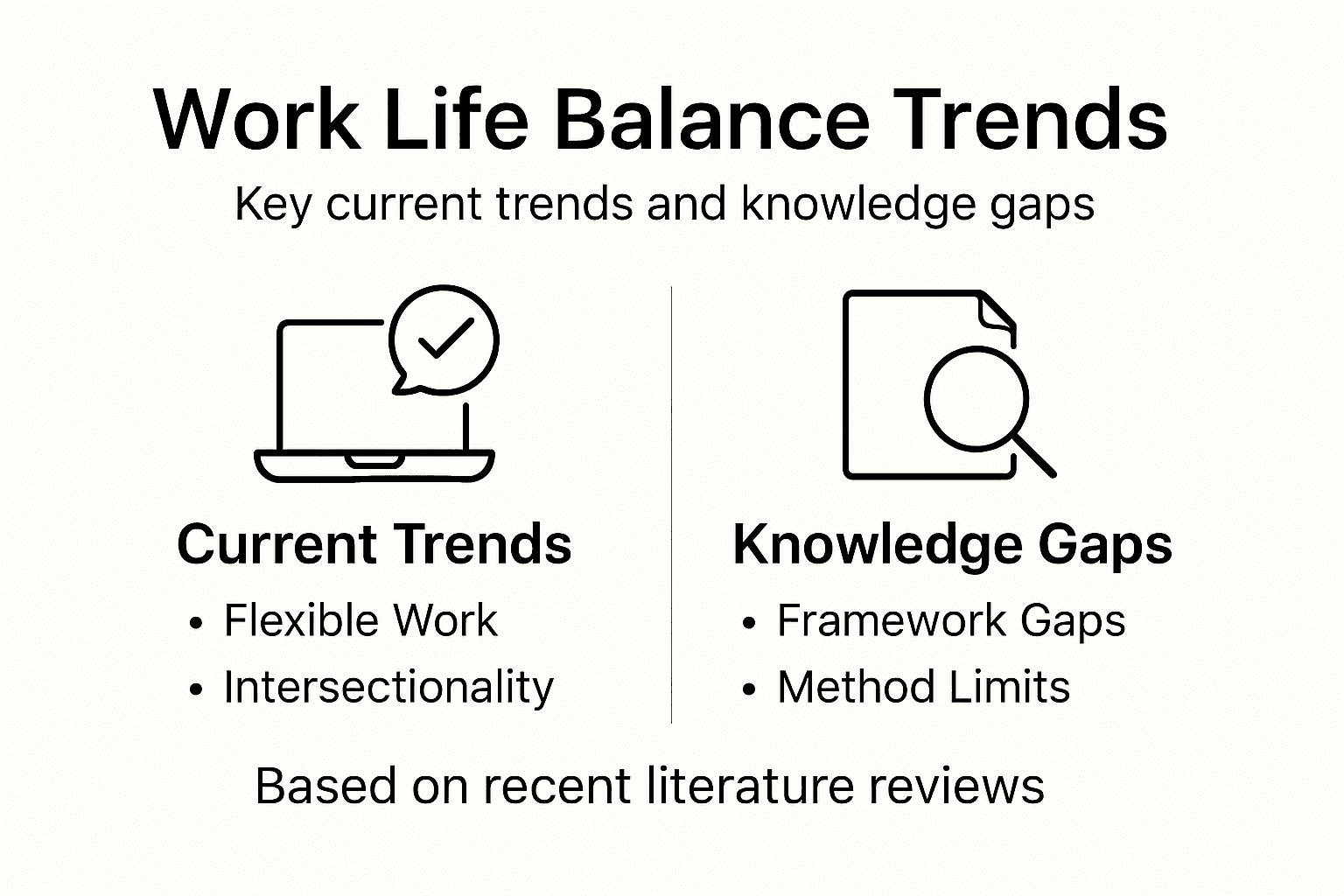
Research still struggles to develop comprehensive frameworks that address the multidimensional nature of work-life balance across different societal and organizational contexts. Understanding these complex interactions remains a crucial academic challenge.
Pro tip: When exploring work-life balance research, prioritize studies that incorporate intersectional perspectives and contextual complexity.
Work-life balance literature synthesis confronts profound methodological complexities that challenge researchers seeking comprehensive understanding. The interdisciplinary nature of this field creates inherent barriers to systematic integration and knowledge consolidation.
Key Challenges in Research Synthesis:
Conceptual Ambiguity
Inconsistent definitional boundaries
Varied theoretical interpretations
Disciplinary perspective differences
Methodological Heterogeneity
Divergent research approaches
Measurement inconsistencies
Contextual variability across studies
Sampling and Contextual Limitations
Demographic representation gaps
Cultural bias in research designs
Organizational context variations
Systematic review meta-analysis reveals significant deficiencies in existing review methodologies. Researchers frequently struggle with applying consistent standards like PRISMA criteria, which further complicates knowledge integration.
Academic scholars must recognize that work-life balance research represents a dynamic, multifaceted domain requiring sophisticated, nuanced synthesis strategies that accommodate complexity and contextual diversity.
Pro tip: Develop rigorous screening protocols and maintain methodological transparency when attempting to synthesize work-life balance research across diverse contexts.
Balancing the complexities of work life balance research can feel overwhelming especially when dealing with concepts like psychological well-being, organizational policies, and intersectional perspectives. If you struggle to synthesize diverse methodologies or manage extensive literature reviews while maintaining academic integrity, you are not alone. The challenge lies in crafting comprehensive, nuanced papers that reflect the multidimensional nature of this topic without oversimplification.
Samwell.ai is designed to empower researchers and graduate students by providing advanced AI tools that streamline essay writing and research paper development. Our platform helps you generate customized, original content with robust citation support across styles like MLA and APA. Features such as the 'Power Editor' let you expand or refine complex sections on themes like flexible work arrangements or gender differences seamlessly. Discover how our AI-driven writing platform simplifies the synthesis of interdisciplinary work life balance studies and supports your academic journey.
Take control of your research challenges today. Visit Samwell.ai to start crafting well-structured, insightful work life balance literature reviews that stand out. With our guided essays and real-time AI checks, ensure your papers meet submission standards with less stress and greater confidence.
The contemporary understanding of work-life balance has evolved into a complex, multidimensional framework that involves ongoing negotiation between professional and personal responsibilities, focusing on satisfaction and quality of engagement rather than just time allocation.
Four primary themes include flexible work arrangements, gender differences, work-life interface, and organizational policies. Each theme examines various aspects such as scheduling flexibility, role expectations, emotional labor, and supportive workplace cultures.
Common methodological approaches include co-citation network analysis, keyword co-occurrence analysis, and publication characteristic mapping. These methods help researchers understand intellectual connections, track trends, and identify research gaps within the field.
Current trends highlight hybrid work normalization, mental health integration in organizational practices, and technological advancements for work-life management. These trends reflect the changing nature of work and emphasize the need for holistic approaches to employee well-being.