
Loading...

The Common App personal statement must run between 250 and 650 words, full stop. There's no partial credit for going shorter and no exceptions for going longer. The platform's editor physically stops accepting text at 650, and most admissions coaches tell you to land somewhere in the 500–650 range, with 600–650 being the sweet spot for competitive applicants who need room for a full scene and real reflection.
TL;DR:
- The official word count limit for the Common App personal statement is 250 to 650 words, with most applications aiming for 600 to 650 words for strong reflection and scene development.
- The in-platform essay counter is the authoritative measure, and pasting a longer draft can result in silent truncation of the ending without warning.
- Most successful essays fall between 500 and 650 words, allowing enough space for narrative detail and meaningful reflection without unnecessary padding.
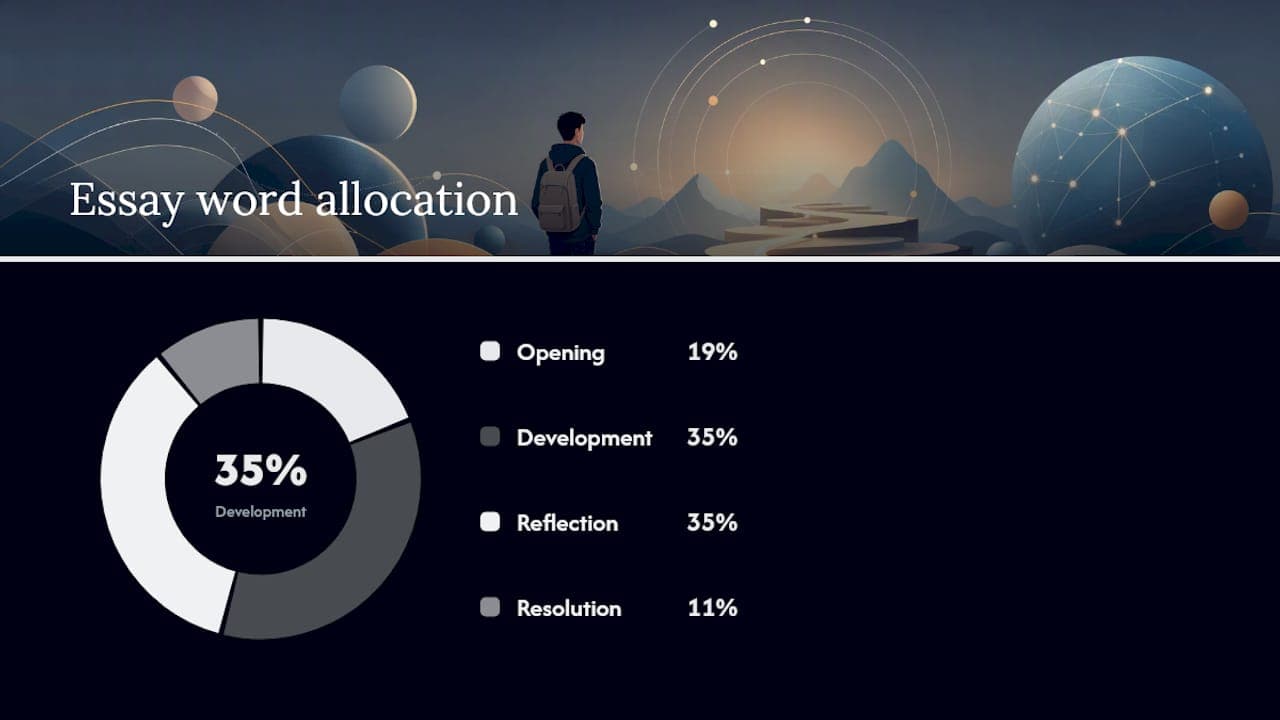
- The essay should be divided into roughly 100–150 words for the opening, 200–250 words for development, 200–250 words for reflection, and 50–100 words for resolution.
- Applicants should verify current policies directly on the Common App platform before submitting, as essay prompts and limits may change across admission cycles.
The 250 to 650 word range applies specifically to the first-year personal statement, the essay attached to whichever of the seven Common App prompts you choose. That's the field most students mean when they ask about the common application word count, and it's the one the official Common App announcement confirms stays stable for the current cycle.
Two other fields get confused with the personal statement, and mixing them up causes real problems:
Applicants sometimes mistakenly use the Additional Information section for essay overflow, which is not appropriate.
Trust the counter inside the Common App essay field over whatever Microsoft Word or Google Docs tells you. Word processors and the Common App platform sometimes calculate hyphenated words and contractions differently, and that small discrepancy can matter when you're sitting at 649 words.
Here's what actually happens technically when you're writing and pasting:
Statistic Callout: The Common App essay counter is the binding measure admissions readers see, not the count from whatever software you drafted in.
Always scroll to the bottom of the pasted text and confirm your actual final sentence is there. It takes ten seconds and prevents submitting an essay that ends mid thought.
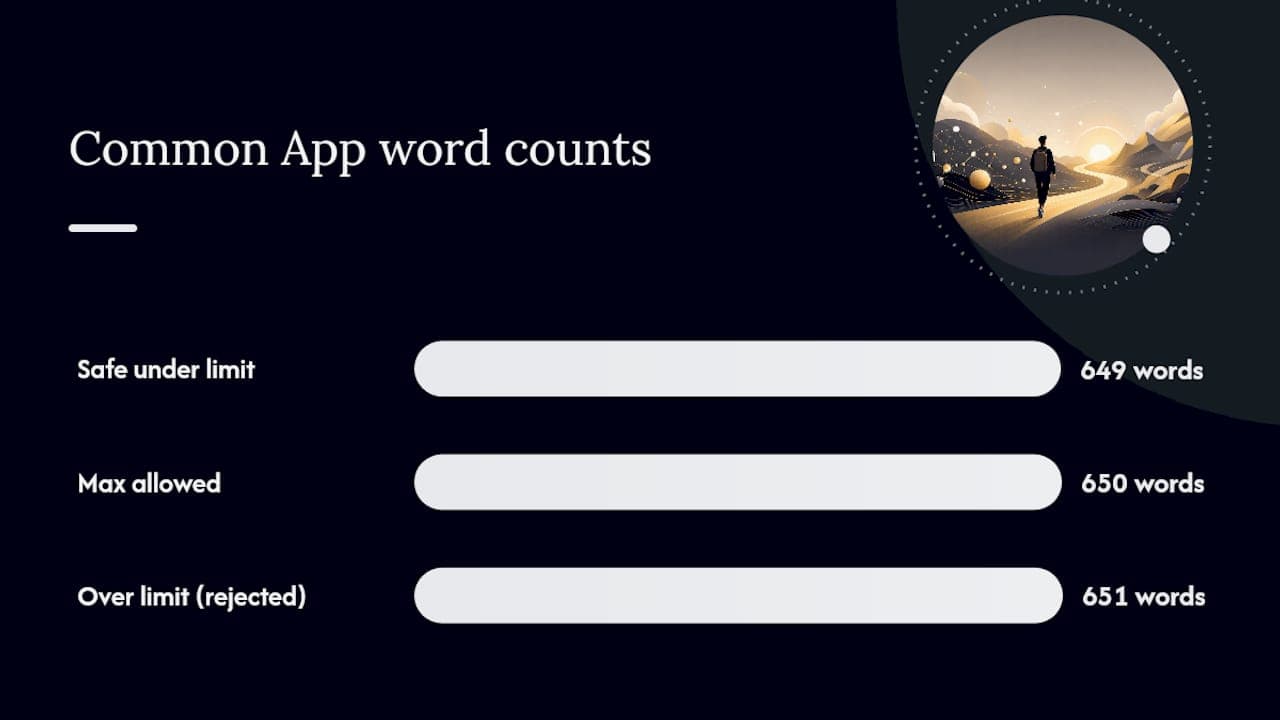
Technically, 250 words satisfies the rule. Practically, 250 words is almost never enough space to set a scene, develop it, and reflect on what it means, so treat the floor as a legal minimum rather than a writing goal.
Admissions coaches tend to recommend a few different bands depending on how much room your topic genuinely needs:
Collegewise makes a useful distinction here: 650 is a limit, not a goal, and using most of that space only helps you if the content earns it. A tight, focused 520-word essay beats a padded 648 word one every time an admissions reader can tell the extra words aren't doing work.
Pro Tip: Read your draft out loud and cut any sentence that restates something you already said in different words. Padding announces itself the moment you hear it spoken.
A rough allocation framework keeps your draft from spending too much time setting a scene and too little time reflecting on why it mattered, which is the single most common structural flaw in weak personal statements.
This allocation, drawn from the framework Oriel Admissions uses with applicants targeting elite schools, isn't a rigid formula so much as a diagnostic. If your reflection section is only 60 words inside a 650 word essay, that's a signal you're describing more than you're thinking.
Pro Tip: Highlight every paragraph in a different color based on whether it's scene, reflection, or transition. If one color dominates the page, you've found your revision priority.
A short, ordered pass through your essay before you hit submit catches the mistakes that cost students the most, mistakes that have nothing to do with the quality of the writing itself.
| Check | Why it matters |
|---|---|
| Word count matches in both places | Prevents relying on a count the platform doesn't use |
| Final sentence is visible after pasting | Catches silent truncation before submission |
| No hidden formatting | Avoids rendering glitches in the reader's view |
| Backup saved elsewhere | Protects your draft if anything goes wrong on submission |
Editing tools can tighten sentences, catch grammar slips, and help you see where a paragraph runs long, but none of that replaces the thinking only you can do about your own experience. Forbes reports that AI-generated writing tends to sound generic exactly where admissions readers are hunting for specificity and authentic reflection.
Some editing tools are built for structure and clarity, not for inventing your story. Draft your ideas first, use tools for polishing rather than generating, run a real-time AI detection check before submitting, and disclose AI assistance if a school's policy requires it. The essay has to sound like you, because that's what it's actually being read for.
— Tilen
Cutting a personal statement from 780 words down to 650 without losing the paragraph that matters most is a real editing skill, and it's exactly where most students get stuck rewriting the same section five times. Samwell's Power Editor is built for that specific problem: targeted line edits and content tightening instead of a full rewrite that erases your voice.

A practical workflow looks like this: draft your ideas and structure on your own, run the draft through Samwell's Guided Essays tool to check pacing against the opening, development, reflection, resolution framework covered above, then paste the result into the Common App editor to confirm the count against the platform's own counter. Real-time AI detection checks can give you a read on how your draft will look to review systems before you submit, and citation support can help if your application includes any supplemental writing that references outside sources. The Free Plan covers a limited word count to get started, and the Academic Plan unlocks the full Power Editor and detection tools if you need them for multiple supplemental essays across several applications. Start with a draft you already believe in, then let the editor do the tightening.
Confirm the current cycle's official Common App policies directly on the platform before finalizing anything, since prompt and field rules can shift between admissions cycles.
No. The Common App editor enforces a hard 650 word maximum and will not accept additional characters past that point. If you paste in a longer draft, the platform may cut off your ending without warning, so always verify your final sentence appears after pasting.
No, 500 words sits comfortably inside the range coaches most often recommend. It clears the 250 word minimum with room to spare and still allows space for a scene and genuine reflection, which matters more than hitting the exact ceiling.
Yes, dramatically so. The Common App personal statement caps at 650 words, so a draft over 650 words would need to be cut by more than half before it could even be submitted. Use the allocation framework covered above to figure out what's essential and what's repetition before you start cutting.
It's on the shorter end but not against the rules, since it clears the 250 word floor. Most admissions coaches would still push you toward 500 words or more if your topic has room to develop, since essays near the 250 word floor often leave little space for both a full scene and meaningful reflection.



