Loading...

Word count for essays is the number of words your instructor expects in the main text. Follow the assignment's stated number exactly, or aim for the upper half of a stated range. Before you write a single sentence, confirm whether your references, footnotes, and title page are included in that count.
Quick benchmarks to orient yourself:
For a deeper look at how long essays should be at each academic level, Samwell's guide breaks down expectations by course type.
Pro Tip: Always check whether your submission portal counts the bibliography separately. Application portals like the Common App enforce word limits through client-side validation — they may physically block your submission if you go over.
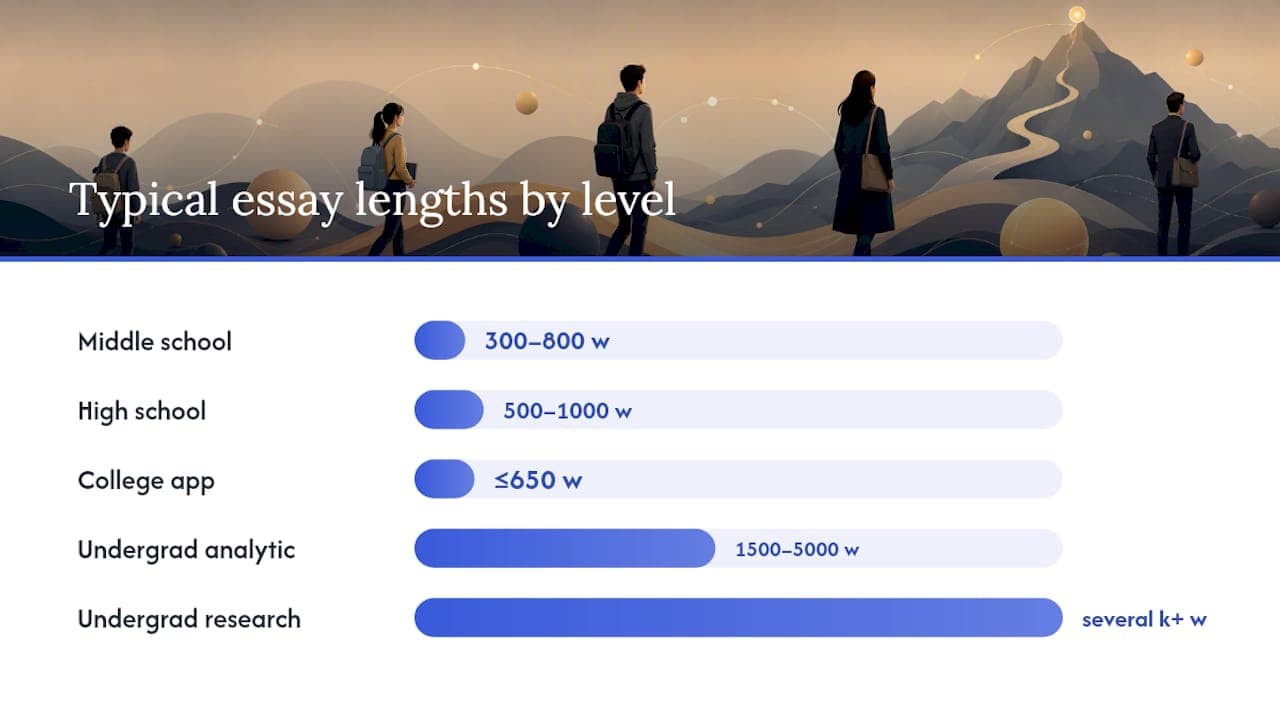
Different assignments carry different expectations, and knowing the range for your level saves you from under-delivering or padding unnecessarily.
| Assignment type | Typical word range | Structural note |
|---|---|---|
| Middle school essay | 300–800 words | Usually one main argument; 3–4 short paragraphs |
| High school class essay | 500–1,000 words | Five-paragraph structure; intro, 3 body paragraphs, conclusion |
| College application statement | Up to 650 words | Hard cap enforced by portals; treat as a strict technical limit |
| Undergraduate analytical essay | 1,500–5,000 words | Multiple supporting arguments; source integration expected |
| Undergraduate research paper | several thousand words or more | Literature review, methodology, and discussion sections |
| Graduate thesis chapter | several thousand words or more | Original argument with extensive citation |
With standard academic formatting (12pt serif font, double-spaced, 1-inch margins), one page yields roughly 250 words. A 1,000-word essay is about four double-spaced pages. That conversion is useful when an assignment specifies pages rather than words.
These ranges reflect common practice across U.S. institutions, but your instructor's brief overrides all of them. If your syllabus says 800 words for an assignment that typically runs 1,500, write 800.
This is where students get caught off guard. The body text of your essay almost always counts. Everything else depends on the instructor or the portal.
What typically counts:
What often does not count:
The problem is that "often" is doing a lot of work in those two lists. Instructor and portal policy always overrides general advice, and policies differ across courses. A professor in the English department may exclude footnotes; a professor in history may count them because footnotes carry substantive argument in that discipline.
How much does it matter? Consider a 1,500-word essay with 15 in-text citations averaging four words each. That's 60 words from citations alone. Add a 10-line footnote and you could be 80–100 words over without touching your body text.
Pro Tip: If the assignment brief doesn't specify, send a one-line email to your instructor before you start drafting: "Does the word count include the bibliography and footnotes?" Two minutes now prevents a rewrite later.
Word also displays a live word count in the status bar at the bottom of the screen. If you don't see it, right-click the status bar and check "Word Count."
WordCounter and similar tools let you paste text directly and see an instant count. They're useful for a quick cross-check, but keep two things in mind:
For high-stakes submissions, compare your editor's count with the portal's count before you submit. If they differ by more than a few words, paste your text into a plain-text editor (like Notepad) and recount. Portals tokenize text differently, and a 5-word discrepancy on a 650-word cap can block your submission.
The goal is more argument, not more words. These techniques add substance:
For a detailed breakdown of how to make an essay longer without filler, Samwell's guide covers expansion techniques with examples.
Before (one sentence): "The study found that sleep deprivation reduces cognitive performance."
After (three sentences): "The study found that sleep deprivation reduces cognitive performance. Specifically, participants who slept fewer than six hours scored 20% lower on memory recall tasks. That gap matters for any argument about student productivity, because it connects sleep directly to academic output."
The expansion adds roughly 40 words and a concrete data point. No padding.
Pro Tip: Turn on Track Changes in Word (or Version History in Google Docs) before you start editing. You can monitor the word count as you cut and restore anything you trim too aggressively.
Markers commonly allow a tolerance of about ±10%, but that's not universal. When the assignment doesn't specify a tolerance, treat the stated count as definitive.
Recommended tools by task:
Three-step workflow:
For a complete walkthrough of a common undergraduate length, Samwell's 1,500-word essay guide walks through structure, pacing, and expansion in detail.
Samwell's toolchain maps directly to the three-step workflow above. Over 1,000,000 students and academic professionals use the platform, and its core features address the specific places where word-count work gets complicated.
Feature-to-task mapping:
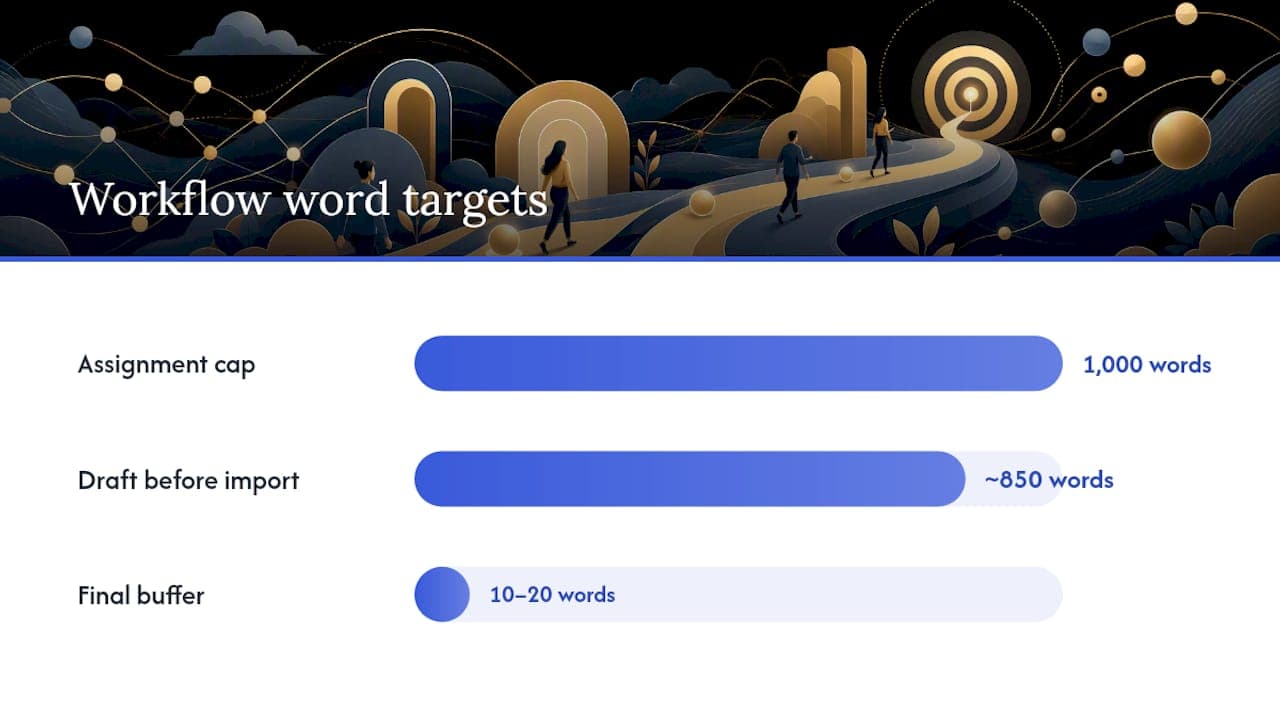
Workflow example for a 1,000-word assignment:
Draft your essay in Google Docs until you reach roughly 850 words. Import the draft into Samwell and use Guided Essays to identify which section is underdeveloped. Run the Power Editor on that section to expand the analysis by one focused paragraph. Export the revised draft, run a final count in WordCounter, and paste into your submission portal with a 10–20 word buffer below the cap.
That sequence keeps the argument intact while hitting the target precisely.
Run through this before you click submit:
Meeting the right word count comes down to three things: knowing your target, confirming what counts, and verifying the final number before you submit.
| Point | Details |
|---|---|
| Aim for the upper half of a range | Landing in the upper half of a stated range signals adequate argument development to markers. |
| Confirm what counts | Always verify whether footnotes, in-text citations, and the bibliography are included before drafting. |
| Use the three-step workflow | Draft in your editor, expand or trim deliberately, then verify the final count in the submission portal. |
| Buffer for hard caps | For a 650-word cap, target 620–645 words to avoid portal validation errors. |
| Samwell for structured expansion | Samwell's Power Editor and Guided Essays help you grow specific sections to hit a target without padding. |
Word count isn't a bureaucratic hoop. When an instructor sets 1,500 words for an analytical essay, that number encodes an expectation about argument depth: how many claims you're expected to develop, how many sources you're expected to integrate, and how much counterargument the assignment assumes. An essay that comes in at 900 words for a 1,500-word assignment isn't just short; it's usually underdeveloped, and markers read it that way.
The reverse is also true. An essay that runs 2,200 words when 1,500 were asked for often signals poor editing judgment, not extra effort. Instructors notice when a student can't cut.
What most guides skip is the asymmetry between expansion and trimming. Adding words is easy; adding argument is hard. The students who hit word counts well aren't padding — they're identifying the weakest paragraph in their draft and making it do more work. That's a skill that transfers directly to professional writing, legal briefs, and research reports. Getting the count right is practice for getting the argument right.
Assignment briefs always supersede general rules. When in doubt, ask.
Reaching a specific word count on a 1,000-word assignment is one of the most common places students lose time. You finish a draft at 820 words, and the question becomes: where do I add 180 words without it reading like filler?
Samwell's Enhanced Essay Creator and sentence and paragraph expansion tools handle exactly that. You identify the paragraph that needs more analytical depth, run the Power Editor on it, and get a targeted expansion that fits the argument you've already built. The Semihuman.ai technology keeps the output original, and the citation tools keep your references formatted correctly whether you're working in MLA or APA.
More than 1,000,000 students have used Samwell to draft, expand, and finalize academic work. If you have a specific word count to hit, start with the Enhanced Essay Creator and let the structured outline tell you exactly how many words each section needs to carry.