Loading...

TL;DR:
- Many students view citations as a final task, which leads to frequent and damaging errors. Proper adherence to citation standards is essential for demonstrating research credibility, situating work in scholarly conversations, and preventing the spread of misinformation. Using verified sources and consistent formatting protects academic integrity and enhances the visibility and trustworthiness of research outputs.
Most students treat citations as a final-step chore, something you rush through before submitting. That framing is exactly why citation errors are so common and so damaging. Understanding why use citation standards goes far beyond following a professor's instructions. It determines whether your research is trustworthy, whether your arguments hold up under scrutiny, and whether you're contributing honestly to a scholarly conversation. The stakes are real. Fabricated and incorrect citations are actively distorting research across disciplines, and the problem is growing faster than most academics realize.
| Point | Details |
|---|---|
| Citations signal credibility | Properly cited work tells readers your claims are verifiable, not invented. |
| Verification precedes management | Always confirm a source exists and says what you think it says before adding it to your reference list. |
| Fabricated citations are widespread | 1 in 277 biomedical papers contains fabricated references, threatening research integrity across fields. |
| Style choice shapes discipline norms | APA, MLA, Chicago, and other formats each serve specific fields and reader expectations. |
| Automation needs oversight | Citation tools speed up formatting but cannot replace manual source verification. |
Citation standards are agreed-upon systems for documenting the sources behind your claims. They tell readers exactly who said what, where it was published, and when. The most widely used formats include APA (American Psychological Association), MLA (Modern Language Association), Chicago, Turabian, and IEEE. Each has its own rules for formatting author names, dates, titles, and page numbers, but all of them share the same core purpose: making sources traceable.
A complete citation typically includes several components working together:
This structure matters because citation standards act as the intellectual packaging of research. They signal to readers and reviewers that you've engaged seriously with the scholarly conversation around your topic. A paper without consistent citations looks unfinished. A paper with incorrect citations looks worse: careless at best, dishonest at worst.
Consistent formatting also does something practical that's easy to overlook. When every source follows the same structure, readers can scan your reference list and locate any source within seconds. That speed and reliability is what citation standards unify across disciplines, letting readers focus on your argument rather than deciphering inconsistent formatting.
Pro Tip: If your institution or target journal specifies a citation style, apply it from the first draft. Reformatting 40 references at the end of a project wastes hours and introduces errors.
Understanding the benefits of citation standards means looking beyond rule-following. The most direct benefit is intellectual honesty. When you cite a source, you acknowledge that someone else's thinking contributed to your work. That's not a formality. It's the difference between scholarship and plagiarism.
Here's how proper citation standards serve you practically:
Pro Tip: When writing your literature review, group citations thematically rather than chronologically. This shows readers you understand how sources relate to each other, not just that you read them.
The advantages of using citation formats extend to the researchers you cite, too. Proper attribution drives recognition and discovery. When your citation leads a reader to another scholar's work, you're extending that scholar's reach within the academic community.

The consequences of skipping or misapplying citation standards are no longer theoretical. The data is stark.
| Risk | What It Means in Practice |
|---|---|
| Fabricated references | 4,046 fake references identified across biomedical papers analyzed in 2026 |
| Misinformation cascade | False citations get picked up by subsequent researchers, compounding the error |
| Damaged credibility | Authors caught with incorrect citations face retractions, reputational harm, and career consequences |
| Institutional liability | Universities can face scrutiny when faculty or student work contains systematic citation errors |
| Patient care impact | In medicine and clinical research, fabricated citations can influence treatment decisions |
What makes this problem particularly insidious is how fake citations often function. Fabricated citations usually support low-load background claims rather than central arguments. They work as social signals, adding the appearance of scholarly depth without actually carrying substantive evidence. A reader skimming a reference list won't catch them. A reviewer pressed for time won't either.
There's also a critical distinction between citation management and citation verification that most students miss entirely. Verification is about trust; management is about organization. Managing unverified citations only compounds errors at scale. If you add a source to your reference manager without confirming it exists and says what you think it says, you're automating the spread of potential misinformation.
"Publishers should implement automated reference verification tools before peer review to combat fabricated citations effectively. Institutional barriers, not technological limits, are what hold this back." — The Scientist, 2026
The fragmented citation system currently in use across academia needs to evolve toward machine-readable formats with formal verification authority. Until that happens, the responsibility sits with individual researchers and students.
Why follow citation guidelines in one format over another? Because each style was built for a specific discipline's priorities and reading conventions.
| Style | Primary Field | Key Feature | In-Text Format |
|---|---|---|---|
| APA | Social sciences, psychology | Emphasizes publication date | (Author, Year) |
| MLA | Humanities, literature | Emphasizes author and page | (Author Page) |
| Chicago | History, arts | Offers footnote or author-date | Footnotes or (Author Year) |
| Turabian | Student research (Chicago-based) | Simplified Chicago for papers | Notes or author-date |
| IEEE | Engineering, computer science | Numbered references | [Number] |
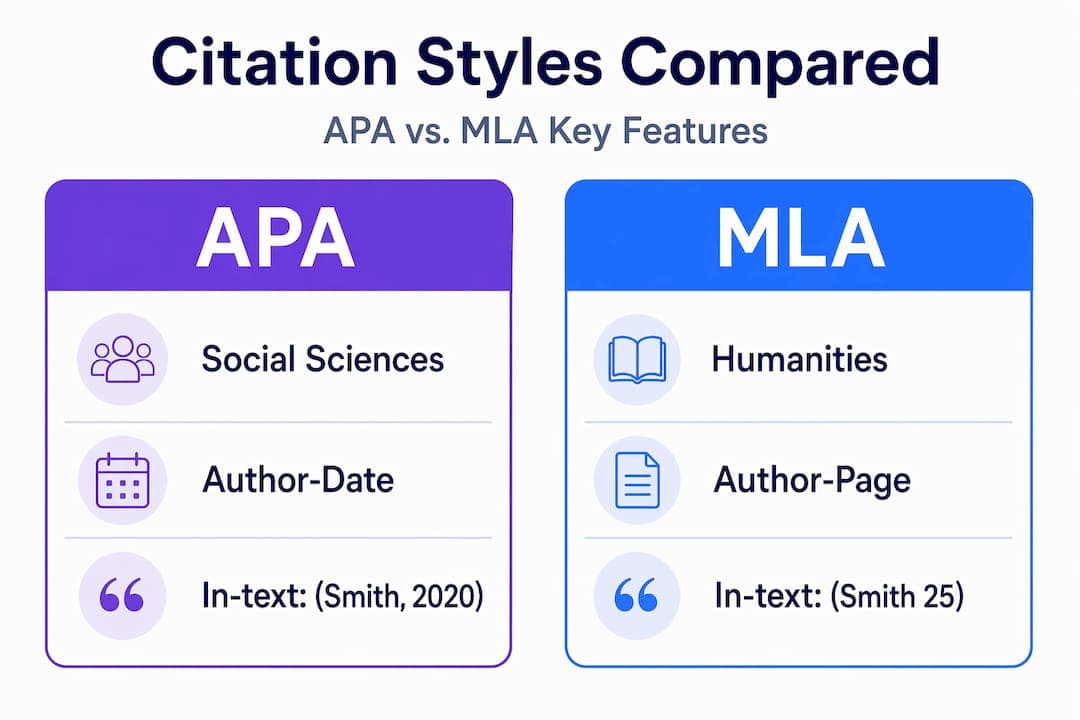
Understanding these differences answers the question of what citation standards are for at the discipline level. A psychology paper using MLA formatting signals to every reader that the author doesn't understand the conventions of their field. It undermines confidence before anyone reads a single finding.
A few practical implications worth knowing:
Choosing the right style isn't arbitrary. It's how you communicate field literacy to your readers. For a deeper breakdown of how citation styles affect research integrity, the differences between formats go beyond aesthetics into disciplinary values.
Knowing why citation standards matter is one thing. Applying them without errors is another. Here's a practical workflow that minimizes mistakes:
For students still building these habits, a detailed citation guide for students can walk through the mechanics of each style with worked examples.
Pro Tip: Never copy a citation from another paper's reference list without verifying it yourself. Citation errors propagate exactly this way, and you inherit the original author's mistakes.
How citation standards improve quality in your writing comes down to this: the discipline of proper citation forces you to engage with sources carefully. You can't cite something correctly without reading it closely enough to know what it actually says.
I've watched the conversation around citation shift dramatically over the past few years. What used to be a formatting question has become a research integrity crisis. And I think most students and academics are underestimating how serious it is.
The rise of AI-assisted writing has made citation fraud easier to produce accidentally. A student asks an AI tool to suggest sources, copies those suggestions into a reference manager, and submits a paper with citations that don't exist or don't say what the paper claims. No malicious intent required. The citation metrics environment already rewards quantity over accuracy in some academic circles, and AI tools are accelerating that tendency.
What I've come to believe is that citation standards are not administrative overhead. They're the infrastructure that keeps collective knowledge honest. When that infrastructure degrades, every paper built on compromised citations becomes unreliable, and the error propagates forward into future research.
My honest advice: treat source verification as the most important step in your writing process, not an afterthought. If you can't confirm a source exists and says what you need it to say, it doesn't belong in your paper. That standard is harder to maintain than copying references from a search result, but it's the only standard that actually means something.
The students and academics who understand this aren't just following rules. They're protecting the quality of the research ecosystem they depend on.
— Tilen
Getting citation standards right is genuinely difficult, especially when you're managing sources across multiple formats and deadlines.
Samwell is built for exactly this. Used by over 1,000,000 students and academics from leading universities, Samwell helps you write research papers that meet citation requirements across APA, MLA, Chicago, and more, while keeping your work original and credible. The platform's real-time AI detection checks and academic writing tools let you verify formatting, expand arguments, and produce structured outlines without sacrificing integrity. Whether you're writing your first research paper or your fiftieth, Samwell gives you the structure to cite correctly from the start, not scramble to fix it at the end.
Citation standards are structured systems for documenting sources in academic writing. They allow readers to locate original sources, verify claims, and assess the credibility of research.
Following citation guidelines protects students from plagiarism, strengthens their arguments by connecting them to credible sources, and demonstrates that their work meets academic standards.
Citation standards improve quality by requiring writers to engage carefully with sources, making claims verifiable, and preventing misinformation from entering the scholarly record.
Fabricated or incorrect citations undermine the reliability of research, can mislead other scholars who build on that work, and in fields like medicine can affect real-world decisions and patient care.
The correct style depends on your discipline: APA for social sciences, MLA for humanities, Chicago for history and arts, and IEEE for engineering. Always confirm with your instructor or target journal before formatting.