Loading...

TL;DR:
- Citation management tools automate reference formatting, protect academic integrity, and scale with research projects.
- In the AI era, maintaining verifiable citations becomes essential to distinguish real sources from fabricated references.
Manually tracking dozens of sources across a semester-long research project is exactly the kind of work that eats hours without adding a single insight to your paper. Most students and researchers tolerate it because they assume citation management is just tedious bookkeeping dressed up with software. It is not. Understanding why use citation management tools changes how you work at a fundamental level: you stop losing sources, stop reformatting the same reference four different ways, and stop gambling with your academic integrity. This article breaks down how citation managers work, what they actually do for you, and why they matter more in 2026 than ever before.
| Point | Details |
|---|---|
| Automates repetitive formatting | Citation tools generate APA, MLA, and Chicago bibliographies instantly, saving researchers hours per project. |
| Protects academic integrity | Organized, verifiable source provenance helps distinguish real research from AI-generated fabrications. |
| Scales with your project | Shared libraries and folder systems make citation management practical for large or collaborative research. |
| Requires active oversight | Automatically generated citations need manual review to meet journal-specific or institutional guidelines. |
| Start early for best results | Integrating a citation manager at the beginning of a project prevents costly retroactive corrections. |
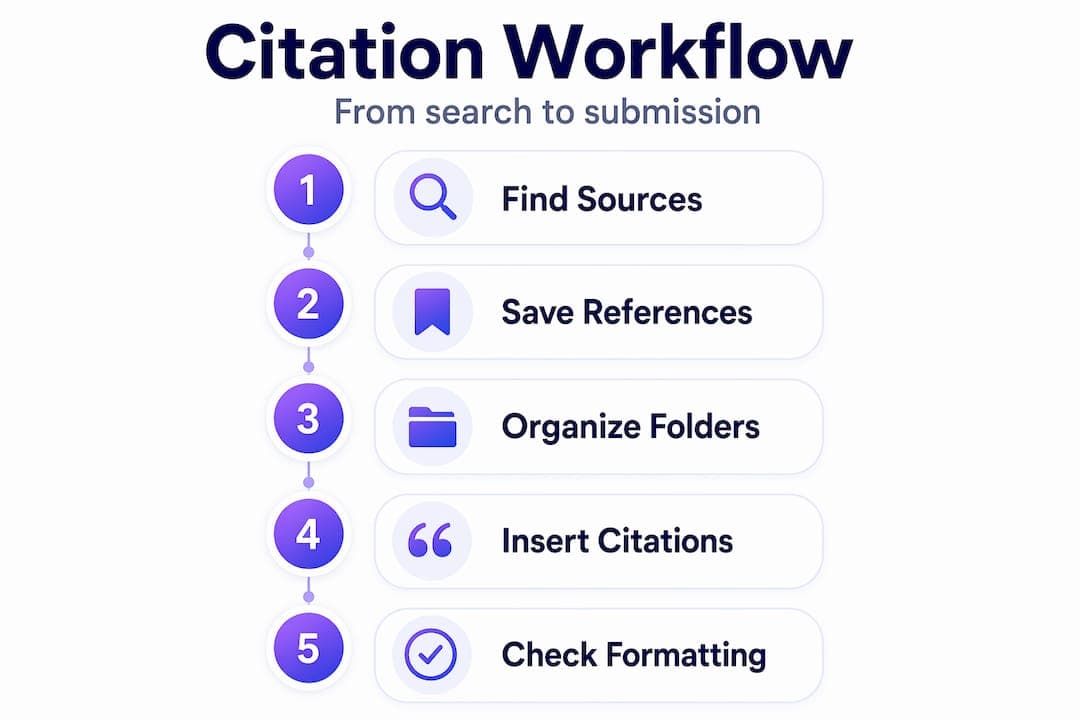
Citation management tools are software applications designed to collect, organize, store, and format your references throughout the research and writing process. At their core, they solve a problem every researcher knows: juggling dozens of sources across weeks or months is cognitively expensive and error-prone when done by hand.
Here is what these tools actually do for you:
That said, citation managers are not magic. Generated citations often need manual verification to confirm they meet specific journal or institutional requirements. The software captures what metadata is available, but database records are sometimes incomplete or inconsistently formatted. You are still responsible for the final output.
The practical gains from using citation management software go well beyond convenience. They touch every phase of academic work, from the first search to the final submitted draft.
Time savings at scale. Citation tools automate formatting tasks, generating complete bibliographies in any major citation style instantly. A 40-source literature review that once took three hours to format manually now takes minutes.
Fewer errors, better accuracy. Manual citation is a mechanical task performed under deadline pressure, which is a reliable recipe for mistakes. Automated tools dramatically reduce transposition errors, missing page numbers, and incorrect author ordering.
Academic integrity by design. Keeping precise, organized provenance for every source you consult is not just good housekeeping. It is the foundation of honest scholarship. When your sources are traceable and documented, your arguments are defensible.
Organization for complex projects. Folder structures, tags, and search functions inside citation managers make it realistic to handle 200-plus references without losing track of which source said what. Citation managers are indispensable for large, interdisciplinary projects where manual management risks omissions.
Collaboration without friction. Platforms now support shared libraries with group access for 10 or more users, so co-authors can work from the same reference pool without emailing spreadsheets back and forth.
Mental focus where it counts. Automating citation tasks frees intellectual bandwidth, allowing you to concentrate on analysis and argument rather than formatting mechanics.
Pro Tip: If you are writing a thesis or dissertation, set up your citation manager folders to mirror your chapter structure from day one. This makes pulling chapter-specific bibliographies effortless at submission time.
Understanding the importance of citation tools becomes especially clear when you consider how much of a researcher's time disappears into administrative tasks that software can handle automatically.
The arrival of AI-generated writing has introduced a problem that no previous generation of researchers faced: the fabricated citation. AI writing tools can produce plausible-looking references to papers that do not exist, complete with realistic author names, journal titles, and volume numbers.
"Citation integrity is transitioning from a procedural task to a trust mechanism crucial in distinguishing valid research from AI-generated content." — Why Citation Integrity Matters More in the AI Era
This shift changes the stakes around citation management entirely. When citation was purely a formatting concern, errors were annoying but usually correctable. Now, unverified citations can indicate something far more serious: that a paper's sources were never real in the first place.
Traditional reference management software cannot fully verify citation authenticity, which means AI-generated fabricated references can slip through standard tools. New verification-focused tools are emerging to address this gap, but for now, the responsibility falls on you to confirm that every source you cite actually exists and says what you claim it says.
The role of citation management has expanded beyond organizing your reading list. It now functions as part of the verification layer that keeps scholarship trustworthy. When your citations come from a documented, organized library you built yourself from real sources, you are producing something that AI-generated fluff simply cannot replicate: accountable research.
Citation integrity now serves as a trust mechanism for the entire research community, not just a formatting requirement for individual papers. That reframing is worth holding onto every time citation management feels like extra work.
Citation managers are genuinely useful, but they come with limitations that trip up users who expect them to work flawlessly out of the box. Knowing these pitfalls in advance saves real frustration.
Pro Tip: Before committing to any citation manager, ask your advisor, department, or research group which tool they use. Sharing a library is far more valuable than having the most sophisticated feature set.
The benefits of citation management only materialize fully when you use the tool consistently and verify its output. Think of it as a highly capable assistant that still needs your final review.

Knowing a tool exists and actually integrating it into your research practice are two different things. Here is how to make citation management work from the start.
Set up your manager before you begin. Install the word processor plugin and create your folder structure on day one of the project. Integrating citation managers early is crucial; retroactive insertion is tedious and prone to errors.
Organize with folders, tags, and notes. Create folders by chapter, theme, or research question. Use tags for cross-cutting topics. Attach brief notes to each reference summarizing its argument and where you might use it.
Use collaborative features intentionally. For group projects, designate one person to manage the shared library structure. Set naming conventions for folders so all contributors can find sources quickly.
Verify every citation before submission. Do a final pass comparing your formatted bibliography against the original sources. Check author names, publication years, and page ranges, particularly for sources imported from preprint databases.
Treat the manager as your assistant, not your authority. You remain responsible for citation accuracy. The tool handles the mechanical work. The scholarly judgment about what to cite and how to represent it stays with you.
Pairing these habits with a resource like a solid citation guide for academics gives you both the tool fluency and the stylistic knowledge to produce references that hold up to scrutiny.
I have watched researchers at every level treat citation management as an afterthought, something to sort out during the final week before submission. It almost always costs them. Last-minute citation formatting is where mistakes happen and where the temptation to cut corners becomes hardest to resist.
What I have come to believe, after seeing hundreds of research workflows, is that citation management is really a proxy for research discipline. Researchers who track their sources carefully from the start tend to think more carefully about the sources themselves. They notice when a claim rests on a single, weak reference. They catch when two sources actually contradict each other. The tool creates the conditions for better thinking, not just tidier bibliographies.
The AI era has made this more pressing, not less. When fabricated citations are a real and documented risk, maintaining a clean, verifiable reference library is one of the clearest ways to demonstrate that your work is the product of genuine inquiry. That matters to your readers, your reviewers, and your own scholarly reputation.
My advice: pick a tool your community uses, start with your next project rather than your current one if you are new to it, and commit to reviewing every auto-generated citation before it leaves your document. The returns compound over time.
— Tilen
Samwell is built for exactly the kind of academic work this article describes: research that demands both efficiency and integrity. Beyond generating well-structured essays and research papers, Samwell supports proper citation standards including APA and MLA, with built-in tools that keep your sources organized and your writing original. The platform's real-time AI detection checks and Semihuman.ai technology mean you are producing content that is both credible and academically defensible. If you are ready to take the manual labor out of academic writing while keeping the scholarly rigor in, explore Samwell's writing tools and see how over one million students and researchers are already working smarter.
A citation manager collects, organizes, and formats your references automatically, generating complete bibliographies in styles like APA, MLA, or Chicago from your stored source library.
Manual citation is time-consuming and error-prone. Citation management tools automate repetitive formatting and reduce mistakes, freeing your attention for the analytical work that actually advances your argument.
No. Generated citations require manual verification to confirm they meet specific journal or institutional standards, particularly when metadata from databases is incomplete.
Prioritize the tool your collaborators use over one with the most features. Shared libraries and easy collaboration outweigh minor interface advantages when working in a research group or academic department.
As AI-generated content becomes more common, traditional citation tools cannot verify fabricated references, making human oversight and a well-maintained personal reference library critical for research integrity.