Loading...

Graduate students using AI writing tools reduce their drafting time by over 56%, transforming what once took hours into minutes. Despite skepticism about AI compromising academic integrity, research shows these tools enhance both speed and quality when used responsibly. This guide explores how AI revolutionizes academic writing by delivering instant feedback, improving grammar and style, and accelerating research workflows while addressing ethical concerns and overreliance risks. You'll discover evidence-based strategies to maximize AI benefits without sacrificing originality or critical thinking skills.
| Point | Details |
|---|---|
| Speed and quality gains | AI writing tools dramatically cut drafting time while improving grammar and coherence when used responsibly. |
| Balance AI with thinking | Optimal results come from combining AI assistance with independent critical thinking and original insight. |
| AI for grammar and brainstorming | AI should support grammar, brainstorming, and style while leaving core analysis and originality to the student. |
| Ethics and integrity risks | Overreliance can erode critical thinking and raise concerns about citation integrity and hallucinated sources. |
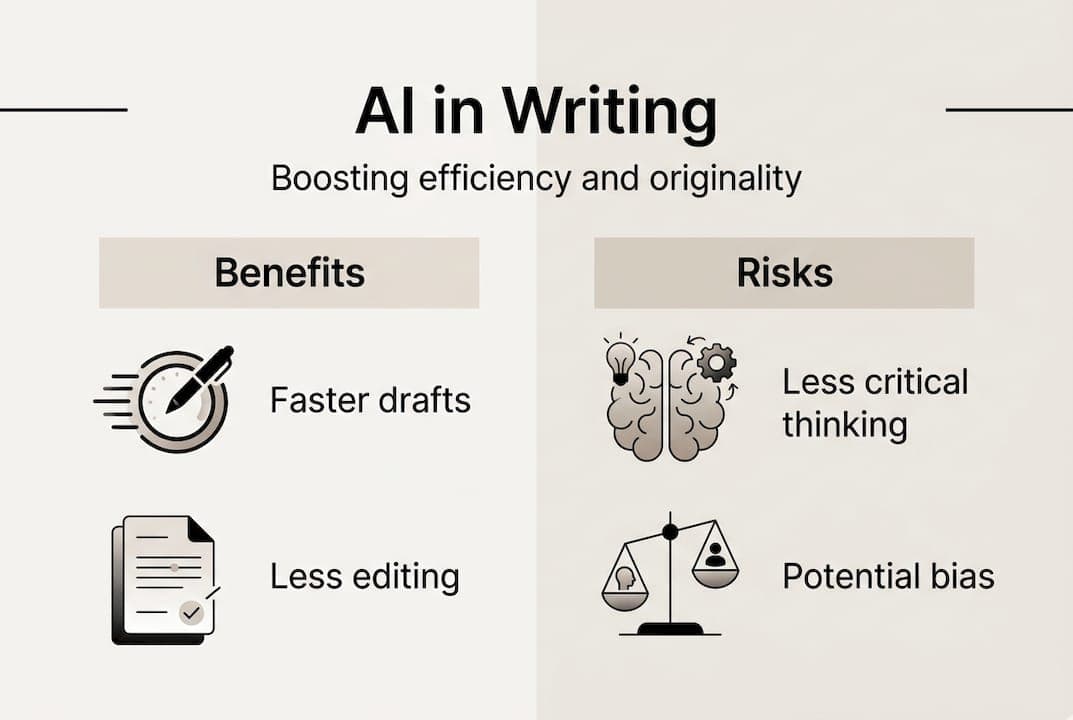
AI tools significantly enhance writing efficiency for students and academics by reducing time spent on drafting and editing. Graduate students report cutting their writing time by more than half, while undergraduates achieve even greater gains. These tools analyze your text instantly, identifying grammar errors, suggesting style improvements, and offering alternative phrasings that strengthen clarity.
The quality improvements extend beyond simple spell checking. AI improves writing quality, particularly grammar, coherence, style, and for non-native speakers who benefit from real-time language guidance. Instead of waiting days for professor feedback, you receive immediate suggestions that help you learn writing conventions faster. This instant response loop decreases frustration and cognitive load, allowing you to focus energy on developing arguments rather than wrestling with sentence structure.
Common applications include:
Pro Tip: Use AI to generate three different versions of a challenging paragraph, then combine the strongest elements from each to create your final version.
The efficiency gains free up time for deeper research and analysis. When you spend less time fixing commas and restructuring sentences, you invest more energy in developing original insights and synthesizing sources. Understanding AI writing helps you recognize where these tools add the most value to your workflow. Non-native English speakers particularly benefit from AI's ability to suggest natural-sounding phrases that align with academic writing conventions, leveling the playing field in competitive academic environments.
Speed matters in academic settings where multiple deadlines converge. AI tools process entire essays in seconds, highlighting weak transitions, inconsistent terminology, and unclear references that might otherwise slip through manual review. This rapid feedback cycle accelerates skill development because you see patterns in your writing mistakes and learn to avoid them in future drafts.
Risk of overreliance erodes critical thinking, originality, and skill development when students depend too heavily on AI-generated content. Excessive use creates a crutch that prevents you from developing the analytical muscles essential for advanced academic work. Your unique voice, the perspective that makes your writing valuable, can disappear under layers of AI-polished prose that sounds competent but lacks authentic insight.
Ethical concerns include academic integrity, plagiarism detection challenges, and hallucinations that introduce false information into scholarly work. AI systems sometimes fabricate citations that look legitimate but reference non-existent sources, creating serious credibility problems. Publishers increasingly require transparent disclosure of AI use because undisclosed AI assistance blurs the line between original scholarship and machine-generated content.
Key ethical challenges:
Pro Tip: Always verify every citation an AI tool suggests by checking the actual source, even if the reference looks perfectly formatted.
Academic institutions struggle to update integrity policies fast enough to address AI's rapid evolution. What counts as acceptable AI use varies dramatically across departments and institutions, creating confusion about boundaries. Some professors welcome AI for grammar checking but prohibit it for idea generation, while others ban all AI assistance entirely. Navigating these challenges requires understanding both technological capabilities and institutional expectations.
"The fundamental question isn't whether AI helps you write faster, but whether it helps you think better. Speed without substance undermines the entire purpose of academic writing."
Bias represents another serious concern because AI systems learn from existing texts that may contain prejudiced assumptions. When you use AI suggestions uncritically, you risk perpetuating historical biases in your academic work. Complex topics requiring nuanced cultural understanding often trip up AI systems that lack real-world context, producing recommendations that sound plausible but miss crucial subtleties.
Best practices include using AI for mechanics like grammar and paraphrasing, with human oversight and verification ensuring accuracy and originality. Think of AI as a research assistant who handles tedious formatting while you focus on developing compelling arguments. This division of labor maximizes efficiency without compromising the intellectual work that defines academic scholarship.
Follow these steps for responsible AI integration:
Pro Tip: Create a personal AI use policy that defines which tasks you'll delegate to AI and which you'll always handle yourself, then stick to it consistently.
Avoid using AI for core analysis or arguments where your original thinking adds the most value. The sections requiring deep engagement with sources, synthesis of multiple perspectives, and development of novel insights should remain primarily human-driven. AI can suggest connections between ideas, but you must evaluate whether those connections hold up under scrutiny and advance your thesis meaningfully.
Develop skills to critically evaluate AI feedback rather than treating every suggestion as correct. AI tools make mistakes, especially with discipline-specific terminology and complex theoretical concepts. Staying current with AI writing trends helps you understand evolving capabilities and limitations. When AI suggests a change, ask yourself whether it genuinely improves clarity or simply makes the text sound more generic.
Transparency matters more than perfect independence from AI assistance. Academic integrity doesn't require you to avoid all AI tools, but it does demand honesty about which tools you used and how they influenced your final work. Most institutions recognize that AI has become part of the research landscape and focus on ensuring students understand what they're submitting rather than banning technology outright. Practical tips for students can help you navigate institutional expectations while leveraging AI benefits.
Traditional writing emphasizes deep analysis and originality but demands significant time investment for drafting, editing, and formatting. You develop strong critical thinking skills through repeated practice, learning to construct arguments from scratch without technological scaffolding. This approach builds intellectual independence and creates truly unique perspectives, but it can feel overwhelming when facing multiple deadlines simultaneously.

AI-assisted writing speeds drafting and improves mechanics but risks creating overdependence that weakens analytical muscles. You complete assignments faster and produce cleaner prose with fewer grammar errors, yet you might miss opportunities to struggle productively with complex ideas. The efficiency gains are real, but they come with the danger of outsourcing too much thinking to algorithms that can't replace human judgment.
| Approach | Strengths | Limitations | Best For |
|---|---|---|---|
| Traditional | Deep critical thinking, authentic voice, skill building | Time-intensive, slower feedback, higher error rates | Complex analysis, original research, skill development |
| AI-assisted | Fast drafting, instant feedback, grammar accuracy | Overreliance risk, potential voice loss, ethical concerns | Grammar checking, formatting, brainstorming, editing |
| Hybrid | Combines speed with originality, leverages both strengths | Requires discipline and clear boundaries | Most academic writing tasks |
Hybrid human-AI approaches maximize benefits by using AI for speed and feedback while humans handle critical analysis and originality. This balanced model treats AI as a tool that enhances rather than replaces your intellectual work. You draft initial ideas independently, use AI to refine expression and catch errors, then review suggestions critically before incorporating them.
Pro Tip: Alternate between traditional and AI-assisted writing sessions to maintain strong independent skills while enjoying efficiency benefits.
The hybrid approach requires clear boundaries about which tasks belong to AI and which demand human judgment. Use AI for mechanical tasks like checking subject-verb agreement, formatting citations, and suggesting alternative word choices. Reserve tasks requiring interpretation, evaluation of source credibility, and synthesis of competing perspectives for your own analysis. Comparing AI writing tools helps you select platforms that support this balanced approach rather than encouraging complete automation.
Combining both methods lets you work smarter without sacrificing the intellectual growth that makes academic writing valuable. You learn discipline-specific conventions faster through AI feedback while still developing the critical thinking skills that define scholarly expertise. The goal isn't choosing between traditional and AI-assisted writing but rather integrating both strategically based on task requirements and learning objectives.
Samwell offers AI tools specifically designed for students and academics who want to boost efficiency while maintaining academic integrity. The platform supports grammar checks, writing enhancement, and originality assurance through advanced plagiarism detection and citation verification. Unlike generic AI tools, Samwell integrates ethical safeguards that help you use AI responsibly according to academic standards.
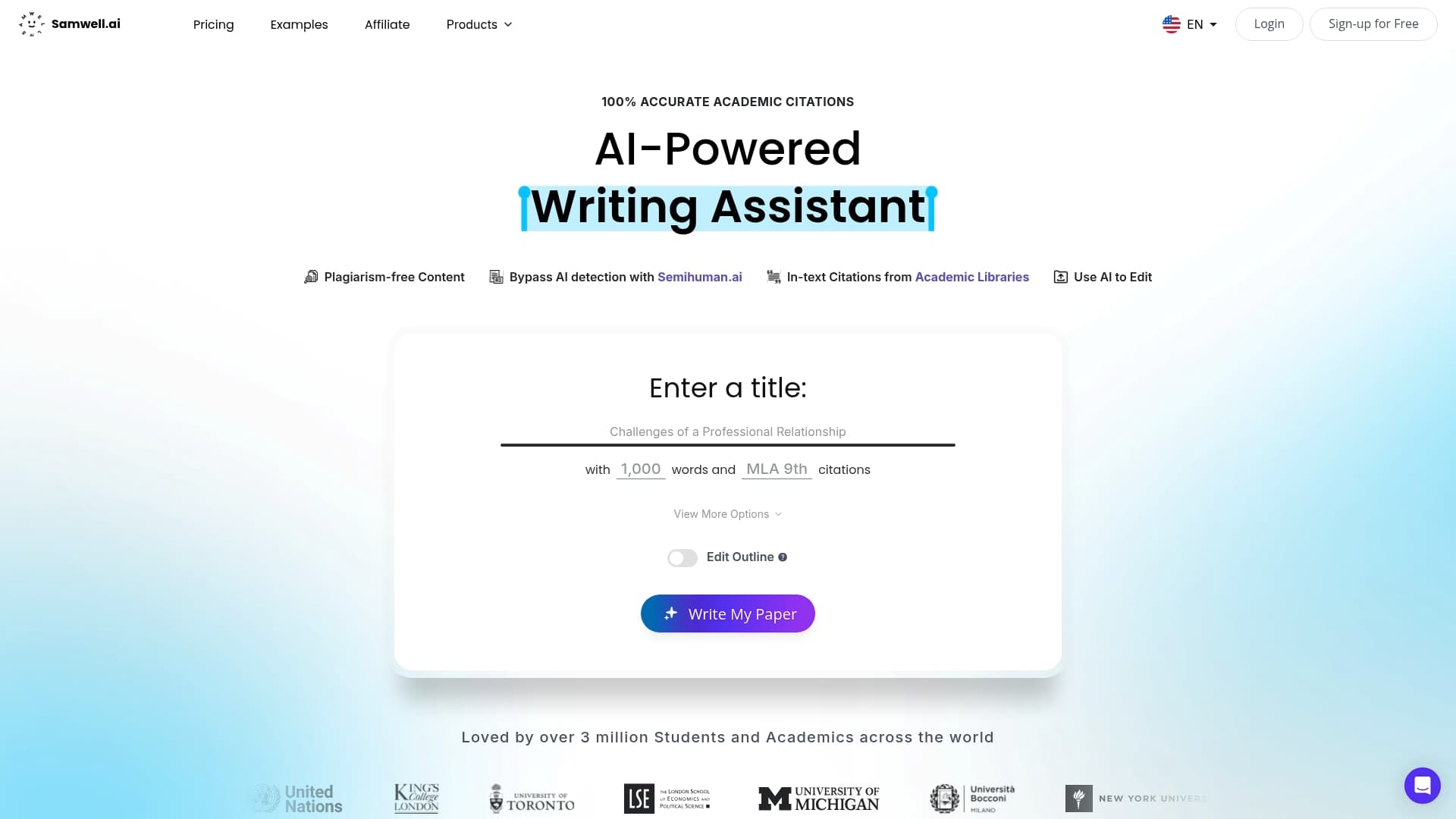
The Power Editor feature provides targeted editing suggestions that improve clarity without replacing your voice, while Guided Essays help structure complex arguments through intelligent outlining. Real-time AI detection checks ensure your work passes institutional screening tools, and customizable citation support handles MLA, APA, and Chicago formatting automatically. With over 1,000,000 students and academic professionals using the platform, Samwell represents a trusted solution for applying the best practices covered in this guide to your actual writing projects.
AI dramatically cuts drafting and editing time, with graduate students reporting over 56% faster completion rates compared to traditional methods. The tools improve grammar, coherence, and writing style through instant feedback that helps you learn conventions faster. AI benefits for essays include personalized suggestions tailored to your writing patterns and real-time error detection that catches mistakes before submission.
Use AI primarily for grammar checking and brainstorming rather than generating final ideas or core arguments. Always review and edit AI outputs carefully, treating suggestions as starting points rather than finished products. Balance AI use with independent critical analysis by drafting key sections yourself first, then using AI to refine expression. Student tips for responsible AI use emphasize maintaining control over intellectual content while delegating mechanical tasks.
Most academic publishers and institutions require disclosure of AI assistance to maintain transparency and trust in scholarly work. Non-disclosure risks integrity violations that can result in rejected submissions or academic penalties. Transparency supports ethical standards by helping readers understand how AI influenced your work and evaluate its originality appropriately. AI disclosure policies vary by institution, so always check your specific guidelines before submitting AI-assisted work.
AI provides substantial support for non-native speakers by suggesting natural-sounding phrases and correcting grammar patterns that differ from academic English conventions. The instant feedback helps you learn language rules faster than traditional methods while reducing anxiety about making errors. However, you should still develop independent language skills rather than relying entirely on AI translation, using these tools as learning aids that accelerate rather than replace skill development.
Core analysis, argument development, and synthesis of multiple sources should remain primarily human tasks where your original thinking adds the most value. Critical evaluation of source credibility, interpretation of complex data, and development of novel theoretical insights require human judgment that AI cannot replicate. Use AI for supporting tasks like grammar checking and citation formatting, but maintain personal control over intellectual content that defines your unique contribution to academic conversations.