Loading...

Many students hesitate to use AI for essays, fearing it compromises academic integrity or replaces genuine learning. Yet AI enhances efficiency by simplifying complex essays and saving time on repetitive tasks while boosting creativity when used responsibly. This guide explores how AI tools streamline research, drafting, and editing, and explains ethical practices that maintain originality. You'll discover practical strategies to balance AI assistance with your unique voice, ensuring you meet academic standards while maximizing productivity. Understanding these principles helps you leverage AI as a powerful learning aid rather than a shortcut.
| Point | Details |
|---|---|
| Efficiency gains | AI streamlines research drafting and editing to save time while maintaining quality. |
| AI feedback benefits | AI generated feedback highlights weaknesses and guides iterative revision to improve essay quality. |
| Transparency and human oversight | Ethical use requires transparent practice and active human involvement to preserve originality. |
| Risks of overreliance | Overreliance and academic integrity concerns are risks that require careful balancing with your own thinking. |
AI tools transform the essay writing process by handling time-consuming tasks that traditionally slow students down. During research, AI quickly summarizes sources and identifies relevant information, cutting hours from the initial phase. You can feed multiple articles into an AI tool and receive condensed key points that help you decide which sources merit deeper reading. This means less time scrolling through dense academic papers and more time developing your argument.
Outlining becomes systematic when AI helps organize ideas logically. You input your thesis and main points, and the tool suggests a coherent structure that flows naturally. Drafting accelerates as AI generates structured text suggestions based on your outline, providing a foundation you can refine. Instead of staring at a blank page, you start with content that needs shaping rather than creation from scratch. Editing benefits enormously from AI grammar and style checks that catch errors human eyes miss, polishing your work to professional standards.
Users consistently report saving substantial time on multi-page essays. A typical 10-page research paper that might take 20 hours can drop to 12-15 hours with strategic AI use. AI breaks down complexity and boosts creativity by handling mechanical aspects while you focus on critical thinking and argument development. This efficiency gain doesn't compromise quality when you maintain active oversight.
Pro Tip: Use AI to generate three different introductions for your essay, then combine the strongest elements from each into your final version. This approach leverages AI's speed while ensuring your unique perspective shines through.
The ai essay writer approach works best when you view AI as a collaborative partner rather than a replacement. Start with your own brainstorming, then use AI to expand and refine. This workflow preserves your creative control while benefiting from AI's processing power. Students who adopt this method find their essays become more polished and comprehensive without sacrificing authenticity. For additional strategies, explore tips for students that complement AI-assisted writing techniques.
AI-generated feedback creates a powerful revision cycle that elevates essay quality beyond what students typically achieve alone. When you submit a draft to an AI tool, it highlights specific weaknesses in argument structure, evidence use, and clarity. This targeted critique tells you exactly where to focus revision efforts rather than making you guess what needs improvement. Empirical studies show AI feedback significantly improves essay quality and motivation, with students producing measurably better work after incorporating AI suggestions.
The instant nature of AI feedback changes the revision dynamic entirely. Traditional feedback requires waiting days or weeks for instructor comments, by which time you've mentally moved on from the assignment. AI provides immediate, objective critique that keeps you engaged with your work. You can revise a paragraph, get fresh feedback, and revise again within minutes. This tight loop encourages iterative improvement that compounds over multiple cycles.
Student motivation increases substantially when AI feedback feels constructive rather than judgmental. Unlike human graders who may seem subjective, AI offers consistent standards that feel fair. You're more likely to revise thoroughly when suggestions come without emotional baggage. Research confirms that active engagement with AI feedback causally improves outcomes over passive acceptance, meaning you must critically evaluate each suggestion rather than blindly accepting changes.
"Students who actively interact with AI feedback, questioning and modifying suggestions, show significantly better essay outcomes than those who passively accept AI-generated content."
However, emotional responses to AI feedback vary. Some students feel empowered by objective critique, while others experience frustration when AI misunderstands their intent. Teachers play a crucial role in helping students interpret AI feedback constructively. You should view AI suggestions as starting points for reflection rather than absolute truth. When AI flags a sentence as unclear, ask yourself what confused the algorithm, then decide whether human readers might share that confusion.
The quality gains from proper AI feedback use are measurable and substantial. Students report stronger thesis statements, better-supported arguments, and clearer prose after multiple AI revision cycles. The ai essay writer tools that incorporate feedback mechanisms create a learning environment where improvement happens continuously. Pair this with guidance from tips for students to maximize your revision effectiveness and develop stronger writing instincts over time.

Using AI for essays carries genuine risks that demand careful attention to ethical boundaries. The most serious concern is plagiarism through overreliance on AI-generated content. When you submit AI-written text as your own work without substantial modification, you've essentially plagiarized from an algorithm. Many institutions now consider this academic misconduct equivalent to copying from another student. 69% of academics see full AI essays as severe misconduct, with ethical beliefs influencing AI use more strongly than institutional policies.
Overreliance erodes the critical thinking skills that essay assignments are designed to develop. If AI does your analysis and argument construction, you miss the cognitive workout that builds intellectual capacity. This creates a dangerous cycle where you become less capable of independent thought with each AI-assisted assignment. The long-term cost to your education far outweighs short-term time savings.
AI hallucinations present another significant risk. These tools sometimes generate plausible-sounding but entirely false information, including fabricated citations and statistics. You might unknowingly include fictional research in your essay, damaging your credibility and grade. Always verify AI-generated facts against reliable sources before incorporating them into your work.
Transparency through disclosure is critical to maintaining integrity. Publishers require disclosure and forbid verbatim AI use in final content, setting a standard that academic institutions increasingly adopt. Check your institution's AI policy and follow it precisely. When policies allow AI use, disclose it in your author's note or methodology section. This honesty protects you from accusations of misconduct and demonstrates ethical awareness.
Pro Tip: Create a personal AI use log for each essay, noting which sections received AI assistance and how you modified the suggestions. This documentation protects you if questions arise and helps you track your own writing development.
Human oversight must guide every aspect of AI use in essay writing. You should never accept AI suggestions without critical evaluation. Ask yourself whether each AI-generated sentence advances your argument and reflects your understanding. Treat AI as a junior writing partner whose work requires your expert review. This approach keeps you in control while benefiting from AI efficiency.
The ai writing trends 2025 academia landscape shows institutions developing more nuanced policies that distinguish between acceptable AI assistance and misconduct. Understanding these distinctions helps you navigate ethical gray areas confidently. For deeper exploration of these issues, the artificial intelligence essay guide provides comprehensive ethical frameworks tailored to academic contexts.
Implementing AI effectively requires a structured approach that preserves your intellectual contribution while leveraging AI's strengths. Use AI iteratively with active human modifications to improve quality and maintain originality throughout the writing process. This iterative method ensures AI enhances rather than replaces your thinking.
Start with these steps for balanced AI integration:
Human edits ensure your voice, argument originality, and critical thought remain central to the essay. After AI suggests content, ask yourself whether it reflects your actual understanding and perspective. If AI generates a paragraph that sounds impressive but doesn't match your thinking, rewrite it completely. Your goal is using AI as a thinking partner, not a ghost writer.
| Aspect | AI-Assisted Approach | Manual Writing Approach |
|---|---|---|
| Originality | High when actively modified | Naturally high |
| Time efficiency | Saves 30-40% of writing time | Baseline time investment |
| Learning depth | Requires deliberate reflection | Natural through struggle |
| Skill development | Needs conscious practice | Automatic through repetition |
| Quality ceiling | Very high with expertise | Limited by current skill |
The comparison shows hybrid approaches are best for scalability and learning, combining AI efficiency with human insight. Hybrid systems let you handle more complex topics and longer assignments without sacrificing educational value. You develop meta-cognitive skills by evaluating AI output critically, which builds judgment that transfers to other intellectual tasks.
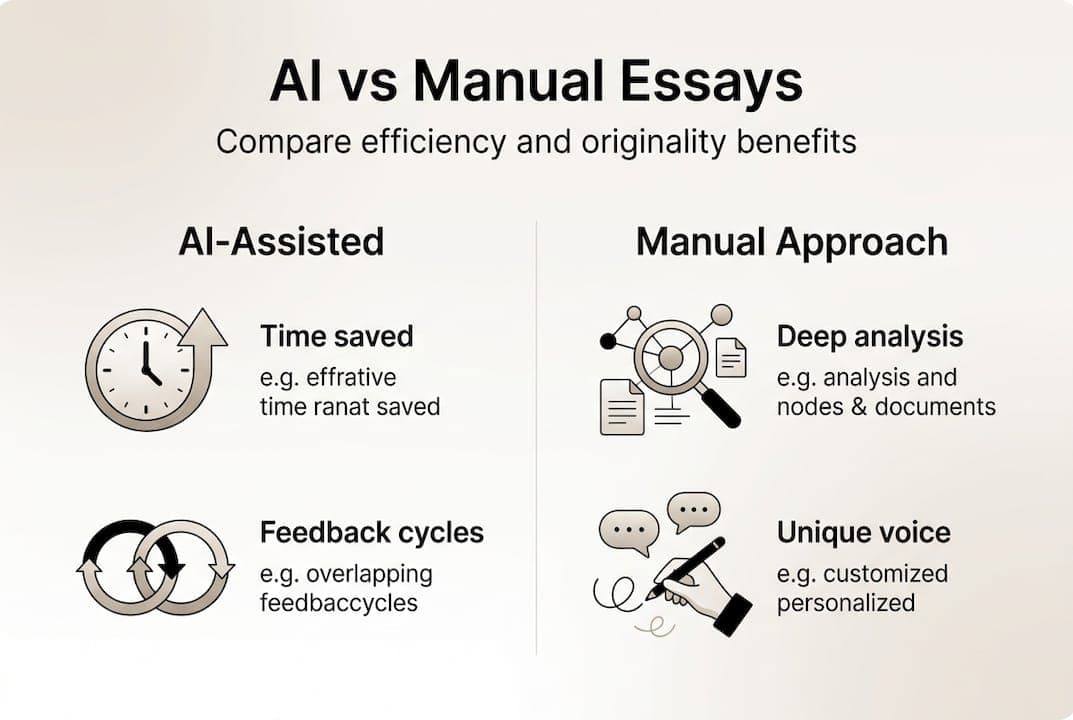
Balancing AI suggestions with personal input requires constant vigilance. Set a personal rule that at least 60% of your final essay must be originally written or substantially rewritten by you. This threshold ensures you've engaged deeply enough with the material to claim authentic authorship. Track your ratio during drafting to maintain this standard.
Pro Tip: After completing an AI-assisted essay, write a one-paragraph reflection on what you learned from the process. This metacognitive practice reinforces learning and helps you identify where AI helped versus where it hindered your thinking.
The content creation ai tools available today offer varying levels of human control and transparency. Choose platforms that make AI contributions visible so you can evaluate and modify them easily. The ai essay writer systems that support iterative refinement rather than one-click generation align best with ethical academic practices and genuine learning outcomes.
After learning how to effectively use AI in essay writing, discover tools designed to help you apply these strategies with Samwell AI. Our platform addresses the core challenges students face when seeking AI assistance while maintaining academic integrity. Samwell AI's unique Semihuman.ai technology minimizes plagiarism risks and produces high-quality, credible content that reflects your voice and thinking.
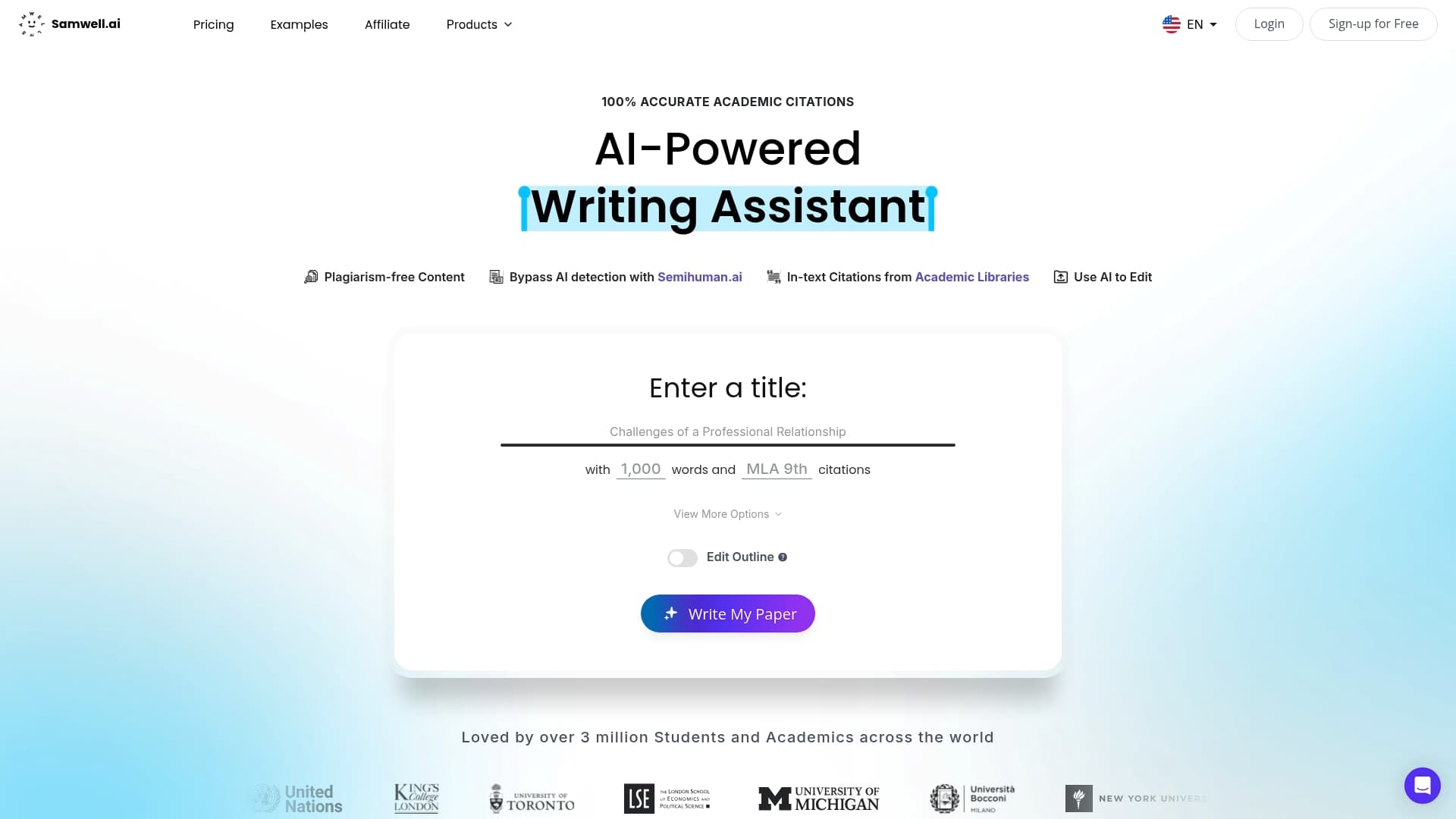
The Power Editor feature enables targeted editing and content expansion, giving you precise control over AI suggestions. You can highlight specific paragraphs for enhancement while leaving others untouched, ensuring your original thinking remains central. Guided Essays provide structured outlines that organize your ideas logically, then support you through drafting with contextual suggestions. Real-time AI detection checks align with evolving institutional technologies, helping you verify your work meets academic standards before submission. Over 1,000,000 students and academic professionals from leading universities trust Samwell AI to blend efficiency with integrity. Explore plagiarism free essays tools that ensure originality, try the enhanced essay creator for comprehensive support, or visit Samwell AI to discover how our platform helps you write better essays faster while protecting your academic reputation.
Using AI for essay writing is ethical when you maintain transparency and human oversight throughout the process. Disclose AI use according to your institution's policies and ensure you actively modify AI suggestions rather than submitting them verbatim. The ethical line lies in using AI as a tool that supports your thinking rather than replaces it, similar to how calculators assist with math without eliminating the need to understand mathematical concepts.
Ensure originality by using AI for structural suggestions and grammar improvements while writing arguments and analysis yourself. Always rewrite AI-generated content in your own words, verifying that it reflects your actual understanding of the topic. Run your final draft through plagiarism detection tools and disclose AI use according to academic guidelines, demonstrating that you've engaged critically with the material rather than simply accepting machine-generated text.
Overreliance on AI erodes critical thinking skills that essay assignments are designed to develop, leaving you less capable of independent analysis over time. AI hallucinations can introduce fabricated citations and false information that damage your credibility if you don't verify facts against reliable sources. Full AI-generated essays typically violate academic integrity policies and constitute misconduct at most institutions, potentially resulting in serious academic consequences.
AI enhances but cannot replace the critical thinking and writing skills that define effective communication and analysis. These tools handle mechanical tasks efficiently, but they lack the judgment, creativity, and deep understanding that human writers develop through practice. Active human input remains necessary for producing quality work and achieving genuine learning, with AI serving best as a collaborative partner that amplifies your capabilities rather than substitutes for them.