Loading...

Many students and academics worry that AI tools compromise originality and undermine academic integrity. Yet AI can enhance efficiency while supporting proper citation and originality when used ethically. This guide explains why and how to effectively use AI for academic writing, addressing concerns about plagiarism while highlighting practical benefits. You'll discover how AI accelerates research, maintains citation standards, and helps you produce high-quality academic work faster without sacrificing your unique voice or violating ethical guidelines.
| Point | Details |
|---|---|
| Speed up writing | AI accelerates research and drafting tasks, potentially reducing writing time by up to 40 percent, while preserving quality. |
| Originality and citations | When used ethically, AI supports original thinking and proper attribution without replacing the writer's voice. |
| Disclose AI use | Always disclose AI assistance according to your institution's policies to maintain integrity. |
| Citation management aid | AI tools track sources and format citations in MLA, APA, or Chicago styles, reducing errors. |
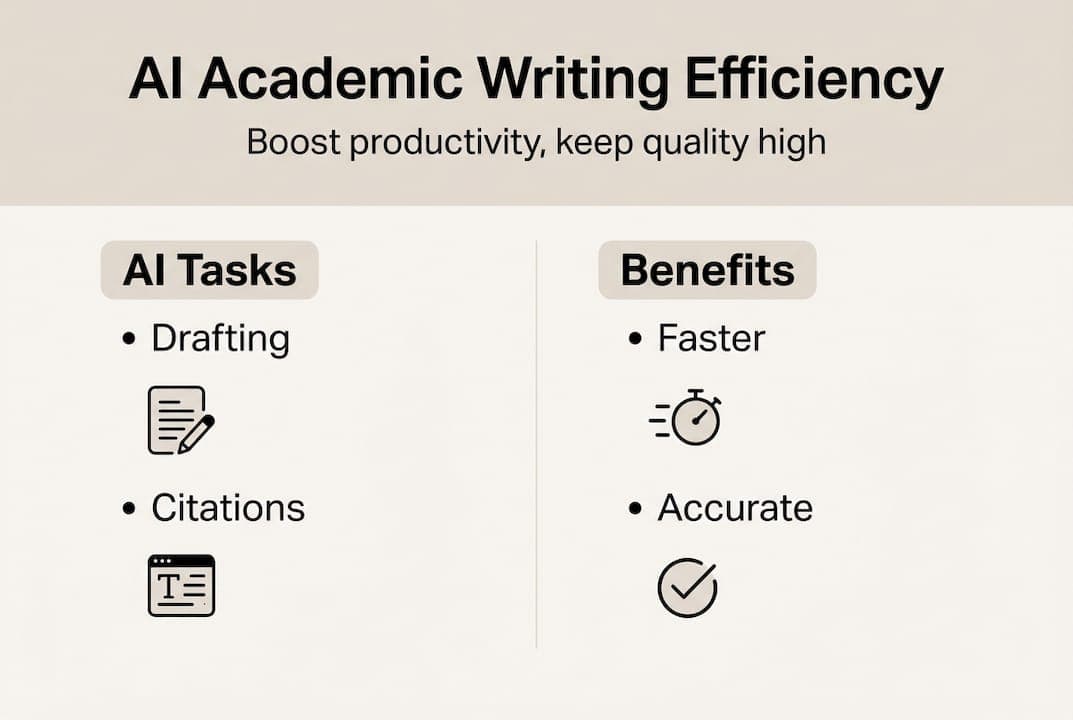
AI transforms academic writing by accelerating the most time-consuming tasks while maintaining quality standards. AI can reduce academic writing time by up to 40% through intelligent research engines and drafting assistance, giving you more time to focus on critical analysis and original thinking.
Smart research engines scan thousands of sources in seconds, identifying relevant studies and extracting key findings that would take hours to locate manually. These tools understand context and academic terminology, delivering precisely targeted results that match your research questions. Instead of drowning in irrelevant search results, you get curated information that directly supports your thesis.
Draft generation features help overcome writer's block by suggesting paragraph structures and content frameworks based on your outline. You provide the direction and key arguments, while AI fills in supporting details and transitions. This collaborative approach keeps your writing momentum strong, especially during challenging sections where you might otherwise stall.
Pro Tip: Use AI to generate multiple versions of difficult paragraphs, then combine the best elements from each version with your own analysis to create stronger content.
Editing and formatting tools streamline the revision process by identifying unclear phrasing, inconsistent terminology, and structural weaknesses. Content creation AI helps polish your work faster than manual editing while catching errors you might miss after hours of writing. These tools suggest improvements without replacing your voice, maintaining the personal insight that makes academic writing valuable.
"AI writing tools serve as intelligent assistants that handle mechanical tasks, freeing writers to focus on analysis, argumentation, and original contribution to their field."
Citation management integration ensures you maintain academic integrity throughout the writing process. AI tools track sources automatically, generate properly formatted citations in MLA, APA, or Chicago style, and flag potential citation gaps before submission. This systematic approach prevents accidental plagiarism and saves hours of tedious formatting work. Understanding AI writing efficiency and originality helps you leverage these tools effectively while preserving your academic voice.

Concerns about plagiarism and originality are valid, but understanding how AI supports ethical writing practices helps you use these tools responsibly. Plagiarism occurs when you present someone else's work or ideas as your own without proper attribution. Using AI becomes problematic only when you submit AI-generated content without disclosure, fail to cite sources properly, or let AI replace your critical thinking entirely.
AI tools can support academic honesty by helping educators detect plagiarism and guiding students to cite properly. These same tools help you verify originality and maintain citation standards before submission. The key is understanding AI as a writing partner, not a replacement for your intellectual contribution.
Ethical AI-assisted writing practices:
Transparency builds trust with instructors and demonstrates your commitment to academic integrity. Most institutions recognize that AI tools are becoming standard writing aids, similar to grammar checkers and citation managers. Ethical use of AI involves transparency and understanding AI's role as an aid, not a substitute for your intellectual work.
"The ethical boundary is clear: AI should enhance your ability to express ideas, not generate ideas for you. Your analysis, interpretation, and argumentation must remain authentically yours."
Proper citation practices prevent unintentional plagiarism when using AI. Cite any direct quotes or specific ideas generated by AI tools, and document your AI usage in methodology sections when appropriate. This approach protects you from academic misconduct charges while demonstrating responsible tool use. Following AI academic integrity trends keeps you aligned with evolving standards, and understanding ethical AI essay use ensures you benefit from technology without compromising your academic reputation.
Choosing the right AI writing tool requires evaluating features that specifically support academic work. Various AI writing tools differ in functionality, pricing, and academic support features, so understanding these differences helps you select the best option for your needs.
| Tool Feature | Importance | What to Look For |
|---|---|---|
| Citation management | Critical | Automatic citation generation in multiple formats, source tracking, bibliography creation |
| Plagiarism detection | Critical | Real-time originality checking, similarity reports, paraphrasing suggestions |
| Research integration | High | Academic database access, source evaluation, reference organization |
| Writing assistance | High | Grammar checking, style improvement, argument strengthening |
| Customization | Medium | Adjustable tone, field-specific terminology, formatting options |
Key evaluation criteria for academic AI tools:
Price ranges vary significantly across AI writing tools. Basic grammar checkers start around $10 monthly, while comprehensive academic platforms range from $20 to $50 monthly depending on features. Student discounts often reduce costs by 30% to 50%, making premium tools more accessible. Annual subscriptions typically offer additional savings compared to monthly billing.
Pro Tip: Start with free trials to test multiple tools before committing to a subscription. Focus on the specific features you need most rather than paying for comprehensive packages with unused functionality.
Some tools uniquely support student needs with features like guided essay structures and educational resources, while others target professional researchers with advanced analytics and collaboration features. Students benefit most from tools offering writing tutorials, citation help, and plagiarism prevention, whereas researchers prioritize literature review assistance and data visualization. Exploring AI writing tools comparison helps you identify which platform aligns with your academic level and writing goals.
Successful AI integration requires a strategic approach that applies tools at specific stages while preserving your intellectual contribution. Using AI strategically throughout stages maximizes benefits while preserving originality, ensuring technology enhances rather than replaces your academic skills.
Stage-by-stage AI integration approach:
Verifying AI-generated content for accuracy is essential because AI tools occasionally produce plausible-sounding but incorrect information. Cross-reference every statistic, date, and factual claim against primary sources. Check that citations actually say what AI claims they say, as tools sometimes misinterpret source content or combine information from multiple sources incorrectly.
Pro Tip: Create a verification checklist for AI-assisted sections: factual accuracy confirmed, sources cited properly, tone matches your voice, arguments reflect your analysis, and no unintentional plagiarism detected.
Blending AI output with your own ideas maintains your unique voice and ensures genuine intellectual contribution. Read AI-generated paragraphs critically, asking whether they truly support your argument or just fill space. Rewrite sections that lack your perspective, adding examples from your experience or insights from your analysis. The final product should sound like you wrote it, with AI serving as an invisible assistant rather than a ghostwriter.
Detailed documentation of AI assistance protects you academically and helps you track which tools and approaches work best. Note which sections received AI help, what type of assistance you used, and how you modified AI suggestions. This record serves multiple purposes: demonstrating transparency if questions arise, helping you improve your AI integration skills, and providing methodology details for papers discussing your research process. Following this AI essay writing guide approach ensures you use AI responsibly while maximizing its benefits for your academic success.
Ready to experience how AI can transform your academic writing while maintaining originality and proper citations? Samwell AI offers advanced tools specifically designed for students and academics who want to boost efficiency without compromising integrity. Our AI writing assistant helps you research, draft, and revise papers faster while ensuring every source is properly cited and every argument reflects your unique perspective.
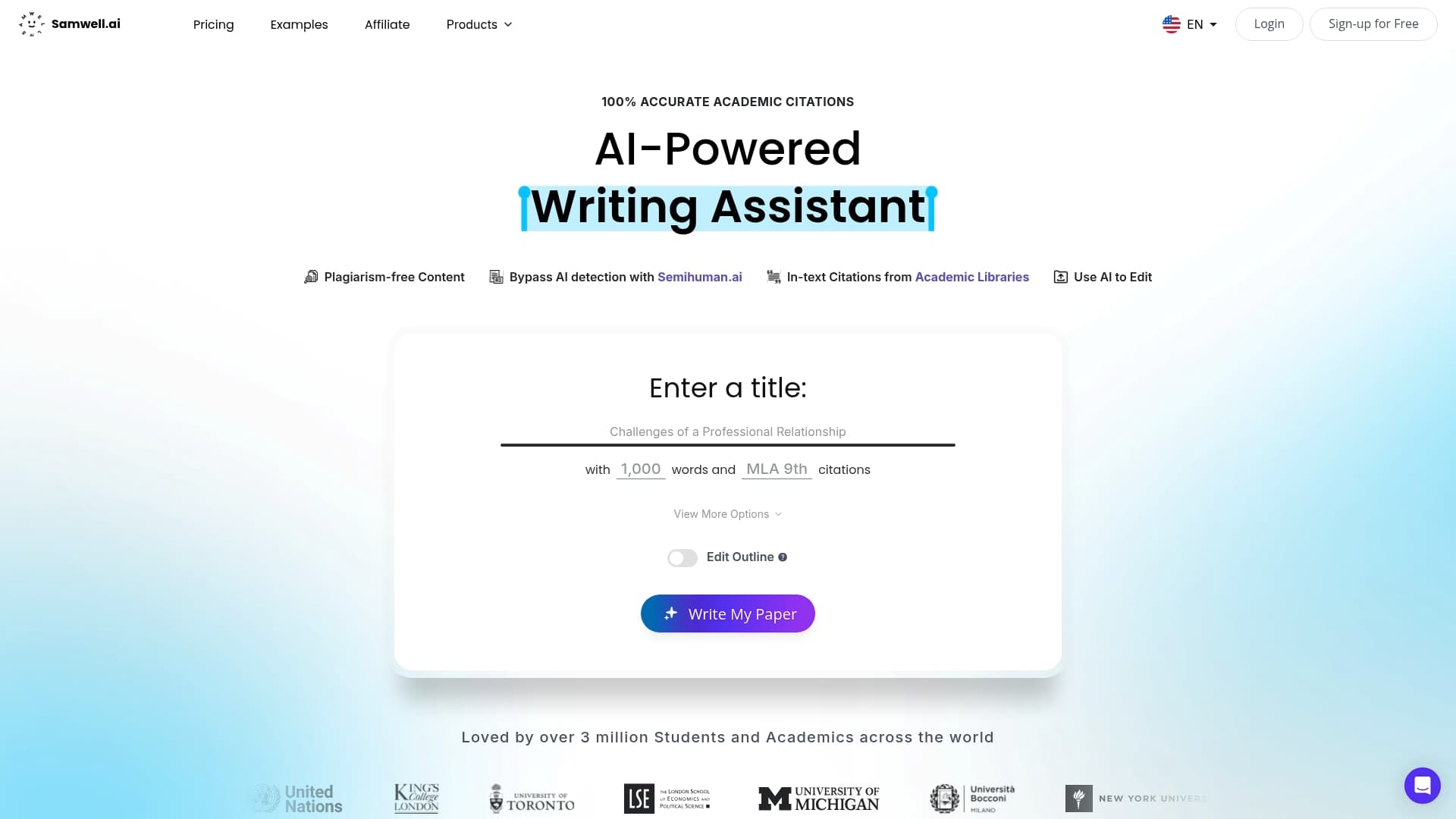
The essay enhancement tool strengthens your arguments and improves clarity without replacing your voice, while sentence and paragraph expansion features help you develop ideas more fully when you're stuck. With over 1,000,000 students and professionals trusting Samwell AI, you'll join a community that values both efficiency and academic integrity.
Using AI is not plagiarism if you disclose assistance and cite sources properly according to your institution's policies. AI should support, not replace, your original thinking and analysis. Transparency about AI usage and verification of all AI-generated content ensures ethical practice.
Many AI tools integrate citation generation and management features that ensure accuracy across MLA, APA, Chicago, and other formats. They help reduce formatting errors, maintain consistent citation styles, and flag missing citations before submission. This systematic approach saves time while strengthening academic integrity.
Tools vary by features and price, with top picks offering citation help, plagiarism detection, and easy integration with academic workflows. Student-focused platforms provide guided structures and educational resources, while comprehensive tools include research databases and advanced editing. See our detailed best AI writing tools comparison to choose one that fits your academic needs and budget.
Combine AI assistance with your own analysis and wording to maintain originality and preserve your unique voice. Use plagiarism checkers to verify content originality, cite any AI-generated material appropriately, and document which sections received AI help. Keep your critical thinking and argumentation central to every paper, using AI only to enhance expression and efficiency.