Loading...

TL;DR:
- MLA format ensures academic credibility through consistent citation and presentation standards.
- Proper MLA use enhances readability, traceability, and ethical scholarship in humanities writing.
- Mastering MLA builds reputation and credibility beyond mere formatting, supporting scholarly communication.
Most students treat MLA format like a tax form: something to dread, rush through, and forget. But here's what that mindset costs you. Every time you skip a proper Works Cited entry or ignore margin rules, you're not just losing points; you're signaling to instructors and readers that your scholarship can't be trusted. MLA format, created by the Modern Language Association, is the backbone of academic writing in the humanities. It isn't busywork. It's the professional language that turns a rough draft into a credible, verifiable piece of scholarship. This article breaks down what MLA format actually is, why it matters deeply, and how to use it to your advantage.
| Point | Details |
|---|---|
| MLA boosts trust | Using MLA format makes your writing more credible and easier to verify. |
| Reduces citation errors | Standard rules for citation minimize mistakes and plagiarism risks. |
| Stays current with updates | Keeping up with MLA revisions helps you correctly cite new digital and AI sources. |
| Professional first impression | MLA’s polished look improves your grades and academic reputation. |
MLA stands for Modern Language Association, a professional organization founded in 1883 to support language and literature scholars. Their formatting guidelines emerged as a response to a real problem: academic papers had no consistent structure, making it nearly impossible for readers to verify sources or compare research. The MLA format solved that by establishing a unified system that every writer and reader could rely on.
At its core, MLA format is a set of rules for how a paper looks and how it credits sources. It covers everything from page margins and font choices to how you introduce a quote and list your references. This overview of MLA format shows how each rule serves a larger purpose: making research readable, honest, and reusable.
The format is particularly dominant in humanities disciplines like English literature, history, philosophy, film studies, and cultural criticism. Unlike science-focused formats such as APA, MLA emphasizes the author and specific page number of a source rather than the publication year. This matters because in the humanities, the exact wording and location of an argument within a text is often what's being discussed.
Here's what MLA standardizes at a glance:
As one widely cited library resource notes, MLA standardizes paper presentation including 1-inch margins, double-spacing, 12-pt Times New Roman font, and specific heading structures to enhance readability and professionalism.
"MLA format transforms student papers from isolated assignments into contributions to an ongoing academic conversation, where every source cited is a thread in a larger intellectual fabric."
That's not an exaggeration. When you follow MLA properly, your paper can be read, checked, and built upon by anyone in your field. Without it, your ideas may be brilliant but they're essentially unverifiable, and in academia, unverifiable work carries very little weight.
Having understood MLA's purpose, let's break down the practical elements you'll use in every paper. Think of MLA format as a set of building blocks. Each element does a specific job, and skipping even one creates gaps in your paper's credibility and presentation.
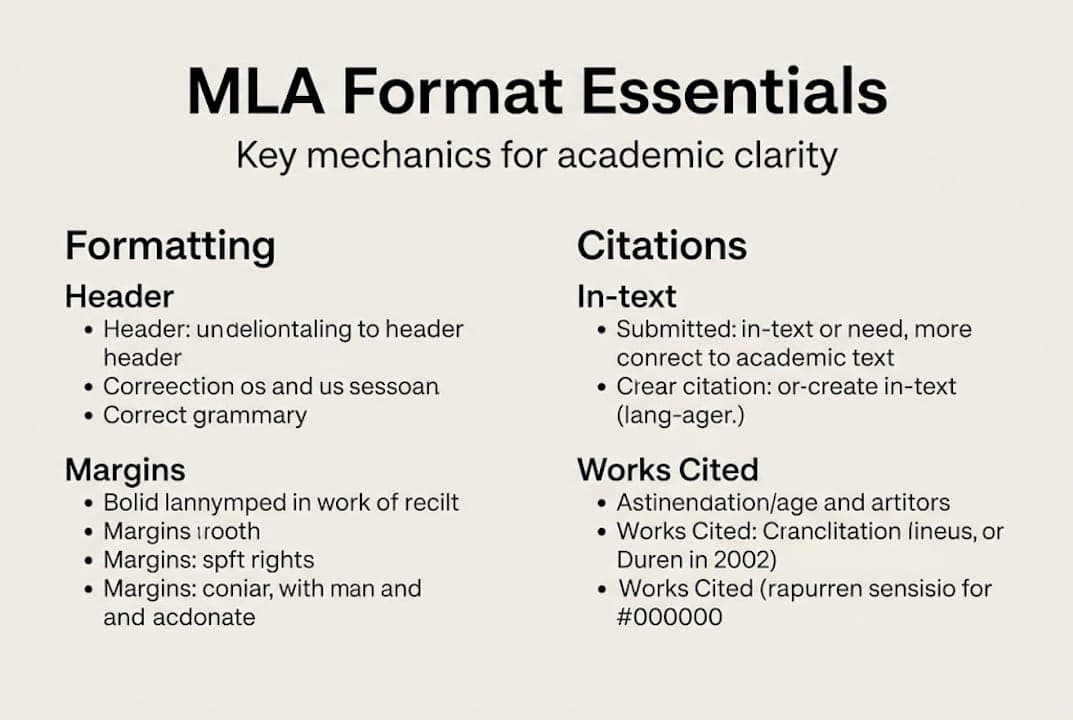
Here's a breakdown of the core mechanical elements and what each one does:
| Element | Requirement | Why it matters |
|---|---|---|
| Margins | 1 inch on all sides | Creates clean, readable layout |
| Font | 12-pt Times New Roman | Ensures consistent readability |
| Spacing | Double-spaced throughout | Allows room for instructor comments |
| Header | Last name + page number | Makes pages identifiable if separated |
| Heading block | Name, instructor, course, date | Identifies the work and context |
| In-text citation | (Author page) | Links claims directly to sources |
| Works Cited | Alphabetical source list | Enables source verification |
Setting up an MLA paper correctly involves a clear sequence. Start with the MLA first page setup before writing a single word of your introduction. Here's a simplified order of operations:
In-text citations are where many writers stumble. MLA's in-text citations use an author-page format (e.g., Smith 47) and pair with a full Works Cited list to ensure proper source attribution, preventing plagiarism and building academic integrity. The citation goes inside the sentence's closing punctuation, not after it.

For longer quotations of more than four lines of prose, you'll need a block quote. This means starting the quote on a new line, indenting the entire passage half an inch from the left margin, and omitting quotation marks. The in-text citation goes after the final punctuation of the block, not before it. Many students reverse this order and lose points unnecessarily. Review these MLA essay formatting tips for common mistakes to avoid before submission.
Pro Tip: Before submitting any paper, use your word processor's "Find" function to search for quotation marks. Each opening quotation mark should have a matching citation nearby. If you find a quote without a parenthetical reference, you've spotted a citation gap that could flag your work as plagiarism.
Understanding the details is useful, but why does strict adherence to MLA actually matter for students and professionals? The short answer: it builds trust. Instructors, journal editors, and peer reviewers don't just read your argument. They read your formatting as a signal of your seriousness and your respect for the academic community.
When a reader encounters a properly formatted paper, they can move through your ideas without friction. The citations are predictable, the layout is clean, and every source claim is traceable. When a paper is inconsistently formatted, the reader's attention constantly shifts from your argument to the mechanics, and that's where credibility breaks down.
Here's a concrete comparison of how MLA compliance affects reader perception:
| Factor | Paper with MLA | Paper without MLA |
|---|---|---|
| Readability | Smooth, consistent flow | Uneven, distracting |
| Source trust | Every claim is traceable | Claims feel unsubstantiated |
| Instructor confidence | Signals competence and care | Raises doubts about rigor |
| Plagiarism risk | Minimal, all sources cited | High, attribution unclear |
| Publication potential | Meets submission standards | Typically disqualified |
Citation consistency does more than satisfy a checklist. It enables scholarly conversation. When you cite a source correctly, you're inviting your reader to go deeper into that argument themselves. Consistent MLA use establishes trust between researchers and readers, facilitates source verification, and supports scholarly conversation. That's how academic knowledge grows: one well-cited paper building on another.
Ethically, MLA's citation rules protect you just as much as they protect the authors you're citing. Consider what happens without them:
Review our MLA checklist before finalizing your paper. It covers every element from header setup to Works Cited formatting so nothing slips through the cracks.
The stakes are real. Academic institutions treat plagiarism as a serious offense, often resulting in failed assignments, course failure, or academic probation. Proper MLA usage is your first and most practical line of defense.
With the stakes of accurate formatting clear, let's address the latest updates and some common stumbling blocks in MLA. The 9th edition, released in 2021, made significant changes that many writers are still catching up on, and new challenges like citing AI-generated content have pushed MLA to keep evolving.
Here are the biggest updates and tricky scenarios that catch even experienced writers off guard:
As the SFU Library MLA guide confirms, MLA 9th edition provides guidance on inclusive language, digital sources (DOIs over URLs), section headings at five levels, and AI citations, giving writers tools for virtually every modern source type.
For a deeper look at how MLA compares to other citation systems, the APA vs MLA differences breakdown clarifies when to use each. And if you want to fully understand each rule in context, the MLA manual guide walks you through the official handbook chapter by chapter.
Pro Tip: Bookmark the MLA Style Center at style.mla.org. It's free, updated regularly, and includes sample papers, citation examples for unusual sources, and Q&A threads where MLA experts answer formatting questions directly. It's the most reliable resource when you hit an edge case your professor can't answer.
Here's something most MLA guides won't tell you: the writers who master citation format aren't just avoiding penalties. They're building a professional reputation that follows them into graduate school, publishing, and peer review.
Most students approach MLA as a hoop to jump through. But the writers who internalize why each rule exists start to write differently. They become more precise in how they quote, more deliberate in how they paraphrase, and more confident in how they argue. That precision bleeds into the logic of the paper itself.
Consistent MLA usage also acts as a quiet defense mechanism. If your work is ever questioned, a properly cited paper is nearly impossible to accuse of intellectual dishonesty. As one thorough analysis of academic rhetoric notes, MLA format enforces consistency, readability, and ethical citation, turning papers into credible scholarly contributions. That's protection you're giving yourself every time you add a correct parenthetical citation.
For professionals submitting to academic journals, MLA fluency signals that you understand the community you're writing for. Reviewers notice when formatting is sloppy. They also notice when it's impeccable. It's a soft skill that marks you as meticulous, careful, and credible before your argument even gets evaluated on its merits. That first impression matters more than most writers admit.
Ready to put your knowledge into action? Applying MLA correctly takes practice, but you don't have to figure it out alone.
Samwell AI helps students and academic professionals produce papers that are not only well-argued but properly formatted from the first draft. Our AI-powered essay creator handles citation formatting, Works Cited generation, and MLA structure automatically, so you spend your energy on ideas rather than mechanics. If your draft needs expansion or polish, our sentence and paragraph expansion tool builds out your arguments while keeping your voice intact. Over 1,000,000 students from leading universities already rely on Samwell AI to write with confidence and academic integrity. Try it on your next essay and see what error-free MLA formatting looks like in practice.
MLA format ensures consistency, enhances readability, and upholds academic integrity by standardizing citations and presentation across humanities disciplines, making your paper credible and verifiable.
Yes, MLA's in-text citations and Works Cited page make every source fully traceable, which directly reduces the risk of accidental or intentional plagiarism in your paper.
Use MLA for humanities versus social sciences writing: MLA fits literature, history, and philosophy, while APA is the standard for psychology, education, and social sciences where publication dates are central.
Use DOIs for digital sources whenever available, and follow the newest MLA 9th edition guidance for AI-generated content, which requires identifying the tool, the input, and the date accessed.
No, mixing citation styles within a single paper undermines consistency and credibility. Always stick to MLA or whichever style your instructor specifies, from the first page to the Works Cited.