Loading...

TL;DR:
- Academic dishonesty is more prevalent than students and professors realize, with many risking their futures. Ethical academic writing requires honesty, proper attribution, and responsibility at every stage of research and composition. Using reliable tools and developing disciplined habits help maintain integrity and promote trustworthy scholarship.
Academic dishonesty is far more widespread than most students and professors want to believe. 68% of undergraduates admit to some form of written cheating, including plagiarism, and 39% acknowledge copying or paraphrasing internet sources without attribution. These numbers aren't just alarming statistics sitting in a research report somewhere. They represent real students making choices that put their academic futures, professional reputations, and personal credibility at serious risk. Ethical academic writing isn't a bureaucratic box to check. It's the foundation of everything you build in your academic career and beyond.
| Point | Details |
|---|---|
| Ethics are foundational | Upholding honesty, trust, and fairness shapes your academic credibility and future. |
| Penalties are severe | Academic dishonesty puts degrees, jobs, and reputations at risk. |
| Practical habits prevent breaches | Quoting, paraphrasing, and tracking sources from the start ensure compliance. |
| Technology is not foolproof | AI and plagiarism detectors assist but cannot replace personal integrity. |
| Responsible citation matters | Avoid self-citation manipulation and always cite for genuine scholarly value. |
Ethical academic writing means producing scholarly work that honestly represents your ideas, properly acknowledges the contributions of others, and upholds the standards of the academic community. It goes well beyond simply avoiding copy-pasting someone else's paragraphs. At its core, it's about intellectual honesty at every stage of the writing process, from how you take notes to how you construct your argument to how you format your references.
The TEQSA framework identifies five core values that define academic integrity: honesty, trust, fairness, respect, and responsibility. These aren't abstract ideals. They translate directly into how you handle sources, how you represent your thinking, and how you engage with the scholarly conversation around your topic.
Here's what those values look like in practice:
"Academic integrity isn't just about avoiding penalties. It's about developing the habits of mind that make you a trustworthy thinker and professional in whatever field you enter."
Many students think of academic dishonesty as something dramatic, like submitting a fully purchased essay or copying a classmate's exam. But the types of academic dishonesty that most commonly undermine student success are far more subtle, including patchwriting, undercitation, and misrepresenting the origin of ideas.
Understanding what ethical writing is matters a lot. But understanding what's genuinely at stake when you compromise those standards matters just as much, maybe more, because the consequences extend far beyond a failing grade on a single assignment.
Plagiarism undermines learning, harms the culture of scholarly creativity, and leads to a cascade of penalties: academic failure, loss of institutional reputation, suspension, and serious career impacts. And these consequences don't stay neatly inside the walls of your university. They follow you.

Consider the range of consequences that violations can trigger:
| Type of consequence | Short-term impact | Long-term impact |
|---|---|---|
| Academic | Failing grade, assignment zero | Transcript notation, degree revocation |
| Institutional | Suspension, disciplinary hearing | Expulsion, loss of enrollment |
| Legal/visa | Administrative hold | Visa cancellation for international students |
| Professional | Blocked references | Damaged reputation, hiring barriers |
| Personal | Loss of scholarship | Lost career opportunities, ongoing stress |
One thing students consistently underestimate is the permanence of academic misconduct records. In many universities, a serious violation stays on your academic record indefinitely. When employers, graduate programs, or licensing bodies request transcripts or reference letters, that record becomes visible. Professors who once supported your career may decline to write references. Professional organizations in law, medicine, and finance conduct background checks that can surface academic misconduct.
The impact on integrity and success is not theoretical. There are well-documented cases of degrees being revoked years after graduation when plagiarism is discovered in dissertations. A 2022 analysis found that academic misconduct cases increased significantly during and after the COVID-19 pandemic, partly due to the shift to online assessment and the growing availability of digital shortcuts.
"The short-term relief of a shortcut is never worth the long-term cost of a compromised reputation. Integrity, once questioned, is incredibly difficult to rebuild."
For international students especially, the stakes are even higher. Expulsion due to academic misconduct can trigger visa cancellation under student visa conditions, meaning the consequences extend beyond academics into immigration status, family plans, and financial investment.
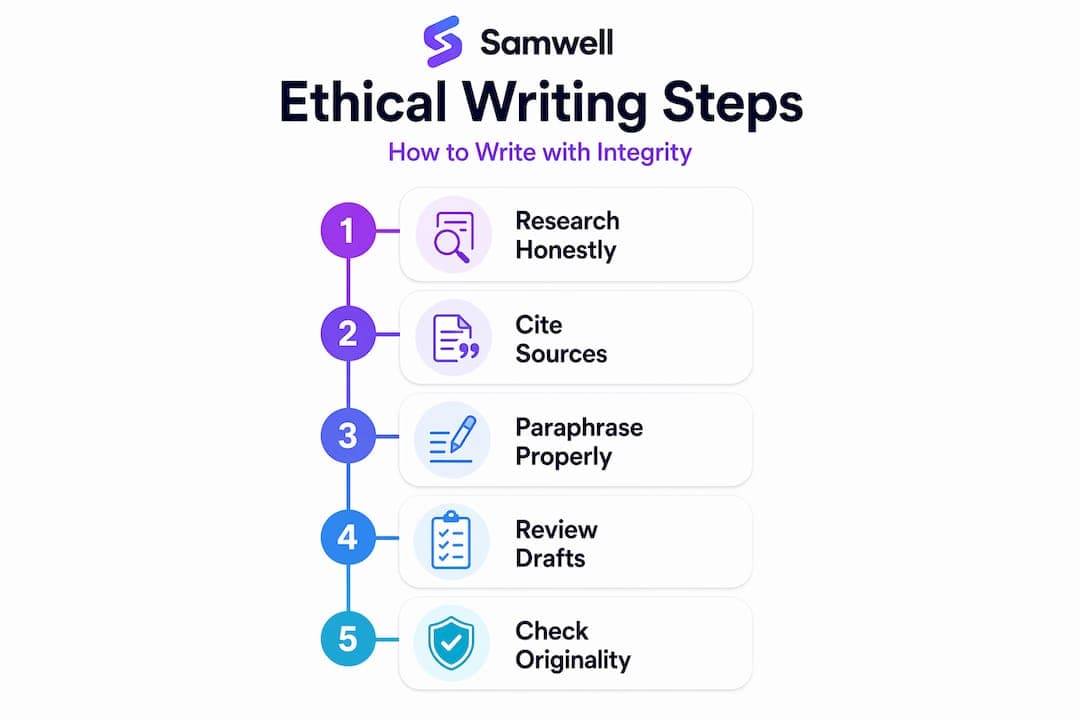
Knowing the risks is one thing. Knowing how to consistently write ethically, especially under deadline pressure, is where most students actually struggle. The good news is that ethical writing is a skill, and like any skill, it gets easier with the right habits and methods.
Here are the core strategies you need to internalize:
Pro Tip: Use a reference manager like Zotero or Mendeley from day one of any research project. Capturing citation details at the source (not retroactively) eliminates one of the most common causes of accidental plagiarism.
Understanding ways to avoid plagiarism isn't just about rule-following. It's about building writing habits that make your work more persuasive and credible.
| Citation element | What to do | What to avoid |
|---|---|---|
| Direct quotes | Use quotation marks, cite immediately | Quoting without marks or attribution |
| Paraphrasing | Rewrite fully, add in-text citation | Cosmetic changes with no citation |
| Ideas and frameworks | Attribute to original source | Using ideas as if they're your own |
| Data and statistics | Cite original study, not secondary source | Citing aggregator sites as primary |
| Images and figures | Attribute creator and source | Embedding without credit |
Understanding citation styles and integrity is equally important. APA, MLA, Chicago, and other formats aren't arbitrary formatting preferences. They're systems designed to make attribution transparent and verifiable. Knowing common citation formats and why academic referencing matters will help you navigate this with more confidence and less last-minute panic.
With the rise of AI writing tools and digital content, plagiarism detection has become both more sophisticated and more complicated. Most universities now use automated detection software as a standard part of assignment submission. But students need to understand what these tools can and cannot actually do.
Current data shows that 11% of student papers have more than 25% unattributed textual overlap, and 28% of submissions show moderate to high similarity scores. Those numbers suggest detection is catching a meaningful portion of potential misconduct, but also that many borderline cases exist in a gray zone.
AI-specific detection tools have entered the picture rapidly, but they come with serious limitations. AI detectors show accuracy only around 60 to 70%, struggle significantly with hybrid texts (where AI-drafted content is edited by humans), and show measurable bias against non-native English speakers. Academic bodies are increasingly cautioning institutions against using AI detectors as the sole basis for misconduct charges.
Here's what you should know about the current detection landscape:
Pro Tip: Run your own paper through your institution's detection tool before submission if that option is available. Seeing your similarity report lets you catch unintentional over-quoting or missing citations before they become a problem.
The broader truth about detection is that it serves as a deterrent, not a complete solution. As AI writing trends in academia continue to evolve, students who rely on detection tools to define the boundaries of ethical behavior are already operating with the wrong framework. The role of AI in education should be to support learning and writing quality, not to obscure the origins of your thinking.
Most students are familiar with basic citation requirements. Fewer are aware that citations themselves can be misused in ways that violate academic ethics. This is especially relevant for researchers, graduate students, and academics who operate in environments where publication metrics matter.
Unethical citation practices, including excessive self-citation and coercive citation, distort academic metrics and undermine research integrity. These practices inflate journal impact factors, artificially boost an author's h-index, and misrepresent the scholarly conversation around a topic.
Common citation ethics violations include:
These aren't just abstract concerns for senior academics. Graduate students are often caught in coercive citation dynamics without fully recognizing what's happening. If a supervisor or reviewer insists you add citations that don't seem justified by your work, that's worth flagging with your institution's integrity office.
Pro Tip: A good rule for self-citation is this: only cite your previous work if it would genuinely help a reader understand or evaluate your current argument. Relevance, not resume-building, should drive every citation decision.
Understanding citations best practices in the context of research integrity means recognizing that citation is a form of scholarly conversation, not a game of metric optimization.
Here's something the rules and detection tools and honor codes won't tell you directly: compliance is the floor, not the ceiling.
Most integrity frameworks focus on what not to do. Don't plagiarize. Don't fabricate. Don't submit work twice. But ethical academic writing is not primarily a matter of knowing the prohibited list. It's a matter of who you are as a thinker and what habits you build when no one is checking your work.
We've seen students meticulously avoid every technical violation while still writing dishonestly, borrowing ideas without genuine engagement, assembling arguments from barely-transformed sources, producing work that technically passes but represents almost none of their own thinking. That's a problem no similarity checker will ever flag.
The growing pressure from AI tools makes this gap even more visible. When examples of dishonesty increasingly include AI-assisted shortcuts that technically stay under detection thresholds, the question shifts from "did you follow the rules?" to "did you actually learn anything?" Academic integrity becomes a question of self-awareness and genuine intellectual engagement.
Ethical writing habits compound over time. Students who practice honest attribution, genuine paraphrasing, and rigorous source evaluation don't just become better academics. They become more careful thinkers, more credible professionals, and more reliable colleagues. The character you build in the library and at your desk is the character you carry into every professional environment you enter.
The uncomfortable truth is that ethics requires active, ongoing choice. It means choosing the harder path of genuine engagement over the easier path of shortcut. Policies and checklists can guide that choice. But they can't make it for you.
Developing strong ethical writing habits doesn't mean navigating this alone. Having the right resources and support makes the process significantly more manageable, especially when deadlines are tight and citation formats feel overwhelming.
Samwell.ai is built specifically for students and academics who want to write with both efficiency and integrity. With built-in real-time AI detection checks, plagiarism-free essay generation powered by Semihuman.ai technology, and full support for APA, MLA, and Chicago citation standards, Samwell.ai helps you produce original, credible work without cutting corners. The Power Editor and Guided Essays features make it easier to develop your own ideas into well-structured, properly sourced papers. More than 1,000,000 students from leading universities already use it to strengthen their academic writing practice while staying fully on the right side of integrity standards.
Examples include plagiarism, falsifying data, excessive self-citation, and submitting AI-generated content as your own original work. Even cosmetic paraphrasing without proper attribution counts as academic dishonesty.
Consequences can include failing the assignment, suspension, or expulsion, plus lasting reputational damage. Plagiarism leads to both academic failure and long-term career impacts that are difficult to overcome.
No. AI detectors show accuracy only around 60 to 70%, struggle with hybrid texts, and carry bias against non-native English writers. They should not be used as the sole basis for misconduct decisions.
Track sources from the start of your research, paraphrase in your genuine own voice, and follow proper citation mechanics that attribute every idea, quote, image, and piece of data you use.