Loading...

TL;DR:
- Citation styles standardize scholarly communication, attribution, and source verification.
- Proper citation prevents academic misconduct and safeguards research integrity.
- Precise, consistent citations are essential for reproducibility and building trust in academic work.
Citation styles look like a minor technicality until a professor deducts points or, worse, until your entire argument collapses because a reader cannot verify your sources. Most students treat APA, MLA, and Chicago as annoying formatting checklists they memorize before a deadline. But these systems are actually the structural framework that makes academic knowledge shareable, verifiable, and trustworthy. Understanding why citation styles matter and how to apply them correctly is one of the most practical skills you can develop in your academic career. This article breaks down what these systems are, what they protect, and how to use them with confidence.
| Point | Details |
|---|---|
| Foundation for academic trust | Citation styles are essential for verifying sources, giving credit, and preventing plagiarism. |
| Enables scholarly dialogue | Standardized citations let others check, debate, or build on your research with precision. |
| Adapt to style differences | Knowing each style’s rules—especially for tricky cases—helps avoid errors and upholds integrity. |
| Future-proof research clarity | Meticulous citation habits matter more than ever, even with advanced search technology. |
Citation styles are standardized sets of rules that govern how you document and present sources in academic writing. They specify everything from how you format an author's name to where you place a publication date, how you handle a journal article versus a book, and what information you must include for digital sources. These are not arbitrary preferences invented by style committees to make students suffer. They exist because academic writing is fundamentally a conversation, and every participant in that conversation needs to speak the same language.
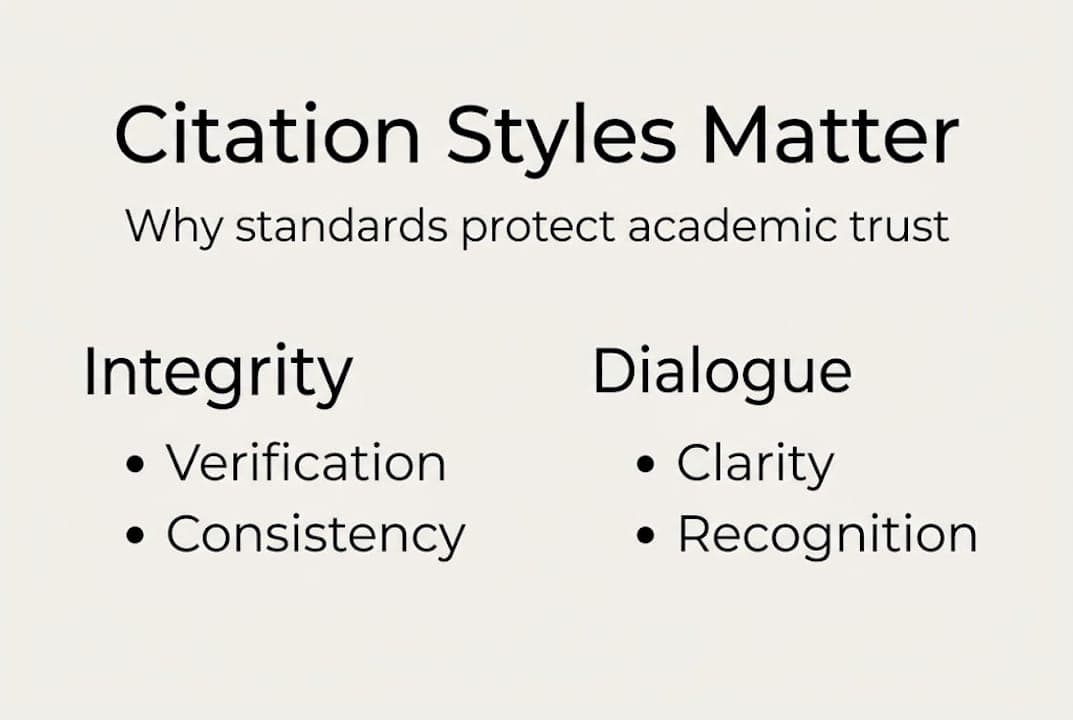
The three most widely used systems each grew out of the needs of specific disciplines. The American Psychological Association developed APA style in 1929 to support clarity in the social sciences, where currency of research matters enormously. MLA, created by the Modern Language Association, serves the humanities by emphasizing authorship and textual evidence. The Chicago Manual of Style, first published in 1906, offers two distinct systems: notes and bibliography for history and the arts, and author-date for sciences. Each one reflects the values and working methods of its field.
Citations in research serve a set of core functions that every serious scholar should internalize:
As the McGill University Library puts it, citation styles uphold academic integrity by standardizing scholarly communication, crediting sources, enabling verification, and preventing plagiarism all at once. That is a remarkable amount of work for a set of formatting rules to do.
Understanding academic referencing deeply means seeing it not as a bureaucratic requirement but as a professional commitment. When you cite accurately, you are telling your reader: "I did not invent this. Here is exactly where it came from. You can go check it yourself." That transparency is the foundation of scholarly trust.
Now that you know what citation styles are, let's look at their role as an active defense against plagiarism and academic misconduct.
Academic dishonesty takes more forms than most students realize. Submitting someone else's paper is obvious plagiarism, but the more common violations are subtle: paraphrasing without attribution, citing a source in your bibliography but not in the text, or failing to distinguish your own analysis from a source's argument. Proper citation practice addresses each of these risks directly.
Here are the most frequent integrity problems that consistent citation habits help prevent:
There is also an important legal dimension. While plagiarism is primarily an ethical and institutional concern, copyright infringement is a legal one. Citation does not automatically grant you permission to reproduce large blocks of copyrighted text, but it does demonstrate good faith and reduces the risk of misrepresentation. The ethics of citation require both giving credit and using sources appropriately within the bounds of fair use.
The validation function of citations is equally important. Every properly formatted in-text citation paired with a complete reference list entry creates a double checkpoint. Your reader can identify the source from your in-text note and then retrieve the full details from your bibliography. That two-step verification system is what makes it possible to safeguard integrity even in large research papers with dozens of sources.
As the Arizona State University library notes, plagiarism is a common academic dishonesty violation, and consistent citation using recognized styles is one of the most reliable tools for preventing it through systematic attribution.
Pro Tip: Before submitting any paper, run a citation-by-citation check against your source list. Make sure every in-text citation has a corresponding full entry in your bibliography, and vice versa. Many students lose marks not because they plagiarized intentionally but because they missed this final verification step. Use this citation in essays guide to build that checklist habit.
Beyond maintaining honesty, citation styles serve as communication frameworks for the scholarly community.
Think about what it means to "check" a source. In everyday life, you might Google a claim and skim the first result. In academic writing, "checking" means locating a specific edition of a specific book or a precise article from a specific journal volume and issue. That level of specificity is not possible without detailed, standardized citation. A vague reference like "Smith argued this in his book on cognition" is essentially useless to a researcher trying to verify or build on the claim.
Precise citations include publication year, edition, page numbers, DOI (Digital Object Identifier) for online articles, and publisher location. These details matter because they distinguish between a 1998 edition that predates a major revision and a 2018 edition that incorporates twenty years of additional research. As the LA Review of Books explains, citations ensure reproducibility in the humanities the same way lab procedures do in science, by documenting sources precisely enough that another scholar can replicate the exact evidence you used.
"The purpose of a citation is not simply to acknowledge an author. It is to hand the reader a precise key to the exact door you opened."
This is especially important in fields where the same text exists in multiple translations or editions. A scholar citing Plato's Republic needs to specify the translator and edition because different translations make substantially different interpretive choices. A social scientist citing a dataset needs to include the version and access date because datasets are updated. Verifying sources at this level of detail is what separates a credible research paper from an opinion piece.
Here is how the major citation styles compare in terms of precision requirements:
| Feature | APA | MLA | Chicago (Notes) |
|---|---|---|---|
| Publication year placement | After author | End of citation | Footnote |
| DOI required | Yes (when available) | Yes (when available) | Yes (when available) |
| Edition noted | Yes | Yes | Yes |
| Translator credited | Yes | Yes | Yes |
| Access date for websites | Not required | Recommended | Required |
| Volume and issue | Yes (journals) | Yes (journals) | Yes (journals) |
This table illustrates something important: all three major styles converge on requiring precision, even if they present that information differently. The format changes. The commitment to specificity does not.
When scholars can locate, read, and evaluate your sources, they can also challenge your interpretation or build on your findings. That is how academic knowledge advances. A citation is not a formality. It is an invitation for intellectual engagement.
To apply citation styles accurately, it's crucial to recognize their unique features and know how to handle tricky situations.
The most common student frustration with citation styles is not the routine cases but the edge cases. What do you do when there is no author? When you have seven authors? When you are citing something you read about in another paper? When you want to cite an AI tool? These situations trip up even experienced writers, and getting them wrong can undermine otherwise solid work.
Here is a comparison of how the three major styles handle the most common edge cases:
| Scenario | APA 7th Ed. | MLA 9th Ed. | Chicago 17th Ed. |
|---|---|---|---|
| 3 or more authors | First author + "et al." | First author + "et al." | All authors up to 3; then "et al." for 4+ |
| No author | Use title of work | Use title of work | Use title of work |
| AI-generated content | Cite as software (company as author) | Cite as software with access date | Footnote with tool description |
| Indirect source | "as cited in" | "qtd. in" | Explain in footnote |
| No publication date | Use "n.d." | Use "n.d." | Note absence in citation |
As ASU Library clarifies, edge cases including et al. thresholds vary by style, and AI tools should be cited as software with the company identified as author when applicable. This is especially relevant now that AI-generated text appears in more academic contexts.
There are also structural details to double-check before every submission:
When comparing APA vs MLA citation styles, the practical differences go beyond punctuation. APA places the year immediately after the author because the social sciences value currency of research. MLA places page numbers in text because humanities scholarship values textual location. These choices reflect disciplinary logic, not random preference.
Pro Tip: Bookmark the official style guide for your discipline and keep a saved citation style checklist for every paper you write. Digital citation managers like Zotero or the citation tools built into Samwell.ai can catch many formatting errors automatically, but human review of edge cases is always worthwhile before final submission.
Here is something the standard advice on citations rarely acknowledges: the rise of powerful search engines and AI tools has made people more confident about finding information and simultaneously less careful about documenting it. When you can search for almost any fact in seconds, it is tempting to believe that a rough reference is good enough because anyone could "just Google it."
That reasoning collapses under scrutiny. Search results change. Pages disappear. Websites update or remove content. An imprecise citation that relies on a reader's ability to search for the source is not a citation at all. It is an assumption. And academic writing cannot afford assumptions where evidence is concerned.
There is a deeper issue too. Misapplied citation details signal carelessness about your evidence. If you cite the wrong edition, you may be pointing to a version that does not contain the passage you quoted. If you omit a DOI, you make verification harder. These are not cosmetic problems. They are substantive failures of scholarly communication.
Citing sources correctly is, at its core, an act of respect: respect for the reader's time, for the original author's contribution, and for the integrity of the academic record. Scholars who develop rigorous citation habits early are the ones who produce research that can be trusted, built on, and remembered.

If managing citation styles across multiple papers and source types still feels overwhelming, you are not alone. The rules are detailed, the edge cases are real, and the stakes are high.
Samwell.ai is built to take that pressure off. With support for APA, MLA, Chicago, and other major formats, the platform generates accurately formatted citations and reference lists as part of the writing process, not as an afterthought. The Power Editor lets you refine and expand sections, while real-time AI detection checks ensure your work meets academic integrity standards before submission. Over 1,000,000 students from leading universities already use Samwell.ai to write, cite, and submit with confidence. Visit Samwell.ai to start your next paper the right way.
Using the wrong citation style can lower your grade and damage the credibility of your argument, and if sources become unclear or unverifiable, it can raise academic integrity concerns as well.
No, common knowledge does not require citation, but when in doubt, cite the source rather than risk plagiarism, since proper citation in two places (in-text and reference list) is the safest practice.
Most major citation styles recommend citing AI tools as software and listing the developing company as the author with an access date included.
Exact citations ensure your sources can be verified or challenged by other researchers, and as scholarship confirms, citations ensure reproducibility in a way that a general web search never can.