Loading...

MLA format gets a bad reputation. Most students treat it like a checklist of annoyances: one-inch margins, Times New Roman, double spacing. But that framing misses the point entirely. MLA format, which stands for Modern Language Association style, is the backbone of credible academic communication in the humanities. It tells your reader that you take your work seriously, that your sources are real, and that your arguments can be trusted. This guide breaks down everything you need to know about MLA format, from its foundational purpose to practical steps for getting it right every time.
| Point | Details |
|---|---|
| Standardization is key | MLA format brings uniformity and clarity to academic writing, making work easier to read and assess. |
| Supports academic honesty | Proper MLA citation practices directly combat plagiarism and uphold academic ethics. |
| Improves professional credibility | Mastery of MLA format signals attention to detail and professionalism in academic communities. |
| Practical resources available | Many tools and guides make learning and using MLA format straightforward and accessible to everyone. |
MLA format is a standardized set of guidelines developed by the Modern Language Association for writing and documenting research in the humanities. It covers everything from how you set up your page to how you credit the sources behind your ideas. Think of it as a shared language between writers and readers in academic settings.
Standardization matters more than most students realize. When every paper follows the same structure, readers can navigate your work without friction. Instructors can evaluate your argument instead of decoding your layout. Peer reviewers can verify your sources without guessing. As noted in the MLA manual guide, "MLA format provides a consistent framework for writing and allows readers to focus on content."
One of the biggest misconceptions is that MLA is just about aesthetics. It is not. Formatting signals professionalism. A paper with inconsistent citations or missing source information raises immediate red flags about its credibility, regardless of how strong the argument is. Following MLA formatting guidelines tells your reader you respect both the research process and their time.
"Format is not decoration. It is infrastructure. When the infrastructure is solid, the ideas inside can stand on their own."
Here is what MLA format is actually designed to accomplish:
Now that you see the bigger purpose, let's break down the actual components of MLA format.
Getting MLA right starts with the basics. Your paper should use a readable font like Times New Roman at 12-point size, with one-inch margins on all sides and double spacing throughout. Your last name and page number go in the upper right header on every page.
The first page is where many students slip up. You do not use a separate title page in standard MLA format. Instead, your name, your instructor's name, the course name, and the date go in the upper left corner of page one, followed by your centered title. As outlined in the guide to MLA first page formatting, "proper first-page formatting is fundamental to MLA compliance." If your assignment requires a separate cover page, check the MLA title page guide for the correct approach.

Here is how MLA compares to the two other most common academic citation styles:
| Feature | MLA | APA | Chicago |
|---|---|---|---|
| Primary field | Humanities | Social sciences | History, publishing |
| In-text citation | (Author page) | (Author, year) | Footnotes or author-date |
| Reference page title | Works Cited | References | Bibliography |
| Title page | Usually not required | Required | Required |
| Date placement | End of citation | After author name | End of citation |
To structure a typical MLA paper correctly, follow these steps:
Pro Tip: Run a formatting check before you submit. Open your document's paragraph settings and confirm double spacing is applied throughout, not just in the body. Many students accidentally leave single spacing in their header block or Works Cited page.
With the basics in mind, let's explore how MLA format ensures academic integrity through citation.
Citation systems exist for one core reason: to keep knowledge honest. When you cite a source, you are telling your reader exactly where an idea came from. That transparency is what separates academic writing from opinion. It also protects you. As the MLA citation guide makes clear, "accurate citations are crucial for preventing plagiarism."
Plagiarism is not always intentional. Forgetting to add a citation, paraphrasing too closely, or misattributing a quote can all count as academic dishonesty, even when the writer did not mean to deceive anyone. MLA's in-text citation system makes it harder to accidentally omit credit because every borrowed idea needs a parenthetical reference right in the sentence where it appears.
Citation frameworks like MLA are designed to promote academic ethics across disciplines, reinforcing a culture where ideas are respected and properly traced back to their origins. The consequences of poor citation are real and serious.
| Citation issue | Potential consequence |
|---|---|
| Missing in-text citation | Grade penalty or paper rejection |
| Uncited paraphrase | Academic dishonesty charge |
| Fabricated source | Expulsion or degree revocation |
| Inconsistent Works Cited | Loss of credibility with reviewers |
Understanding what plagiarism actually means is the first step toward avoiding it. MLA makes avoidance straightforward when you follow its system consistently.
Best practices for citation and attribution in MLA:
Now that citation is clear, let's see where MLA fits versus other academic style guides.
MLA is not the only citation style in academia, and knowing when to use it matters as much as knowing how. The key distinction is discipline. MLA is the standard for literature, language, film studies, cultural studies, and most other humanities fields. If you are writing about Shakespeare or analyzing a novel, MLA is almost certainly your format.
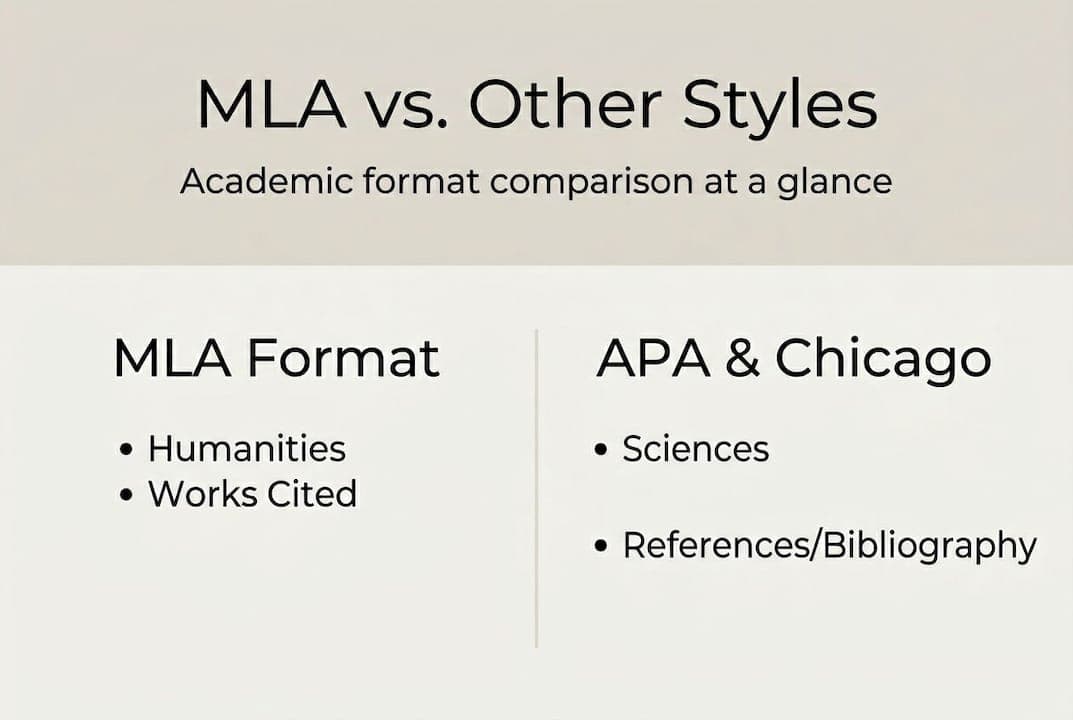
APA, by contrast, dominates the social sciences, psychology, education, and nursing. Chicago style is common in history and some professional publishing contexts. As research into APA vs MLA differences confirms, there are "significant differences between MLA and APA, particularly around citation structure and field of study."
For a side-by-side look at APA formatting, you will notice that APA prioritizes publication date in its citations, reflecting the social sciences' emphasis on how recent a study is. MLA, by contrast, prioritizes the author and page number, reflecting the humanities' focus on textual analysis and close reading.
"MLA trusts that a great argument can come from a 300-year-old text. APA wants to know how recent your data is. Neither is wrong. They just serve different intellectual traditions."
Assignments and disciplines best suited to MLA format:
Comparing styles brings us to the practical steps: how to implement MLA format with ease.
Knowing the rules is one thing. Applying them consistently under deadline pressure is another. The most effective strategy is to build a pre-submission checklist you use every single time. Consistency beats memory.
Using a structured approach to your outline helps too. The MLA formatting steps outlined in step-by-step essay guides show that "clear step-by-step guides boost MLA mastery and reduce errors." Start with a solid outline before you write, and your citations will naturally fall into place as you draft.
Technology can also help. Citation managers like Zotero and tools built into platforms like Samwell.ai can generate Works Cited entries automatically. The Purdue OWL MLA guide is a free, reliable reference for any formatting question you encounter.
Pro Tip: After finishing your draft, read your Works Cited page first, then trace each entry back to its in-text citation. If you find an entry with no matching in-text citation, or a citation with no Works Cited entry, fix it before submission. This reverse-check catches more errors than reading forward.
Here is a simple compliance checklist to run through before turning in any MLA paper:
You now have a complete view. Here is our perspective on why MLA mastery really matters.
Most students treat MLA as a tax they pay to get a grade. Do the formatting, move on. But that mindset costs them more than they realize. Instructors notice when a student genuinely understands citation versus when they are just going through the motions. A paper with clean, consistent MLA formatting signals something deeper: that the writer respects the scholarly conversation they are entering.
Fluency in MLA is a form of academic credibility. It tells your reader that you have done real research, that you can be trusted, and that you understand the standards of your field. That trust compounds over time. Students who internalize MLA early in their academic careers write stronger papers, get better feedback, and build habits that serve them in graduate school and professional research.
The uncomfortable truth is that formatting errors are often the first thing an instructor notices, before they even read your argument. A paper that looks sloppy loses credibility before it earns it. Mastering MLA, as explored in depth through the MLA academic success guide, is one of the highest-return investments you can make in your academic writing.
Mastering MLA takes practice, but you do not have to do it alone. Samwell.ai is built specifically for students and academic professionals who want to write better papers without spending hours on formatting details.
With Samwell.ai MLA tools, you get automatic citation formatting, structured essay outlines, and real-time checks that catch compliance issues before you submit. The platform handles the technical side of MLA so you can focus on building your argument and strengthening your research. Over 1,000,000 students from leading universities already use Samwell.ai to write with more confidence and less stress. Try it on your next paper and see the difference that smart formatting support makes.
MLA format ensures consistency, clarity, and proper crediting of sources in essays and research papers. It gives academic writing a consistent framework that helps readers focus on your ideas rather than your structure.
MLA format requires in-text citations and a Works Cited section, making it clear where information comes from and discouraging plagiarism. Proper citation through MLA creates a transparent trail from your argument back to its original sources.
MLA is mainly used in the humanities and differs from APA and Chicago in formatting, citation style, and field usage. MLA and APA have distinctive guidelines based on discipline and how citations prioritize author, date, or page information.
The most important components are the formatted first page, in-text citations, and a full Works Cited page. Correct first-page and citation structure is fundamental to MLA compliance and academic credibility.