Loading...

Picking the wrong research paper type derails even the strongest arguments. Most students face this exact problem when professors assign open research tasks. You need clarity on analytical versus argumentative, experimental versus interpretive. This guide breaks down seven research paper types with selection criteria, structural differences, and situational recommendations. You'll walk away knowing exactly which format matches your research question and academic goals.
| Point | Details |
|---|---|
| Research paper types serve distinct purposes | Each type targets specific academic goals like analysis, persuasion, or data collection. |
| Selection depends on research question and data | Your topic and available resources determine which format works best. |
| Seven main types cover academic needs | Analytical, argumentative, experimental, survey, case study, comparative, and interpretive papers address different research scenarios. |
| Structure varies significantly by type | Experimental papers use IMRAD format while case studies emphasize narrative depth. |
| Matching type early streamlines writing | Choosing the correct format upfront guides your research process and saves revision time. |
Your research question drives everything. Start by defining what you're trying to prove, explore, or explain. A clear question reveals whether you need to persuade readers, compare variables, or interpret cultural phenomena.
Check your discipline's conventions next. Engineering favors experimental papers with hypothesis testing. Literature departments expect interpretive analysis. Psychology values empirical surveys. Choosing a research paper type inconsistent with the research question is a common failure among novice researchers, so align your choice with field standards early.
Assess your data and resources honestly. Experimental papers require lab access and controlled conditions. Survey papers need large sample sizes and statistical software. Case studies demand deep qualitative sources. Match your paper type to what you can realistically gather and analyze.
Consider your audience and purpose. Writing for journal submission differs from classroom assignments. Persuading skeptics requires argumentative structure. Exploring complex issues suits analytical formats. Define your impact goal before committing to a type.
Pro Tip: Create a simple decision matrix listing your research question, available data, discipline norms, and audience. Score each paper type against these criteria. The highest scoring option usually fits your project best.
Match your paper type early to guide structure and writing approach. This decision shapes your outline, research methods, and citation strategy. Switching formats midway wastes time and creates structural confusion. Commit to the right type from day one.
Analytical papers examine topics through critical evaluation without taking a persuasive stance. You break down complex issues into components, identify patterns, and explore relationships. Think of dissecting a novel's themes or evaluating policy impacts. The goal centers on understanding, not convincing.
Humanities and social sciences rely heavily on analytical formats. You present multiple perspectives, weigh evidence objectively, and draw balanced conclusions. The structure flows from introduction to analysis sections addressing different angles, concluding with synthesis. No thesis defense appears because you're exploring rather than arguing.
Argumentative papers present a clear position and defend it against counterarguments. You stake a claim, marshal evidence, anticipate objections, and persuade readers your stance holds merit. Every paragraph reinforces your thesis through logic and credible sources.
More citations strengthen argumentative papers because you're building a case. You acknowledge opposing views then dismantle them with superior reasoning. The structure includes introduction with thesis, body paragraphs each advancing one supporting point, counterargument section, and conclusion reinforcing your position.
Both formats demand strong critical thinking but serve opposite purposes. Analytical writing asks "What does this mean?" while argumentative writing asserts "This is correct because." Choose analytical when exploring ambiguous topics with multiple valid interpretations. Pick argumentative when clear evidence supports a definitive position you can defend.
Pro Tip: If your research question includes "why" or "how," lean analytical. If it asks "should" or "is," go argumentative. The question structure often reveals which format fits naturally.
Students switching between these types mid draft create messy hybrids that confuse readers. Decide upfront based on whether your goal involves exploration or persuasion. Your entire research approach, from source selection to paragraph construction, flows from this fundamental choice.
Experimental papers test hypotheses through controlled studies following the IMRAD format: Introduction, Methods, Results, and Discussion. You manipulate variables, measure outcomes, and determine cause and effect relationships. Lab sciences, psychology, and medicine favor this rigorous structure.
Your methods section details experimental design, participant selection, materials, and procedures with enough precision that others can replicate your work. Results present data objectively through tables and statistical analysis. Discussion interprets findings and addresses implications. The entire paper hinges on methodology transparency and data validity.
Survey papers gather quantitative data via questionnaires distributed to large sample groups. You analyze response patterns using statistical methods to identify trends, correlations, or population characteristics. Market research, sociology, and public health rely on survey designs.
Statistical software becomes essential for survey papers. You need tools for data cleaning, descriptive statistics, regression analysis, and significance testing. Sample size calculations determine whether your findings generalize beyond participants. Clear demographic reporting and response rate disclosure build credibility.
Case study papers deliver rich qualitative analysis of specific instances, individuals, or organizations. You examine one subject in depth rather than surveying many. Case study research papers provide detailed contextual analysis and constitute about 30% of qualitative research methods in graduate theses. Business schools, law programs, and education departments embrace this format.

| Research Type | Primary Data | Analysis Method | Best For |
|---|---|---|---|
| Experimental | Controlled measurements | Statistical hypothesis testing | Cause effect questions |
| Survey | Questionnaire responses | Descriptive and inferential stats | Population trends |
| Case Study | Interviews, observations, documents | Thematic qualitative coding | Complex contextual understanding |
Case studies increase teaching understanding retention by 20% compared to lectures, making them valuable beyond research contexts. The narrative structure engages readers while demonstrating real world application of theoretical concepts. You balance thick description with analytical insights.
"The case study method allows researchers to retain holistic and meaningful characteristics of real life events while generating insights that surveys cannot capture." This depth comes at a cost: case studies take longer and findings don't generalize easily.
Pro Tip: Match your paper type to your evidence access. Can't run experiments? Survey data might substitute. Limited to one organization? Case study depth compensates for narrow scope. Work with what you can secure.
Each type serves distinct research questions with different trade offs in scope, depth, and generalizability. Experimental papers offer strongest causal claims but require resources. Surveys provide breadth but miss nuance. Case studies deliver context but lack statistical power. Choose based on your question and constraints.
Comparative research systematically examines differences and similarities between two or more groups, variables, or cases. You establish clear comparison criteria, gather parallel data, and analyze contrasts. Political science compares governance systems. Education research contrasts teaching methods. Business studies benchmark company strategies.
The structure follows a point by point or block format. Point by point alternates between subjects for each criterion. Block format covers all aspects of subject A, then all of subject B. Choose based on complexity: simpler comparisons suit point by point, while intricate subjects need block organization.
Comparative research papers increase acceptance rates by 15% in interdisciplinary journals due to clear difference mapping. Editors value explicit frameworks showing what you're comparing and why. Your contribution lies in revealing patterns invisible when examining subjects isolation.
Interpretive research focuses on subjective understanding and cultural context from qualitative data. You analyze meanings, symbols, and lived experiences rather than measuring variables. Anthropology, cultural studies, and phenomenology embrace interpretive approaches. The goal involves understanding how people make sense of their worlds.
Narrative richness defines interpretive papers. You weave participant quotes, field observations, and theoretical insights into coherent explanations. Thick description captures context that statistics miss. Your interpretation connects data to broader cultural or theoretical frameworks.
| Feature | Comparative Research | Interpretive Research |
|---|---|---|
| Focus | Differences and similarities | Meanings and context |
| Data Type | Quantitative or qualitative | Primarily qualitative |
| Structure | Systematic parallel analysis | Narrative thematic exploration |
| Goal | Identify patterns across cases | Understand subjective experience |
| Strength | Clear contrasts aid theory building | Rich contextual depth |
Comparative papers require careful case selection ensuring meaningful comparison. You need equivalent data sources and comparable contexts. Apples to oranges comparisons undermine credibility. Define selection criteria explicitly and justify why your cases illuminate broader questions.
Interpretive papers demand reflexivity about researcher bias. Your background shapes how you interpret data. Acknowledge your perspective and explain how it influences analysis. Triangulation using multiple data sources strengthens interpretive claims by showing consistent patterns.
Pro Tip: Comparative papers work best when differences prove theoretically significant, not just interesting. Ask "So what?" about every contrast. Interpretive papers shine when exploring understudied populations or phenomena where existing theories fall short.
Both types require analytical sophistication but differ fundamentally in epistemology. Comparative research assumes observable patterns exist across cases. Interpretive research explores how meaning gets constructed situationally. Your philosophical stance on knowledge production should guide this choice alongside practical research considerations.
The seven research paper types each serve specific academic scenarios with distinct trade offs. Understanding when to deploy each format separates successful researchers from those struggling with mismatched approaches.
| Paper Type | Best For | Key Strength | Main Challenge | Typical Timeline |
|---|---|---|---|---|
| Analytical | Exploring complex topics | Balanced perspective | Avoiding opinion | 4 to 6 weeks |
| Argumentative | Defending positions | Persuasive impact | Handling counterarguments | 3 to 5 weeks |
| Experimental | Testing hypotheses | Causal claims | Resource requirements | 8 to 12 weeks |
| Survey | Population trends | Statistical generalizability | Sample size needs | 6 to 10 weeks |
| Case Study | Contextual depth | Rich qualitative insight | Limited generalizability | 6 to 8 weeks |
| Comparative | Cross case patterns | Theory building clarity | Case selection validity | 5 to 7 weeks |
| Interpretive | Cultural meanings | Subjective understanding | Researcher bias management | 6 to 9 weeks |
Rank your priorities before selecting a format. Need quick turnaround? Argumentative or analytical papers using existing sources move fastest. Want publication impact? Experimental and comparative papers attract journal editors. Building qualitative skills? Case studies and interpretive work develop different competencies than quantitative formats.
Novice researchers should start with analytical or argumentative papers using secondary sources. These formats teach critical thinking and academic writing conventions without methodology complexity. You focus on argument construction and source integration rather than data collection logistics.
Experienced researchers can tackle experimental, survey, or comparative designs requiring methodological expertise. You need statistical knowledge for surveys, lab protocols for experiments, and case selection skills for comparative work. These formats demand more planning but generate stronger contributions.
Align paper type with research objectives for best outcomes. Exploring ambiguous questions suits analytical approaches. Advocating policy changes needs argumentative structure. Understanding cultural practices requires interpretive depth. Testing interventions demands experimental rigor. Let your research question guide format selection rather than defaulting to familiar types.
Consider your audience's expectations. Academic journals specify preferred methodologies in submission guidelines. Dissertation committees expect certain approaches based on your program. Conference presentations favor digestible formats. Professional reports emphasize practical applications. Match your type to audience needs.
Pro Tip: When torn between two types, draft outlines for each. The outline that flows naturally with fewer forced transitions reveals the better fit for your material and argument.
Evaluate data availability realistically before committing. Ambitious experimental designs fail when you can't access labs or participants. Survey papers flounder without sufficient response rates. Case studies need cooperative subjects willing to share information. Choose formats matching your resource constraints.
Timeline pressures matter significantly. Experimental papers require lengthy data collection and analysis. Interpretive work involves transcription and iterative coding. Argumentative papers using existing literature move faster. Build buffer time for unexpected delays in data dependent formats.
Now that you understand the seven research paper types and selection criteria, you need tools that streamline the writing process. Samwell.ai offers AI powered assistance specifically designed for academic writing across all formats covered in this guide.
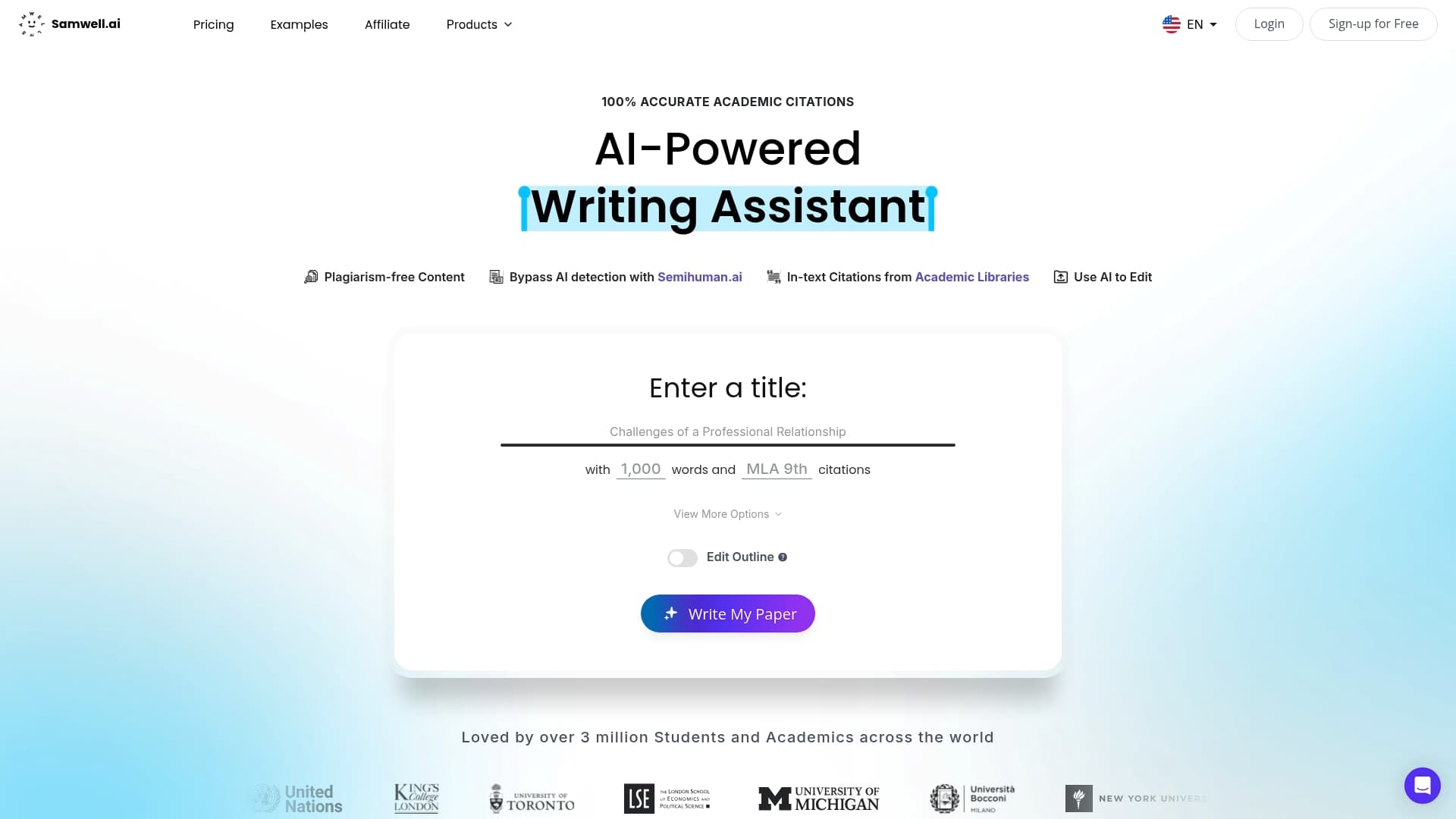
Our platform adapts to whether you're crafting analytical explorations, argumentative defenses, or empirical reports. You get customized outlines matching your chosen paper type, citation support for MLA and APA standards, and plagiarism detection ensuring originality. The Power Editor helps you expand sections strategically while maintaining academic tone and structure.
Over 1,000,000 students and academics from leading universities use Samwell.ai to produce higher quality papers in less time. The Best AI Writing Tools 2025 comparison on our blog details how different platforms handle research paper challenges. You'll discover which features matter most for your specific needs.
Whether you're writing your first argumentative paper or your tenth case study, AI Writing Tools for Content Creation can help you overcome writer's block and structure challenges. Visit our blog for detailed guides on maximizing AI assistance while maintaining academic integrity and developing your unique voice.
Analytical papers explore topics objectively without taking a stance, examining multiple perspectives to understand complexity. Argumentative papers defend a specific position using evidence and counterarguments to persuade readers of your viewpoint's validity.
Choose experimental papers when you can manipulate variables in controlled conditions to test cause and effect hypotheses. Select survey papers when you need to gather data from large populations about attitudes, behaviors, or characteristics you cannot experimentally control.
Yes, case studies often incorporate interpretive analysis since both emphasize qualitative depth and contextual understanding. You examine a specific case while interpreting meanings and cultural contexts. Just maintain methodological consistency and explain your combined approach clearly.
Avoid selecting types based on familiarity rather than fit for your research question. Don't ignore research paper guidance about discipline norms or resource requirements. Never switch formats midway without reconsidering your entire structure and research approach.
Analytical papers work best for beginners because they use secondary sources and focus on critical thinking rather than complex methodology. You develop essential skills in argument construction, source integration, and academic writing without data collection challenges that experimental or survey papers require.