Loading...

Most American undergraduates find that fitting a big idea into a tiny space is tougher than it sounds. With professors expecting precision and clear analysis, even seasoned students stumble over the strict limits of a two-page essay. Over seventy percent of American students report stress when assigned short-form essays. This guide explains exactly how to develop a sharp focus, organize your argument, and use research effectively so every word packs a punch and meets academic standards.
| Point | Details |
|---|---|
| Conciseness is Key | A two-page essay requires distilling complex ideas into essential components for clarity and impact. |
| Strategic Structure is Essential | The essay should include a clear introduction, focused body paragraphs, and a concise conclusion to support the central thesis. |
| Effective Citation is Crucial | Proper formatting and citations enhance academic credibility and allow traceability of ideas. |
| Utilize AI Responsibly | AI tools can support the writing process, but they should be used to enhance, not replace, original thought and analysis. |
A two-page essay represents a concise academic writing format designed to communicate a focused argument or exploration of a specific topic within a limited space. These compact compositions require precise thinking, clear communication, and strategic information management. Unlike longer research papers, a two-page essay demands writers distill complex ideas into their most essential components.
The primary purpose of a two-page essay is to demonstrate a student's ability to articulate a clear thesis, provide supportive evidence, and draw meaningful conclusions within a restricted word count. Effective purpose statements help readers understand the essay's scope and direction, ensuring that every sentence contributes directly to the central argument. Writers must carefully select information, prioritizing depth and clarity over extensive elaboration.
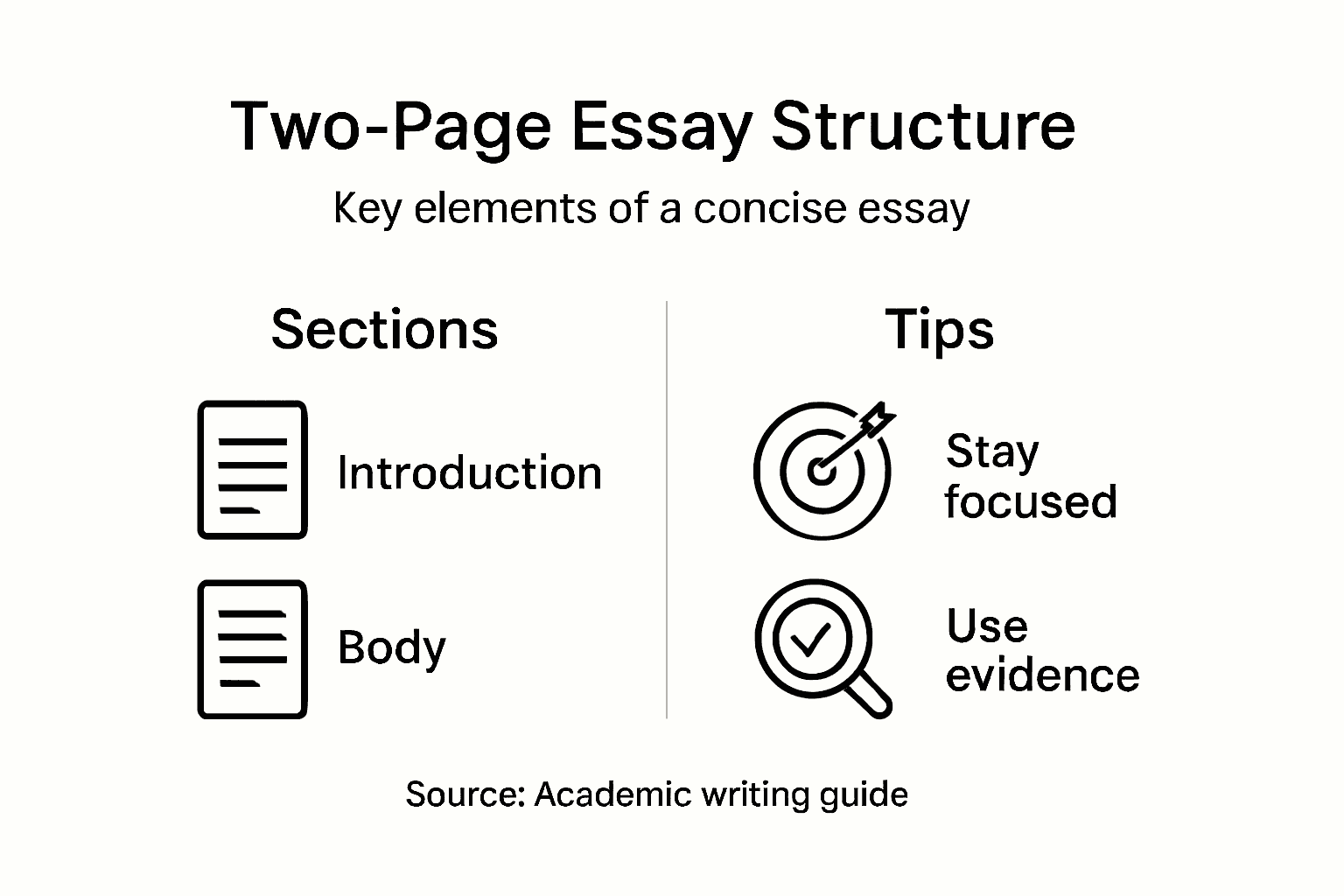
Structurally, a two-page essay typically follows a traditional academic format with three core components: an introduction that presents the thesis, body paragraphs that develop and support the central argument, and a concise conclusion that synthesizes key insights. The condensed nature of this format requires writers to be extremely intentional about word choice, research selection, and analytical precision. Each paragraph must serve a specific function, advancing the overall argument without unnecessary digressions or redundant information.
Pro Tip: Practice outlining your two-page essay before writing to ensure every paragraph serves a strategic purpose and contributes directly to your central thesis.
Creating an effective two-page essay requires a strategic approach to structure and organization. Organizational strategies must prioritize logical progression, ensuring each paragraph builds coherently toward the central thesis. This means carefully selecting and sequencing ideas to maximize the limited space, transforming potential constraints into an opportunity for precision and clarity.

The recommended structural framework for a two-page essay typically involves three critical components: a focused introduction, targeted body paragraphs, and a concise conclusion. Essay structuring techniques suggest breaking down the thesis into manageable claims, with each paragraph serving a distinct purpose. Writers should aim to develop a clear hierarchy of information, presenting the most compelling evidence and analysis first while maintaining a smooth narrative flow.
To optimize organization, consider implementing strategic approaches such as chronological progression, cause-and-effect relationships, or problem-solution structures. Each paragraph should contain a clear topic sentence, supporting evidence, and a direct connection to the overall thesis. Visual signposting through strategic paragraph breaks and potentially subtle subheadings can help readers navigate the condensed academic landscape, ensuring maximum comprehension within the limited word count.
Pro Tip: Create a detailed outline before writing, allocating specific word counts to each paragraph to ensure balanced coverage and prevent unnecessary elaboration.
Here's a quick overview of structural techniques for organizing a two-page essay:
| Technique | Main Benefit | Ideal Use Case |
|---|---|---|
| Chronological order | Logical flow of events | Historical or process analysis |
| Cause-and-effect | Clear explanation of impact | Arguments or scientific topics |
| Problem-solution | Direct path to resolution | Policy or practical topics |
| Thematic grouping | Focused evidence clusters | Comparing multiple viewpoints |
Mastering academic formatting is crucial for creating a professional two-page essay that meets rigorous scholarly standards. Academic formatting guidelines specify precise requirements that go beyond mere aesthetic considerations, serving as a fundamental framework for clear scholarly communication. These standards ensure consistency, readability, and academic credibility across different research disciplines.
For most academic papers, including two-page essays, APA style represents the gold standard of formatting. Key technical requirements include using 12-point Times New Roman font, maintaining 1-inch margins on all sides, and double-spacing the entire document. In-text citations are critical, requiring authors to provide precise attribution for all borrowed ideas, quotes, and research findings. Each source must be carefully documented both within the text using author-date format and in a comprehensive reference list at the document's conclusion.
Beyond technical specifications, proper citation serves multiple academic purposes. Citation practices demonstrate scholarly integrity, give credit to original researchers, and allow readers to trace and verify the intellectual lineage of your arguments. In a two-page essay, where space is limited, writers must be especially strategic about selecting and integrating sources, ensuring that each citation adds substantive value to the overall argument without unnecessary verbosity.
Pro Tip: Always keep a style guide or digital reference tool nearby to double-check formatting and citation details, preventing potential point deductions for technical errors.
Compare academic formatting styles commonly used in short essays:
| Style | Disciplines | Main Features | Citation Method |
|---|---|---|---|
| APA | Social sciences | Times New Roman, double-spaced | Author-date in-text |
| MLA | Humanities | Flexible font, indented paragraphs | Author-page in-text |
| Chicago | History, Arts | Footnotes, wide margins | Footnote markers |
Navigating the challenges of a two-page essay requires a strategic approach to avoiding common writing mistakes that can undermine your academic work. Common writing pitfalls often stem from wordiness, unclear language, and structural inefficiencies that dilute the essay's core message. Understanding and proactively addressing these issues can significantly improve the quality and impact of your academic writing.
Grammatical and structural errors represent another critical area of concern for student writers. Academic writing errors frequently include problematic elements like sentence fragments, run-on sentences, and inconsistent grammatical structures. In a condensed two-page format, these mistakes become even more pronounced, potentially compromising the clarity and professionalism of your argument. Writers must pay careful attention to sentence construction, ensuring each sentence communicates ideas precisely and flows logically within the broader context of the essay.
Perhaps the most insidious pitfall in short academic essays is the tendency to include unnecessary information or use overly complex language. Students often mistakenly believe that academic writing requires elaborate phrasing or excessive technical terminology. In reality, the most effective two-page essays demonstrate clarity, concision, and direct communication. This means ruthlessly editing out redundant phrases, eliminating jargon that does not add substantive meaning, and focusing instead on presenting a clear, well-supported argument that can be understood quickly and comprehensively.
Pro Tip: Read your draft aloud to catch awkward phrasing, grammatical errors, and unnecessary words that might not be immediately apparent when reading silently.
The landscape of academic writing has been dramatically transformed by advanced AI technologies that offer unprecedented support for student writers. Generative AI tools utilize sophisticated language models capable of generating human-like text, providing students with powerful resources for brainstorming, drafting, and refining their two-page essays. These innovative technologies can help overcome common writing challenges by suggesting structural improvements, identifying potential research angles, and offering nuanced writing suggestions.
Strategic integration of AI assistance requires a thoughtful and responsible approach. AI-assisted academic writing strategies emphasize using these tools as collaborative partners rather than replacement writers. Students can leverage AI to generate initial essay outlines, explore different perspectives on a topic, and receive constructive feedback on sentence structure and argumentation. The key is maintaining academic integrity by using AI as a supportive tool that enhances rather than replaces original thinking and scholarly analysis.
Successful implementation of AI writing tools demands critical evaluation and active engagement from the student. While these technologies offer remarkable capabilities, they cannot replace the fundamental skills of critical thinking, research, and personal argumentation. Writers must carefully review and modify AI-generated content, ensuring that the final essay reflects their unique voice, academic expertise, and specific assignment requirements. This approach transforms AI from a potential shortcut into a genuine learning and writing enhancement tool.
Pro Tip: Always cross-reference AI-generated content with academic sources and your own research to verify accuracy and maintain scholarly authenticity.
Writing a compelling two-page essay demands precision, clarity, and avoiding common pitfalls like wordiness and unclear structure. If you find yourself struggling with condensing ideas, organizing arguments, or perfecting citation styles such as APA or MLA, you are not alone. The challenge of fitting insightful analysis into a limited format while maintaining academic integrity can be overwhelming.
Unlock the power of advanced AI-driven assistance with Samwell.ai. Our platform offers tailored tools like the 'Power Editor' to refine your writing, 'Guided Essays' for streamlined outlines, and real-time AI detection that ensures originality and compliance with citation standards. Start crafting clear, concise, and well-structured essays today. Don’t wait to elevate your academic writing—visit Samwell.ai and transform your two-page essays into impactful works with ease.
The purpose of a two-page essay is to articulate a clear thesis and support it with evidence while demonstrating the ability to communicate effectively within a limited word count.
A two-page essay typically includes an introduction that presents your thesis, body paragraphs that develop your argument, and a conclusion that synthesizes key insights. Each paragraph should have a clear purpose and directly contribute to the thesis.
Common pitfalls include being overly wordy, using unclear language, and including unnecessary information. It's essential to maintain precision and clarity while ensuring your writing directly supports your argument.
AI tools can assist in brainstorming, drafting, and refining your essay by suggesting structural improvements and providing feedback on your writing. However, they should be used responsibly to enhance your original ideas and maintain academic integrity.