
Loading...

This article gives you ready-to-use thesis topic ideas organized by academic level and by subject, along with a compact checklist for testing whether any topic is actually workable. Jump to the level-based lists if you need a starting point that matches your program, the subject lists if you already know your field, or the checklist if you have an idea but aren't sure it will survive contact with real data, drawing on guidance from Penn State and standard thesis-structure references.
TL;DR:
- Undergraduate theses can use existing datasets, small surveys, or focused case studies; master’s work should fill a gap, while doctoral research needs an original contribution.
- Generate roughly 20 candidate questions, then check data access, method fit, time, ethics approval, and supervisor expertise before committing to one.
- Turn a broad interest into a testable question naming a population, time frame, and measurable outcome, then ensure the method can produce relevant evidence.
- Check institutional AI rules before using tools; some universities require disclosure and prompt records, while others limit AI to language polishing or literature overviews.
The right thesis topic changes with how much time, data access, and methodological independence you actually have. A senior thesis and a doctoral dissertation might touch the same subject area, but the scope, sample size, and expected contribution differ enormously. Here is what "manageable" tends to look like at each stage, with starter prompts you can adapt.
At the senior or undergraduate level, a thesis usually is usually of a moderate length, suitable for demonstrating mastery without requiring multi-year study and relies on existing datasets, a small original survey, or a focused case study rather than years of fieldwork. The goal is demonstrating that you can frame a question and follow a method through to a defensible conclusion.
Master's theses generally expect a sharper original contribution, often 50 to 100 pages, built on a research question that fills a specific gap rather than reproducing a known pattern.
Doctoral dissertations require an original theoretical or empirical contribution sustained across a longer project, typically 100 to 250 pages, often involving multi-year data collection or a novel method.
Picking a subject first and a method second often produces vague topics. Flipping the order (deciding what kind of evidence you can realistically gather, then narrowing the subject) tends to produce sharper questions. The prompts below pair each idea with a method hint and a typical data source.
For data sources, surveys and institutional datasets (such as those cataloged through ERIC) tend to suit education and social science questions, while experiments and lab data fit psychology and engineering, and archival or textual sources anchor humanities and arts work. Matching your subject to a data source you can actually reach, before you commit to a question, saves weeks of revision later.
A topic is a subject area; a research question is a specific, answerable claim you can test and potentially refute. "Social media and mental health" is a topic. "Does daily Instagram use predict sleep quality among first-year university students?" is a question you can actually investigate. Mixing the two up is one of the most common reasons proposals get sent back for revision.
One effective brainstorming tactic: write down roughly 20 possible research questions in your area of interest without filtering for quality, then narrow by feasibility. Practitioners who work directly with thesis students recommend this volume-first approach because it forces you past the first few obvious ideas into ones that reflect a genuine gap, according to guidance from Penn State.
Once you have a shortlist, run each candidate through this checklist:
A thesis question should also align logically across four dimensions: the question itself, the method you choose, the evidence that method can produce, and the reasoning that connects evidence back to the question. This compatibility check, recommended in MIT's thesis preparation guidance, catches a common failure mode: a fascinating question that no available method can actually answer.
Practice converting broad topics into testable questions. "Climate change and agriculture" becomes "How did the 2012 drought affect corn yield variability among small farms in a specific county?" The second version names a population, a time frame, and a measurable variable, which makes it possible to say in advance what would count as an answer.
Pro Tip: Write your research question as a single sentence with a measurable outcome; if you can't identify what数据 would prove it wrong, it probably isn't specific enough yet.
A thesis proposal is usually concise, often kept short and focused for initial approval, which means the document should state your idea clearly rather than pre-write your literature review.
For a project with a 9-month window, a workable milestone plan might allocate the first six to eight weeks to finalizing the proposal and securing any IRB approval, the next two to three months to data collection, two months to analysis, and the remaining time to drafting and revision, with a buffer month built in for unexpected delays. Building that buffer in from the start, as proposal guidelines from the University of St. Gallen suggest, matters more than most students assume: data collection almost always takes longer than planned. For more on breaking a long project into milestones, see this guide on organizing research for academic projects.
Most theses follow a predictable skeleton, which is worth knowing before you finalize scope, since a narrow topic can still produce a thin methods chapter if you haven't planned what evidence each chapter needs.
Monograph theses follow this chapter sequence as one continuous document, while paper-based or cumulative formats compile several standalone articles (sometimes co-authored) with a connecting introduction and conclusion, a distinction laid out in standard thesis-structure guidance. Cumulative formats tend to suit fields where publishing results as discrete papers is already the norm, such as many lab sciences; monograph formats remain more common in the humanities and social sciences. If your literature review chapter feels hard to wrap up, this guide on concluding a literature review walks through tying that section back to your research question.
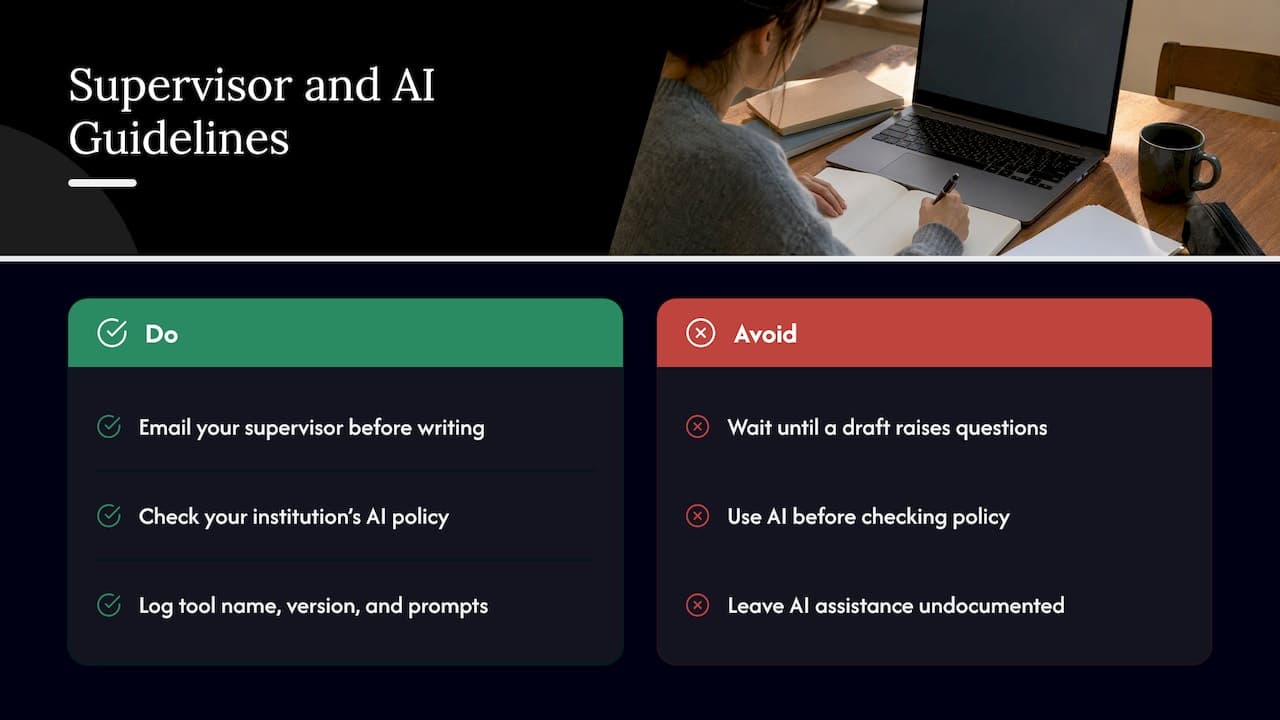
Confirm your scope and any AI-use boundaries with your supervisor before you start writing, not after a draft raises questions. A short email proposing your question, method, and planned AI use (if any) gives your advisor something concrete to approve or redirect early.
Universities increasingly require that students disclose generative AI use and document prompts and outputs in an appendix, per guidance from the University of St Andrews, a practice echoed in some institutions' formal regulations limiting AI to tasks like language polishing or literature overviews rather than methodology or interpretation, as RWTH Aachen's rules specify. Before using any AI tool, check your institution's specific policy, since rules vary.
A short checklist: confirm IRB or ethics review needs for any human-subjects research, get written sign-off on AI-use boundaries, and keep a log of tool name, version, and prompts used if AI assists any part of your drafting.
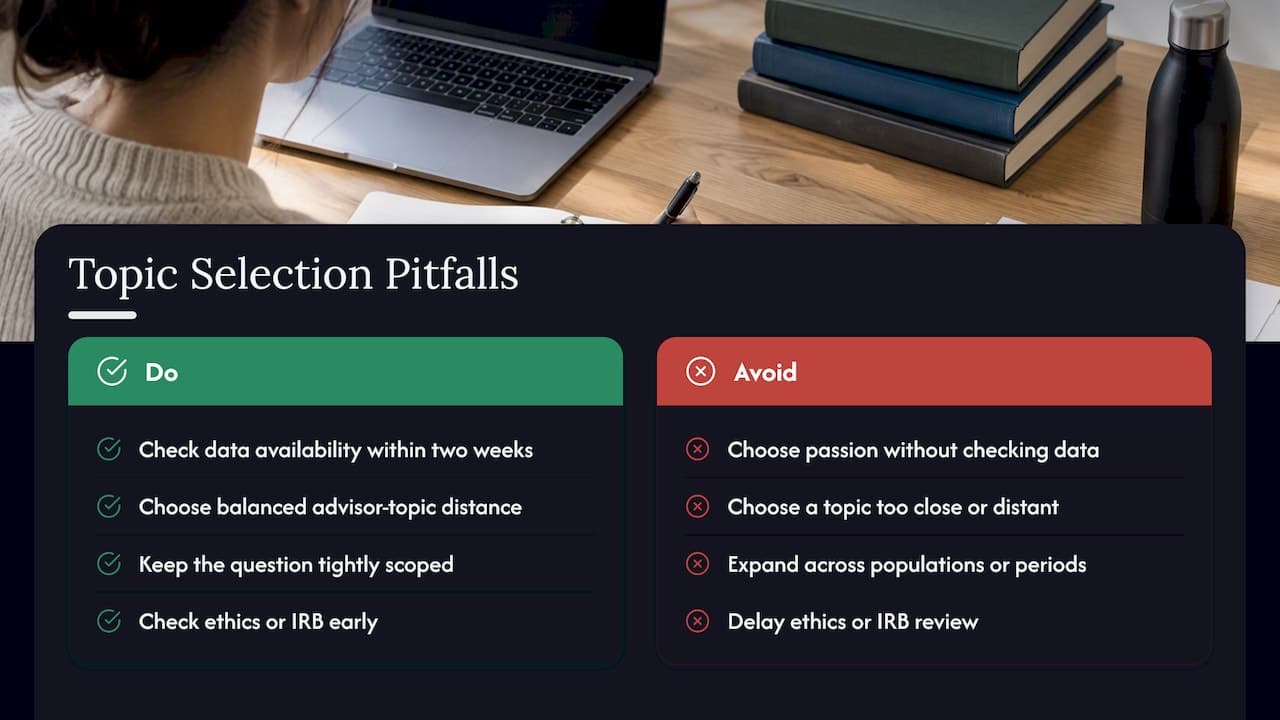
The most frequent mistake is choosing a topic for passion alone without checking whether the data exists. A fascinating question with no accessible evidence stalls a project for months. Test data availability in the first two weeks, not after the proposal is approved.
A second pitfall is picking a topic too close to your advisor's exact expertise or too far from it: too close risks limited independence, too far risks getting feedback that misses methodological problems. A third is scope creep, where an initially focused question grows to cover multiple populations or time periods because narrowing feels like giving something up. Treat narrowing as a strength, not a compromise; a tightly scoped thesis that answers one question well tends to defend better than a sprawling one that answers several questions poorly. Finally, students sometimes skip the ethics or IRB check until late, only to discover their timeline no longer fits the review board's schedule.
Beyond talking with faculty, a few concrete resources help at the brainstorming stage. National and institutional data repositories such as those indexed through ERIC give you a quick way to check whether secondary data exists for an education or social-science question before you commit to collecting your own. University writing centers and thesis-office guidance pages, like the proposal structures referenced earlier, offer templates worth adapting rather than starting from a blank page.
AI-assisted brainstorming tools can help generate and filter candidate research questions quickly, provided their use fits your institution's disclosure rules. Used this way, such a tool functions as a structured thinking partner for narrowing a broad interest into several testable questions, which you then take to your supervisor for feedback rather than treating as a finished answer.
The topics that cause students the most trouble are rarely the modest ones. They're the ambitious questions chosen because they sound impressive, backed by data that doesn't exist or a method the student has never used. A thesis defended on time, with a clear question and evidence that actually supports its conclusions, demonstrates research maturity in a way that an abandoned attempt at originality never can.
I'd rather see a student complete a focused study on a narrow population than start an ambitious cross-national comparison that stalls at the data-collection stage. Methodological rigor on a modest question outlasts forced novelty on a grand one, and it's the rigor, not the ambition, that shows up in how your committee evaluates the finished work.
— Tilen
Picking a feasible topic is the first step; turning it into a structured draft without losing weeks to formatting and citation management is the next one. We built our tools to map onto exactly the steps covered above: our Outline Generator helps narrow a broad research question into a workable chapter structure, our Power Editor supports expanding or tightening sections as your draft grows, and our Reference Builder keeps citations consistent across APA, MLA, and other formats as your source list grows.

If your institution requires documenting AI assistance, our platform supports tracking outputs and edits for reference in an appendix alongside your other source material, in line with institutional disclosure guidance. For structuring that documentation, our guide on appendices for research papers walks through formatting supplementary material clearly.
| Step in your thesis process | Samwell.ai tool |
|---|---|
| Narrowing a topic into an outline | Outline Generator |
| Drafting and expanding sections | Power Editor |
| Managing citations | Reference Builder |
| Literature review support | Literature Review tool |
| Uploading and refining existing drafts | Upload Essay |
Pro Tip: Start with your proposal's working title and research question in our Outline Generator before you write a single paragraph; a clear structure up front saves rounds of revision later.
We built Samwell.ai around the idea that academic integrity and AI efficiency aren't opposites: real-time AI detection checks and citation tools from verified academic databases exist so your draft stays both original and properly sourced.
Our platform serves students and academic professionals from universities worldwide, and our free tier lets you test the outline and drafting tools before committing to our Academic Plan or Custom Professional Plans for extended word limits and advanced features.
Ready to turn your topic into a structured draft? Start with our research paper tools or explore the full toolkit at Samwell.
A good thesis consists of front matter, an introduction stating a clear and refutable research question, a literature review positioning that question, a methodology section, results, and a discussion that ties findings back to the question, per standard thesis-structure guidance. The question, method, evidence, and reasoning should all align logically with each other.
AI tools can assist with brainstorming, outlining, or polishing language, but institutional policies generally require that methodology and interpretation be authored by the student and that any AI use be disclosed and documented. Some universities restrict AI to specific tasks like literature overviews, so checking your institution's policy before use matters more than the tool's capability.
A dissertation conclusion interprets your results in light of your original research question, addresses the study's limitations honestly, and explains what the findings contribute to existing knowledge in your field. It should avoid introducing new data and instead connect back to the gap identified in your literature review.
Strong education thesis topics include how formative feedback frequency affects achievement, how bilingual exposure shapes early vocabulary development, and how screen time policies intersect with classroom attention research. Repositories like ERIC are a useful starting point for checking whether secondary data already exists for a given question.



