
Loading...

This page gives you ready topic prompts for an annotated bibliography, grouped by field, plus a short formula for narrowing any of them into a workable research question. You will also find model annotations and a quick guide to using AI tools without crossing into academic dishonesty.
TL;DR:
- Narrowing broad topics with specific populations, places, and time frames is essential to finding credible, debate-rich sources for annotations.
- Using a research question format helps identify sources that either support or challenge your argument, improving the annotation's evaluative quality.
- Sources with diverse perspectives, such as empirical studies and literature reviews, create richer annotations by providing multiple viewpoints.
- Credible sources like peer-reviewed research, primary documents, and reputable news coverage are crucial for building a reliable bibliography.
- Verify all AI-generated citations and content against original sources and disclose AI assistance according to institutional policies to maintain academic integrity.
Every entry has two parts: a citation formatted in the style your instructor requires (MLA, APA, or Chicago), followed by the annotation itself. The Cornell University Library guide describes the annotation as a short analysis, not a second abstract. It summarizes the source's central argument, evaluates the author's authority and methods, notes the intended audience or perspective, and explains how the source connects to your research question.
Each annotation typically covers:
Cornell notes that annotations usually run about 150 words, though that figure is a convention, not a rule. Assignment sheets override it. Some instructors want 100 words per entry, others want a full paragraph, and some specify a minimum number of sources. Read the prompt before you draft anything.
A broad interest like "social media" or "climate change" cannot become a bibliography entry on its own. It needs a funnel. The Loyola Marymount University library guide recommends moving from a general area to a specific aspect, then a defined scope, then a focused question.
Before you commit, preview a handful of abstracts. If you can find several credible sources that disagree with each other, the topic has enough depth for real analysis. If every source says the same thing, the topic is probably too narrow or too settled to support evaluative annotations.
For example, "social media and mental health" becomes "how does Instagram use affect body image in teenage girls in the United States." "Climate change" becomes "how has drought frequency changed agricultural policy in the Midwest since 2000."
Pro Tip: Search your topic plus "literature review" first. If a recent review article exists, it will point you to the strongest sources in the field and save hours of searching.
Each prompt below is written so you can convert it into a question using the formula above: add a population, place, or time frame, then ask it as a direct question.
Education
Technology
Health and mental health
Business and politics
Media and literature
History and culture
Environment and travel
Arts and sports
Interdisciplinary and methods-focused prompts work well too: a comparative study of two countries' recycling policies, a case study of one school district's response to a teacher shortage, or a policy evaluation of a specific public health intervention. These naturally invite sources with different methods and conclusions, which makes for stronger evaluative annotations.
Take any prompt above and specify who, where, when, and what outcome or mechanism you are tracking. "Remote work and retention" becomes "how did remote work policy affect voluntary turnover at mid-size US companies between 2021 and 2023."
Match your sources to what the annotation needs to say:
When searching, try your keywords alongside synonyms (adolescent and teenager and youth), and always preview the abstract before deciding a source fits.
The UW-Madison Writing Center describes three annotation types. Descriptive annotations summarize the source without judgment and suit assignments that ask for an overview of the field. Evaluative annotations judge strengths, weaknesses, and usefulness, and they are the most common type in upper-level coursework. Combination annotations do both, summarizing and evaluating in the same short paragraph.
An evaluative annotation for a scholarly article might read:
This study surveys 400 college students on Instagram use and body image, using a validated self-esteem scale. The sample is limited to one region, which weakens generalizability, but the methodology is sound and the findings align with earlier work. Useful for establishing a baseline correlation before comparing platforms.
A descriptive annotation for a news source might read:
This article reports on a school district's pilot of a four-day week, describing attendance changes without statistical analysis. Useful for context and a real-world example, though it should be paired with peer-reviewed sources for evidence of broader trends.
AI tools can help you brainstorm topic angles, tighten awkward sentences, and format citations faster. What they should never do is hand you an uncited fact or a generated reference you have not verified against the original source. The Boston University Libraries guidance on generative AI warns that these tools can produce convincing but fake citations, so every source still needs a human check against the actual text or abstract.
When you do use AI, most university policies expect disclosure of four things:
Some instructors require an appendix with your prompts or chat transcripts attached, so keep a record as you go. For a closer look at building that habit into your workflow, see how AI can support research without replacing judgment.
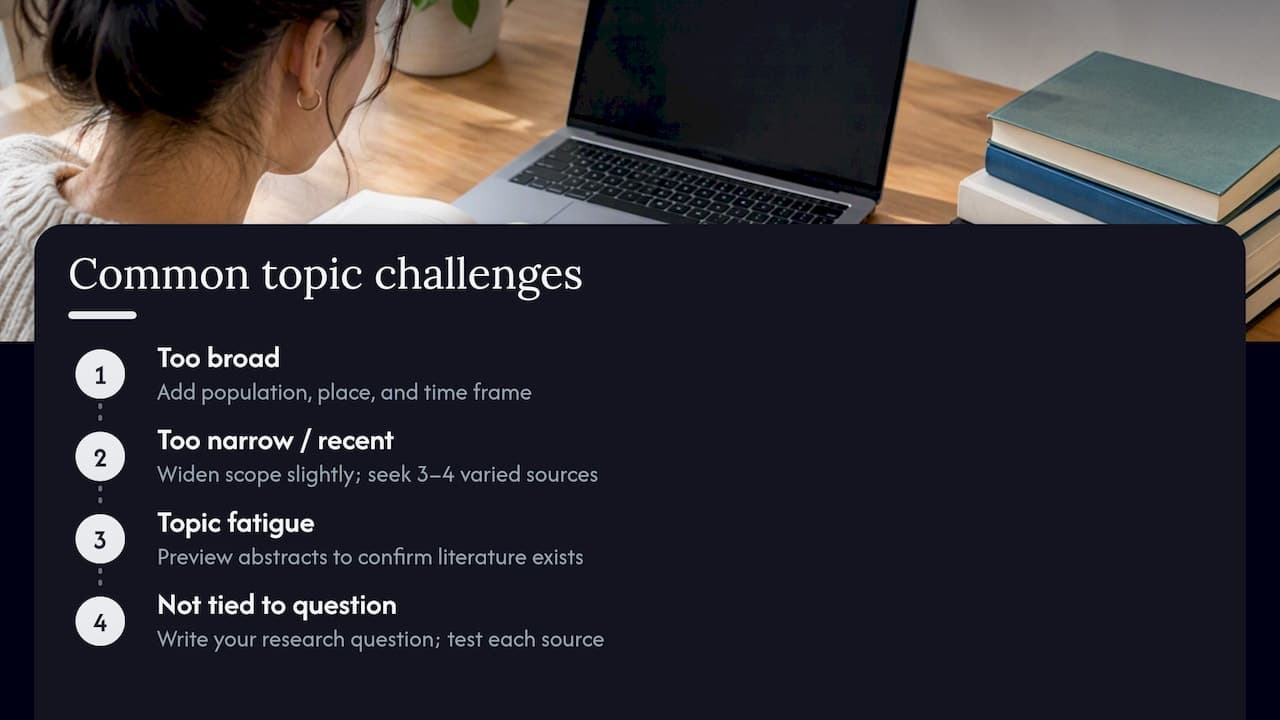
The most common problem is picking a topic too broad to annotate meaningfully. "Mental health" or "technology" invites hundreds of unrelated sources with no shared thread, which makes the evaluation section of each annotation feel repetitive. The fix is the narrowing formula from earlier: add a population, place, and time frame before you search.
The second problem is the opposite: a topic so narrow or so recent that credible sources barely exist. If you cannot find three or four sources with real disagreement or variation after a genuine search, widen the scope slightly rather than forcing weak sources into the bibliography.
A third challenge is topic fatigue, choosing something because it sounds impressive rather than because sources actually exist for it. Preview abstracts before you commit, the way the UNCW library guide recommends, so you know the literature is there before you build an argument around it.
Finally, students sometimes pick a topic that cannot be clearly tied back to the assignment's research question. The University of Tennessee Knoxville assignment planner notes that if a source cannot be connected to the question's scope, it likely belongs out of the bibliography. Write your research question down before you search, and test every candidate source against it.
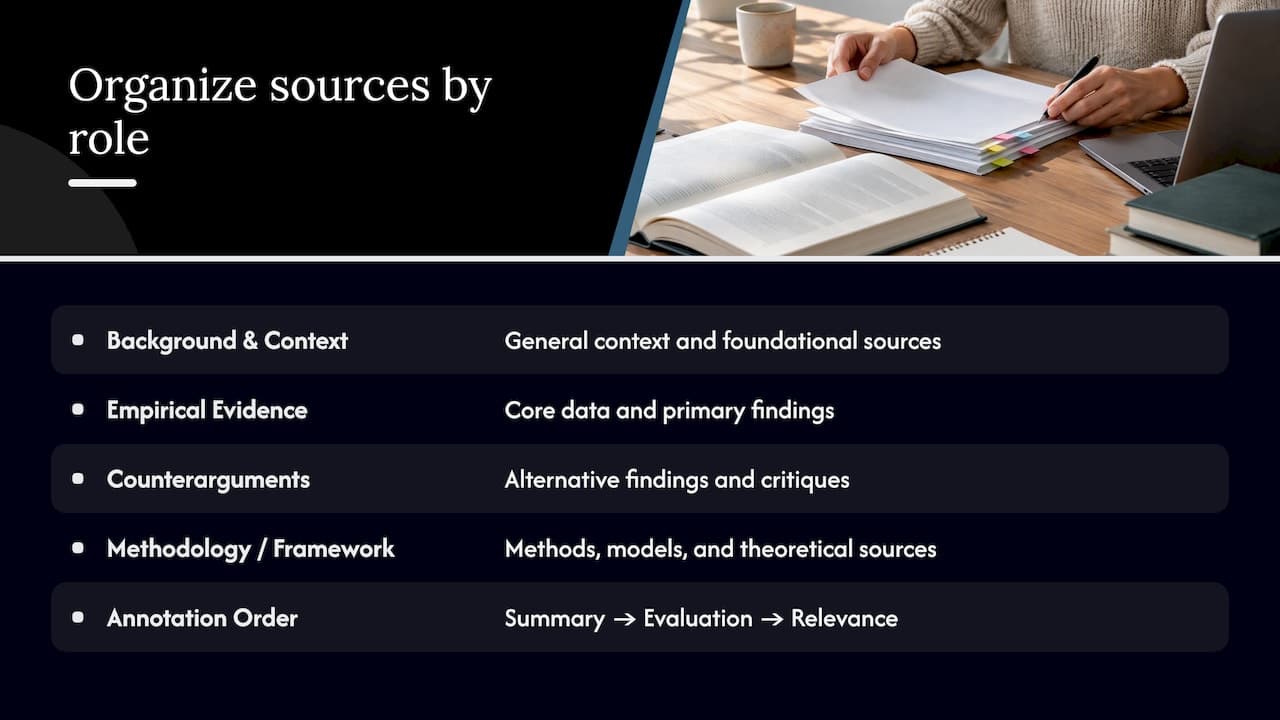
Once you have a working topic and a handful of sources, organize them by the role each one plays rather than just alphabetically. Group sources into categories such as background and context, core empirical evidence, counterarguments or alternative findings, and methodology or framework sources. This makes it easier to see where your bibliography has gaps.
Within each entry, keep a consistent order: summary first, evaluation second, relevance to your question last. Readers and instructors scan for this pattern, and consistency makes a bibliography easier to grade and easier for you to review later.
If your assignment covers several subtopics, consider subheadings within the bibliography itself, grouping sources by theme (causes, effects, proposed solutions) instead of listing them in one long undifferentiated list. Keeping a running log as you research, rather than writing all annotations at the end, also helps you spot repetition or missing perspectives early. A simple spreadsheet with columns for citation, source type, and one-line takeaway works well for this, and the same habit carries over into organizing sources for larger academic projects.
"The effects of technology on society" fails because it has no population, no time frame, and no specific mechanism. A better version: "how smartphone notifications affect sustained attention among high school students."
"Climate change is bad for the environment" fails because it states an opinion rather than a question, and it offers nothing to evaluate or dispute. A better version: "how has sea level rise affected coastal zoning policy in one specific region over the past decade."
"History of World War II" fails because entire books are written on narrower slices of this subject. A better version: "how did wartime propaganda posters shape public opinion on rationing in one specific country."
In each case, the fix is the same: add a bounded population, place, or time period, and phrase the topic as a question with an answer that sources can actually support or challenge.
Most students treat topic selection as the easy part and rush to finish it so they can get to "the real writing." That is backward. A topic with no built-in debate produces flat, repetitive annotations no matter how well they are written, because there is nothing to evaluate. A topic with genuine disagreement among sources gives you something to say in every entry. Favor topics with competing perspectives over topics that sound safe. Start the search early, keep a running log of what you find, and let the sources tell you whether the topic has enough depth before you commit to it.
— Tilen
Picking a topic is only the first hurdle. Formatting citations correctly, expanding thin annotations, and keeping sources organized across a longer assignment take real time. Samwell.ai's Outline Generator helps structure a bibliography or literature review before you write, its Citation Editor and Reference Builder format entries in MLA, APA, and other styles, and the Power Editor expands a thin annotation into a fuller paragraph without losing your original analysis.

If AI assisted part of your process, disclose it the way your instructor requires: name the tool, what you used it for, and how you verified the result. For students building a full paper around their bibliography, the Research Paper tools and Literature Review support carry the same sourcing forward into the next stage of the assignment. Visit the upgrade page to compare the Free Plan against the Academic Plan and Custom Professional Plans.
Most university guides agree on three core tasks: summarize the source's main argument, evaluate its credibility and methods, and explain its usefulness to your specific research question. The UW-Madison Writing Center frames this as the difference between descriptive and evaluative annotation, with combination annotations covering all three in one entry.
Each entry needs a correctly formatted citation followed by a short annotation that summarizes the source, evaluates its authority and methods, and explains how it connects to your research question. The Cornell University Library guide notes annotations typically run around 150 words, though your assignment sheet always takes priority over that convention.
AI tools can help brainstorm topics, draft outlines, and tighten sentence structure, but they can also generate fake citations and sources that do not exist. The Boston University Libraries guidance recommends verifying every source against the original text and disclosing any AI use per your instructor's policy.
A typical entry pairs a citation with a short paragraph: one or two sentences summarizing the source, a sentence judging its reliability and methods, and a sentence connecting it to your topic. The model evaluative and descriptive examples earlier on this page show both formats in practice.



