
Loading...

Strong social-issue topics cluster in several areas: economic inequality, mental health, climate and environment, governance and polarization, technology and misinformation, and identity and civil rights. Pick the one that fits your assignment, then run it through three questions: is it debatable, is credible data available, and can you scope it to your word count? Global reports from the UN and WHO give you evidence to start.
TL;DR:
- Match one of six issue areas to your discipline, then frame a debatable question around a defined population, place, policy, or mechanism.
- Before committing, confirm credible evidence exists and the question fits your word count; narrow broad subjects such as poverty to one local policy.
- Use surveys or experiments for cause and effect, and policy analysis or case studies for institutional questions; name one limitation in the paper.
- WHO estimates that 14.3% of adolescents aged 10 to 19 experience a mental health disorder; cite the figure to justify a youth focused topic.
- Balance a strong counterargument with mixed sources, separate measurable claims from value judgments, and verify events against primary records before setting a research freeze date.
A social issue is defined by public disagreement over its nature, causes, or solutions, and that clash is what makes a topic academically powerful. These categories can contain such clashes, and each comes with its own typical evidence.
Each prompt below names a population, place, or mechanism so you can start researching right away. Swap in your own country, city, or time frame.
Economic inequality
Mental health
Climate and environment
Governance and polarization
Technology and misinformation
Identity and civil rights
Run your draft prompt through this process before you commit to it.
Compare the phrasing. Weak: "Social media is bad." Better: "How does evening social media use relate to sleep loss among high school students?" Weak: "Climate change and poverty." Better: "How do heat waves affect outdoor workers' wages in one US state?"
Pro Tip: Match your method to your claim: use surveys or experiments for cause-and-effect claims, and policy analysis or case studies for questions about institutions.
Start with this checklist, then build your reading list outward.
Try three search patterns: "[topic] statistics [country] site:gov", "[topic] systematic review [year range]", and "[topic] report filetype:pdf". Judge every source on authority, recency, and methodology.
As of 2025, 35% of SDG targets are on track, which tells you that progress is real but uneven. About 14.3% of adolescents aged 10–19 experience a mental health disorder, a figure you can cite to justify a youth mental health topic.
State one limitation for each, such as small samples or local data.
The same topic reads differently depending on your field. Take housing costs.
A sociology paper asks how rents shape family structure, neighborhood networks, and class position. It favors interviews, ethnography, and survey data, and it treats the issue as one that is often systemic and intersectional, so showing how one issue reinforces another strengthens your argument.
A political science paper asks who decides, through which institutions, and with what incentives. It uses policy documents, voting records, and comparisons across jurisdictions. Angles about systemic power dynamics and tension between ordinary citizens and elites suit this field well.
An ethics paper asks what we owe one another and which principle should win when values conflict. It leans on philosophical frameworks such as fairness, rights, and harm, and it can still cite empirical data to ground its claims.
Economics asks about incentives and measurable trade-offs, public health asks about population outcomes and prevention, and history asks how today's problem took shape. Pick the lens your instructor expects, say it in your introduction, and let it decide your evidence. Debate experts also note that topics allowing both moral and empirical arguments tend to produce the most defensible positions, so consider borrowing one method from a neighboring discipline.
Headlines fade quickly, so anchor your paper in a durable value conflict and use recent events as evidence rather than as the topic itself. Durable subjects focus on genuine clashes of values, which makes them stronger foundations for academic work than whatever is trending this week.
Here is a practical routine. Define the lasting question first, such as how much governments should regulate online speech. Then collect two or three recent developments that test it: a new law, a court ruling, a platform policy change. Date every item, and note whether it is a report, a study, or a news article.
Check recency in annual reports. The Global Risks Report 2026 draws on expert surveys across three timeframes and treats societal risks as a dominant near-term feature, which helps you justify why your topic matters now. Its analysis also links polarization, misinformation, and weakened rule of law to reduced social cohesion.
Cross-check breaking stories against primary sources such as court documents, agency releases, and original studies. Set a freeze date for your research and say so in your methods note, because events will keep changing after you submit.

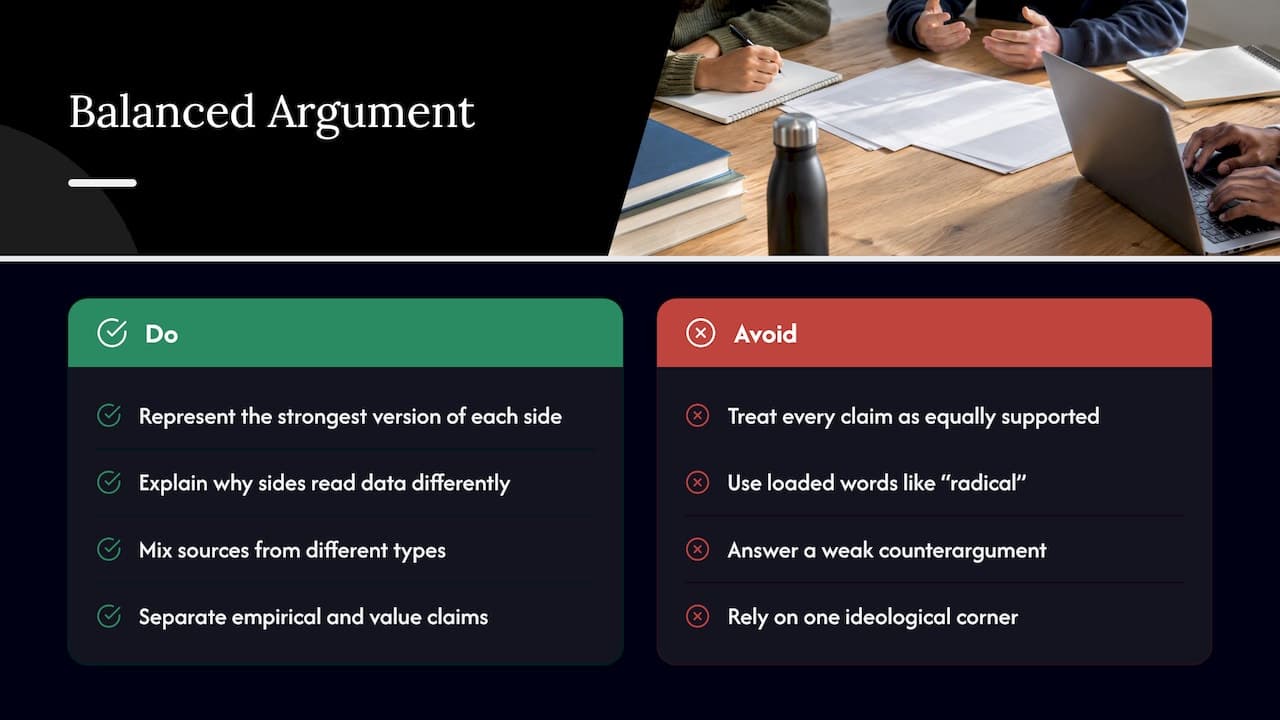
Balance does not mean pretending every claim has equal evidence. It means you represent the strongest version of each side and let the evidence do the sorting.
Start by stating the disagreement fairly. If two sides read the same data differently, say why. Then ask yourself who benefits from each claim and whether your sources come from one ideological corner. Mix source types: government statistics, peer-reviewed studies, think tanks from different leanings, and affected communities' own accounts.
Watch your language. Loaded words like "radical" or "obvious" signal a conclusion before the evidence. Use neutral verbs such as "argues" or "reports." Make sure your counterargument section answers the best objection, not a weak version of it; our guide on how to write a counter argument walks through this step.
Finally, separate empirical claims from value claims. "Rents rose" can be checked. "Rents should be capped" depends on values and trade-offs. Label each clearly. Interacting forces matter too: the WEF notes that inequality and misinformation interact to deepen social fractures, so acknowledge that causes rarely come alone. If your own view is strong, say so openly and show how you tested it against opposing evidence.
Strong submissions often share habits such as an original framing, balanced evidence, a visible method, and a real counterargument. Instructors reward papers that explain why they chose their sources, not just what those sources say. A clear thesis in the first paragraph, one limitation named honestly, and an opposing view answered directly will do more for your grade than extra pages. Our work with students across many universities points the same direction.
— Tilen
Once you have chosen a prompt, we help you move faster. Our Outline Generator and Guided Essays build a structure around your thesis, our Reference Builder manages citations, our Power Editor lets you expand and refine sections, and real-time AI detection checks run as you write. You can start with the Free Plan or step up to the Academic Plan on our upgrade page, or try our Research Paper tool directly. For argumentative drafts, our guide to writing an opinion paper pairs well with your new topic.

Pick a prompt from the list above, open the tool, and have an outline before your next study session.
Inequality, polarization, misinformation, and mental health dominate current analysis. The WEF Global Risks Report 2026 ranks societal polarization fourth among 2026 risks and calls inequality the most interconnected risk.
Mental health, climate, economic security, and online safety come up most in youth-focused research. WHO reports that about 14.3% of adolescents aged 10–19 experience a mental health disorder, which keeps that issue central.
Choose a clash of values with local evidence, such as phone bans in schools or labeling AI-generated political images. A good commentary topic is debatable, narrow, and backed by data you can verify.
Poverty, conflict, displacement, climate, and health lead most lists. The UN reports that over 800 million people remain in extreme poverty, and that figure frames many global-issue essays.



