
Loading...

The proper style for an argumentative essay is formal, objective, and evidence-driven language that builds reasoned claims rather than personal opinion. This academic register typically uses third-person perspective and avoids contractions and colloquialisms, according to UMGC's Online Writing Center. The UNC Writing Center frames this style around five working parts: claim, reasons, evidence, warrants, and counterargument.
TL;DR:
- Make the thesis arguable and narrow enough to defend; longer essays often benefit from a closed thesis that previews each reason.
- Build each body paragraph around one reason, then present evidence and explain the warrant that connects it to the claim.
- Use current, credible evidence such as named studies, primary source quotations, expert analysis, or documented examples, and explain its relevance after citing it.
- Address plausible objections fairly: shorter essays usually need one counterargument, while longer research papers often handle two or three distinct objections.
- Let the argument determine paragraph count, giving each body paragraph one logical step rather than forcing a complex claim into five paragraphs.
An argumentative essay works because its parts connect logically, not because it follows a fixed paragraph count. The UNC Writing Center identifies five elements that make an argument function: a claim, reasons, evidence, warrants, and a response to counterarguments.
A strong claim, or thesis, is arguable (someone could reasonably disagree), specific, and narrow enough to defend in the space you have. Reasons answer "why" you believe the claim; evidence answers "what" supports that reason, drawn from data, texts, or expert analysis. A warrant is the often-unstated logic explaining how the evidence actually proves the reason, which is where many drafts fall apart because the connection feels obvious to the writer but not to the reader.
A compact paragraph might move like this: state the claim, present evidence, then spell out the warrant connecting the two before moving to the next point.
Counterarguments belong near the end of a body paragraph or in a dedicated section before the conclusion, where Purdue OWL recommends acknowledging opposing views directly rather than ignoring them.
Academic tone is a set of concrete choices, not a vague feeling of seriousness. Writing in third person keeps attention on the argument instead of the writer, and dropping contractions ("do not" instead of "don't") signals a formal register immediately.
The appropriate tone stays matter-of-fact and respectful, even when refuting an opposing view, according to BBC Bitesize's guidance on argument writing, which notes that aggressive language undercuts credibility rather than strengthening it.
Pro Tip: Read your draft aloud and flag any sentence that sounds like a conversation rather than an argument; that is usually where a contraction or slang term has crept in.
A thesis earns its place when it is nonobvious, arguable, and specific enough to guide every paragraph that follows. "Social media affects teenagers" says nothing debatable; "Platforms that reward engagement over accuracy push teenagers toward measurable declines in sustained attention" gives you something to prove.
Writers choose between a closed thesis, which previews the specific reasons you will cover, and an open thesis, which states the position without listing every point in advance. Longer essays benefit from a closed thesis because a short forecast helps readers track multiple reasons across several pages, a structural move Purdue OWL treats as standard practice for academic argument papers.
Before moving past your introduction, test the thesis against these questions:
Evidence only strengthens a claim when it is credible, current, and explicitly tied back to your reasoning. Useful evidence types include statistics from named studies, direct quotations from primary sources, expert analysis, and documented examples, with the right type depending on whether you need scale, authority, or illustration.
Evidence should be current and explicitly linked to the claim it supports, a standard Purdue OWL's guidance on argument papers applies across academic argumentative writing, since a strong source loses value the moment its connection to your reasoning is left unstated.
Acknowledging a plausible objection does more for your credibility than ignoring it ever could, since it shows you have tested your claim against real resistance rather than cherry-picking support. Shorter essays usually need one counterargument; longer research papers often address two or three, each tied to a distinct part of your reasoning.
Transition phrases like "critics might argue," "while it is true that," or "this objection overlooks" signal the move clearly. A concession might read: "Critics note that remote classrooms reduce peer interaction. This is a fair concern, but structured breakout discussions can recover much of that engagement while preserving flexible access."
Instructors reading dozens of essays notice rigidity fast: a five-paragraph structure forced onto a complex argument reads as padding rather than reasoning. Complex claims often need more body paragraphs, each carrying one logical step toward the thesis rather than a fixed count, an approach that research on thesis construction treats as the organic alternative to the five-paragraph formula.
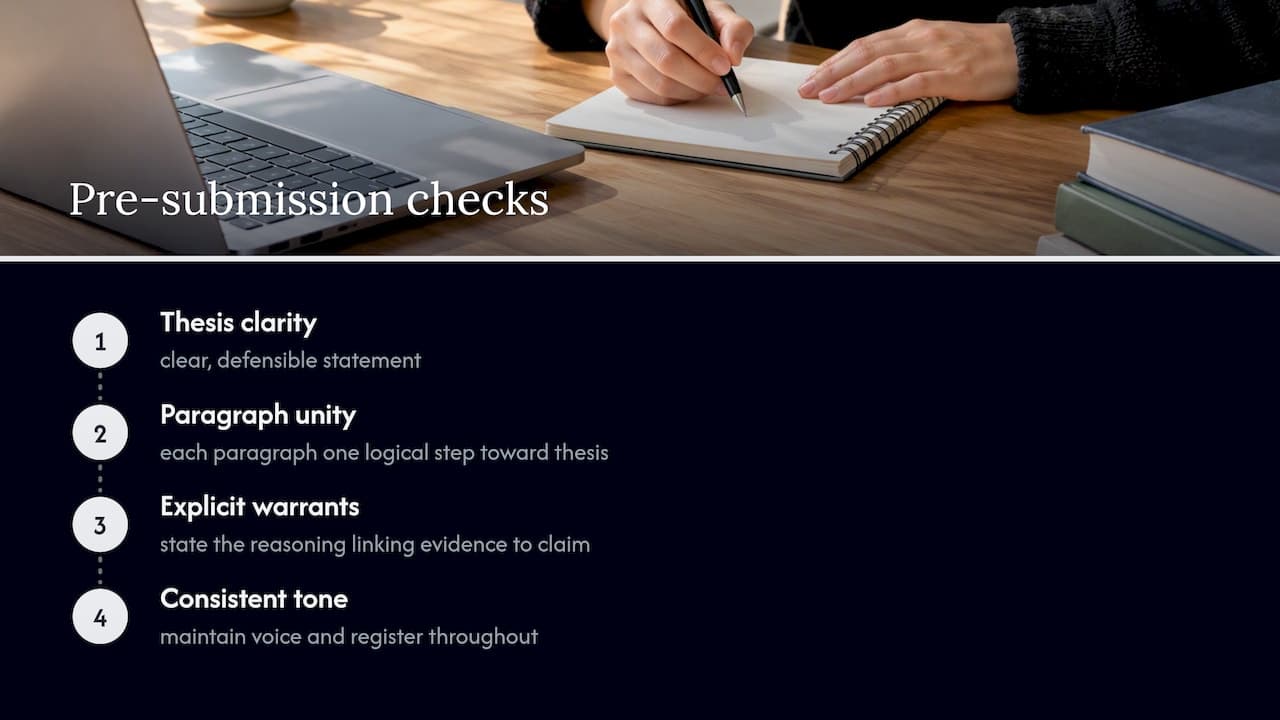
Before submitting, check four things: thesis clarity, paragraph unity, explicit warrants, and consistent tone. Drafting tools can speed up citation checks and style edits during this revision pass without replacing your own judgment about the argument itself.
— Tilen
Getting an argumentative essay from rough claim to polished draft takes real revision time, and that is where our tools fit into your workflow. Our Guided Essays feature walks you through building a structured outline before you write a single paragraph, our Power Editor expands thin sections once you have evidence but need stronger warrants, and our Citation Editor formats in-text citations and references in MLA, APA, and other required styles.

If you already have a draft and want to tighten tone or catch leftover contractions and vague phrasing, our Upload Essay tool runs a style and AI-detection check against your existing text. Students working on longer argumentative projects can also start a Research Paper directly. Check our upgrade plans to see which option fits your workload this semester.
The style is formal, objective, and evidence-based, relying on reasoned claims rather than personal anecdotes or emotional appeals, according to UMGC's writing guidance. It typically favors third-person perspective and avoids contractions and slang.
The UNC Writing Center identifies claim, reasons, evidence, warrants, and counterargument as the five core elements. Each part connects to the next, with warrants explaining how evidence actually supports the stated reasons.
The correct tone is matter-of-fact, respectful, and serious, conveying rigor without aggressive language toward opposing views, per BBC Bitesize's tone guidance. This tone stays consistent whether you are presenting your own claim or responding to a counterargument.
MLA format calls for 12-point font, double-spaced text, 1-inch margins, and a Works Cited page listing every source cited, following Purdue OWL's MLA guidelines. Always confirm your instructor's required style before finalizing formatting, and see our guide to MLA page numbers for exact placement rules.
No single paragraph count is required; the structure should match the complexity of the argument rather than a fixed template. Longer or more layered claims often need additional body paragraphs, each developing one distinct reason toward the thesis.



