Loading...

TL;DR:
- Structured essays organize arguments around a clear thesis, supported by coherent paragraphs and transitions. They enhance clarity, build credibility, and facilitate effective thinking and communication in academic and professional contexts. Proper structure prevents paragraph drift, improves revision, and signals respect for the reader’s attention.
Structured essays are defined as written arguments organized around a thesis, supported by coherent paragraphs, and concluded with a synthesis of key ideas. The importance of structured essays extends beyond academic compliance. Structure is a cognitive tool that helps writers develop arguments clearly and helps readers follow complex reasoning without losing the thread. Humanities LibreTexts identifies/09%3A_Essay_Organization) thesis statements, topic sentences, integrated evidence, transitions, and conclusive summaries as the core skills for essay organization in university courses. A 2026 study further confirms that structured instruction reduces cognitive load and sentence-level errors among learners, which means structure does not just improve grades. It improves thinking.
Structure is not a bureaucratic checklist. It is the architecture that holds an argument together. When an essay lacks structure, ideas compete for attention rather than build on each other. The result is a piece that feels scattered, even when the individual ideas are strong.
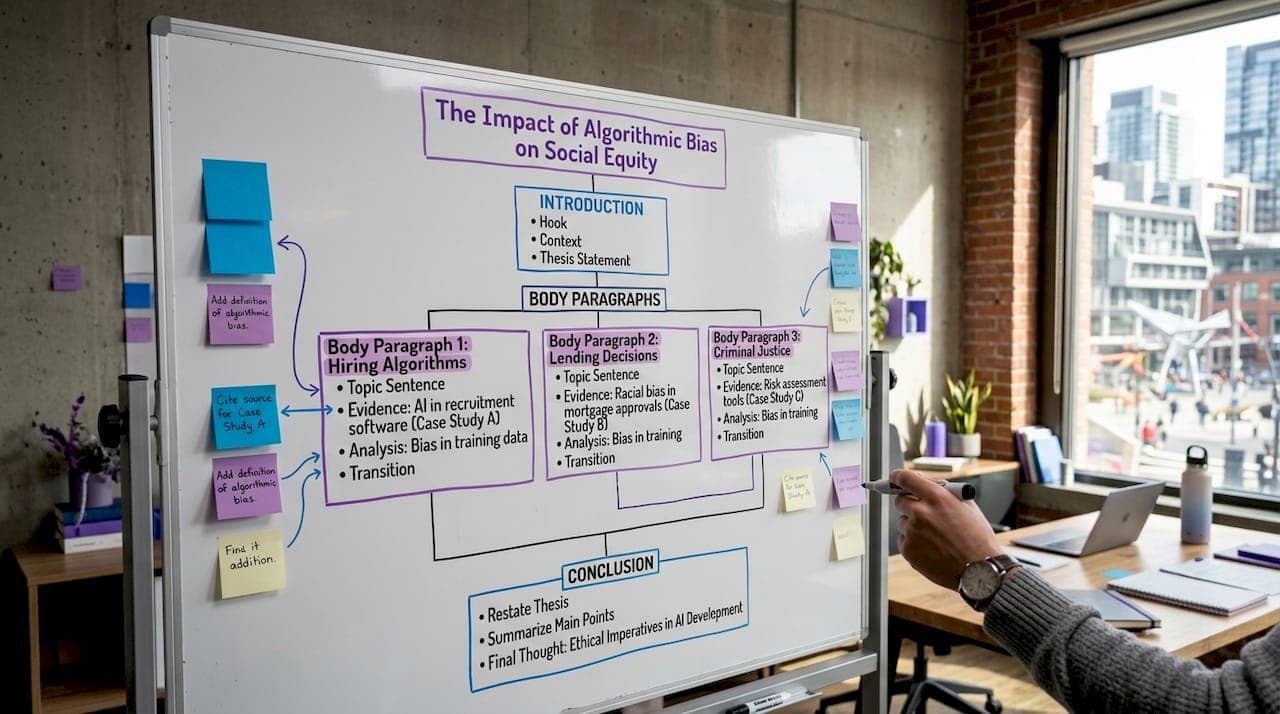
The University of Notre Dame Australia describes paragraph plans as an effective method to map points directly to the thesis, improving flow and connectivity across the entire essay. This matters because an essay without that map tends to drift. Writers introduce a point, lose track of how it connects to the central argument, and end up with paragraphs that feel like separate notes rather than a unified case.
Structure also serves the reader. A well-organized essay signals that the writer respects the reader's time and attention. It reduces the mental effort required to extract meaning, which is why structured writing performs better in both academic assessment and professional communication. The benefits of structured writing are not limited to school. They carry directly into reports, proposals, and any context where persuasion matters.
Every structured essay shares five core components. Understanding what each one does makes it easier to use them purposefully rather than mechanically.
| Essay component | Role in the essay |
|---|---|
| Introduction with thesis | States the central argument and sets the direction for the entire piece |
| Topic sentences | Open each paragraph with a clear claim that connects back to the thesis |
| Supporting evidence | Provides facts, examples, or analysis that prove the paragraph's claim |
| Transitions | Signal logical relationships between sentences and paragraphs |
| Conclusion | Synthesizes the argument and provides closure without introducing new claims |
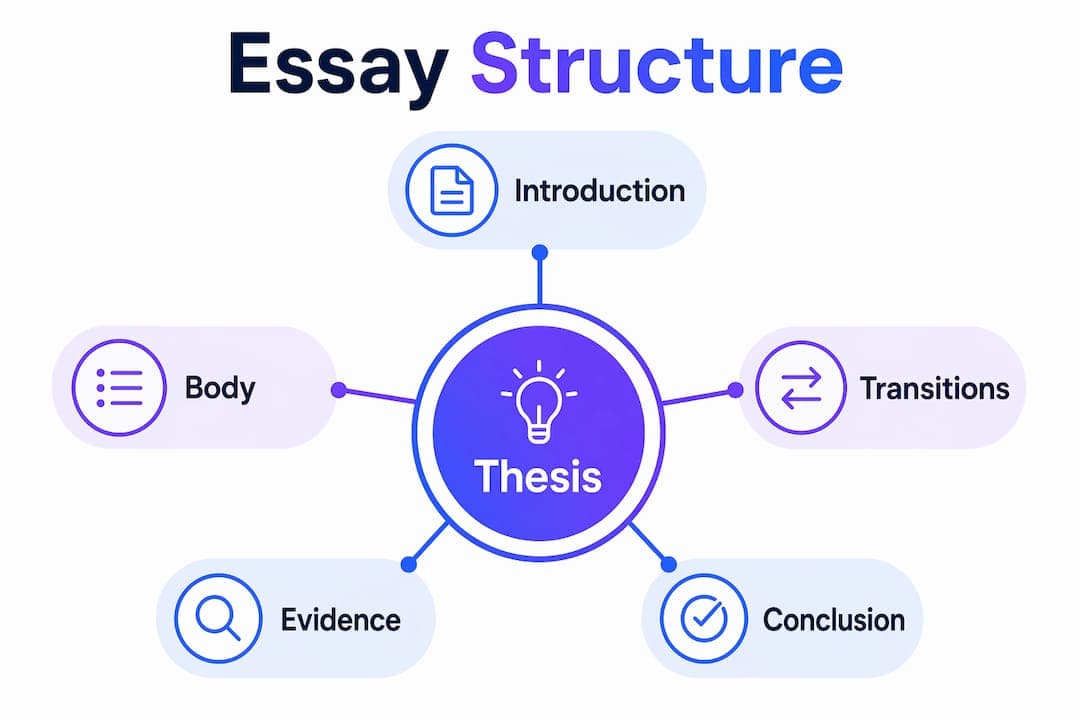
The thesis statement is the essay's spine. Every paragraph should connect back to it, either supporting, qualifying, or extending the central claim. Topic sentences and paragraph cohesion/09%3A_Essay_Organization) serve distinct roles. A topic sentence articulates the paragraph's specific claim, while transitions and supporting sentences build the internal logic that makes that claim convincing.
Transitions deserve more attention than most writers give them. Phrases like "as a result," "by contrast," and "building on this point" do not just connect sentences. They tell the reader exactly what kind of logical move is happening. Without them, even well-supported paragraphs can feel disconnected. The elements of a structured essay work as a system. Weaken one component and the others carry less weight.
Structure reduces cognitive load for both the writer and the reader. When a writer builds a paragraph plan before drafting, they force themselves to decide what each paragraph is actually arguing before committing to prose. This prevents the most common structural failure: writing a paragraph that contains ideas but makes no clear claim.
Common transition categories and their functions:
The University of Notre Dame Australia recommends specific transition phrase groups to link paragraphs and sentences effectively, treating them as tools for signaling logical relationships rather than decorative connectors. That distinction matters. A transition used decoratively adds noise. A transition used precisely adds meaning.
Pro Tip: After drafting each paragraph, read only the topic sentence and the final sentence. If those two sentences do not logically connect, the paragraph has drifted from its claim. Revise the body sentences until the opening and closing align.
Paragraph-level cohesion checks like this one take less than a minute per paragraph and catch structural failures before they compound. Writers who use tools like Grammarly or the Hemingway Editor for sentence-level clarity still need to perform this kind of structural audit manually. Sentence polish cannot fix a paragraph that argues two different things at once.
The most frequent structural failure is paragraph drift. A paragraph starts with one claim, introduces a piece of evidence, and then follows that evidence into a different argument entirely. By the end, the paragraph is making a point the topic sentence never promised.
"The five-paragraph essay is a zombie pedagogy. It walks, it moves, but it is not alive. It teaches students that knowledge is fixed and the audience is passive, when writing should be discovery and interaction." — Terry Underwood
Terry Underwood's critique of the five-paragraph essay format identifies a real risk: treating structure as a formula rather than a framework. Students who learn to fill five paragraphs without thinking about why those paragraphs exist produce technically compliant essays that argue nothing. The format becomes a substitute for thinking.
Common structural pitfalls and how to avoid them:
Pro Tip: Read your essay backward, paragraph by paragraph. This forces you to evaluate each paragraph as a standalone unit and reveals whether it makes a coherent claim on its own.
A University of Cambridge-led study found that AI grading favors style features like length and complexity over argumentative substance. This means a structurally formulaic essay that looks organized can score well with automated tools while failing to make a real argument. Human readers and professors assess conceptual merit more accurately. Writing for genuine argument, not surface structure, is the only reliable strategy.
An outline is the cheapest place to fix structural problems. Rearranging three bullet points takes ten seconds. Rearranging three fully drafted paragraphs takes twenty minutes and usually means rewriting transitions, adjusting evidence, and reconsidering the thesis. Treating the outline as flexible architecture before drafting prose reduces structural errors like paragraph drift and keeps the argument focused from the start.
Follow these steps to build an outline that actually works:
Pro Tip: Use a tool like Samwell's Guided Essays feature to generate a structured outline from your thesis. This gives you a starting architecture you can modify rather than a blank page to fill.
The academic paper structure guide from Samwell walks through this process in detail for different essay types. The key principle is the same across all formats: the outline exists to serve the argument, not to satisfy a template.
Structure determines whether an argument is persuasive or merely present. An essay can contain accurate information, credible sources, and genuine insight. Without structure, none of those elements work together. The reader encounters good ideas in no particular order and leaves without a clear sense of what the essay argued.
"Assessment is about educational meaning, trust, and fairness, not just scoring." — Dr. Steve Watson, University of Cambridge
Dr. Steve Watson's observation about assessment and educational fairness points to something students rarely consider. Structurally weak essays do not just receive lower grades. They undermine the writer's credibility and the reader's trust. In professional contexts, a poorly structured report signals that the writer cannot organize their thinking, regardless of how strong the underlying analysis is.
Structured writing also prepares students for complex reasoning tasks beyond the essay itself. The discipline of connecting every paragraph to a central claim, supporting claims with evidence, and synthesizing arguments in a conclusion maps directly onto how professionals build cases, write proposals, and present findings. The impact of essay structure on long-term communication skills is documented and significant. Students who master structured writing in academic settings carry that skill into every professional context that requires persuasion.
Structured essays succeed because they align every paragraph with a central thesis, use transitions to signal logical relationships, and give readers a clear path through the argument.
| Point | Details |
|---|---|
| Thesis as the spine | Every paragraph must connect back to the thesis or the essay loses coherence. |
| Topic sentences prevent drift | Write the topic sentence before the paragraph to keep the claim focused. |
| Transitions signal logic | Use specific transition categories to tell readers what kind of move is happening. |
| Outlines are flexible tools | Rearrange outline points before drafting to fix structural problems cheaply. |
| Structure builds credibility | In academic and professional contexts, organized writing signals clear thinking. |
Most writers treat structure as a constraint. They see the thesis-body-conclusion format as a cage that limits what they can say. That framing gets it exactly backward.
Structure is how you find out what you actually think. When I force myself to write a thesis before drafting, I often discover that my initial idea is vague or contradictory. The act of committing to one sentence clarifies the argument in a way that freewriting never does. The outline is not a restriction. It is a thinking tool.
The five-paragraph essay critique from Terry Underwood is worth taking seriously, but not as an argument against structure. It is an argument against mindless structure. The problem is not having an introduction, body, and conclusion. The problem is treating those sections as containers to fill rather than moves in an argument to make.
I have also noticed that writers who resist structure tend to produce drafts that are harder to revise. When every paragraph is doing its own thing, there is no clear principle for deciding what to cut or what to expand. Structure gives you that principle. If a paragraph does not serve the thesis, it does not belong. That clarity makes revision faster and less painful.
The goal is not a perfectly formatted essay. The goal is an argument that a reader can follow, trust, and remember. Structure is the means to that end. Use it purposefully, adapt it to your audience, and treat it as a scaffold for thinking rather than a template for compliance.
— Tilen

Samwell is built specifically for students and writers who want to produce well-structured, credible academic work without starting from a blank page. The Guided Essays feature generates a structured outline from your thesis, giving you a clear architecture to build on. The Power Editor lets you expand or refine individual sections without disrupting the overall argument. Real-time AI detection checks keep your work original and aligned with academic integrity standards. Over 1,000,000 students from leading universities use Samwell to write faster and argue more clearly. If you want to put the principles in this article into practice immediately, start writing with Samwell and see how structured guidance changes the quality of your drafts.
A structured essay is a written argument organized around a thesis statement, supported by coherent body paragraphs with clear topic sentences and transitions, and concluded with a synthesis of the main argument. Humanities LibreTexts identifies these components as the core skills for essay organization in university-level writing.
Essay structure determines whether an argument is persuasive and credible, not just whether it contains accurate information. Dr. Steve Watson from the University of Cambridge notes that assessment is about educational meaning and trust, which structurally weak essays undermine regardless of content quality.
Write the topic sentence before drafting the paragraph, not after. This forces you to commit to a single claim before introducing evidence, which prevents the paragraph from following the evidence into a different argument.
Write the thesis in one sentence first. Then list the main supporting points, assign evidence to each, and order them logically before drafting any full paragraphs. Treating the outline as flexible architecture lets you rearrange ideas before committing to prose.
Structured writing is directly applicable to professional reports, proposals, and presentations. The discipline of connecting claims to evidence and organizing ideas for a reader maps onto every professional context that requires persuasion or clear communication.