Loading...

TL;DR:
- Getting citations wrong can quickly undermine the credibility of your work, regardless of effort invested. Following a clear, style-specific process ensures accurate in-text citations and reference lists, reducing errors and improving scholarly confidence. Proper citation management transforms your writing into credible, navigable scholarship, essential for academic success.
Getting citations wrong is one of the fastest ways to undermine work you've spent weeks building. Whether you're writing a research paper for the first time or refining a dissertation, following a clear step by step citation guide separates confident, credible scholarship from rushed, error-prone work. This guide walks you through the full citation process for APA, MLA, and Chicago styles. You'll learn how to build in-text citations, format complete reference lists, and avoid the mistakes that cost students points every semester.
| Point | Details |
|---|---|
| Match in-text to reference list | Every author name and date in your in-text citation must match exactly with your reference list entry. |
| Choose your style early | Your discipline or instructor determines whether you use APA, MLA, or Chicago. Confirm before you start. |
| Capture location info during reading | Record page or paragraph numbers while you read so you never lose them at the editing stage. |
| Validate against official examples | Always cross-check auto-generated citations against official style manual examples before submitting. |
| Separate the two citation tasks | Build in-text citations and your reference list as distinct steps to reduce mismatch errors. |
Before you write a single in-text citation, you need two things: a clear understanding of what a citation actually consists of, and a firm decision about which style you're using.
Every citation system has two moving parts. The first is the inline citation, a short reference placed directly in your text immediately after you use a source. The second is the full reference entry, which appears at the end of your paper and gives readers enough detail to locate the original source. As citation workflow research confirms, these are linked but distinct tasks, and treating them as separate steps dramatically improves accuracy.
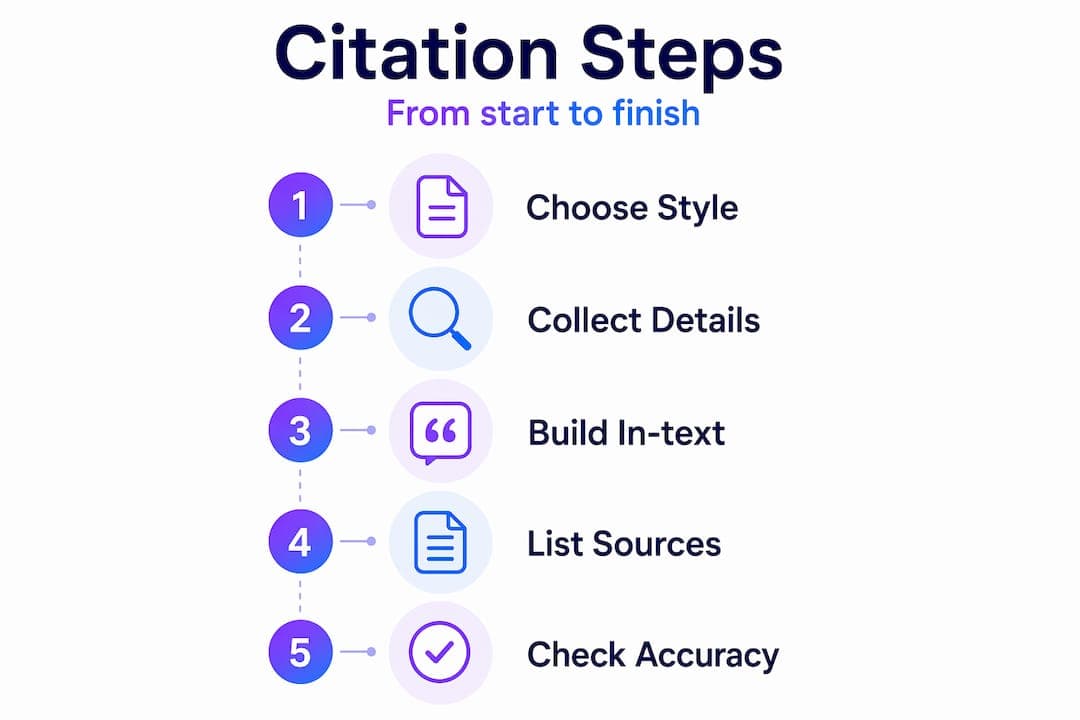
Your choice of style is usually not yours to make freely. It follows your academic discipline or your instructor's requirements. Here's a quick comparison to orient you:
| Style | Used in | In-text format | End-of-paper list |
|---|---|---|---|
| APA (7th ed.) | Social sciences, psychology, education | Author, year: (Smith, 2022) | References |
| MLA (9th ed.) | Humanities, literature, languages | Author, page: (Smith 45) | Works Cited |
| Chicago (NB) | History, arts, some humanities | Footnote or endnote number | Bibliography |
Beyond format, the core elements you'll gather for almost any source are the same: author name(s), publication year, title of the work, title of the container (journal, website, book), publisher, and location information such as page numbers, volume, or URL. Collect these the moment you identify a source. Hunting them down later wastes time.
With your style confirmed and source details collected, you're ready to build in-text citations. The process differs by style but the principle is constant: cite immediately after the idea or quotation, not at the end of the paragraph.
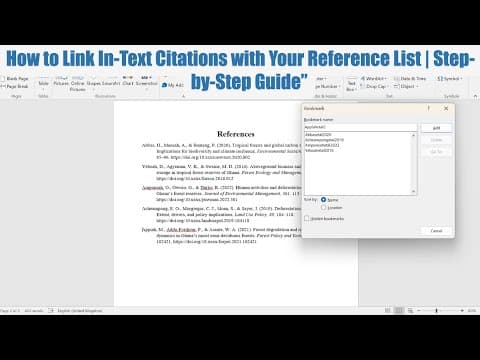
APA uses an author-date system. The year in your in-text citation must always match the year in your reference list. Per APA's author-date system, narrative citations spell out "and" between authors, while parenthetical citations use an ampersand.
Follow this sequence:
Pro Tip: Record page and paragraph numbers in your notes the moment you copy or paraphrase a passage. Trying to locate them during editing is how citations end up vague or incomplete.
MLA places the author's last name and a page number inside parentheses, with no comma between them: (Smith 112). If the author's name appears in your sentence, you only need the page number in parentheses: (112). For sources without page numbers, omit the locator entirely rather than guessing.
Chicago's Notes-Bibliography style uses superscript numbers in the text that correspond to notes at the bottom of the page (footnotes) or at the end of the paper (endnotes). The first reference to a source gets a full citation. All later references to the same source use a shortened version. Per Chicago style documentation, when a quotation spans multiple paragraphs, you still include all relevant page references even if note placement shifts for readability.
For more detail on formatting Chicago citations within your text, the Chicago in-text citation guide at Samwell covers both footnote and endnote approaches with worked examples.
Once your in-text citations are in place, your end-of-paper source list needs to account for every source you cited and nothing more.
The APA reference list format follows strict rules:
Pro Tip: APA publishes over 100 reference examples on its official website. Before submitting, pull up the relevant example type (journal article, book chapter, website) and compare your entry field by field. Citation managers get metadata wrong more often than you'd expect.
MLA's approach is built around nine core elements: author, title of source, container, contributor, version, number, publisher, date, and location. The key rule is omission: if an element does not apply to your source, skip it entirely rather than leaving a blank space. This makes the same template work for a journal article, a film, a tweet, and a book chapter without switching mental frameworks.
Entries go in alphabetical order by author's last name. If a source has no named author, alphabetize by the first major word of the title. For a detailed walkthrough of MLA formatting, the MLA citation guide at Samwell is worth bookmarking.
Chicago bibliography entries look similar to APA reference entries but use different punctuation and ordering conventions. The first time you cite a source in a footnote, write the full citation. Subsequent footnotes for the same source use a shortened form (Author, Shortened Title, Page). Your bibliography at the end lists every source alphabetically, using the full citation format, with the author's last name first.
Even careful writers run into predictable problems. Here's where most errors cluster:
The single most preventable citation error is losing location information. Whether you use a citation manager or plain notes, record page numbers and paragraph numbers immediately when you copy or paraphrase a passage. Editing stage retrieval is almost always inaccurate.
Citation managers like Zotero or Mendeley are genuinely useful, but treat their output as a starting draft, not a finished product. Citation manager reliability depends entirely on the quality of the metadata they pull. Always verify against official style examples before submitting.
I've reviewed hundreds of student papers over the years, and the citation section is almost always where I can tell whether someone understood the assignment or just rushed to finish it. The writers who struggle most aren't careless. They treat citation as an afterthought instead of a parallel workflow.
What I've learned is that the stepwise citation process described in this guide changes that dynamic completely. When you handle in-text citations and reference list entries as two separate, deliberate tasks rather than one frantic session at the end, errors drop significantly. The separating inline from reference tasks principle sounds obvious, but almost no one applies it until they've made the mismatch mistake once.
There's also a misconception I keep seeing: that rigorous citation is about satisfying instructors. It isn't. APA, for instance, frames citations as navigation tools, not formalities. You're giving readers a map to find your sources. That reframing matters because it shifts citation from a compliance task to a craft decision. When I started thinking that way, my own reference lists became cleaner and more deliberate.
My practical advice: build your reference list entry the same moment you decide to use a source. Don't wait until your paper is drafted. This single habit eliminates most of the common errors described in this guide.
— Tilen
If working through a full citation process for every paper feels like it's consuming time you should spend on analysis and argumentation, Samwell is built specifically to change that.
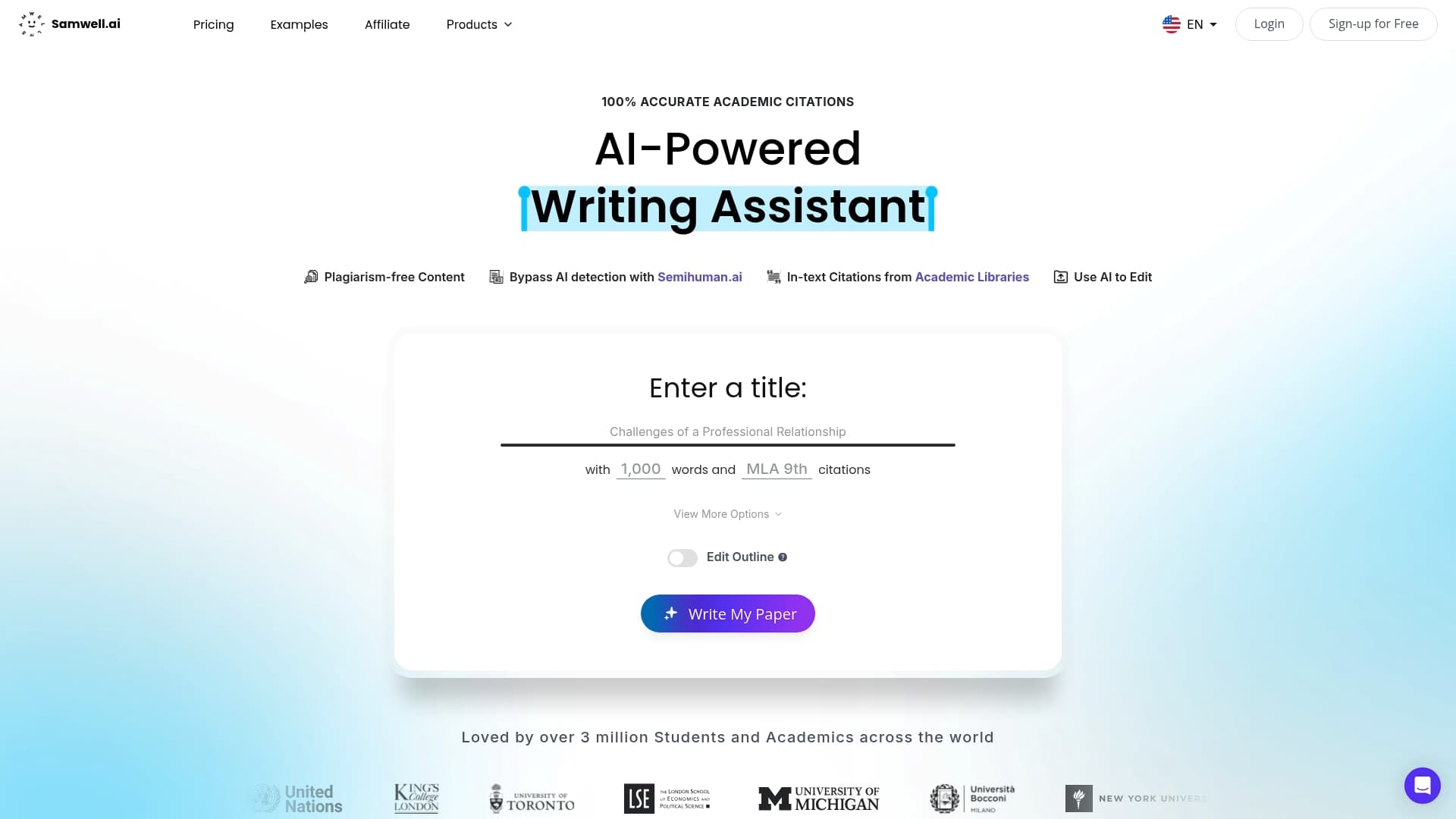
Samwell's AI-driven research paper generator handles citation formatting across APA, MLA, and Chicago styles while you focus on the substance of your argument. You can provide your own sources and specific citation requirements, and Samwell integrates them directly into your paper with properly formatted in-text citations and reference lists. The platform's Semihuman.ai technology also runs real-time originality checks so your paper stays academically credible from first draft to submission. Over one million students at leading universities already use Samwell to write with confidence. If you're ready to stop second-guessing your citations, get started here.
A step by step citation guide covers how to build in-text citations, format a complete reference list, and avoid common errors across major styles like APA, MLA, and Chicago. It walks you through both the preparation and execution phases of the citation process.
APA in-text citations use the author's last name and publication year in parentheses immediately after the referenced idea, for example (Smith, 2023). Direct quotations also require a page number or paragraph number for sources without page numbers.
An APA reference list starts on a new page labeled References, lists all cited sources in alphabetical order by first author's last name, uses a hanging indent, and is double-spaced throughout. Each entry includes the author, year, title, and publication details.
MLA uses author name and page number in parentheses rather than author and year, and the end-of-paper list is called Works Cited rather than References. MLA's nine-core-elements template also applies universally across source types, simplifying formatting decisions.
In APA, use the organization or website name in place of a personal author, and replace the year with "n.d." for no date. In MLA, alphabetize the Works Cited entry by the first major word of the source title.