Loading...

You've probably heard that bragging about your achievements helps your self-introduction essay stand out. Research shows the opposite is true. Admissions officers rate essays showing genuine reflection 40% higher than those perceived as boastful. Effective essays balance personal stories with authentic reflection, creating meaningful connections with readers. This guide will teach you how to structure and personalize your essay to genuinely stand out.
| Point | Details |
|---|---|
| Purpose and impact | Self-introduction essays create positive first impressions and distinguish you beyond grades. |
| Clear structure boosts engagement | Essays with clear introductions and conclusions score 15% higher on average. |
| Use specific experiences | Concrete details and reflection on growth create memorable, authentic narratives. |
| Connect past to future | Link your experiences directly to academic and career aspirations for coherent storytelling. |
| Authenticity over credentials | Genuine reflection and personal voice engage readers more effectively than listing achievements. |
Self-introduction essays present your identity, experiences, and aspirations authentically to evaluators. These essays play crucial roles in college admissions, scholarship applications, and even job interviews. They help create positive first impressions with admissions officers, scholarship committees, and potential employers who review hundreds of applications.
The essay distinguishes you beyond test scores and transcripts. Your GPA shows academic capability, but your essay reveals character, values, and potential. It sets the foundation for connecting your past experiences with future goals in ways that numbers cannot.
Consider these key purposes:
When you understand these purposes, you can craft essays that resonate. Writing effective essays about yourself starts with recognizing that evaluators want to know the person behind the application, not just a list of accomplishments.
Research confirms that essays showing genuine reflection score significantly higher. This means focusing on authentic stories rather than impressive-sounding credentials creates better outcomes.
A clear three-part structure transforms your essay from a jumbled narrative into an engaging story. This framework includes an introduction that hooks readers, body paragraphs that develop your narrative, and a conclusion that ties everything together.
Your introduction should accomplish two goals immediately. First, grab attention with a vivid scene, surprising fact, or thought-provoking question. Second, preview what readers will learn about you without giving away everything.
Body paragraphs follow logical progression with clear topic sentences. Each paragraph explores one main idea or experience that builds toward your overall message. Structured essays score 15% higher on average in evaluative assessments, making organization crucial for success.
Here's a practical structure to follow:
Transitions maintain flow across sections. Use phrases that connect ideas naturally rather than mechanical transitions like "furthermore" or "in addition." Your essay structure checklist should include checking that each paragraph flows smoothly into the next.
Consider this comparison:
| Weak Structure | Strong Structure |
|---|---|
| Random list of achievements | Chronological narrative with clear progression |
| Abrupt topic changes | Smooth transitions between ideas |
| Missing conclusion | Summary that reinforces main message |
| Unclear purpose | Clear thesis guiding entire essay |
Pro Tip: Draft your conclusion first to clarify where your essay should lead, then write your introduction and body to build toward that endpoint.
Crafting compelling introductions requires practice, but following this structure makes the process manageable. The key is maintaining coherence while allowing your authentic voice to shine through.
Specific, vivid details make your experiences memorable and believable. Rather than stating "I learned leadership," describe the moment you rallied your debate team after a tough loss, detailing the emotions and exact words you used.

Concrete sensory details paint scenes readers can visualize. What did you see, hear, or feel during pivotal moments? These details create emotional connections that generic statements cannot achieve.
Balance achievements with insights on personal growth. Listing awards feels hollow without explaining what you learned or how challenges shaped your perspective. Your essay should reveal how experiences changed your thinking, not just what you accomplished.
Include challenges you faced and how they shaped you. Struggles make your story relatable and demonstrate resilience. Model essays increase student confidence by 50% by showing how successful writers handle vulnerability authentically.
Avoid these common pitfalls:
Maintain authenticity by reflecting true feelings and lessons. Readers detect insincerity quickly, so write about what genuinely matters to you rather than what you think sounds impressive.
Personal essay introduction examples demonstrate how specific details create engagement. Notice how effective essays zoom in on particular moments rather than summarizing entire experiences.
Pro Tip: After drafting, highlight every vague adjective like "great" or "amazing" and replace with specific descriptions that show rather than tell.
Your past experiences provide the foundation for future goals, and making this connection explicit strengthens your narrative. Explain how specific moments influenced your academic or career aspirations rather than simply listing goals.
Show clear alignment between what you've done and where you want to go. If you're applying to engineering programs, connect childhood curiosity about how things work with your current passion for sustainable design. This demonstrates intentionality rather than random interest.
Demonstrate motivation and vision for your future. Readers want to understand not just your goals but why they matter to you. What problem do you want to solve? What impact do you hope to make?
Use narrative arc to build coherent story linking past, present, and future:
Highlight how experiences prepared you to achieve goals. If leadership roles taught you collaboration skills, explain how those skills will help you succeed in your chosen field. Make the connection concrete and specific.
Your academic narrative should feel inevitable, as if your past experiences naturally lead to your future plans. This coherence convinces readers that you've thoughtfully considered your path rather than choosing goals arbitrarily.
Avoid disconnects between your story and stated goals. If you write about artistic pursuits but suddenly claim you want to study finance without explanation, readers will question your authenticity. Every element should support your overall message.
Many students assume boasting about achievements improves their essays, but this approach consistently backfires. Essays showing genuine reflection score 40% higher than those perceived as boastful, proving that humility increases trust with readers.
Another myth suggests self-introductions are simply biographies listing life events chronologically. Effective essays emphasize reflection and connection over mere fact-stating. Your essay should reveal how experiences shaped your thinking, not just what happened.
Some students believe perfect form matters more than substance, leading them to prioritize sophisticated vocabulary and complex sentence structures over authentic voice. This overemphasis on form reduces originality and creates essays that sound generic.
Let's correct these misconceptions:
Credentials alone don't create compelling essays. Admissions officers review applications from many accomplished students. What distinguishes you is your unique perspective and authentic reflection on experiences.
Starting your essay effectively means rejecting these misconceptions from the beginning. Focus on telling your genuine story rather than crafting what you think evaluators want to hear.
The most damaging misconception is that self-introduction essays require perfection. Your essay should feel human, which means showing vulnerability alongside strength. This balance creates relatability and trust.
Studying successful essay examples builds confidence and reveals effective techniques without creating templates to copy. Model essays boost student confidence by 50% and guide effective content adaptation.
Examples showcase variety in essay styles and tones. Some successful essays use humor, others take serious reflective approaches, and many blend multiple tones naturally. This diversity proves no single "correct" way exists to write your introduction.
Analyze what makes specific examples effective. Notice how writers use specific details, structure their narratives, and connect experiences to aspirations. These observations inform your own writing choices without dictating them.
Consider this comparison:
| Generic Essay Features | Effective Essay Features |
|---|---|
| Lists activities without reflection | Explores meaning behind experiences |
| Uses clichéd phrases | Employs fresh, specific language |
| Tells what happened | Shows through vivid details |
| Sounds like anyone could have written it | Reveals unique perspective |
| Focuses on impressing readers | Focuses on connecting with readers |
Highlight strengths and unique elements of each example you study. What makes the opening memorable? How does the writer transition between ideas? Where does reflection feel genuine versus forced?
Practical essay examples demonstrate how different writers handle similar challenges. Compare approaches to see multiple solutions for common essay obstacles.
Encourage adapting examples while maintaining personal voice. If an essay uses an effective structural technique, apply that technique to your own content. Never copy language or specific details from examples.
Analyzing examples improves creativity by exposing you to diverse approaches. You'll discover possibilities you hadn't considered, expanding your sense of what works in self-introduction essays.
Editing improves essay clarity and reader impact significantly. Your first draft captures ideas, but revision transforms those ideas into polished, engaging prose. Multiple revisions increase essay acceptance likelihood by up to 30%.
Seek feedback from peers, mentors, or instructors who can offer fresh perspectives. They'll catch unclear passages, awkward phrasing, and logic gaps you miss after reading your essay repeatedly. Choose reviewers who understand your goals and will provide honest, constructive criticism.
Use checklists to track structural and content improvements systematically:
Iterative revisions enhance tone and originality. Read your essay aloud to catch awkward phrasing and ensure natural flow. This technique reveals problems silent reading misses.
Avoid common pitfalls like over-editing and losing authentic voice. Some students revise so extensively they strip away personality, creating technically correct but emotionally flat essays. Preserve your unique perspective while polishing language.
Your essay revision checklist should include both macro concerns like overall structure and micro issues like word choice. Address larger problems before fine-tuning individual sentences.
Pro Tip: Set your essay aside for at least 24 hours between drafts. Fresh eyes catch more issues than tired ones, and distance helps you evaluate your writing more objectively.
The Narrative Arc mental model provides a powerful organizing principle for self-introduction essays. This framework structures your essay into four distinct stages: setup, conflict, resolution, and future vision.
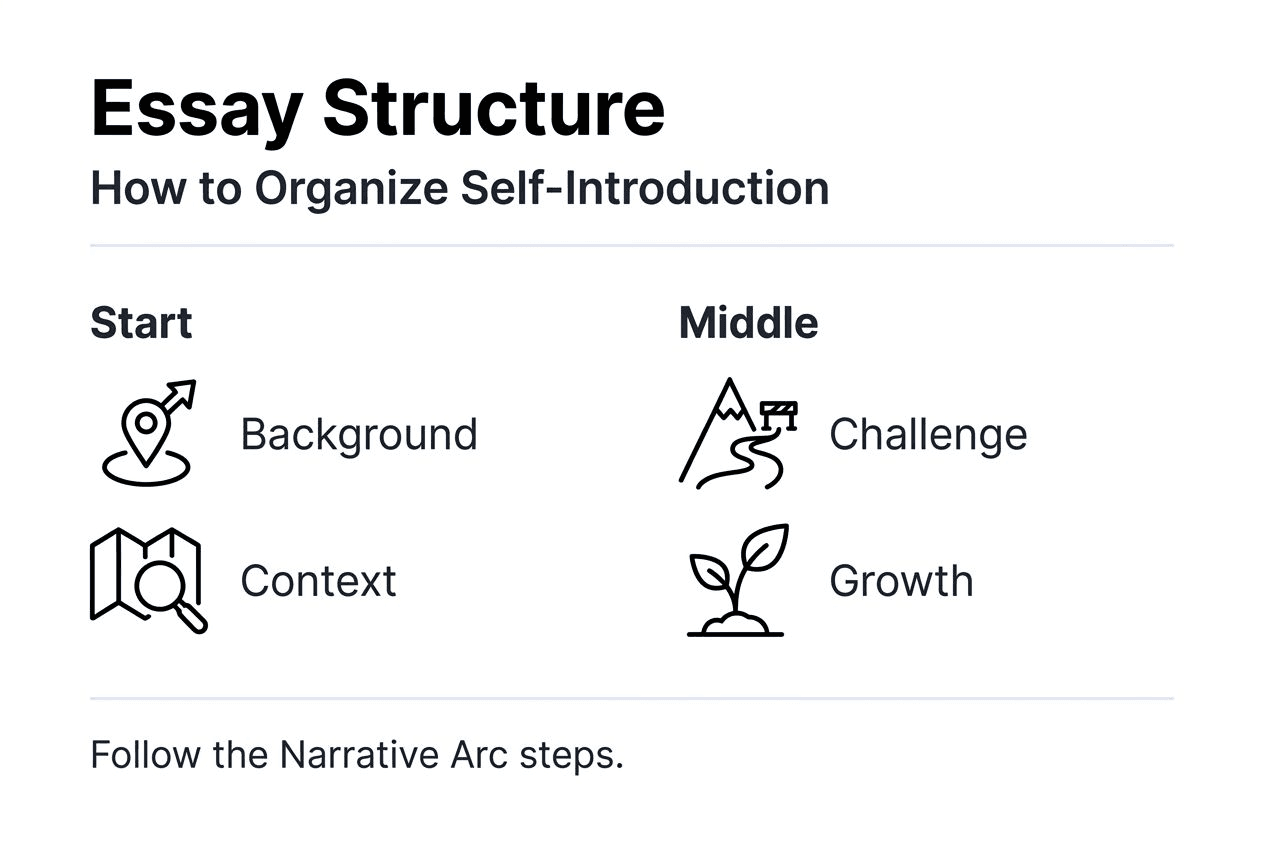
Setup introduces your background and the situation that sparked your interest or growth. This stage establishes context readers need to understand your journey. Keep it concise but vivid enough to engage attention.
Conflict presents the challenge, question, or obstacle you faced. This creates tension and stakes that make readers care about your story. The conflict might be external circumstances or internal struggles with identity or purpose.
Resolution shows how you addressed the challenge and what you learned. This stage demonstrates growth, resilience, and self-awareness. Focus on insights gained rather than simply stating you overcame difficulties.
Future vision connects your growth to aspirations and goals. This final stage completes the arc by showing where your journey leads next. It answers the implicit question: so what?
Here's how to apply this framework:
Compare traditional versus Narrative Arc structures:
| Traditional Structure | Narrative Arc Structure |
|---|---|
| Introduction, body, conclusion | Setup, conflict, resolution, vision |
| Often feels static | Creates dynamic progression |
| May lack clear purpose | Purpose emerges from conflict |
| Conclusion can feel disconnected | Vision naturally extends resolution |
This framework helps create compelling and coherent stories by aligning personal experiences with growth and aspirations. The structure provides flexibility while ensuring your essay maintains momentum and direction.
Your essay structure checklist should verify that your narrative follows this arc naturally. If any stage feels rushed or missing, revise to strengthen that element.
Pro Tip: Draft a one-sentence summary of each Narrative Arc stage before writing your full essay. This outline ensures your story has all essential elements before you invest time in detailed writing.
Mastering self-introduction essays becomes easier when you combine proven techniques with modern writing resources. Samwell.ai offers comprehensive tools designed specifically for students navigating academic writing challenges.
Our academic writing checklist guide provides step-by-step frameworks for organizing and refining your essays. These checklists ensure you address every crucial element without feeling overwhelmed by the process.
Explore our comparison of AI writing tools to understand how technology can enhance your writing efficiency while maintaining originality. The right tools help you focus on crafting authentic narratives rather than struggling with technical details.
Discover academic writing best practices that combine expert advice with practical application. These resources help you develop skills that extend beyond single essays to improve all your academic writing.
Include specific experiences that shaped your identity, reflections on personal growth, and clear connections between your past and future goals. Focus on authentic stories rather than listing achievements, and use concrete details to make your narrative memorable and engaging.
Most self-introduction essays range from 500 to 650 words, though requirements vary by institution. Always follow specific word count guidelines provided, and use every word purposefully to convey meaningful insights rather than filling space with generic statements.
Make your essay stand out through authentic voice, specific details, and genuine reflection. Avoid clichés and focus on unique perspectives only you can offer. Tips for writing about yourself emphasize showing rather than telling to create memorable impact.
Yes, discussing challenges and areas of growth demonstrates maturity and self-awareness. Focus on what you learned from difficulties rather than dwelling on failures. This vulnerability creates relatability and shows evaluators you can reflect honestly on experiences.
Start with a vivid scene, surprising insight, or thought-provoking question that immediately engages readers. Avoid generic openings like "My name is" or "I have always wanted to." Your first sentence should make evaluators want to keep reading.