Loading...

TL;DR:
- Scholarly writing aims to express complex ideas clearly, build convincing evidence-based arguments, and contribute to academic conversations. It is characterized by formal, objective, precise, and concise language, prioritizing transparency and logical structure. Mastering its principles requires adopting an intellectual humility-focused mindset that fosters curiosity and rigorous thinking.
Most students assume scholarly writing is about sounding impressive with elaborate vocabulary. That assumption leads to bloated sentences, vague arguments, and papers that fail to convince anyone. Scholarly writing actually aims to express complex ideas clearly, build convincing arguments from solid evidence, and contribute to expert conversations in a given field. This article breaks down the real definition of scholarly writing, maps out its core features and structures, clarifies how it differs from related academic styles, and gives you practical strategies to strengthen your own research writing immediately.
| Point | Details |
|---|---|
| Definition clarity | Scholarly writing means using clear, evidence-backed language to advance academic conversations. |
| Core features | It is formal, objective, concise, and avoids personal opinions in favor of precise reasoning. |
| Structural patterns | Most scholarly texts use distinctive structures such as IMRaD to organize complex arguments. |
| Key distinctions | Scholarly and peer-reviewed writing overlap, but not all scholarly writing is peer reviewed. |
| Application | Learning scholarly writing helps you build credible research and stronger arguments in academia. |
Scholarly writing is not a style reserved for professors and journal editors. It is a mode of communication built around precision, evidence, and advancing knowledge within a specific discipline. When you write scholastically, you are entering a conversation that experts have been building for decades, sometimes centuries, and your contribution needs to meet established standards of rigor and clarity.
Understanding why academic writing matters starts with recognizing that scholarly writing differs sharply from journalistic or popular writing. A newspaper article might summarize a scientific finding in two paragraphs with colorful language and personal anecdotes. A scholarly piece on the same topic would define its terms carefully, explain the methodology used, cite prior research, and present conclusions qualified by the limits of the evidence.
"Scholarly writing is generally characterized by formal, objective, precise, and concise language and is not conversational; it avoids personal judgments and uses evidence and precise wording to reduce ambiguity."
Who produces and reads scholarly writing?
One distinction that confuses many students is the difference between "scholarly," "academic," and "peer-reviewed." Academic writing is a broad category that covers everything from a freshman essay to a doctoral thesis. Scholarly writing is a subset: it specifically refers to work written by and for experts, reporting original research or critical analysis. Peer review is a process, not a writing style. A piece can be scholarly without being peer-reviewed, though peer-reviewed work is always part of the scholarly literature. Knowing these types of academic sources helps you use and produce them more effectively.
With the definition established, let's break down the essential features that set scholarly writing apart. These are not arbitrary conventions. Each principle serves a specific communicative function and helps your writing do its job: persuade an expert audience through transparent reasoning and reliable evidence.
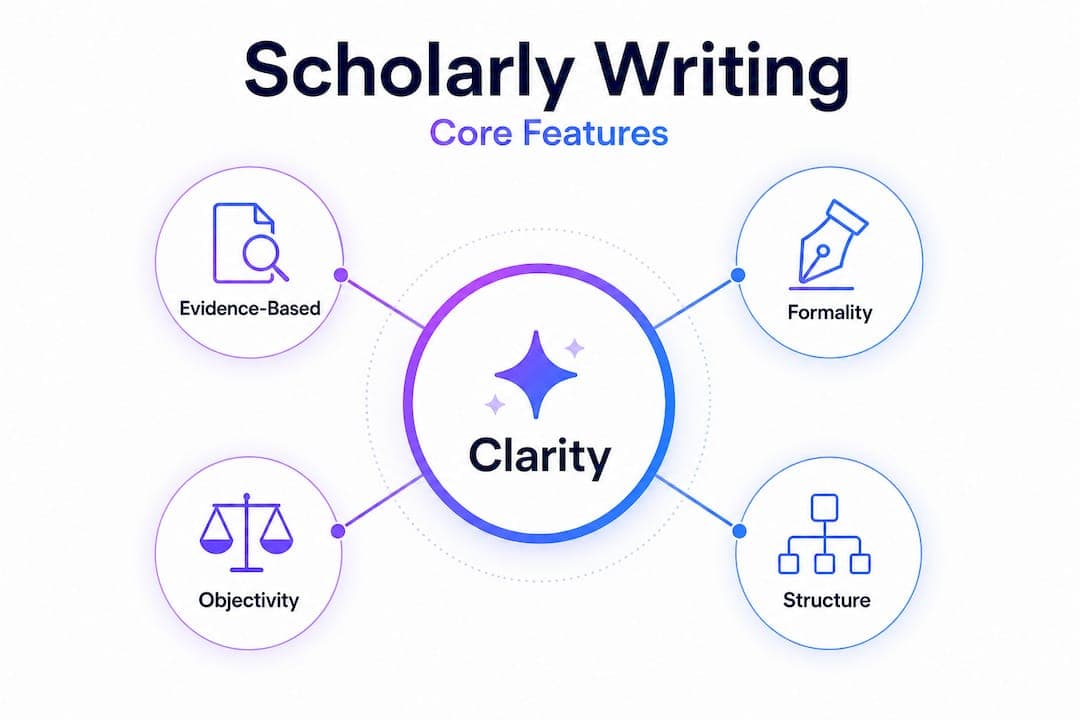
Academic writing aims to express complex ideas clearly, build a convincing argument based on evidence, and contribute to broader expert discussion. To accomplish that, five core principles run through every strong scholarly text.
| Principle | What it means | Example phrase |
|---|---|---|
| Formality | Avoid contractions, slang, and casual phrasing | "The results indicate…" not "The results show we were right" |
| Objectivity | Minimize first-person opinion; let evidence lead | "The data suggest…" not "I think…" |
| Precision | Use exact, discipline-specific terms defined on first use | "Participants (n=120) were randomly assigned…" |
| Conciseness | Every word earns its place; no padding | "Studies show X" not "Research in the field has demonstrated that X may indeed be the case" |
| Evidence-based argumentation | Every claim is supported by cited, verifiable sources | "(Smith, 2022, p. 45)" following a specific factual claim |
These principles interact. A precise sentence is often more concise. An objective tone supports evidence-based argumentation because it removes the author's personality as a variable in the reader's evaluation.
Common pitfalls that undermine scholarly writing:
Understanding the essential components of academic essays can help you avoid these traps before they undercut your argument.
Pro Tip: Formality does not mean complexity. Read your draft aloud. If you stumble or lose the meaning halfway through a sentence, your reader will too. Clear, formal language is your goal, not dense language. See our resource on improving academic writing for concrete editing techniques.
Once you know the features, it's crucial to understand how scholarly writing is typically structured for different research purposes. Structure is not just a template. It is a signal to readers about what kind of knowledge you are presenting and how they should evaluate it.

The most widely recognized framework for empirical research is IMRaD. Empirical research articles often use an evidence-forward structure such as IMRaD (Introduction, Methods, Results, Discussion), and research reports follow a similar logic. Each section has a distinct job: the Introduction frames the research question and reviews prior work; the Methods section explains exactly how data were collected and analyzed; the Results section reports findings objectively; and the Discussion interprets what those findings mean within the broader scholarly context.
But IMRaD is not the only structure in scholarly writing. Different genres call for different frameworks.
| Structure | Best for | Key components |
|---|---|---|
| IMRaD | Empirical research articles | Introduction, Methods, Results, Discussion |
| Standard essay | Argumentative or analytical papers | Thesis, body paragraphs, conclusion |
| Literature review | Synthesizing existing research | Thematic or chronological organization, critical synthesis |
| Case study | In-depth examination of one subject | Background, analysis, findings, implications |
When should you use each structure?
The academic paper structure you choose shapes how your reader evaluates your argument. Choosing the wrong structure, like writing a narrative case study when an empirical report is expected, signals to reviewers that you misunderstood the task. Understanding the role of research papers in building disciplinary knowledge makes it easier to select the right format for your work.
Pro Tip: Before you write a single sentence, check the submission guidelines from your journal, your instructor, or your institution. Required structure is usually non-negotiable. Misaligning your format with expectations is one of the fastest ways to get a paper returned unread.
Now let's clear up how scholarly writing relates to other forms of academic writing, and why these differences matter for how you read, cite, and produce texts.
It is common to treat "scholarly," "academic," "peer-reviewed," and "educational writing" as synonyms. They are not, and using them interchangeably leads to poor source selection and misaligned writing choices. Knowing the types of academic writing puts you in a much stronger position as both a reader and a writer.
Here is how these categories actually differ:
"Scholarly and peer-reviewed are related but not identical; some scholarly work may not be peer reviewed, but peer-reviewed work is always part of scholarly literature."
This distinction matters when your instructor says "use scholarly sources." A working paper from a university research center, a book chapter by a leading expert, or a preprint posted before journal review may all be scholarly. Not all of them are peer-reviewed. Knowing the difference protects you from either over-restricting your sources or relying on materials that lack the vetting process peer review provides.
With the distinctions clear, let's see how you can put scholarly writing principles into practice. Theory without application is just description. Here are concrete steps you can take right now to make your writing more scholarly, regardless of your current level.
Methodology and evidence are central to scholarly writing. The purpose is building arguments based on evidence rather than personal opinion. Every step below points back to that core idea.
Understanding how to write the methodology section of a research paper is especially valuable if you are writing empirical work, since transparency about your methods is what allows other scholars to evaluate and build on your findings.
Pro Tip: Find three to five published articles in your target journal or field that you consider models of strong scholarly writing. Read them not for content but for structure, sentence style, and how the authors handle evidence and transitions. Then revise your own draft with those models in mind. Research on teaching academic writing consistently shows that reading exemplary texts in your discipline is one of the most effective ways to internalize scholarly conventions.
Most guides on scholarly writing give you a checklist: use formal language, cite your sources, follow the structure. Those rules are necessary. But they are not sufficient. After working with students and academic professionals across dozens of disciplines, the pattern is clear: students who struggle with scholarly writing are usually missing not knowledge of the rules, but a particular mindset.
Scholarly writing is fundamentally an act of intellectual humility. You are not asserting your opinion loudly enough to drown out disagreement. You are presenting the strongest possible case for a position, showing your reasoning transparently, and inviting expert scrutiny. That requires a genuine orientation toward curiosity and precision, not just a style guide.
Here is what most advice misses: the process of learning to write scholastically does not just improve your papers. It sharpens your thinking. When you force yourself to find evidence for every claim, you discover which of your beliefs are actually well-founded and which are assumptions you picked up without examination. That is an enormously valuable skill outside academia too.
"Learning to write with scholarly precision is, at its core, learning to think more rigorously about what you actually know versus what you merely believe."
Checklists get you to a passing grade. Mindset gets you to original contribution. The difference between a student who produces competent scholarly work and one who produces genuinely interesting scholarly work usually comes down to curiosity: they want to know the answer to their research question, not just complete the assignment. If you approach every paper as an opportunity to actually figure something out, the precision and formality of scholarly writing stop feeling like constraints and start feeling like tools. Explore more on improving academic writing as you continue to develop this mindset in practice.
Understanding the principles of scholarly writing is the first step. Putting them into consistent practice is where most students need ongoing support, especially when juggling multiple courses, tight deadlines, and complex citation requirements.

Samwell AI is built specifically for students and academic professionals who want to produce rigorous, well-structured scholarly work without losing hours to formatting and source management. The enhanced essay creator guides you through building thesis-driven papers with structured outlines, integrated citation management for APA and MLA, and a Power Editor that helps you expand and refine arguments at the section level. Real-time AI detection checks mean your submissions stay academically honest. Whether you are writing your first research paper or preparing a graduate-level literature review, Samwell AI gives you the scaffolding to write with scholarly confidence from the first draft forward.
The main purpose of scholarly writing is to communicate complex ideas clearly, support arguments with evidence, and participate meaningfully in academic discussions within a specific field.
No. While peer-reviewed work is always part of scholarly literature, some scholarly work such as working papers, book chapters, and conference presentations may be scholarly without undergoing formal peer review.
Empirical articles usually follow the IMRaD structure (Introduction, Methods, Results, Discussion), while argumentative essays, literature reviews, and case studies each follow distinct but equally systematic organizational frameworks.
Scholarly writing requires formal, objective, and precise language, meaning you should avoid contractions, conversational phrases, and personal judgments throughout your text.
Scholarly writing is produced by and for experts, reporting original research or critical analysis, while general academic writing is a broader category that includes student assignments and instructional materials not necessarily aimed at specialist audiences.