Loading...

TL;DR:
- Writing the introduction first is a common mistake; understanding the research structure can prevent desk rejection and revision loops.
- Following the IMRaD framework—Introduction, Methods, Results, Discussion—ensures clarity and alignment with journal expectations, with Methods drafted prior to other sections.
Most researchers write their introduction first. That's already a mistake. The scholarly article writing process has a logic to it that isn't obvious until someone lays it out clearly, and most students discover the hard way that pouring words into a blank document without understanding structure, sequencing, and journal requirements leads to desk rejection or rounds of painful revision. This guide walks you through every stage, from identifying a research gap to responding to peer reviewers, so you spend less time backtracking and more time producing work worth publishing.
| Point | Details |
|---|---|
| Follow IMRaD structure | Most empirical articles use Introduction, Methods, Results, Discussion as the foundational framework. |
| Write Methods before Introduction | Drafting Methods first locks in your methodology before interpretive sections are written. |
| Make your lit review argumentative | A thematic, debate-driven literature review builds the case for your research gap far better than summaries do. |
| Edit in multiple passes | Each revision pass should target one element: clarity, flow, citations, or formatting compliance. |
| Match journals before submitting | Review Aims and Scope before submission to avoid desk rejection on the first read. |
The backbone of most empirical research is IMRaD structure: Introduction, Methods, Results, and Discussion. According to UCSF's publishing guide, original empirical articles typically follow this format, though article-specific variations exist depending on the journal and discipline. A review article, for instance, won't have a Methods section in the traditional sense, while a case study may blend Results and Discussion into a single narrative section.
Understanding what each section is actually for matters more than memorizing labels.
Beyond IMRaD, some journals require additional sections like a Theoretical Framework, Limitations paragraph, or Implications for Practice subsection. Always download the journal's author guidelines before you write a single paragraph. Those guidelines dictate word limits, citation style, figure formatting, and even the level of subheading you are allowed to use. Skipping that step is one of the fastest routes to desk rejection.
Good scholarly writing starts weeks before you open a word processor. The planning phase determines whether your article will have a genuine contribution or just add noise to an already crowded field.
Finding a real research gap
A research gap is not simply a topic nobody has written about lately. It is a specific, defensible absence in the scholarly record: a population not studied, a methodology not applied, a contradiction between existing studies that hasn't been resolved. Read widely in your field first, then narrow your reading to the last five to seven years of publications in your target journals. Gaps reveal themselves when you notice researchers saying "future studies should examine..." or when two well-cited papers reach contradictory conclusions.
Building a strategic literature review
The most common mistake in the scholarly article writing process is treating the literature review as a chronological summary of everything ever written on a topic. A well-executed literature review structure is thematic and argumentative. It organizes prior work into conceptual groupings, highlights debates, identifies what remains unresolved, and positions your study as the logical next step. A thematic, debate-driven review does something a summary never can: it builds a case that your research is necessary.
Drafting a focused thesis or hypothesis
Your thesis or research hypothesis should be narrow enough to test and defend within the scope of one article. "Social media affects student learning" is not a thesis. "Passive social media use during lecture correlates with lower recall scores among undergraduate students in STEM programs" is a thesis. The specificity of your research question controls the shape of your entire article.

Pro Tip: Create a simple outline with one sentence per section before drafting. This forces you to commit to an argument before getting lost in the writing itself.
Once your outline is in place and your notes are organized by theme rather than by source, you are genuinely ready to write.
Here is where most students waste hours of effort by starting in the wrong place. The recommended sequence for drafting is counterintuitive but grounded in logic.
Methods first. Drafting Methods before other sections forces you to document your procedures while they are still fresh and ensures the level of detail needed for reproducibility. It also anchors every subsequent section to what you actually did, not what you wish you had done.
Results second. Report your findings as objective facts. Every claim in this section should be traceable to a specific table, figure, or statistical output. Resist the urge to explain or interpret. Save that for Discussion.
Discussion third. Now interpret. Connect your results to the literature you reviewed during planning. Address unexpected findings directly. State your limitations plainly; reviewers will notice if you do not, and they will flag it. Strong Discussion sections answer the question "So what?" for every major finding.
Introduction fourth. Writing your Introduction after you know your results and discussion lets you frame the research gap and purpose with precision. You know exactly what your study found, so you can write an Introduction that sets it up cleanly. The Introduction should establish significance, survey the current knowledge, name the gap, and state your study's purpose.
Abstract and title last. Title and abstract are best written after you have finished the manuscript. The abstract is typically around 250 words and must summarize the problem, methods, results, and implications concisely. Your title should contain the key variables or constructs from your study and make the article's contribution obvious in under fifteen words.
Pro Tip: Write your Discussion section with a printed copy of your Results next to you. Anytime you make an interpretive claim, physically check that a corresponding data point supports it before moving on.
This sequence is not arbitrary. It mirrors the way knowledge is built: from evidence outward, not from argument inward.
Writing a draft is roughly half the work. The scholarly article writing process depends heavily on revision, and the researchers who get published are usually the ones willing to tear apart a draft and rebuild it multiple times.
The most effective approach is to run separate editing passes for different priorities:
Build section-level quality checkpoints into your revision routine. Before finalizing Results, confirm every finding references a data table. Before finalizing Discussion, confirm that limitations are explicitly stated. These checkpoints catch the errors that most commonly come back from peer review.
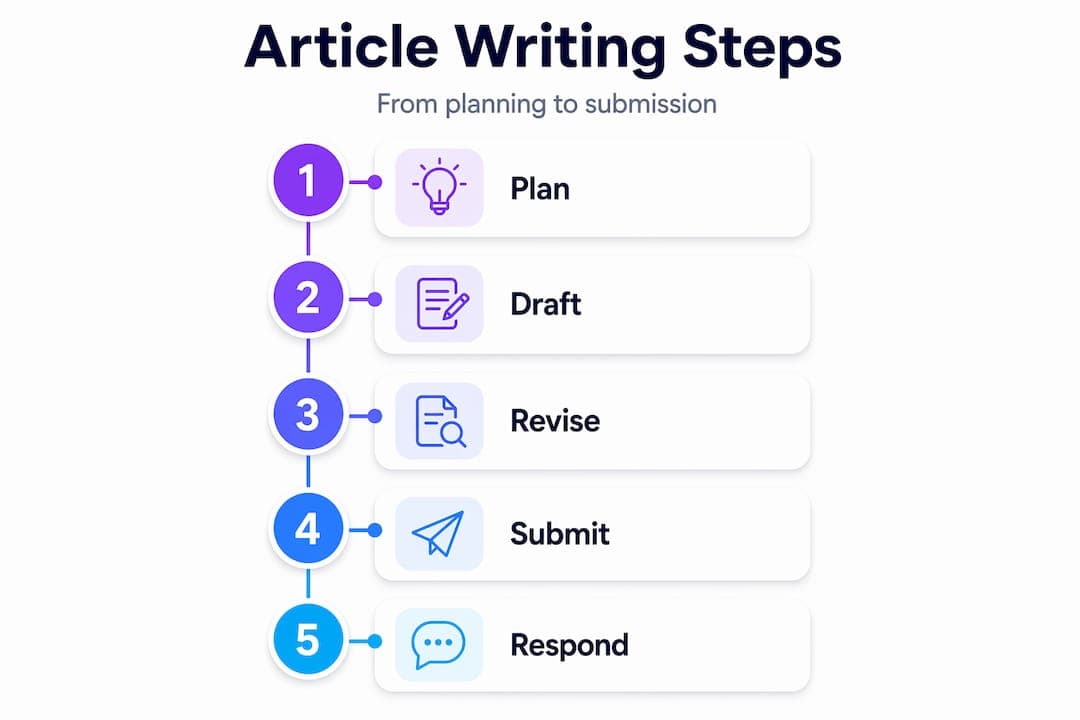
Choosing the right journal is a strategic decision. Review the Aims and Scope of every journal you consider. Selecting a journal aligned with your research type and intended audience directly affects your chances of passing the initial editorial review. A qualitative education study submitted to a biomedical journal is not going to make it past a desk check, no matter how well it is written.
When you are ready to submit, prepare your cover letter with as much care as the manuscript itself. Your cover letter is a direct pitch to the editor: state why your article fits this journal specifically, what gap it fills, and why it is relevant to the journal's readership right now. Three focused paragraphs are enough. Keep it professional and direct.
When peer review feedback arrives, treat it as a technical problem, not a personal critique. Respond to every comment, whether you agree or not. For each suggested revision, either make the change and note where in the manuscript, or explain clearly and respectfully why the critique does not apply. Reviewers are not always right, but they are always the gatekeepers.
I've watched researchers spend months circling the same draft because they tried to write everything at once. The scholarly article writing process rewards people who break it into discrete phases and resist the temptation to polish prose before the argument is solid.
What I've learned from watching dozens of submission cycles is that the writers who publish consistently treat editing as a separate cognitive task from drafting. They draft to discover, then edit to clarify. The two modes require different mental states, and mixing them leads to slow progress and mediocre outcomes.
My take on the literature review is that most people write too much of it. A tight, argumentative review of the fifteen most relevant papers beats a sprawling summary of fifty. Quality of engagement, not quantity of citations, is what demonstrates scholarly command of a field.
The most underrated skill in academic publishing is knowing when a draft is good enough to submit, not perfect. Perfectionism produces excellent research that never gets published. Publish, get feedback, and improve.
— Tilen
Writing a scholarly article is demanding work, and having the right tools makes the process significantly less overwhelming.
Samwell's AI research paper tools help you move from raw notes to a structured draft without losing your voice or your argument. The platform supports proper citation formatting across APA, MLA, and other major styles, and its real-time AI detection checks help you maintain originality throughout the drafting process. Whether you are building out a literature review, refining your Discussion section, or improving your abstract, Samwell's Power Editor lets you target specific sections for revision. Over one million students and academic professionals have used Samwell to produce credible, well-structured academic work.
IMRaD stands for Introduction, Methods, Results, and Discussion. It is the standard framework used in most empirical research articles across sciences and social sciences.
Write Methods first, then Results, then Discussion, then Introduction, and finish with the Abstract and title. This sequence ensures each section is grounded in what you actually found.
Most abstracts run around 250 words and should cover the research problem, methods, key results, and implications. Always check the specific journal's author guidelines for exact limits.
A scholarly literature review is thematic and argumentative. It groups prior work by concept or debate, identifies what remains unresolved, and builds a case for why your research fills a specific gap.
Read the journal's Aims and Scope carefully and match your submission to its stated focus and article types. Follow the author guidelines precisely on formatting, word count, and citation style before you submit.