Loading...

A synthesis essay sample is a model essay that builds an original argument by weaving at least three provided sources into a single, defensible thesis. This page gives you exactly what you need to write one confidently.
Here is what you will find:
All examples and guidance are aligned with College Board AP English Language and Composition standards.
A strong synthesis essay requires a defensible thesis, evidence from at least three provided sources, and commentary in every body paragraph that connects evidence directly to the thesis.
| Point | Details |
|---|---|
| Thesis is non-negotiable | Write a defensible position that a reasonable person could dispute; topic statements earn zero points. |
| Three-source minimum | The AP rubric requires synthesis of at least three of the six provided sources; count citations before concluding. |
| Commentary drives the score | Evidence & Commentary is worth four of six rubric points; every piece of evidence needs a follow-up explanation. |
| Plan before you draft | Spend 8–12 minutes reading and outlining; students who skip planning tend to summarize rather than synthesize. |
| Samwell for practice | Samwell's Guided Essays and Power Editor help students practice source integration and catch commentary gaps before exam day. |
A synthesis essay asks you to build your own argument using multiple provided sources as evidence. You are not summarizing what the sources say. You are using them to support, complicate, or extend a position you take.
That distinction trips up a lot of students because the three main AP essay types look similar on the surface. The table below shows exactly where they split.
| Essay type | Your task | Evidence source | Prompt signal words |
|---|---|---|---|
| Synthesis | Build an argument integrating multiple provided sources | Provided sources (usually six) | "synthesize material from at least three sources," "use the sources to support your position" |
| Argument | Defend a position using your own reasoning and evidence | Your knowledge, experience, examples | "develop your argument," "support your claim," "write an essay that argues" |
| Rhetorical analysis | Analyze how a writer uses rhetorical strategies to achieve a purpose | One provided text | "analyze the rhetorical choices," "how does the author build an argument," "examine the strategies" |
The clearest signal that a prompt wants synthesis: it hands you a packet of sources and tells you to use them. If the prompt gives you one text and asks how the author persuades, that is rhetorical analysis. If it gives you no sources at all and asks you to take a position, that is argument.
Synthesis sits in the middle. You have a position, but the sources are the fuel. The skill the grader is measuring is whether you can make those sources talk to each other in service of your claim, not whether you can recall facts from memory.
According to AP English Language and Composition student samples, the synthesis prompt provides six sources and requires you to synthesize material from at least three of them into a defensible thesis. That "at least three" threshold is not a suggestion. Graders track it.
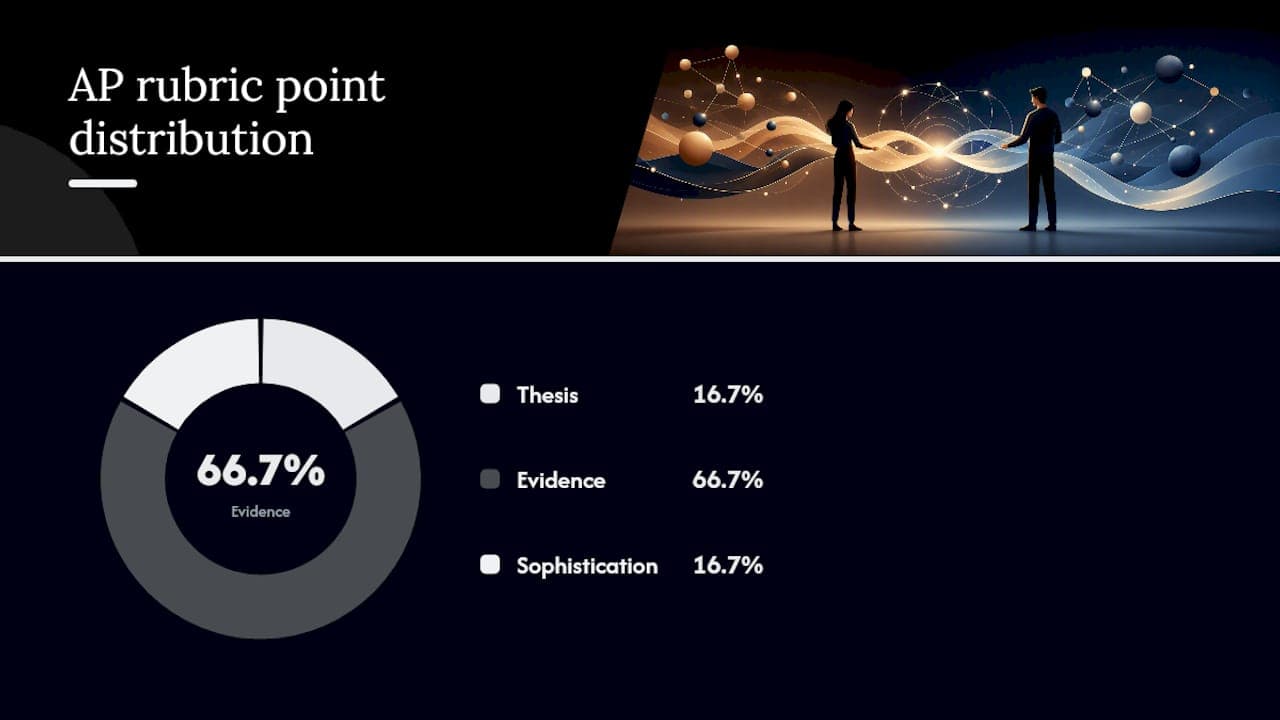
The AP scoring rubric scores synthesis essays across three categories:
| Rubric category | Points available | What graders look for |
|---|---|---|
| Thesis | 1 | A defensible claim that responds to the prompt and is not merely a restatement of it |
| Evidence & Commentary | 4 | Specific evidence from at least three sources, with commentary explaining how each piece supports the thesis |
| Sophistication | 1 | A nuanced argument: acknowledging complexity, using effective rhetoric, or situating the argument in a broader context |
Six points total. The Evidence & Commentary row is where most students win or lose the essay. A thesis earns one point or zero. Sophistication is a single bonus point that rewards genuine complexity, not just a fancy vocabulary. The middle four points come from how well you use and explain your sources.
Pro Tip: Read the rubric before you read the sources. Knowing that commentary is worth four points changes how you annotate the source packet. You are not hunting for quotes; you are hunting for evidence you can explain.
The synthesis, argument, and rhetorical analysis essays collectively make up the free-response section of the AP English Language exam. Graders use the same three-category rubric structure across all three tasks, so the habits you build for synthesis transfer directly to the other essays.
The fastest path to an AP-quality synthesis essay in a timed setting is to spend roughly 8–12 minutes reading and planning, 35–40 minutes drafting, and 5–7 minutes revising. Students who skip the planning stage almost always produce essays that summarize sources instead of synthesizing them.
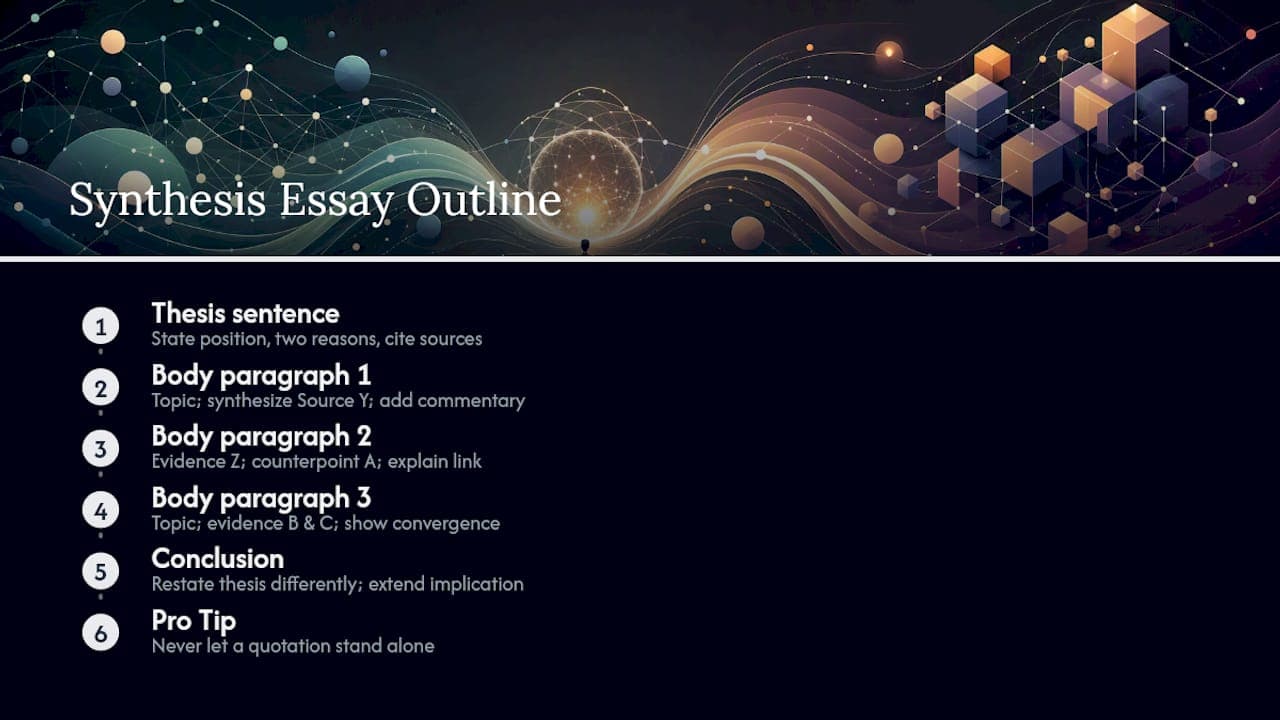
Use this skeleton on test day. Fill in the brackets with your own content.
Thesis sentence: [Specific position on the prompt's question] because [reason 1] and [reason 2], as [sources] demonstrate.
Body paragraph 1: Topic sentence: [Aspect of thesis this paragraph develops].
Synthesis: Source [Y] reinforces this point by [specific connection]. Commentary: Together, these sources show [how evidence supports thesis claim].
Body paragraph 2: Topic sentence: [Second aspect or complicating factor]. Evidence: Source [Z] argues that [specific claim]. Counterpoint/nuance: While Source [A] suggests [contrasting view], this actually strengthens the thesis because [explanation]. Commentary: [Connect back to thesis].
Body paragraph 3: Topic sentence: [Third aspect or broader implication]. Evidence: Sources [B] and [C] both indicate [shared point]. Commentary: This convergence suggests [larger significance for the thesis].
Conclusion: [Restate thesis in new language] + [extend to broader implication or unresolved complexity].
Pro Tip: *When you integrate a quotation, never let it stand alone.
For a deeper walkthrough of source integration moves, the UNLV synthesis essay resource shows classroom-ready paragraph models that demonstrate exactly how to move from evidence to analysis.
The best way to understand what a high-scoring synthesis essay looks like is to read one with the scoring logic explained alongside it. Below are three models at different levels.
AP English Language student samples from recent administrations include full student responses with examiner commentary. A representative high-scoring response typically opens with a paragraph like this:
The body paragraph that follows in a high-scoring response does something specific: it does not summarize Source B, then Source D, then Source F in sequence. It uses all three to build a single point. That is the synthesis move.
Here is a before-and-after showing how a competent paragraph becomes a high-scoring one. The topic is the same technology-and-reading prompt.
Before (summary-heavy, lower score): Source A says that screen time has increased. Source C says reading scores have dropped. Source E says schools are concerned about this.
After (synthesized, higher score):
The Write Like An Eagle sample essays and YourDictionary's synthesis essay examples both offer full essays on topics like internet addiction and social media that you can study for structure. A strong opening from that kind of essay typically reads:
Notice the thesis commits to a causal claim, names sources without summarizing them, and sets up a three-part argument in one sentence.
Scorers look for three things in sequence: a defensible thesis, explicit use of multiple sources, and commentary that connects evidence to the thesis. If any of those three is missing, the score drops. The AP scoring rubric is explicit that evidence without commentary earns fewer points than evidence with it, even when the evidence itself is strong.
Take this sample paragraph and read it as a grader would:
Topic sentence: "The economic argument for renewable energy is strongest when viewed through the lens of long-term infrastructure cost, not short-term installation expense." What the grader sees: A clear, arguable claim that connects to the thesis. Good.
Signal phrase + evidence: "Source B's cost-projection data shows that solar installations reach cost parity with fossil fuels within 12 years in most U.S. markets." What the grader sees: Specific evidence, properly attributed. One source used.
Synthesis move: "Source D complicates this timeline by noting that rural grid infrastructure adds 20–30% to installation costs, a factor Source B does not account for." What the grader sees: A second source introduced not to repeat the point but to add nuance. This is synthesis, not summary.
Commentary: "Taken together, these sources suggest that cost-parity arguments are geographically uneven — which means federal policy, not market forces alone, must close the gap." What the grader sees: Original analysis that connects both sources to the thesis. This is what earns the upper Evidence & Commentary score.
These rewrites fix the three most common paragraph-level problems:
Weak thesis fix: ✗ "There are many ways renewable energy affects the economy." ✓ "Renewable energy reduces long-term infrastructure costs, but only when federal policy addresses the geographic inequities that market pricing ignores."
Missing commentary fix:
Single-source overreliance fix: ✗ Three consecutive sentences all citing Source B. ✓ Introduce Source B for the data point, then bring in Source D or Source E to confirm, complicate, or extend it. The AP student samples consistently show that high-scoring responses pose sources against one another rather than leaning on one.
Pro Tip: Label your sources in the margin of the packet before you write a single sentence. Write "agrees with C," "contradicts B," or "adds nuance to A" next to each source. That annotation becomes your paragraph plan, and it forces you to think in conversations rather than summaries. Evidence-based academic writing instruction consistently identifies this pre-writing move as one of the highest-leverage habits for timed essays.
Most synthesis essays that score in the 3–4 range out of 6 share the same handful of problems. Here is what to watch for and what to do about it.
Run this before you put your pencil down:
The AP synthesis task is part of a longer free-response section, so time discipline matters more than most students expect. A realistic minute-by-minute plan:
If you fall behind: Skip the conclusion first and return to it. A strong three-paragraph essay with a missing conclusion scores higher than a four-paragraph essay where the body paragraphs are thin. Never sacrifice body-paragraph depth for a rushed conclusion.
The AP 2025 FRQ set includes sample prompts with examiner commentary that make excellent timed-practice material. Use them under real conditions: no notes, no internet, 55 minutes.
Most students treat the source packet as a list of quotes to deploy. The students who score 5s and 6s treat it as a conversation they are moderating.
Before drafting, write one sentence in the margin of your scratch paper that captures the relationship between your three strongest sources. Something like: "Source A gives the data, Source C gives the counterargument, and Source E gives the policy implication." That sentence is not your thesis. It is your paragraph architecture. Once you know how the sources relate to each other, you stop summarizing them and start using them.
The AP rubric rewards this directly. Sophistication points go to essays that acknowledge complexity, and the clearest path to complexity is putting sources in genuine tension rather than lining them up as agreeable witnesses. A student who writes "Source B agrees with Source A" earns less credit than one who writes "Source B's data complicates Source A's optimism by showing that the trend reverses in low-income communities." Same two sources, completely different analytical depth.
One practical habit: before you write each body paragraph, write the word "CONVERSATION" at the top of your scratch paper and ask which two or three sources are talking to each other in this paragraph. If only one source is talking, you are summarizing.
Writing a synthesis essay from scratch is hard enough in a classroom. Doing it under timed exam conditions, with six unfamiliar sources and a rubric you are still learning, is harder. Samwell's Guided Essays feature gives you a structured outline the moment you enter a prompt, so you spend your practice time on source integration and commentary rather than figuring out where to start.
The workflow is straightforward: paste a sample synthesis prompt into Samwell, let the Guided Essays tool generate a thesis-driven outline with body-paragraph skeletons, then draft your response directly in the Power Editor. The editor flags thin commentary and source-drop errors in real time, which means you catch the same mistakes during practice that graders catch on exam day. Samwell's plagiarism-minimizing technology also keeps your drafts original, which matters when you are borrowing sentence structures from model essays.
Over 1,000,000 students have used Samwell for academic writing. If you want to move from reading synthesis essay samples to producing your own, start with Samwell's guided essay tools and work through two or three timed practice prompts before exam day.
Use these resources in the order that matches where you are in your preparation: