Loading...

Most students assume AI in academic writing means one thing: cheating. That assumption is wrong, and universities are starting to say so clearly. AI tools provide grammar correction, paraphrasing, citation formatting, and originality safeguards that can genuinely strengthen your work. This guide breaks down exactly how AI fits into ethical academic writing, what the research says about outcomes, and how to use these tools without putting your academic standing at risk.
| Point | Details |
|---|---|
| AI tools save time | AI can cut writing time by over 50% while automating tedious tasks like citations and grammar. |
| Verify and disclose always | To avoid plagiarism and policy violation, always disclose AI use and verify accuracy of outputs. |
| AI can't replace analysis | AI excels at structure and editing, but only you can provide depth, originality, and critical insight. |
| Follow university rules | Every university expects proper AI disclosure and bans uncredited content—check your school's policy. |
AI has moved well beyond basic spell-check. Today's academic writing tools handle a wide range of tasks that used to eat hours of your time. Understanding what they actually do helps you use them strategically rather than blindly.
Here is what modern AI writing tools typically cover:
Tools like Paperpal offer grammar, citation, and plagiarism checks in one platform, while models like Claude 3.7 handle nuanced academic tone across disciplines. The gap between a generic chatbot and a purpose-built academic tool is significant. Purpose-built tools are trained on peer-reviewed content and understand field-specific conventions.
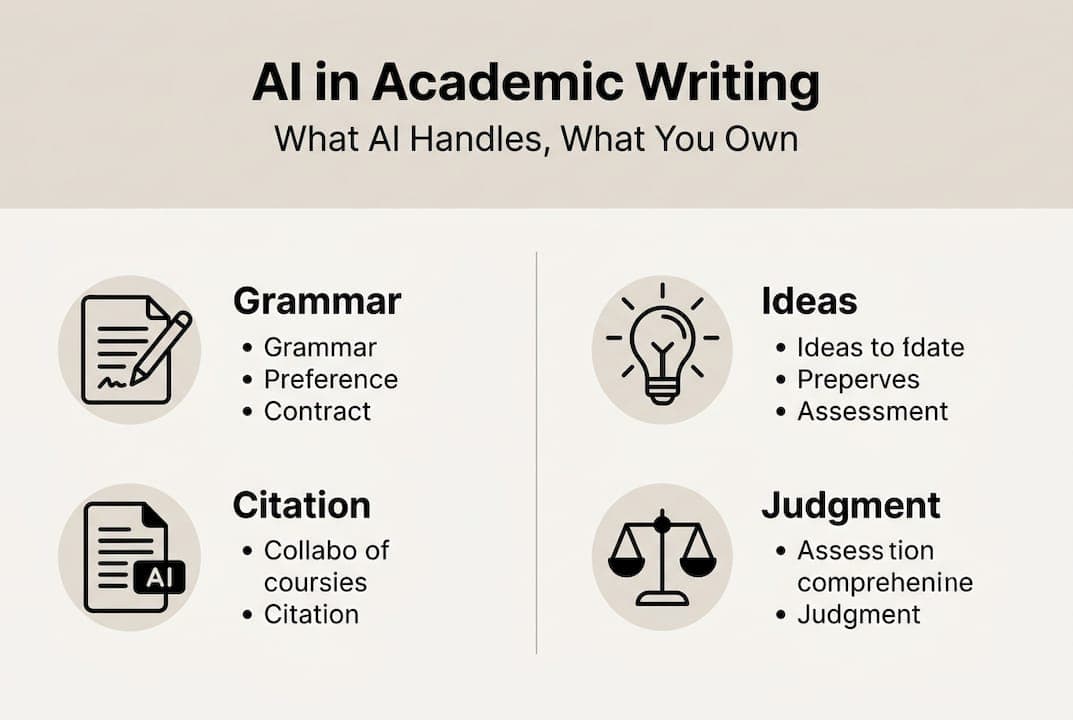
| Task | What AI handles | What you still own |
|---|---|---|
| Grammar and style | Flags and corrects errors | Final judgment on voice |
| Citations | Formats references automatically | Verifying source accuracy |
| Outlining | Suggests logical structure | Core argument and thesis |
| Plagiarism check | Detects overlapping text | Rewriting flagged sections |
| Research summary | Condenses source material | Critical evaluation of sources |
For a broader look at how these tools fit into your workflow, the AI writing overview at Samwell.ai is worth reading alongside AI trends in academia that are reshaping how universities approach these tools in 2026.
Pro Tip: The quality of AI output depends almost entirely on the quality of your prompt. Give the tool your thesis, your target audience, and your required citation style upfront. Then revise the output heavily before treating it as usable.
The honest answer is: yes, with caveats. The data on AI-assisted writing is more nuanced than either enthusiasts or critics admit.

On speed, the numbers are striking. Writing time drops 40% to 70% with AI assistance, with one study showing average completion time falling from 6 hours to 1.8 hours. That is not a marginal gain. For students juggling multiple deadlines, that difference is real.
On quality, the picture is more complicated. AI tools match human writers on mechanics like grammar and formatting, but human writers score 4.2 out of 5 on analysis versus AI's 3.1 out of 5. AI is strong on surface quality. It is weaker on original insight.
Key outcome highlights from current research:
The takeaway is that AI works best as a support layer, not a replacement for your thinking. Use it to sharpen what you already know, not to generate ideas you have not developed yourself. For more on balancing writing efficiency and originality, and on cutting writing time without sacrificing quality, Samwell.ai's research blog covers both in depth.
If you are comparing platforms, the best AI writing tools breakdown is a useful starting point before committing to one.
AI tools can fail you in ways that are not obvious until it is too late. Knowing the failure modes in advance is the difference between a stronger paper and an academic integrity violation.
The four major risks to watch for:
"Ghost citations are among the most common and dangerous outputs of AI writing tools. A reference that looks credible but links to nothing can invalidate an entire paper."
The fix for most of these risks is the same: treat AI output as a rough draft, not a finished product. Verify every citation manually. Run your draft through a plagiarism checker before submission. Review AI challenges in student writing to understand where these tools consistently fall short, and check AI plagiarism risks for specific strategies to protect your work.
Pro Tip: Never submit AI-generated text word for word. Use AI for structure, grammar passes, and citation formatting. Write your analysis yourself. That combination gives you the efficiency gains without the integrity exposure.
University policies on AI are moving fast. What was ambiguous two years ago now has explicit guidelines at most major institutions. The core requirements are consistent across schools, even if the specifics vary.
Policies generally allow AI for editing, grammar correction, and citation formatting when disclosed, but prohibit submitting AI-written content without attribution. Durham University requires students to note AI use in their methods section. Oxford emphasizes that AI cannot be listed as a co-author and that students are responsible for verifying all AI outputs. OSU guidelines published in early 2026 require disclosure, output verification, and explicitly prohibit AI co-authorship.
Steps to stay compliant at any institution:
The safest approach is to over-disclose rather than under-disclose. Most instructors respond better to transparency than to discovering undisclosed AI use after the fact.
Knowing the rules is one thing. Knowing how to work within them efficiently is another. These practices reflect what researchers and academic writing experts consistently recommend.
The expert consensus is clear: blending your analytical skills with AI's mechanical efficiency produces better papers than either approach alone. For practical guidance on improving academic writing at every stage, Samwell.ai's resources walk through the editing and revision process in detail.
Pro Tip: Think of AI as a writing coach, not a ghostwriter. A coach helps you perform better. A ghostwriter replaces you. The first builds your skills over time. The second leaves you dependent and vulnerable.
The conversation in higher education is not settled. Academics, administrators, and students hold genuinely different views on where AI belongs in the writing process.
The current debate breaks down like this:
Arguments for broader AI use:
Arguments for limiting AI use:
"The greatest risk of AI in higher education is not cheating. It is the erosion of learning itself when students stop wrestling with ideas and let AI do the intellectual heavy lifting."
That tension is real. The students who use AI to avoid thinking will likely fall behind when it matters most, in exams, defenses, and professional settings where AI is not available. The students who use AI to think more efficiently will have a genuine advantage.
The direction universities are heading is toward transparent, structured AI integration rather than blanket bans. Expect more explicit disclosure requirements, AI-literacy coursework, and assignment designs that make pure AI generation ineffective. For a deeper look at the ethical and practical dimensions, the AI essays guide covers the evolving landscape well.
You now have a clear picture of what AI can and cannot do in academic writing, where the risks are, and how to stay on the right side of your institution's policies. The next step is putting that knowledge into practice with tools built specifically for academic integrity.
Samwell.ai is built for exactly this use case. Its Semihuman.ai technology minimizes AI detectability while keeping your work original. The Power Editor helps you refine and expand specific sections without rewriting everything. Guided Essays give you structured outlines to work from, and real-time AI detection checks flag issues before you submit. Over 1,000,000 students and academics use Samwell.ai to write faster without compromising integrity. If you want plagiarism-free essays that hold up to scrutiny, it is the platform designed for that outcome.
Most universities permit AI for editing and citation formatting if you disclose it, but prohibit submitting AI-written text as your own without acknowledgment.
Edit AI drafts substantially, verify all citations against primary sources, and run your final draft through a plagiarism checker before submission.
Yes. AI tools improve grammar, structure, and citation accuracy for non-native speakers, with writing time dropping from 6 hours to 1.8 hours in documented studies.
Include a brief disclosure in your methods section, acknowledgments, or a standalone statement specifying which tools you used and for what purpose, as OSU guidelines and most major universities now require.