Loading...

You sit down to write a reflection paper, but your thoughts scatter in every direction. What seemed clear in your mind becomes a jumbled mess on the page. Without a proper format, even your best insights can get lost in confusion. This guide walks you through the exact structure you need to organize your reflection paper effectively, helping you turn personal experiences into powerful academic writing that earns better grades and deepens your learning.
| Point | Details |
|---|---|
| Reflection papers demand critical thinking | These assignments push you to analyze personal experiences and connect them to academic concepts for deeper learning. |
| Structured format improves clarity | A clear introduction, body, and conclusion framework helps organize complex thoughts and insights effectively. |
| Four-step process guides writing | Experience, Observation, Reflection, and Application provide a systematic approach to developing meaningful content. |
| First person and varied tenses work best | Reflection papers naturally use "I" and shift between past, present, and future tenses to capture evolving insights. |
| Theory integration deepens analysis | Connecting personal experiences to academic concepts adds credibility and demonstrates sophisticated critical thinking. |
Reflection papers serve as powerful tools for personal learning and academic growth. Reflection papers stimulate learning by asking you to think critically about what you learned from a text, event, or experience. Unlike traditional essays that focus on external analysis, reflection papers turn the lens inward, examining your own thoughts, reactions, and evolving understanding.
The format matters because scattered thoughts lead to weak arguments. A structured approach helps you organize complex ideas into coherent paragraphs that readers can follow easily. The reflection paper format typically includes three core elements: an introduction that sets context, body paragraphs that explore specific aspects of your experience, and a conclusion that synthesizes your insights.
Reflective writing involves critical analysis of your experiences, responses, assumptions, values, beliefs, and perspectives. This depth separates reflection from simple summarizing. You examine why you reacted certain ways, what assumptions shaped your thinking, and how your perspective changed through the experience.
The benefits of mastering reflection paper format extend beyond a single assignment:
Pro Tip: Before writing, spend 10 minutes freewriting about your experience without worrying about structure. This brain dump helps identify the most significant insights you want to explore in your formatted paper.
The standard reflection paper follows a simple structure: introduction, body paragraphs organized by reflection stages, and conclusion. This framework keeps your writing focused while allowing flexibility to explore meaningful insights. Starting a reflection paper becomes easier when you understand each component's purpose.
Reflective writing follows a four-step process: Experience, Observation, Reflection, and Application. Each step serves a specific function in developing your analysis:
Experience: Describe what happened objectively. Include relevant details about the event, text, or situation you're reflecting on. Keep this section factual and concise, providing just enough context for readers to understand your later analysis.
Observation: Analyze what you noticed during the experience. What patterns emerged? What surprised you? What connections did you make to prior knowledge? This stage moves beyond description into initial interpretation.
Reflection: Evaluate the significance of what you observed. Why did certain aspects matter? How did the experience challenge or confirm your existing beliefs? What assumptions did you discover about yourself? This represents the deepest analytical work.
Application: Explain how you'll use these insights moving forward. What will you do differently? How has your perspective shifted? What new questions emerged that you want to explore? This forward-looking component demonstrates growth.
Each step typically receives one or two paragraphs, depending on your assignment length and complexity. The introduction previews your main insight, while the conclusion synthesizes how all four steps connect to create new understanding.
Reflective writing uses first person and shifts between past, present, and future tenses naturally. You might write "I observed" (past) when describing the experience, "I believe" (present) when analyzing current understanding, and "I will apply" (future) when discussing next steps. This tense variation creates dynamic, engaging prose that mirrors how we actually think about experiences.
Pro Tip: Draft a simple outline before writing, assigning each of the four steps to specific paragraphs. This 5-minute planning session prevents the common mistake of jumbling different reflection stages together, which confuses readers and weakens your analysis.
Many students stumble over the same formatting pitfalls that undermine otherwise strong insights. Recognizing these errors helps you write more effectively from the start.
Unfocused content represents the most frequent problem. Students try to reflect on too many experiences at once, creating superficial analysis of everything instead of deep exploration of something specific. Fix this by choosing one significant moment or concept and mining it thoroughly. A single class discussion analyzed deeply outperforms three weeks of activities covered shallowly.
Poor structure confuses readers when paragraphs jump randomly between description, analysis, and application. Each paragraph needs a clear purpose tied to one of the four reflection steps. Use topic sentences that signal which stage you're addressing: "During the group project, I noticed an interesting pattern in how we made decisions" clearly marks the Observation phase.

Ignoring the reflection process altogether turns your paper into a diary entry or summary. Simply describing what happened without analyzing why it mattered fails the assignment's purpose. Reflection papers benefit from structured format to enhance clarity and coherence, typically including an introduction, body paragraphs addressing specific experiences or concepts, and a conclusion.
Weak conclusions that just repeat the introduction waste valuable space. Your conclusion should synthesize new understanding that emerged through the writing process itself. What do you know now that you didn't realize when you started writing? That insight belongs in your final paragraph.
Additional mistakes to watch for:
Pro Tip: After drafting, read your paper aloud and mark every paragraph with its reflection stage (Experience, Observation, Reflection, Application). If you find three paragraphs in a row all doing description, you know you need to reorganize for better flow and deeper analysis. Check out reflective writing examples to see how successful papers balance all four stages.
Seeing concrete examples helps you understand how abstract formatting principles work in practice. Reflective essays stimulate learning by asking you to think about what you learned from a particular text, event, or experience, and different formats serve different academic purposes.
A simple reflection paper format works well for shorter assignments or introductory courses. This approach dedicates one paragraph to each reflection stage: a brief introduction, one paragraph describing the experience, one analyzing observations, one exploring deeper reflection, one discussing application, and a short conclusion. The straightforward structure helps you focus on developing clear insights without getting lost in complex organization.
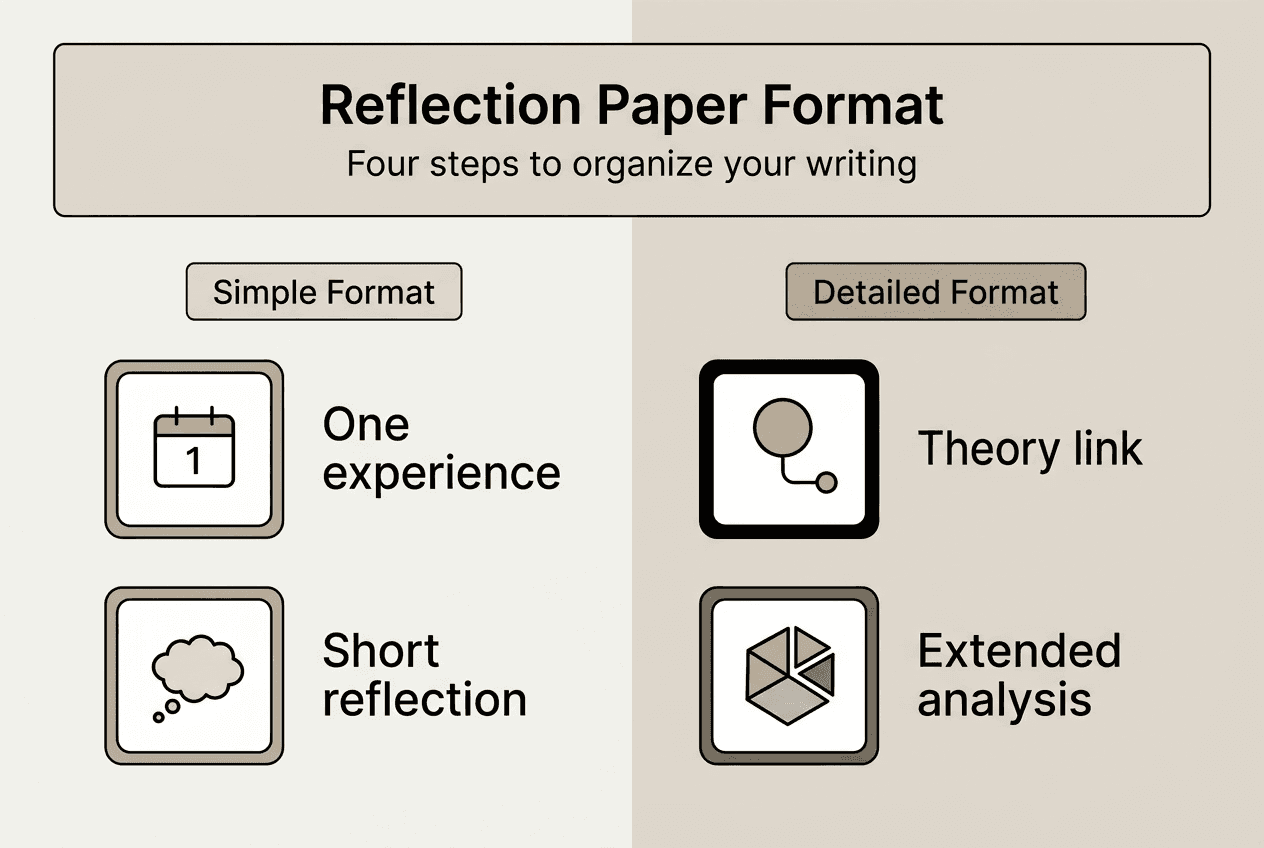
A detailed reflection paper format suits longer assignments or advanced courses requiring theoretical integration. This version expands each reflection stage into multiple paragraphs, weaving in academic sources and connecting personal insights to scholarly concepts. The introduction might span two paragraphs, establishing both personal context and theoretical framework. Body sections could include subsections examining different aspects of the experience through various analytical lenses.
| Component | Simple Format | Detailed Format |
|---|---|---|
| Introduction | Single paragraph setting context | Two paragraphs with personal context and theoretical framework |
| Experience section | One descriptive paragraph | Multiple paragraphs with rich detail and scene-setting |
| Observation section | One paragraph noting patterns | Several paragraphs analyzing patterns through different lenses |
| Reflection section | One paragraph exploring significance | Extended analysis connecting to theory and prior knowledge |
| Application section | One paragraph on future use | Multiple paragraphs discussing specific implementation plans |
| Conclusion | Brief synthesis paragraph | Comprehensive synthesis linking all elements |
Both formats share essential components that make reflection papers effective:
The simple format prioritizes clarity and accessibility, making it perfect when you're learning reflection skills or working under tight word limits. The detailed format allows sophisticated analysis and demonstrates advanced critical thinking, ideal for upper-level courses or when you have complex experiences to unpack. Choose based on your assignment requirements and the depth of analysis your experience warrants.
Explore personal writing examples to see how different writers adapt these formats to various academic contexts and disciplines.
Mastering reflection paper format takes practice, but you don't have to figure it out alone. Expert-guided tools can accelerate your learning and help you produce stronger papers while developing genuine writing skills. Samwell.ai offers comprehensive support for students working to improve their academic writing across all formats and disciplines.
Access templates that show exactly how successful reflection papers organize content, from introduction hooks to conclusion synthesis. Browse detailed reflection paper format guides that break down each component with specific examples you can adapt to your own experiences. Study reflective writing examples that demonstrate how to balance personal insight with academic rigor, showing you what strong reflection looks like in practice. These resources help you see the principles from this guide applied in real academic contexts, making abstract concepts concrete and actionable for your next assignment.
Reflection papers usually range from 300 to 700 words for shorter assignments, while more comprehensive reflections can extend to 1,500 words or more. Your assignment guidelines will specify the required length, which determines whether you use a simple or detailed format. Shorter papers focus on one specific moment or insight, while longer ones allow exploration of multiple connected experiences or deeper theoretical integration. Always prioritize depth over breadth, fully developing fewer ideas rather than superficially covering many.
Yes, first person is not only acceptable but essential in reflection papers. Reflective writing uses first person and shifts between past, present, and future tenses to capture your evolving understanding. Writing "I observed" or "I realized" establishes the personal voice that makes reflection authentic and meaningful. Avoiding first person in reflection papers creates awkward, passive constructions that distance you from your own insights, defeating the assignment's purpose of examining personal learning and growth.
Scholarship and theory integrate into Reflection and Application stages to provide deeper analysis and context. After describing your experience and initial observations, connect what you noticed to relevant academic concepts from your coursework. Explain how a specific theory helps you understand your experience differently or reveals aspects you initially missed. In the Application section, discuss how theoretical frameworks will guide your future practice. This integration demonstrates sophisticated thinking that moves beyond personal opinion into scholarly analysis.
Avoid treating reflection papers as casual diary entries without analytical depth. Reflection papers benefit from structured format to enhance clarity and coherence, including an introduction, focused body paragraphs, and a synthesizing conclusion. Other critical mistakes include using only description without analysis, failing to explain why observations matter, ignoring the four-step reflection process, and writing vague generalizations instead of specific examples. Poor tense usage that sticks to past tense only, rather than naturally shifting between past, present, and future, also weakens reflection papers by making insights feel disconnected from current learning.