Loading...

TL;DR:
- Academic essays primarily develop critical thinking, argumentation, and research skills.
- Structuring essays with introduction, body, and conclusion ensures clear, supported arguments.
- Using frameworks like TEECL or PEEL aids organization, while AI tools support editing without replacing critical analysis.
Most students treat academic essays as boxes to check before the semester ends. Write it, submit it, move on. But that mindset misses something important: academic essays primarily develop and demonstrate critical thinking, not just prove you read the assigned chapters. Essays are one of the few academic tasks that force you to take a position, defend it with evidence, and anticipate counterarguments. That process builds skills that transfer directly into research, professional communication, and decision-making. This article breaks down the real purpose of academic essays, the structures that make them work, and the frameworks that separate average writing from genuinely strong academic work.
| Point | Details |
|---|---|
| Develop critical thinking | Academic essays are designed to challenge and improve your ability to analyze, argue, and reflect. |
| Structure supports clarity | A strong introduction, evidence-based body, and thoughtful conclusion are essential for an effective essay. |
| Use proven frameworks | Applying methods like TEECL or PEEL helps organize ideas and develop stronger arguments. |
| Balance technology and skill | AI tools can enhance your writing, but genuine insight and critical thinking should guide your work. |
| Focus on process | Emphasizing the writing and revision process improves outcomes and prevents common academic pitfalls. |
Academic essays are not summaries. They are not book reports dressed up with citations. At their core, they are structured arguments that require you to engage with evidence, form an original position, and communicate that position clearly. That distinction matters more than most writing guides acknowledge.
The higher-order abilities assessed in essay writing include critical thinking, argument development, and the ability to synthesize multiple sources into a coherent claim. These are not skills you pick up passively. They require practice, feedback, and repeated effort. Essays provide exactly that kind of structured repetition.
Here is what academic essays are genuinely designed to build:
"The essay is not just a vehicle for demonstrating knowledge. It is a space for intellectual work."
These skills extend well beyond the classroom. Professionals who can analyze information, form clear positions, and communicate them persuasively are consistently more effective in their fields. The impact of AI on essay quality is a growing conversation precisely because these transferable skills are so valuable. When you understand that an essay is training your mind, not just fulfilling a requirement, your relationship with the task changes completely. You stop asking "what does the professor want?" and start asking "what do I actually think about this, and how do I prove it?"

That shift in perspective is where real academic growth begins.
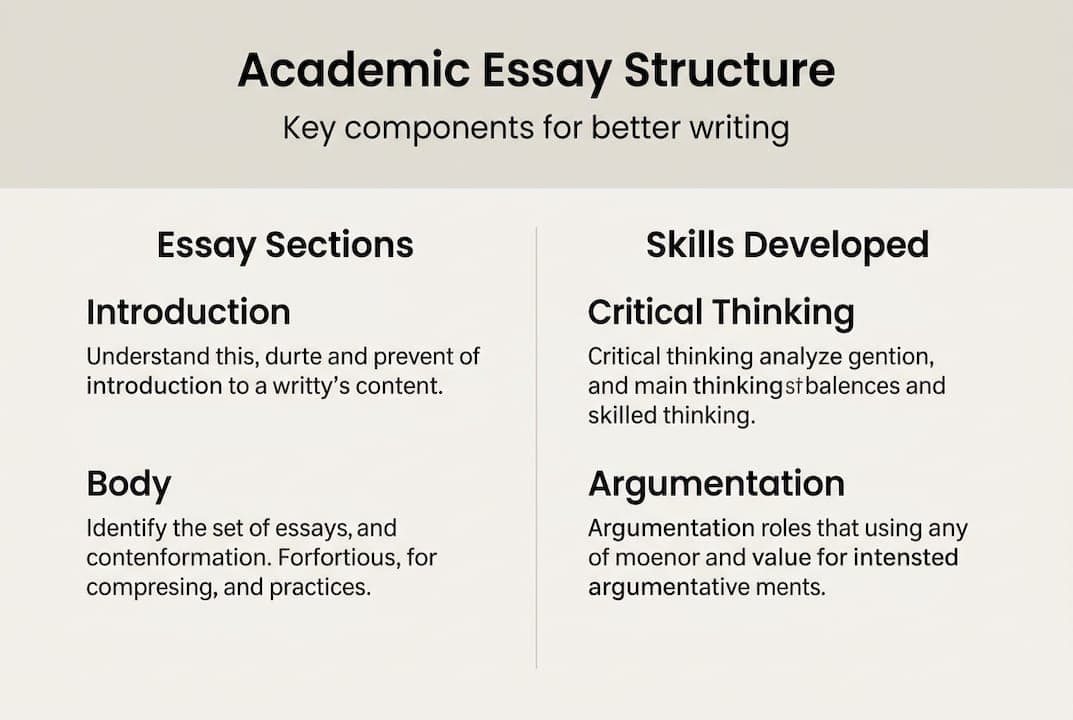
Understanding purpose is only half the story. Now let's explore what makes a well-constructed essay. Even the sharpest argument collapses without a solid structure to hold it together. Fortunately, the standard essay structure follows a clear and learnable pattern: introduction, body, and conclusion.
Here is how each component functions:
Within the body, the TEECL and PEEL models provide a reliable paragraph structure. TEECL stands for Topic sentence, Evidence, Explanation, Comment, and Link. PEEL stands for Point, Evidence, Explanation, and Link. Both models ensure that every paragraph has a clear purpose and connects back to the central argument.
| Essay component | Function | Common mistake |
|---|---|---|
| Introduction | Frame argument and state thesis | Vague or missing thesis |
| Body paragraphs | Develop and support argument | Evidence without explanation |
| Conclusion | Synthesize and show significance | Simply restating the introduction |
| Topic sentence | Signal paragraph focus | Starting with evidence instead |
| Linking sentence | Connect back to thesis | Leaving paragraphs isolated |
For essay structure support, many universities offer writing centers that can help you map your argument before you write a single sentence. That planning step is where most students skip ahead and pay for it later.
Pro Tip: Before you write, draft a one-page outline using the PEEL or TEECL model. Assign one key idea to each body paragraph, identify your evidence for each, and write a one-sentence explanation of how that evidence supports your thesis. This takes 20 minutes and saves hours of revision. Using AI for essay structure can also help you build and refine outlines quickly without bypassing the thinking process.
With the basic structure in place, let's look at which specific frameworks bring essays to life and how to use them. Not every essay calls for the same approach. A philosophy essay that asks you to evaluate a moral argument needs a different strategy than a science essay asking you to analyze experimental data. Knowing your options gives you flexibility.
The three most widely used frameworks are TEECL, PEEL, and the process-genre approach. Here is how they compare:
| Framework | Best for | Core strength | Potential weakness |
|---|---|---|---|
| TEECL | Analytical and argumentative essays | Encourages deep explanation and comment | Can feel formulaic in creative contexts |
| PEEL | Shorter essays and exam writing | Fast, clear, and easy to apply under pressure | Less room for nuanced commentary |
| Process-genre | Academic writing development | Builds organization and grammar through practice | Requires more time and instructor feedback |
Body paragraphs using TEECL, PEEL, or TEEL ensure logical argument development by forcing you to connect every piece of evidence back to your central claim. The key is not picking the "best" framework in the abstract but choosing the one that fits your assignment type and your current skill level.
The process-genre and collaborative writing approaches have shown strong results in building essay skills related to organization and grammar, particularly for students writing in a second language. These methods emphasize drafting, feedback, revision, and genre awareness over simply producing a finished product.
When applying any of these frameworks, focus on:
If you find yourself struggling to apply these frameworks, exploring AI writing challenges can help you identify where the process breaks down and how to fix it.
As essay writing tools and habits change, so do the challenges and the ways to address them. The rise of AI writing assistants has introduced both genuine benefits and serious risks that every student and academic professional needs to understand clearly.
AI tools aid grammar and structure but risk undermining critical thinking when overused. That is the central tension. Using AI to check sentence clarity or suggest a stronger transition is a legitimate productivity tool. Asking AI to generate your argument, select your evidence, and write your paragraphs is something else entirely. It hollows out the very skills the essay is designed to build.
Common pitfalls that weaken academic essays include:
Essays risk misconduct but revive when educators and students shift focus from product to process. That means valuing drafts, outlines, and revision cycles as much as the final submission.
Pro Tip: Use AI as an assistant, not a replacement. Let it help you organize your outline, check your grammar, or identify gaps in your argument. Then do the actual thinking yourself. Staying current on AI and academic integrity trends will help you use these tools responsibly and stay on the right side of your institution's policies.
Most writing guides focus on structure and mechanics. Very few acknowledge that the essay's greatest value is the intellectual discomfort it creates. When you sit with a complex question, resist the urge to grab the first answer, and push yourself to build a real argument, you are doing something that no shortcut can replicate.
Here is what the conventional advice misses: essays have survived every attempt to replace or eliminate them precisely because they are irreplaceable as a thinking tool. They are not just assessments. They are rehearsals for every professional situation that requires you to form a position under uncertainty and defend it with evidence.
The students who get the most from essay writing are not the ones chasing perfect grades. They are the ones who treat every draft as a chance to think more clearly. That mindset, combined with the right tools used responsibly, is what produces lasting skill development. If you want to write better, start by valuing the process. Tools that support efficient and original writing are most powerful when they amplify your thinking rather than replace it.
If you are ready to put these insights to work and advance your essay writing, here is where you can start. Understanding structure and frameworks is one thing. Applying them consistently under deadline pressure is another challenge entirely.
Samwell.ai is built for exactly this situation. With over 1,000,000 students and academic professionals using the platform, it offers tools like Guided Essays for structured outlines, a Power Editor for targeted revisions, and real-time AI detection checks that keep your work original and credible. For a deeper look at how AI content creation fits into responsible academic practice, the platform's resources are a strong next step for anyone serious about improving their essay craft without cutting corners.
Academic essays aim to develop critical thinking, argumentation, and research skills through evidence-based analysis. They train students to form original positions and defend them with credible sources, skills that transfer directly into professional and research contexts.
A clear academic essay structure includes an introduction, body, and conclusion, where the introduction establishes the thesis, body paragraphs develop the argument with evidence, and the conclusion synthesizes findings and explains their significance.
Frameworks like TEECL, PEEL, and TEEL help organize arguments and improve clarity by ensuring every paragraph has a clear point, supporting evidence, and a connection back to the central thesis.
AI tools aid grammar and structure but cannot substitute for independent critical thinking or original analysis, which remain the core skills that academic essays are designed to develop.
Frequent pitfalls include unclear thesis statements, evidence without explanation, superficial source engagement, and plagiarism. Emphasizing process over product helps students avoid these traps by valuing drafts and revision as much as the final submission.