
Loading...

If by "pay someone to do my homework" you mean buying a paid AI academic writing platform, the responsible answer is: you may, but only as an assistant, with instructor permission and careful verification. This means using a subscription tool to draft, edit and cite your own work, not hiring a person to submit work under your name. Some AI academic writing platforms are built for exactly this kind of supervised use.
TL;DR:
- Paid AI tools are most valuable for recurring research, editing, and citation tasks, especially for long papers or group projects, not for one-off assignments.
- Verify that the platform allows source uploading, checks citations against real databases, and provides exportable prompts and revision history before purchasing.
- Always obtain instructor permission and disclose AI assistance, using a transparent workflow with source verification and documentation to maintain academic integrity.
- Test the platform with a low-stakes draft, review privacy and data retention policies, and confirm you can delete or export files prior to committing financially.
- Rely on supervision and verification rather than detection tools alone, since AI-generated citations and content may be unreliable or fabricated.
Buying access to an AI writing platform only pays off when you use it inside a clear process. Universities that have published formal guidance describe a similar sequence, whether the tool is free or paid.
This sequence mirrors Auburn's academic integrity guidance, which frames paid AI platforms as acceptable for planning, drafting with approved sources, editing and citation organization, provided permission is confirmed and use is disclosed as required. Institutional approval, not the tool's own claims about originality, is what ultimately decides whether the output is acceptable.
Northeastern's standards for generative AI in teaching and learning add a detail worth repeating: document your prompts and outputs as you go, because AI detectors are known to be unreliable, and a saved record of your actual process is often the strongest evidence you have if a question ever comes up.
Pro Tip: Keep a simple folder per assignment: prompts, drafts, citation checks and your final edits. It takes five minutes and can save a difficult conversation later.
A paid plan makes sense when your workload is recurring rather than occasional. Students juggling long research papers, frequent citation formatting or collaborative revisions get more value from a subscription than someone writing a single short response paper once a semester.
A 2025 peer-reviewed study on instruction-led generative AI use found that writing time dropped by 56.7% and average quality improved from A− to A when students used the tool under instruction rather than as a replacement for their own work. That gain came from supervised drafting and revision, not from submitting AI output untouched.
The same evidence base flags where AI still fails: hallucinated facts, fabricated citations and struggles with very long or highly technical documents. Detection tools built to catch AI writing remain unreliable, which cuts both ways: a false positive can wrongly implicate honest work, and a false negative offers no real protection to someone who tries to pass off unedited output as their own.
Use a paid tool the way the research supports: to speed up drafting and editing you actively supervise, never as a way to skip the verification step entirely.
A subscription decision should happen after you've checked a few things, not after you've already uploaded a semester's worth of research.
UNESCO's guidance on generative AI in education and research is direct on this point: tools should be validated ethically and pedagogically before use, and a platform's own claims about plagiarism reduction or detection accuracy are not the same as institutional acceptance. Privacy and retention policies vary by country and by provider, so read them rather than assume.
Pro Tip: Run your trial draft through your institution's own citation or plagiarism checker, not just the platform's built-in one, before you trust the output.
Most students who consider paying for AI academic help follow a similar arc over a few days rather than a single sitting.
It usually starts with a search for help once an assignment feels too large or too citation-heavy to manage solo. That's followed by comparing platforms, reading a syllabus twice, and, ideally, a short message to the instructor confirming what's allowed. Once permission is settled, the actual work happens in stages: upload approved sources, generate an outline, draft section by section, and revise using the platform's editing tools rather than accepting the first output.
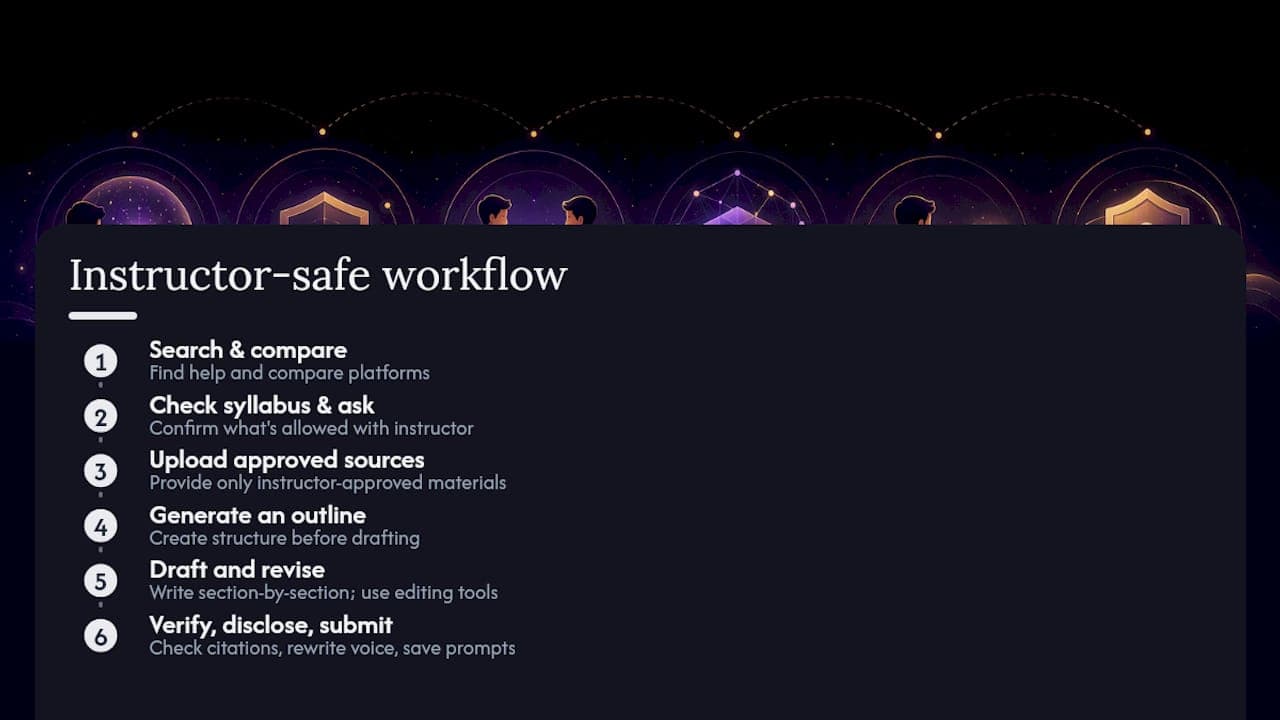
Verification comes next and it's not optional. Every citation gets checked against a real source, every claim gets compared to what the reading actually says, and any AI-written paragraph gets rewritten enough that it reflects the student's own reasoning and voice. Only after that does disclosure happen, if the course requires an AI-use statement. The final step is submission, with the prompts, drafts and citation checks saved somewhere retrievable.
The whole cycle, from first search to final submission, tends to compress research and formatting time rather than replace the thinking that has to happen in the verification stage. That's the entire value proposition of a subscription tool: shorter mechanical work, unchanged intellectual work.
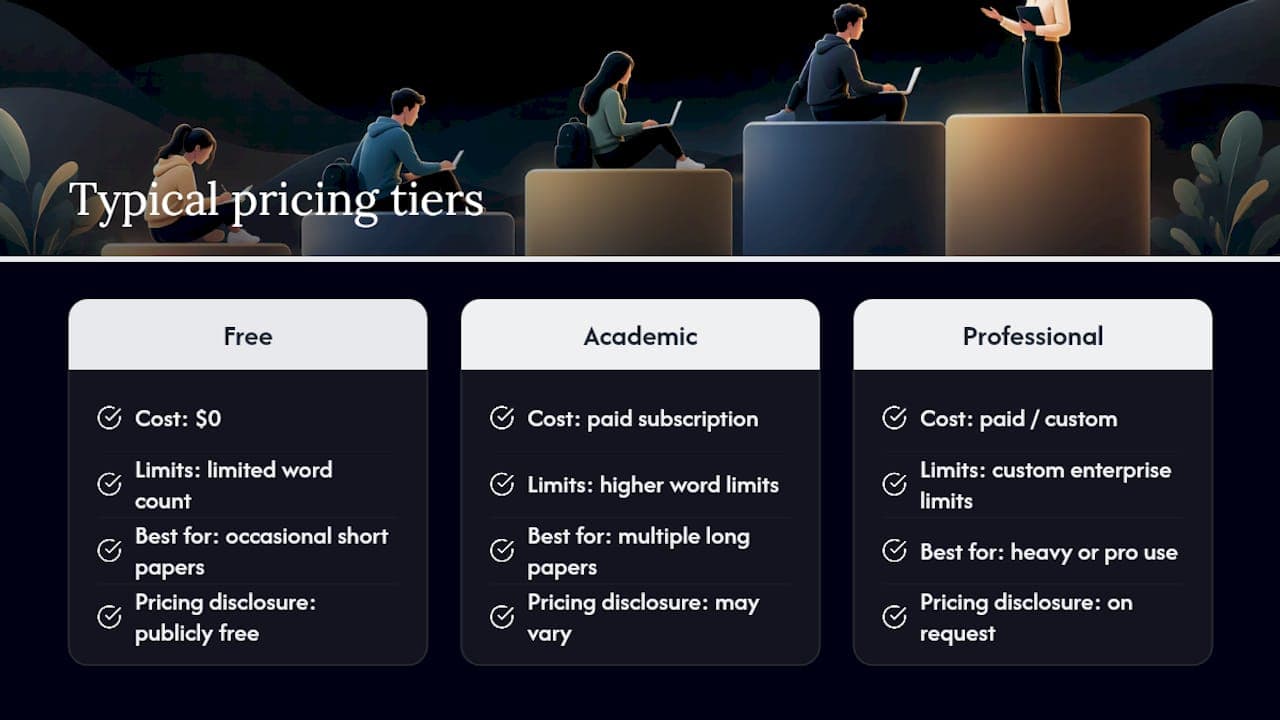
Pricing for AI academic writing platforms generally follows a freemium subscription structure: a free tier with limited word counts, and one or more paid tiers that unlock higher limits, advanced editing and citation features. Samwell.ai follows this same model, offering a Free Plan alongside an Academic Plan and Custom Professional Plans, with pricing details available on request through its upgrade page rather than published as a flat rate.
Because these platforms are priced as recurring software subscriptions rather than one-off purchases, the more useful comparison isn't "what does one paper cost" but "what does a semester of citation formatting and drafting support cost." A student writing one short paper a term may never need to leave the free tier. A student producing multiple long research papers, lab reports or literature reviews across a semester is the one for whom a paid tier tends to pay off, since the subscription covers volume rather than a single document.
Always confirm current pricing directly on the provider's own page before subscribing, since tiers and limits change and no single number applies across every platform or every country.
Not every platform marketed for academic writing help is built the same way, and a few questions separate a legitimate tool from a risky one.
Ask whether the platform lets you upload your own approved sources, or whether it only generates content from its own training data with no source control. Ask how citations are produced and whether they're checked against real academic databases rather than invented by the model. Ask what happens to your uploaded files: are they retained, used for model training, or deletable on request. Ask whether the platform offers any real-time detection or originality check you can review before submission, and whether you can export your full prompt and revision history.
Reliability and confidentiality matter as much as writing quality. A tool that produces polished prose but can't show you where a citation came from, or that has no clear data retention policy, is a liability disguised as a convenience. UNESCO's guidance is explicit that ethical and pedagogical validation should happen before adoption, not after a problem surfaces.
A few patterns show up consistently in problematic services. Watch for platforms that promise a completed, "undetectable" paper with no editing or verification step required on your part, since that framing pushes toward submitting unread AI output rather than supervised drafting. Be wary of any service that asks for payment through untraceable methods, offers no visible terms of service, or refuses to explain how citations are sourced.
Vague guarantees around plagiarism and detection are another red flag. No platform can honestly promise it will always pass every detector, since detection tools themselves are unreliable in both directions. A provider that markets certainty here is overselling. Similarly, be cautious of services with no clear policy on data retention or file deletion, since your uploaded research or drafts could otherwise sit on a server indefinitely with no recourse.
The safest filter is simple: if a service's marketing centers on helping you avoid detection rather than helping you draft, edit and cite faster, it's built for the wrong job.
Submitting AI-generated or purchased writing without disclosure, when your institution requires it, risks the same academic integrity consequences as any other form of unauthorized assistance: failing grades, formal misconduct proceedings, or in serious cases suspension. These outcomes are set by each institution's own academic integrity policy, so the specific consequence depends entirely on your school's rules and the nature of the violation.
The distinction that matters throughout this article is the one between using a paid AI tool to draft and edit your own reasoning, with permission and disclosure where required, and submitting content you didn't meaningfully write or verify. The first is a workflow choice. The second is a policy violation regardless of whether a human or an AI produced the words. APA's own guidance on AI contribution statements makes clear that AI cannot be listed as an author, and that disclosure expectations depend on your instructor or institution, not on the tool you used.
Standard safeguards apply here just as they would for any other subscription purchase. Pay through the platform's own checkout using a credit card or an established payment processor rather than a direct bank transfer or an unfamiliar third-party link, since card payments typically offer dispute protection that direct transfers don't.
Check that the checkout page uses a secure connection before entering any payment details, and avoid platforms that ask you to pay through messaging apps, cryptocurrency with no refund option, or a person rather than the platform itself. A legitimate SaaS subscription will have a visible billing page, a clear cancellation process, and terms you can read before committing.
Keep a receipt or confirmation of what plan you purchased and when, both for your own budgeting and in case a dispute over billing or a data question ever comes up later.
Some AI writing platforms map directly onto the responsible workflow described here, rather than replacing it. Features that let you upload only instructor-approved sources keep source control in your hands instead of the model's own training data. Tools that support generating outlines and drafting sections, along with built-in citation editors, help catch formatting issues before manual verification every source recommends.

Real-time AI detection checks give you an early read before submission, though as the research above shows, no detector result should replace your own citation-by-citation check. Platforms that let you retain drafts and edits help build the audit trail that Northeastern and Auburn both recommend, taking little extra effort.
If you want to see how this works before committing to anything, start with the free plan on a non-assessed draft, confirm your instructor is comfortable with the workflow, and move to the Academic Plan once you know it fits your coursework.
The instinct to search for "someone to do my homework" usually means a student is out of time, not out of ideas. A paid AI platform can legitimately close that gap, but only when the guardrails hold: permission confirmed, sources verified, prompts and drafts documented. Skip the verification step and you've just outsourced the thinking, which defeats the reason you're in school in the first place.
The tools worth paying for are the ones that make it easier to check your own work, not easier to avoid checking it.
— Tilen
A few sources are worth bookmarking, and sharing with an instructor if you're asking for permission.
It can be, as long as your instructor permits AI assistance for that assignment and you disclose its use when required. The distinction is between using the tool to draft and edit your own work versus submitting unverified AI output as finished coursework, per Auburn's guidance.
AI detectors are unreliable, producing false positives and false negatives, according to Northeastern's standards for generative AI. A saved record of your prompts and drafts is a more reliable safeguard than trusting any single detector result.
Whether and how you disclose AI use depends on your instructor's or institution's policy, since APA's own guidance notes that AI cannot be listed as an author and that contribution statements vary by context. Check your syllabus first, then follow APA's instructional aid on AI contribution statements for the specific wording.
Read the platform's policy on data retention, whether your files are used to train its models, and whether you can delete or export them. UNESCO's guidance on generative AI in education recommends this kind of ethical validation before uploading anything, especially unpublished or sensitive research.
Yes, Samwell.ai includes a citation editor and lets you upload your own approved sources, which supports the source-checking step every university guideline recommends. It also lets you retain drafts and revisions, making it easier to build the documentation trail that institutions like Northeastern advise keeping.



