
Loading...

The outline that works for most academic book reports runs: introduction with bibliographic citation and thesis, a brief summary of two or three paragraphs, three to five thematic analysis sections with evidence and page numbers, then a conclusion that restates your argument without new material. This structure suits college and university assignments of 800 to 1,500 words and holds up across APA, MLA, and Chicago citation requirements. The sections below walk through thesis development, citation formatting, and sample templates by genre.
TL;DR:
- Most analysis sections should focus on specific themes, techniques, or claims supported by textual evidence, rather than extensive plot summaries.
- Citation formatting must follow style guidelines accurately, with page numbers included for quotations across APA, MLA, and Chicago styles.
- Develop a clear, specific thesis early in the writing process and use it to guide every analytical paragraph; a weak or late thesis weakens the report.
- Keep the summary brief, limited to explaining what the book is about and its central claim, to leave ample space for critical analysis.
- Organize analysis by thematic points rather than chronological order to enhance clarity and support a cohesive argument.
A usable outline needs section-level purpose, not just labels. Here is the sequence that instructors expect from a college-level book report, with word-count guidance for an 800 to 1,200 word assignment.
Mark every direct quotation with quotation marks and a page number in parentheses immediately after the closing quotation mark, before the period. Paraphrased ideas still need a citation, just without quotation marks. According to academic book review guidance, a useful review structure pairs bibliographic framing and thesis in the introduction with a conclusion that synthesizes rather than introduces new evidence, which is exactly the shape this template follows.
A working thesis is a placeholder claim you write early, before you have read every secondary source or finished your notes. A final thesis is the sharpened version you land on after evidence has pushed back on your first assumptions. According to the UNC Writing Center's guidance on thesis statements, a thesis should be treated as iterative: you refine it as you organize evidence rather than inventing it at the end, because a thesis bolted on after the fact tends to feel forced.
Three examples show how specificity shifts by book type. For a novel: "The narrator's unreliability in [title] forces readers to question the moral authority of every other character." For a scholarly monograph: "[Author]'s argument relies on selective case studies that understate counterexamples from other regions." For an interdisciplinary case study: "The book's data chapters succeed empirically but its policy recommendations ignore the implementation barriers it documents elsewhere."
To revise a vague thesis, ask: does it make a claim someone could disagree with, does it name a specific mechanism or pattern, and could a single paragraph of the book prove it wrong? If any answer is no, narrow it.
Instructors reading book reports expect you to interpret, not retell. According to academic book review guidance, reviews are typically capped around 1,000 words and prioritize analysis over plot recitation, with the thesis unifying the whole piece. That means summary earns only enough space to orient an unfamiliar reader.
Three techniques help you shift the balance:
Edit summary-heavy drafts by applying a simple test to each paragraph: what claim does this evidence prove? If you cannot answer in one sentence, cut the plot detail and replace it with interpretation.
Pro Tip: Highlight every sentence in your draft that only restates what happened; if more than a third of a paragraph is highlighted, rewrite it as analysis.
Citation requirements differ enough between styles that a single mismatched detail can cost points. Below are minimal, accurate formats for a standard book citation in each major style, based on academic book review guidance, which notes that APA, MLA, and Chicago each follow distinct reference and in-text conventions and that page numbers are required for direct quotations across all three.
Paraphrased ideas still require a citation, just without quotation marks or an exact page reference unless your instructor requires one. When your assignment sheet names a specific style, follow it exactly, even if it conflicts with general convention.
Different assignment lengths call for different structures, not just more words stretched over the same skeleton.
For the extended and literature-review formats, Purdue OWL's guidance on writing a literature review recommends grouping sources by theme and turning labels into assertions rather than summarizing each source in sequence. An annotated grid of quotes, page references, and secondary sources organized by claim speeds up drafting and keeps the book under review as the central object rather than letting secondary sources take over. If your assignment moves into full literature-review territory, our guide on organizing essays covers paragraph-level structure in more depth.
A book report needs enough context for an unfamiliar reader to follow your argument, and nothing more. The TAMU Writing Center's book review guidance frames the useful review as one that moves beyond summary to present a clear thesis and substantial critical analysis, with many instructors expecting analysis to dominate depending on the assignment.
In practice, that means your summary should answer three questions only: what is the book about, what is its central claim or plot arc, and why does that matter to your thesis. Anything beyond that, extended plot sequences, minor character details, chapter-by-chapter recaps, belongs in your notes, not your draft. A summary that runs longer than your analysis signals that you have not yet found your argument. If you are struggling to compress the summary, try writing it last, after you have drafted your analysis sections: you will know precisely which context those sections require and can write a summary that serves them instead of standing alone.
The four-part structure recommended by academic book review guidance separates the report's functions cleanly so each section does one job. The introduction carries the bibliographic citation and thesis, typically placed at the end of the opening paragraph so it guides everything that follows. The summary section orients the reader briefly. The analysis sections, usually organized by theme rather than by the book's chronology, carry the weight of your argument. The conclusion restates the thesis in light of what the analysis has shown, without introducing new evidence.
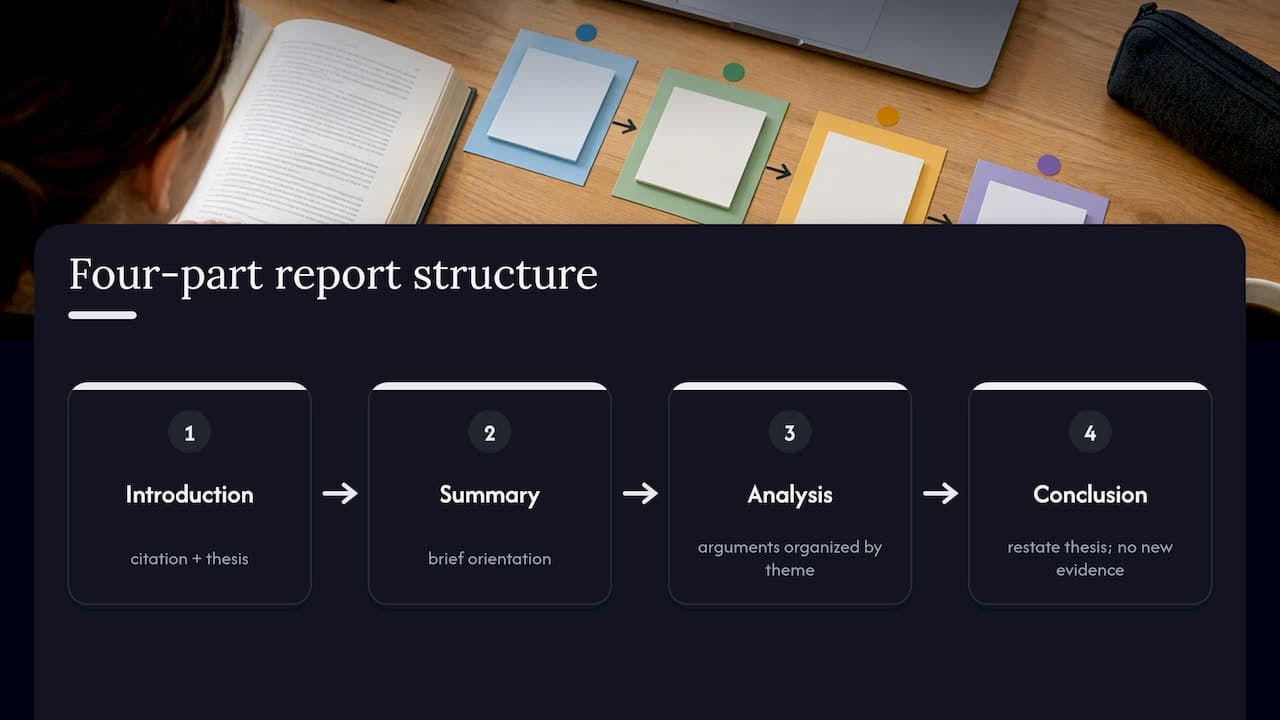
Organizing analysis by theme rather than by chapter keeps each paragraph focused on a single claim, which makes your argument easier to follow and easier to grade. A theme-based paragraph might examine how a novel's structure reinforces its central irony, or how a monograph's methodology shapes its conclusions, each supported by evidence drawn from across the book rather than from a single chapter. This structure also makes revision easier: if a paragraph drifts, you can check whether it still serves its assigned theme, rather than tracing a chronological retelling to find where the drift began.
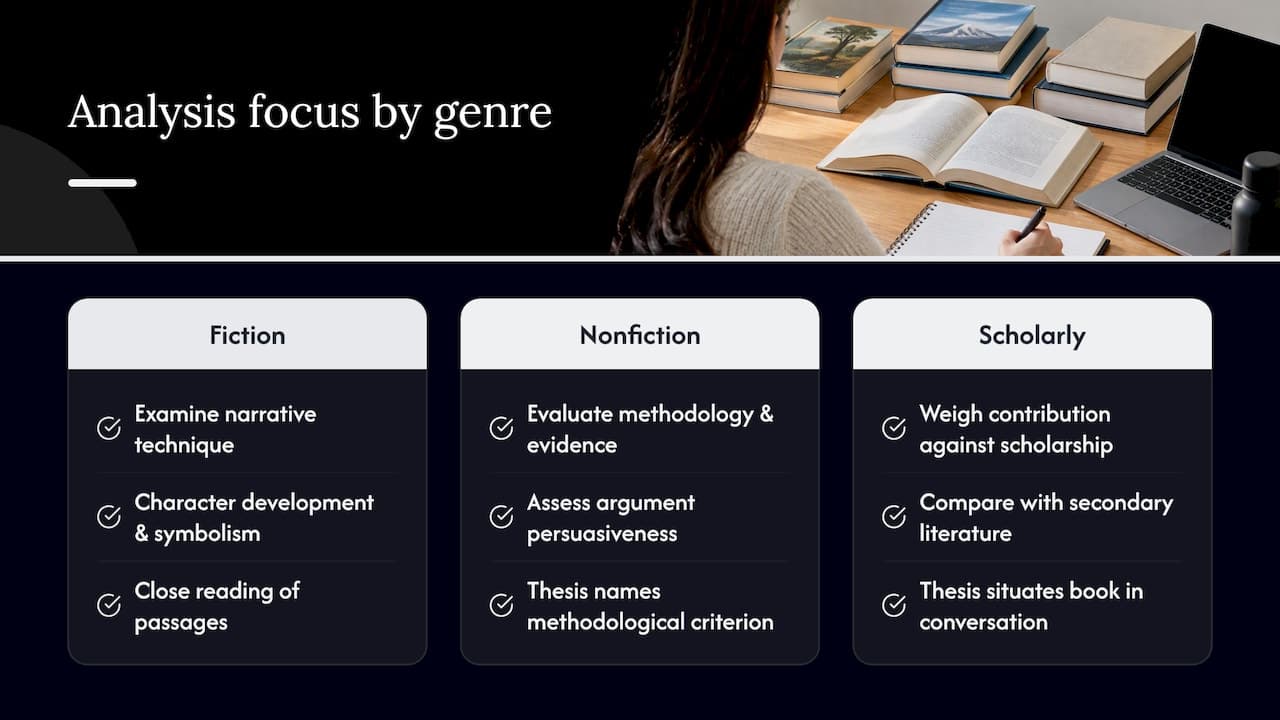
The same four-part skeleton works for nearly any book, but what fills the analysis sections changes by genre. For fiction, analysis sections typically examine narrative technique, character development, symbolism, or thematic argument, often supported by close reading of specific passages. Purdue OWL's guidance on building a literary argument recommends analyzing a small, meaningful aspect of the work in detail rather than making broad claims, since instructors look for evidence of critical thinking beneath the obvious interpretation.
For nonfiction and academic monographs, analysis sections more often evaluate the author's methodology, evidentiary support, and the persuasiveness of the argument rather than literary technique. You might devote one section to whether the author's case studies generalize beyond their sample, and another to how the book's conclusions compare with other scholarship on the subject.
For academic or scholarly texts assigned alongside secondary literature, your analysis sections should weigh the book's contribution against existing scholarly conversation rather than treating it in isolation. In every case, the summary stays brief, and the thesis should name the specific genre-appropriate criterion, narrative technique, methodological rigor, or argumentative persuasiveness, your analysis will judge.
Several recurring mistakes show up across book report drafts regardless of discipline.
Each of these pitfalls traces back to skipping the outline stage. A clear outline, built before drafting, forces the thesis to come first and keeps summary contained to its own section.
Evidence works best when it is planned into the outline before drafting begins, not dropped in afterward to pad a thin paragraph. As you build your analysis sections, note which quotation or passage will support each claim and record its page number immediately, so you are not searching for it later.
Quote selectively: a short, precise phrase that captures the author's exact wording usually serves an argument better than a long block quotation. Introduce each quotation with a signal phrase that frames its relevance, then follow it with your own interpretation rather than letting the quote speak for itself. Purdue OWL's guidance on literary argument recommends close reading as evidence for claims that are not immediately obvious, which means your strongest quotations often come from passages a casual reader would skim past.
When you bring in secondary sources for an extended or literature-review-style report, Purdue OWL's literature review guidance recommends synthesis over summary: group related points from multiple sources under a single thematic claim rather than summarizing each source in turn. Build a short grid during planning, one row per theme, columns for the book's evidence and any secondary source's position, to keep the integration organized before you start writing full paragraphs.
The same four-part structure scales down for younger students by simplifying its demands rather than changing its shape. A middle school book report typically needs only a short introduction naming the book and author, a straightforward summary of the plot, one or two paragraphs of simple reaction or opinion, and a brief conclusion, with no formal citation requirement.
High school reports begin to introduce a thesis-like claim and ask students to support opinions with specific examples from the text, though citation formatting is often simplified or optional. College and university reports, the level this outline is built for, require a genuinely arguable thesis, citation-aware analysis with page numbers, and a structure that treats the report as a piece of academic writing rather than a reading-comprehension exercise. According to the UNC Writing Center, a college-level book review functions as a persuasive essay entering scholarly conversation, not a descriptive summary, which is the clearest marker separating it from earlier school assignments.
If you are moving from high school to college writing, the biggest adjustment is usually the citation requirement and the expectation that your opinion becomes an arguable, evidence-backed claim rather than a personal reaction.
A book report outline only saves time if you build it before the reading is finished, not after. Start taking thematic notes, not just plot notes, from the first chapter onward, flagging passages that might support an eventual thesis along with their page numbers.
Once you have finished reading, draft your working thesis before outlining the analysis sections, since the thesis determines which notes you will actually use. Budget roughly a quarter of your remaining time for outlining and thesis revision, half for drafting the summary and analysis sections, and the final quarter for citation checking and a revision pass focused on converting any remaining summary into analysis. Leaving citation formatting until the final read-through, rather than checking it paragraph by paragraph while drafting, tends to catch more inconsistencies in style and page-number placement. If your schedule is tight, draft the analysis sections first and the summary last: you will know exactly how much context those sections actually require.
Most advice about book report structure assumes the hard part is formatting, when the hard part is almost always the thesis. A perfectly formatted outline with a weak, descriptive thesis still reads as a book report that has nothing to argue. The template matters less than the discipline of writing a claim early and testing it against evidence as you draft, exactly the iterative process the UNC Writing Center describes for thesis development generally.
The other underrated factor is restraint. Students consistently overestimate how much summary a reader needs and underestimate how much interpretation a reader wants. The reports that read as genuinely analytical are rarely the ones with the most quotations, they are the ones where every quotation is doing specific, visible work for a claim the writer committed to early.
— Tilen
Building the outline above by hand works, but it takes time most students do not have during a busy week. Guided Essays can generate a structured outline for your book report in minutes, organized into the same introduction, summary, analysis, and conclusion sequence covered here.

A typical process is: generate a Guided Essay outline for your specific book and assignment length, upload your reading notes or book excerpts so the outline reflects your actual source material, use a Reference Builder to format citations in APA, MLA, or Chicago without manual formatting, then run an editor and real-time AI detection check before you submit.
Start on our Free Plan or move to an Academic Plan for extended features once you need them.
Keep the summary to only what orients an unfamiliar reader, typically two or three paragraphs in an 800 to 1,200 word report. According to TAMU's book review guidance, the bulk of the report should prioritize analysis over plot recitation.
The thesis belongs at the end of your introduction, after the bibliographic citation, where it can guide every analysis section that follows. The UNC Writing Center recommends treating it as a working claim you refine throughout drafting rather than finalizing only at the end.
Direct quotations always require a page number in APA, MLA, and Chicago styles. Paraphrased ideas need a citation to the source but typically do not require a page number unless your instructor's style guide or assignment requires added precision.
Bring in secondary sources only where they directly affect your reading of the book, and organize them by theme rather than summarizing each one separately. Purdue OWL's literature review guidance recommends grouping related points into assertions so the book under review stays the central object of your analysis.
Yes, our Reference Builder formats citations in APA, MLA, and other required styles as part of the broader Samwell platform built for students and academics. You can also run our real-time AI detection check before submitting to confirm the draft meets your instructor's originality requirements.



