Loading...

A solid outline for a reflective essay follows three parts: Introduction (hook + thesis), Body (description → analysis → theory → feelings), and Conclusion (learning + action plan). That structure works for assignments from 500 to 1,200 words, and you can copy it right now.
Here is a five-paragraph skeleton you can paste into your document:
Word-count guidance at a glance:
Building an outline after free-writing helps you place analysis first and cuts revision time significantly.
A strong reflective essay outline separates description from analysis, grounds personal experience in theory, and closes with a specific, measurable action plan.
| Point | Details |
|---|---|
| Use a three-part structure | Introduction (thesis), body (description + analysis + theory), conclusion (action plan). |
| Keep description short | Description should cover roughly 15–20% of total words; analysis earns the marks. |
| Match your model to the rubric | Use Gibbs' Reflective Cycle for structured clinical assignments; What? So What? Now What? for shorter or open-ended reflections. |
| Make the action plan specific | Name the action, the resource, and the deadline — vague intentions do not satisfy marking criteria. |
| Samwell speeds up drafting | Samwell's Guided Essays feature generates a paragraph-level outline from your brief, with citation support and AI detection built in. |
A paragraph-level breakdown turns the skeleton above into a drafting roadmap. Use the sentence starters below as first-draft scaffolding, then rewrite them in your own voice.
Purpose: Orient the reader, establish context, and signal the essay's central learning.
Sentence starters:
Thesis template: "Through [experience], I came to understand [key insight], which will shape how I [future action]."
A strong reflective essay introduction includes a hook and a thesis that previews learning — not just a summary of what happened.
Purpose: Establish the facts of the experience concisely. This is not the place for interpretation.
Sentence starters:
Keep this paragraph tight.
Purpose: Explore your emotional and cognitive response honestly, while maintaining academic distance.
Sentence starters:
Purpose: Explain why the experience mattered using course theory or literature as a lens.
Sentence starters:
For a 1,000–1,200-word critical reflection, split this into two paragraphs: one linking theory to your emotional response, one evaluating what you would do differently and why.
Purpose: Restate the learning and commit to specific future actions.
Sentence starters:
Ordering tip: Move from the most concrete, observable facts (description) toward the most abstract (theory), then back to the concrete (action plan). That arc is what separates a critical reflection from a diary entry.
Two models dominate university assignments: Gibbs' Reflective Cycle and the What? So What? Now What? framework. Choosing the right one depends on how much analytical depth your assignment requires.
Gibbs' Reflective Cycle separates description from analysis across six stages (Description, Feelings, Evaluation, Analysis, Conclusion, Action Plan), making it ideal when your marking rubric explicitly asks for evaluation and a structured action plan. It suits nursing, social work, and education placements where professional development is the goal.
The What? So What? Now What? model compresses the same journey into three stages: describe the event (What?), analyze its significance and the assumptions it challenged (So What?), and plan future changes (Now What?). It is faster to apply and works well for shorter reflections or when the assignment prompt is less prescriptive.
| Model stage | Paragraph in the template | Example prompt |
|---|---|---|
| Gibbs: Description | Description paragraph | "What happened? Who was involved?" |
| Gibbs: Feelings | Reflection/feelings paragraph | "How did you feel at the time?" |
| Gibbs: Evaluation | Analysis paragraph (part 1) | "What went well or poorly?" |
| Gibbs: Analysis | Analysis paragraph (part 2) | "Why did it happen? What theory explains it?" |
| Gibbs: Conclusion | Conclusion paragraph | "What else could you have done?" |
| Gibbs: Action Plan | Action plan (end of conclusion) | "What will you do next time?" |
| What? | Description paragraph | "Describe the event objectively." |
| So What? | Reflection + analysis paragraphs | "Why does it matter? What assumptions were challenged?" |
| Now What? | Conclusion + action plan | "What specific steps will you take?" |
Which to choose:
The most common reason reflective essays lose marks is not weak description — it is analysis that floats free of any theoretical grounding. Marking guidance consistently recommends using theory as an explanatory lens rather than a summary of what scholars have said.

The practical rule: introduce the theory after you have described your reaction, then use it to explain why you reacted that way. That order keeps your voice primary and the theory in service of your argument.
Two example sentences showing integration:
Notice that both sentences name the theory, state the connection to personal experience, and draw a conclusion. That three-part move is what examiners are looking for.
How many sources? For a 1,000-word reflection, two to three references is typical. For a 1,200-word critical reflection, three to five. Check your module handbook first — some courses specify a minimum.
Pro Tip: Use a signpost phrase to mark the shift from description to analysis: "Reflecting on this now, I can see that…" or "In hindsight, [theory] helps explain why…" Explicit signposting shows the examiner exactly where your critical thinking begins.
First-person writing is not only acceptable in reflective essays — it is expected. USC Libraries guidance describes reflective papers as introspective, first-person essays that balance description with critical analysis. The goal is analytical candor, not emotional venting.
Using "I" well:
Privacy rules:
Pro Tip: Read your draft aloud and flag every sentence that starts with a feeling rather than an observation or claim. Rewrite those sentences to lead with what you noticed or what happened, then follow with how you felt about it. That small edit shifts the register from personal diary to academic reflection.
Formatting conventions: write in past tense for the description and feelings sections, shift to present tense for analysis ("this suggests," "the theory indicates"), and return to future tense for the action plan. Paragraph length of 100–150 words per paragraph is standard for most university assignments.
Most reflective essays that score in the middle range share the same problem: too much description, not enough analysis. Critical reflection aims to change thinking and behavior by identifying and testing assumptions — not to narrate what happened.
Pitfall checklist:
Editing prompts to use before you submit:
Thesis (end of introduction): "Through a challenging group project in my second year, I came to understand that my avoidance of conflict was rooted in a fear of negative evaluation, and I will address this by developing structured feedback skills before my next team assignment."
Description paragraph: The project required our group to deliver a client presentation within three weeks. Early in the process, two team members disagreed about the structure. I said nothing, assuming the conflict would resolve itself.
Reflection paragraph: At the time, I felt relieved to stay out of the dispute. Looking back, I recognize that relief as avoidance. My silence allowed the disagreement to persist and affected our preparation time.
Analysis paragraph: Applying Tuckman's model of group development, the conflict was a normal part of the "storming" phase. My failure to intervene prolonged it unnecessarily. Bandura's concept of self-efficacy also applies: my low confidence in managing disagreement led me to underestimate my ability to contribute constructively.
Conclusion and action plan: This experience has shown me that conflict avoidance is not neutral — it has consequences for the group. I will attend the university's conflict resolution workshop in term 2 and practice structured feedback techniques with a peer before our next group assignment.
Reflective writing examples can help you see how these templates look in finished, graded essays.
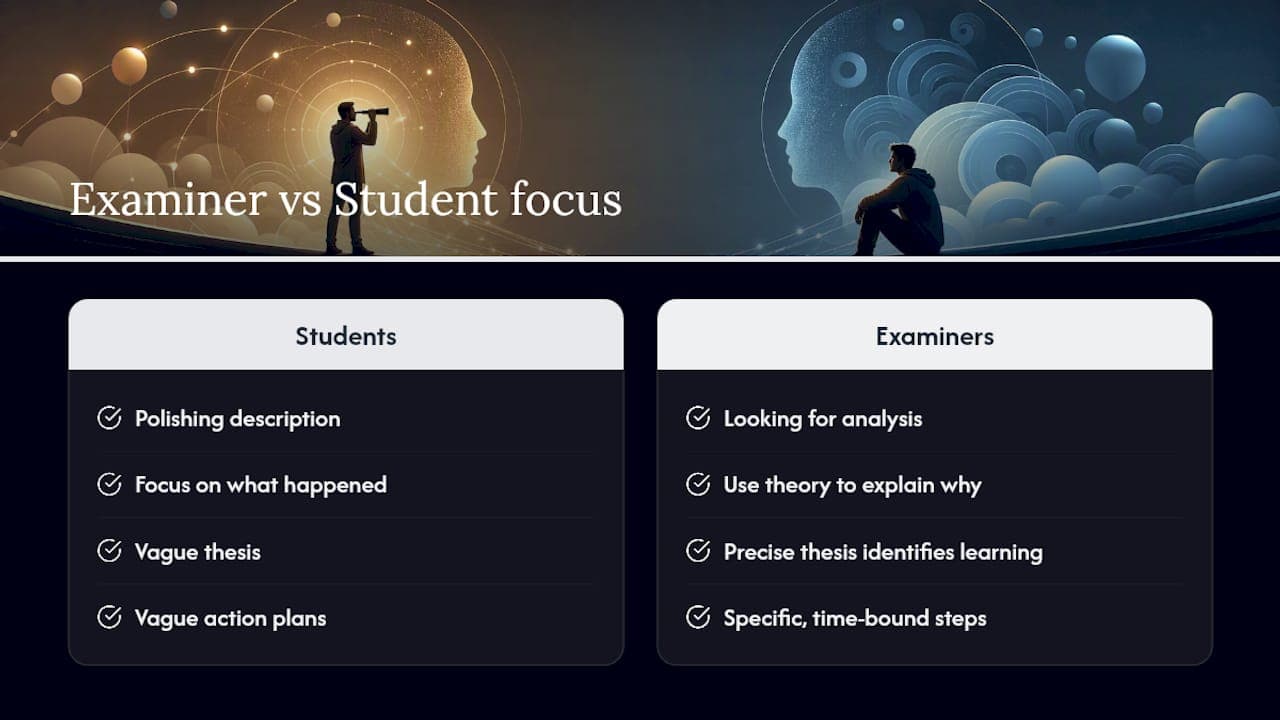
Most students spend their revision time polishing description. Examiners spend their marking time looking for analysis.
The gap between a mid-range reflection and a high-scoring one is almost always the same: the high-scoring essay uses theory to explain why something happened, not just what happened. Description is table stakes. The thesis, the theoretical lens, and the action plan are where the marks live.
A few things students consistently underestimate: the thesis matters more than most guides suggest. A vague thesis ("this experience taught me a lot") signals to the examiner that the writer has not yet identified the actual learning. A precise thesis ("this experience revealed a gap between my stated values and my behavior under pressure") tells the examiner the writer has done the analytical work before writing a single body paragraph.
The action plan is the other underrated section. Vague promises ("I will try harder") read as filler. Specific, time-bound commitments show that the reflection has produced real change in thinking. That specificity is what Salford's reflective writing guidance means when it recommends measurable steps rather than general intentions.
On academic integrity: reflective essays are personal, but they are not exempt from plagiarism or fabrication rules. Write about experiences you actually had. If you use a writing tool to draft or edit, review the output carefully to confirm it reflects your genuine experience and thinking — not a plausible-sounding generic reflection.
Structuring a reflective essay from scratch takes time most students do not have. Samwell's Guided Essays feature generates a paragraph-level outline matched to your assignment brief, so you start with a working skeleton rather than a blank page.
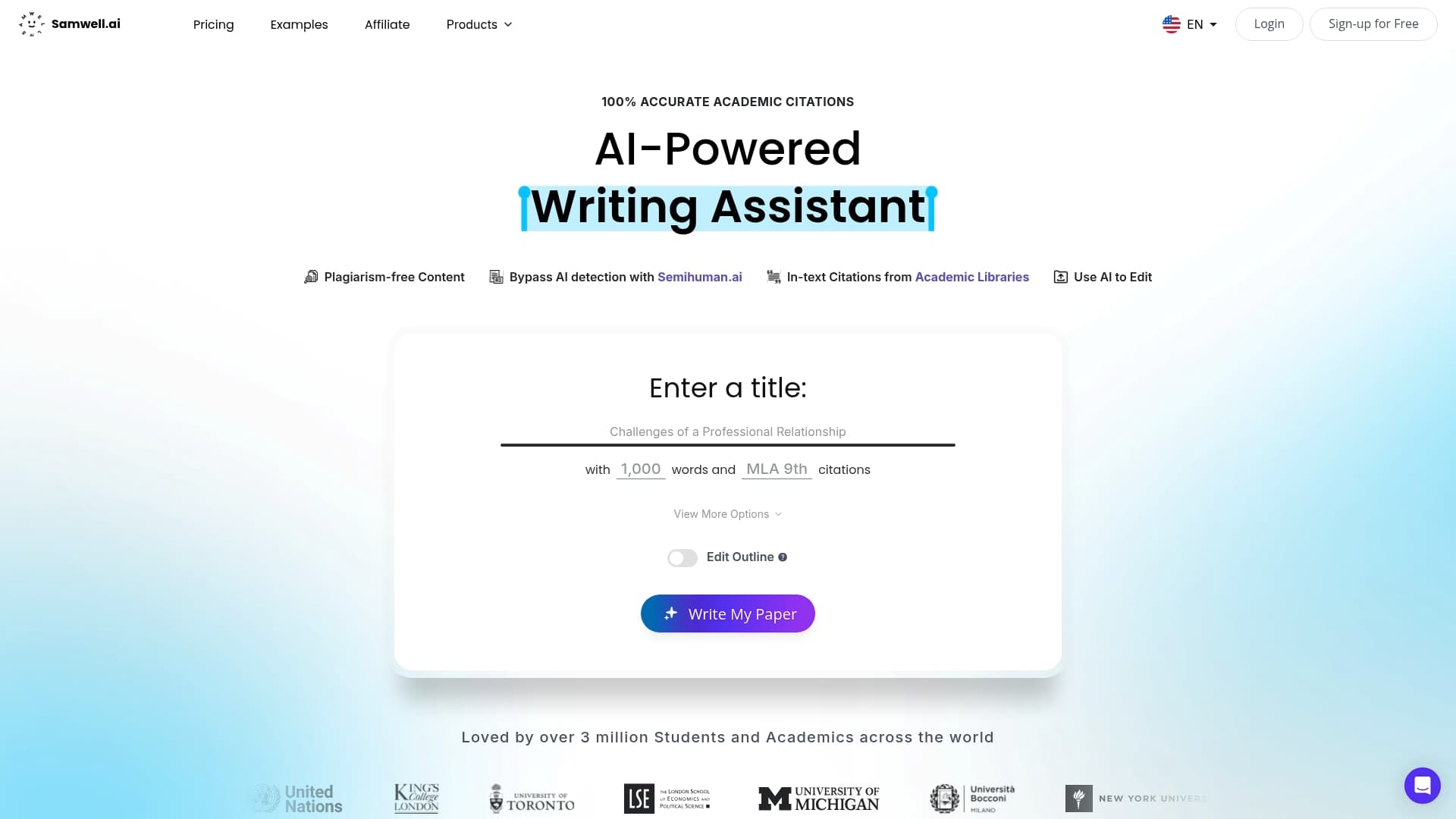
The Power Editor handles targeted revisions — tighten a description paragraph, expand an analysis section, or rebalance word count across sections without rewriting the whole draft. Citation support covers APA and MLA formatting, so your theoretical references are formatted correctly from the first draft. Real-time AI detection checks keep your submission aligned with your institution's academic integrity expectations.
One practical note: before sharing any draft with a writing tool, anonymize names, locations, and any sensitive placement details to avoid common problems with test accommodations and ensure fairness Common Problems with Test Accommodations and How to Solve Them. Protecting privacy is your responsibility regardless of the platform you use.
Start with a guided reflective outline and have a structured draft ready to edit within the hour.
Before consulting any external resource, check your course rubric and module handbook first — assignment-specific guidance always overrides general advice.