Loading...

Writing a strong opinion essay introduction can feel like standing at the edge of a cliff, unsure where to begin. You know your argument matters, but translating that conviction into a compelling opening paragraph often trips up even experienced writers. The introduction sets the tone for your entire essay, clearly states your position, and previews the arguments you'll develop. This article delivers practical examples of opinion essay introductions, breaks down their key components, and shows you how to craft openings that engage readers from the first sentence. Whether you're a student refining your skills or an academic professional seeking fresh techniques, these examples will sharpen your approach and elevate your writing quality.
| Point | Details |
|---|---|
| Structure matters | Opinion essay introductions start with a hook, provide context, and end with a clear thesis stating your opinion. |
| Hook variety | Question hooks, statistics, anecdotes, quotes, or bold statements grab attention and suit different essay tones. |
| Thesis clarity | Your thesis must explicitly express your opinion and preview the main reasons supporting your argument. |
| Formal tone | Academic contexts favor structured, formal introductions over flashy hooks, especially for professional audiences. |
| Revise after drafting | Refining your introduction after writing the body ensures your hook and thesis align perfectly with your full argument. |
Every successful opinion essay introduction combines three essential components: a hook, context, and a thesis statement. The hook grabs attention and makes readers want to continue. It might be a provocative question, a surprising statistic, or a bold claim that challenges assumptions. Context briefly introduces the essay topic without diving into excessive detail, setting the stage for your argument. The thesis statement clearly declares your opinion and previews the key reasons you'll explore in the body paragraphs.
Opinion essay introductions typically start with a hook, provide context, and end with a clear thesis stating the writer's opinion. A concise paragraph of three to six sentences is standard for introductions, balancing engagement with brevity. Pairing these components effectively builds both engagement and clarity, ensuring readers understand your position before you develop your arguments.
Think of your introduction as a roadmap. The hook draws readers into the journey, the context explains why the trip matters, and the thesis tells them exactly where you're headed. Mastering an essay hooks guide can transform your openings from forgettable to memorable. Each element serves a distinct purpose, and skipping any one weakens the entire introduction.

Pro Tip: Draft your introduction first to establish direction, but return to revise it after completing your body paragraphs. This ensures your hook and thesis reflect the full scope of your argument.
Common hooks for opinion essays include questions, statistics, anecdotes, quotes, and bold statements. Question hooks invite readers to think critically about the topic before you present your answer. For example, "Should governments prioritize economic growth over environmental protection?" immediately engages readers by framing the debate. Statistic hooks add authority and relevance with data, such as "Nearly 70% of college students report experiencing severe academic stress, yet campus mental health services remain underfunded." This example using statistic hooks shows strong engagement by grounding the essay in measurable reality.
Anecdotes personalize and engage emotionally, drawing readers into a relatable scenario. A brief story about a student struggling to access mental health resources can humanize abstract policy debates. Quotes offer credibility with expert voices, lending weight to your position before you've stated it. Bold statements create strong impact but must suit your tone. Declaring "Remote work has permanently destroyed workplace culture" demands immediate attention, though it risks alienating readers if your essay context is formal.
Choosing the right hook depends on your audience and subject. Academic essays favor how to write a good hook techniques that balance engagement with formality. Persuasive introduction examples demonstrate how different hooks serve different rhetorical goals. Review types of essay hooks and Grammarly introduction tips to understand when each type works best.
| Hook Type | Example Sentence | Best Use Case |
|---|---|---|
| Question | "Can artificial intelligence replace human creativity in the arts?" | Engages critical thinking, suits debatable topics |
| Statistic | "Over 80% of employers now require digital literacy skills for entry-level positions." | Adds authority, ideal for policy or social issues |
| Anecdote | "When Maria missed three weeks of school due to inadequate public transportation, her grades plummeted." | Personalizes abstract issues, connects emotionally |
| Quote | "As Nelson Mandela said, 'Education is the most powerful weapon which you can use to change the world.'" | Lends credibility, suits essays on established debates |
| Bold Statement | "Social media has become the greatest threat to democratic discourse in modern history." | Creates immediate impact, works for strong opinion pieces |
Pro Tip: Match your hook intensity to your essay's formality. Bold statements energize casual arguments, while statistics and questions suit academic contexts better.
Examining full opinion essay introductions reveals how hooks, context, and thesis statements work together in practice. These examples demonstrate clear structure and effective engagement techniques.
Example 1 hooks with topic restatement and states opinion clearly: "The question of whether community service is a better alternative to imprisonment for minor offenses has sparked considerable debate. While some argue that incarceration deters crime, I believe community service offers more effective rehabilitation and reduces reoffending rates. This essay will explore how community service benefits both offenders and society by promoting accountability and reintegration." This introduction uses a question hook embedded in the opening phrase, provides context about the debate, and delivers a thesis that clearly states the writer's position and previews supporting arguments. The formal tone suits academic audiences.
Example 2 uses a statistic hook about student stress to introduce its thesis on mental health services: "Nearly 70% of college students report experiencing severe academic stress, yet campus mental health services remain chronically underfunded. This alarming gap between need and resources threatens student wellbeing and academic success. Universities must prioritize mental health funding to support students facing unprecedented psychological challenges." The statistic immediately establishes urgency, the context explains why the issue matters, and the thesis advocates for a clear solution. This structure works exceptionally well for policy-focused essays.
Example 3 employs an anecdote hook for emotional connection: "When Sarah arrived at her first college lecture, anxiety paralyzed her. Despite excellent high school grades, she struggled to adapt to university demands without adequate support systems. I believe that first-year students need mandatory peer mentorship programs to ease this transition and improve retention rates. Such programs provide social connection and academic guidance precisely when students need them most." The personal story humanizes the issue, the context broadens from individual to systemic concern, and the thesis proposes a specific intervention.
"Universities must prioritize mental health funding to support students facing unprecedented psychological challenges."
These examples share common strengths: engaging hooks that match their subject matter, concise context that avoids overwhelming detail, and thesis statements that explicitly declare opinions while previewing arguments. Notice how each introduction maintains focus, delivering just enough information to orient readers without diving into body paragraph content. For additional models, explore expository essay introductions to see how structure adapts across essay types. Review British Council opinion essay examples and Grammarly introduction examples for more analysis.
Addressing opposing views briefly in your introduction can strengthen academic credibility and demonstrate sophisticated reasoning. Experts recommend briefly acknowledging counterarguments in introductions for academic essays. This technique shows awareness of alternative perspectives without diluting your main argument. Best used sparingly, a counterargument mention signals to readers that you've considered multiple angles before reaching your position.
The funnel approach works particularly well for this strategy. Use funnel structure, broad to specific, and prioritize formal tone over flashy hooks for academics. Start with a broad statement about the debate, acknowledge the opposing view in one sentence, then narrow to your thesis. For example: "While critics argue that standardized testing provides objective measures of student achievement, I contend that these assessments fail to capture critical thinking skills and creativity. This essay will demonstrate how portfolio-based assessment offers a more comprehensive evaluation of student learning."
Counterarguments add depth in formal academic contexts, demonstrating balanced reasoning that strengthens rather than weakens your position. However, avoid spending too much introduction space on opposing views. Your thesis should dominate the paragraph, with counterarguments serving only to establish the debate's complexity. This approach particularly benefits graduate-level writing and professional academic publications where nuanced argumentation matters most.
For essays requiring counterargument development, consult writing counter arguments techniques. Review Hamilton College introduction guide and UTS introduction writing tips for additional strategies on balancing multiple perspectives in academic introductions.
Crafting compelling opinion essay introductions becomes significantly easier with the right tools. Samwell AI offers specialized features to help you write clear, original opinion essays that meet academic standards. The platform generates introduction examples tailored to your specific topic, helping you identify effective hooks and formulate precise thesis statements. You can experiment with different opening strategies, compare approaches, and refine your introduction until it perfectly captures your argument's essence.
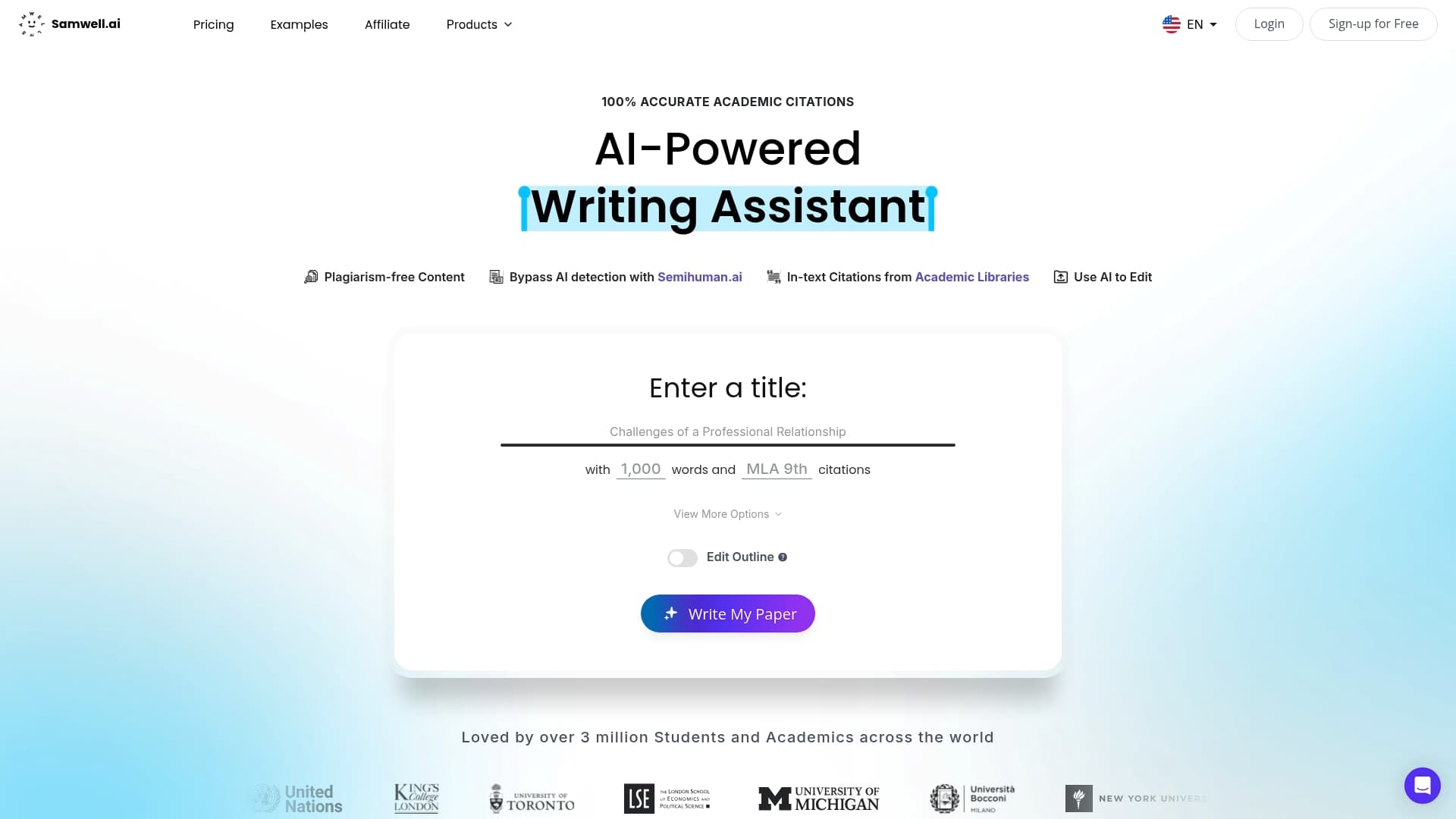
Beyond introduction support, Samwell AI ensures academic integrity with plagiarism-free content generated quickly and efficiently. The Power Editor allows targeted refinement of your opening paragraph, while Guided Essays provide structured outlines that align your introduction with body paragraphs and conclusion. Whether you're writing your first opinion essay or your hundredth, plagiarism free AI-powered essays from Samwell strengthen your essay's quality and boost your confidence. Over 1,000,000 students and academic professionals trust Samwell to enhance their writing while maintaining originality and academic rigor.
An opinion essay introduction typically runs three to six sentences, approximately 50 to 150 words. This length provides enough space to hook readers, establish context, and state your thesis clearly without overwhelming them with detail. Keep it concise but sufficient to orient your audience and preview your argument's direction.
Choose a hook that suits your essay's subject and audience expectations. Statistical or question hooks work well for academic essays requiring formal tone and evidence-based argumentation. Anecdotes suit essays with personal or narrative elements, while bold statements energize opinion pieces on controversial topics. Consider your reader's background and the debate's nature when selecting your opening strategy.
Yes, refining your introduction after drafting the body improves clarity and alignment with arguments. Writing the body first reveals your essay's actual scope and strongest points, allowing you to tighten the hook and thesis to match your full argument. This revision ensures your introduction accurately previews what follows and eliminates any misalignment between opening promises and delivered content. Review Grammarly introduction revision tips for specific strategies.
While possible, combining hook types risks cluttering your introduction and diluting focus. Stick to one primary hook that best serves your essay's purpose, then use context sentences to build toward your thesis. Multiple hooks can confuse readers about your essay's direction and waste valuable introduction space that should establish your position clearly.
A strong thesis explicitly states your opinion using clear, unambiguous language and previews the main reasons supporting your argument. Avoid hedging words like "might" or "could" that weaken your position. Your thesis should answer the essay question directly and signal the organizational structure readers can expect in body paragraphs.