Loading...

Finding quality IELTS essay examples that truly align with exam standards can be frustrating. Many students waste time studying irrelevant or poorly annotated samples. This guide provides carefully curated IELTS essay examples with detailed explanations, scoring insights, and practical strategies to improve your writing performance and boost your band scores effectively.
| Point | Details |
|---|---|
| Alignment with band descriptors | Choose examples matching official IELTS scoring criteria to understand what examiners value. |
| High-scoring features | Band 7+ essays demonstrate sophisticated vocabulary, coherent structure, and complete task achievement. |
| Essay type differences | Opinion, discussion, and problem-solution essays require distinct approaches and language styles. |
| Learning from mistakes | Annotated examples showing common errors help you avoid score-reducing pitfalls. |
| AI-powered feedback | Modern tools provide personalized corrections and practice aligned with IELTS requirements. |
Selecting the right essay examples determines how effectively you prepare for IELTS Writing Task 2. Random samples won't help you understand what examiners actually look for.
Start by choosing examples that align with official band descriptors. These scoring guidelines reveal exactly how examiners evaluate coherence, lexical resource, grammar, and task achievement. Without this alignment, you risk learning incorrect patterns that won't boost your score.
Focus on the three main question types: opinion essays (agree/disagree), discussion essays (balanced views), and problem-solution essays. Each type demands different structural approaches and language choices. Studying varied question types prepares you for whatever prompt appears on test day.
Prioritize examples demonstrating strong lexical resource and grammar accuracy. Look for essays using topic-specific vocabulary naturally, not forced academic words. Check for complex sentence structures that flow smoothly rather than awkward constructions added just for complexity.
Annotated essays with corrections or examiner comments provide the deepest learning. These show why certain choices earn higher scores and where common mistakes happen. Comments like "weak thesis" or "excellent cohesive device" teach you what works.
Pro Tip: Study both high band (7-8) and mid band (5-6) samples side by side to understand the specific differences that separate score levels.
Include variety in your practice materials:
This strategic selection approach transforms random reading into targeted skill development. You'll recognize patterns that earn higher scores and avoid the traps that limit mid-band writers.
Examining actual Band 7+ essays reveals what separates good writing from exceptional performance. These examples demonstrate techniques you can apply immediately.

High-scoring essays open with crystal-clear thesis statements that directly address the question. No vague introductions or wandering setup. The examiner knows your position within the first two sentences. Body paragraphs then develop this stance with specific examples and logical reasoning.
Vocabulary choices in top essays feel natural rather than forced. Writers use topic-specific terms like "sustainable urban development" or "cognitive development" precisely where they fit. They vary word forms (sustain, sustainability, sustainable) and employ less common phrases ("mitigate environmental impact" instead of "reduce pollution").
Grammatical range includes complex structures that enhance meaning. Conditional sentences, passive voice for emphasis, and relative clauses all appear naturally. Importantly, these structures serve clarity rather than showing off complexity.
Key features of Band 7-8 essays:
Annotated comments in quality examples highlight specific scoring elements. You might see notes like "excellent cohesive device" next to "Furthermore" or "precise vocabulary choice" marking "predominantly" instead of "mostly." These annotations connect abstract scoring criteria to concrete writing decisions.
For practical essay samples showing these principles in action, look for resources that explain not just what the writer did but why examiners reward it. Understanding the reasoning behind high scores helps you replicate success in your own writing.
Coherence in top essays comes from logical paragraph structure and clear topic development. Each paragraph explores one main idea fully before moving forward. Pronouns, synonyms, and transition phrases guide readers smoothly from sentence to sentence.
Full task achievement means addressing every part of the question. If the prompt asks about advantages and disadvantages, both receive equal treatment. If it requests your opinion, you state it clearly and support it throughout. Missing any element costs points immediately.
Understanding the three main essay types prevents the costly mistake of using the wrong structure for your prompt. Each type demands specific approaches to maximize your task achievement score.
Opinion essays ask you to state and defend a personal stance on an issue. Prompts include phrases like "To what extent do you agree?" or "Do you agree or disagree?" Your introduction must clearly present your position. Body paragraphs then provide reasons and examples supporting this view. Persuasive language and confident assertions work well here.
Discussion essays require presenting multiple viewpoints before possibly stating your own opinion. Questions include "Discuss both views" or "What are the advantages and disadvantages?" You need balanced treatment of different perspectives using neutral, analytical language. Structure typically dedicates one paragraph to each viewpoint.
Problem-solution essays focus on identifying issues and proposing practical remedies. Prompts ask "What problems does this cause?" and "What solutions can you suggest?" Your response analyzes causes or effects, then offers realistic solutions. Implementation details and potential outcomes strengthen these essays.
| Essay Type | Structure | Language Style | Key Focus |
|---|---|---|---|
| Opinion | Clear thesis, supporting paragraphs, reinforced conclusion | Persuasive, assertive, first person acceptable | Defending one viewpoint consistently |
| Discussion | Balanced presentation of views, optional personal stance | Neutral, analytical, third person preferred | Fair treatment of multiple perspectives |
| Problem-Solution | Issue analysis, proposed remedies, implementation details | Practical, cause-effect language, modal verbs | Realistic solutions addressing root causes |
Vocabulary sets differ significantly across types. Opinion essays use words like "strongly believe," "convinced," and "undoubtedly." Discussion essays prefer "proponents argue," "critics contend," and "both perspectives have merit." Problem-solution essays employ "address," "implement," "mitigate," and "alleviate."
Structural differences matter for scoring. Opinion essays gain from strong, repeated reinforcement of your stance. Discussion essays need equal paragraph length and depth for each view. Problem-solution essays require clear problem identification before solutions, not mixed together.
Pro Tip: Identify your essay type in the first 30 seconds of reading the prompt by looking for key phrases, then mentally outline the required structure before you start writing.
For IELTS problem solution tips, focus on connecting causes to appropriate solutions rather than listing generic fixes. Examiners reward specific, thoughtful responses over broad suggestions.
Choosing the correct structure ensures you meet task requirements fully. Using an opinion structure for a discussion question, or vice versa, immediately limits your band score regardless of language quality. Match your approach to the question type every time.
Recognizing frequent errors through annotated examples helps you avoid the pitfalls that reduce band scores. Task achievement errors cause about 40% of band score penalties in IELTS writing.
Off-topic writing ranks among the most damaging mistakes. Students sometimes misinterpret the question or drift into related but irrelevant territory. An essay about "benefits of online education" that focuses primarily on technology advances misses the mark. Stay laser-focused on what the prompt actually asks.
Weak arguments lacking specific support hurt coherence scores. General statements like "Education is important for society" without examples or reasoning feel empty. Compare this to "Education reduces unemployment by equipping workers with marketable skills, as seen in vocational training programs that achieve 75% job placement rates."
Typical vocabulary mistakes include:
Grammar slips that appear repeatedly signal systemic problems rather than simple typos. Subject-verb agreement errors ("The number of students have increased"), article mistakes ("The education is important"), and tense inconsistency all reduce your grammar score when they occur frequently.
"Many people thinks that government should provide free education because education are very important for develop the country and without education peoples cannot get good jobs."
This excerpt demonstrates multiple issues: subject-verb disagreement ("people thinks"), article errors (missing "the" before "government"), verb form mistakes ("for develop"), and plural errors ("peoples"). Each type appears more than once, signaling the writer hasn't mastered these grammar points.
Annotated corrections show how to fix these problems:
Coherence suffers when essays lack clear paragraph organization. Each paragraph needs one main idea, introduced in the topic sentence and developed with supporting details. Mixing multiple unrelated points in one paragraph confuses readers and costs coherence points.
Task achievement failures happen when writers don't fully address the question. If the prompt asks for both causes and effects, providing only causes means incomplete task fulfillment. If it requests your opinion, sitting on the fence instead of taking a clear stance hurts your score.
Understanding these common errors through specific examples helps you self-edit effectively. When you recognize the patterns that reduce scores, you can catch and correct them before submitting your essay.
Artificial intelligence tools have transformed IELTS preparation by providing personalized support that adapts to your specific needs. These technologies complement traditional study methods with immediate, detailed feedback.
AI essay writing tools generate custom practice essays matching IELTS topics and your target band level. You can request an opinion essay on education policy or a problem-solution piece about environmental issues. The AI creates unique examples that follow proper structure and demonstrate appropriate language.
Instant grammar and vocabulary feedback helps you improve faster than waiting for teacher corrections. AI identifies specific errors, explains why they're wrong, and suggests improvements. This immediate loop between writing and correction accelerates learning.
Key benefits of AI writing assistance:
Personalization addresses your individual weaknesses rather than generic advice. If you struggle with complex sentences, AI can focus practice there. If vocabulary range limits your score, tools suggest topic-specific terms and natural usage examples.
Comparing best AI writing tools reveals different strengths. Some excel at grammar correction, others at generating practice prompts, and platforms like Samwell.ai specialize in academic writing aligned with exam criteria.
Integration with IELTS band descriptors ensures relevant practice. Quality AI tools understand what examiners value at each band level. They can generate Band 6.5 examples showing typical features at that level, or Band 8 essays demonstrating advanced techniques.
AI prevents plagiarism concerns by creating original examples rather than copying existing essays. Each generated piece is unique, letting you study structure and language without ethical worries about reproducing someone else's work.
Feedback depth from AI tools often exceeds what busy teachers can provide. While a teacher might mark "grammar error," AI explains the specific rule violated, shows the correction, and provides similar examples for practice. This detail accelerates understanding.
Using AI strategically means combining it with human guidance. AI excels at identifying technical errors and generating practice material. Human teachers provide cultural context, motivation, and nuanced feedback on argument quality. Together, they create comprehensive preparation.
Comparing essays across band levels clarifies exactly what separates good writing from exceptional performance. This side-by-side analysis reveals concrete differences in coherence, vocabulary, grammar, and task achievement.
| Feature | Band 6 Example | Band 8 Example |
|---|---|---|
| Thesis clarity | States position but somewhat unclear focus | Sharp, specific thesis directly addressing all parts of prompt |
| Vocabulary range | Adequate common words, some repetition | Sophisticated terms used precisely, strong collocations, varied word forms |
| Grammar accuracy | Simple sentences mostly correct, errors in complex structures | Wide range of complex structures with minimal errors |
| Coherence | Basic paragraphing, simple transitions | Seamless flow, sophisticated cohesive devices, clear progression |
| Task achievement | Addresses main points but may lack depth | Fully developed arguments with specific, relevant examples throughout |
| Argument development | General statements with limited support | Specific examples, cause-effect reasoning, counterarguments addressed |
| Errors | Noticeable errors that sometimes reduce clarity | Rare slips that don't impede communication |
Higher scoring essays maintain consistent argument development throughout without introducing irrelevant content. Band 8 writers stay focused on directly answering the question, while Band 6 essays sometimes drift into related but off-topic territory.
Strengths in higher band essays include sophisticated arguments that consider multiple angles. A Band 8 opinion essay might acknowledge counterarguments before refuting them, showing depth of analysis. Band 6 essays typically present one viewpoint without this nuance.
Vocabulary sophistication appears in natural usage of less common words. Band 8 writers employ "substantial investment" instead of "a lot of money" or "alleviate concerns" rather than "make better." These choices feel appropriate, not forced.
Weaknesses in mid-band essays often include grammar inconsistency. The writer might use present perfect correctly in one paragraph but revert to simple past where present perfect fits better. These inconsistencies signal incomplete grammar mastery.
Off-topic content appears more frequently in Band 6 essays. A question about government education funding might trigger paragraphs about general education benefits rather than specifically about funding. This reduces task achievement scores.
Coherence differences show in transition sophistication. Band 6 essays rely on basic connectors like "First," "Second," and "In conclusion." Band 8 writing uses varied cohesive devices: "This approach," "Such measures," "Consequently," integrated smoothly into sentences.
Identifying these concrete differences helps you target improvements for your band goal. If you're scoring Band 6.5 and aiming for Band 7, focus on expanding vocabulary range and improving argument specificity rather than perfecting every grammar rule.
Your current level and specific challenges determine which essay examples and practice strategies will help most. Targeted selection accelerates improvement more than random studying.
Beginners aiming for Band 6 should start with annotated Band 5.5-6.5 opinion essays. These show clear structure basics without overwhelming complexity. Focus on understanding how introduction, body paragraphs, and conclusion function. Practice matching this structure before worrying about sophisticated vocabulary.
Intermediate learners targeting Band 7 benefit from comparing Band 6 and Band 7.5 essays on the same topic. This comparison reveals specific improvements needed: more precise vocabulary, better transitions, fuller task achievement. Study the gap between levels you've achieved and where you want to reach.
Advanced students pursuing Band 8 should analyze Band 8-9 discussion and problem-solution essays. These demonstrate complex language use and nuanced arguments. Focus on how writers integrate counterarguments, use sophisticated cohesive devices, and maintain consistent formal register.
For specific challenges:
Pro Tip: Spend 70% of practice time on your weakest area and 30% maintaining strengths. If grammar is strong but vocabulary limits you, prioritize vocabulary-focused examples and exercises.
Question type matching improves task achievement dramatically. Keep a collection of examples organized by type: opinion, discussion, and problem-solution. When you see a prompt, immediately identify its type and review the matching structural approach before writing.
Band-specific goal setting keeps practice relevant. If you need Band 6.5 for university admission, studying Band 9 essays may inspire you but Band 7 examples provide more realistic, achievable models. Target one band above your current level for optimal challenge.
Balanced practice across all criteria prevents lopsided development. Don't focus only on vocabulary while ignoring coherence, or perfect grammar while neglecting task achievement. Review examples that demonstrate all four scoring criteria working together.
Regular self-assessment using examples as benchmarks shows progress objectively. Every two weeks, compare your latest practice essay to target band examples. Note specific areas where you've improved and where gaps remain. This evidence-based approach focuses effort effectively.
Samwell AI provides specialized tools designed specifically for improving academic writing aligned with IELTS standards. The platform combines AI efficiency with exam-focused features that address common preparation challenges.
The enhanced essay creator generates customized practice essays matching IELTS question types and your target band level. You receive unique, properly structured examples demonstrating appropriate vocabulary and grammar for your goals. Each essay includes detailed feedback highlighting strengths and improvement areas.
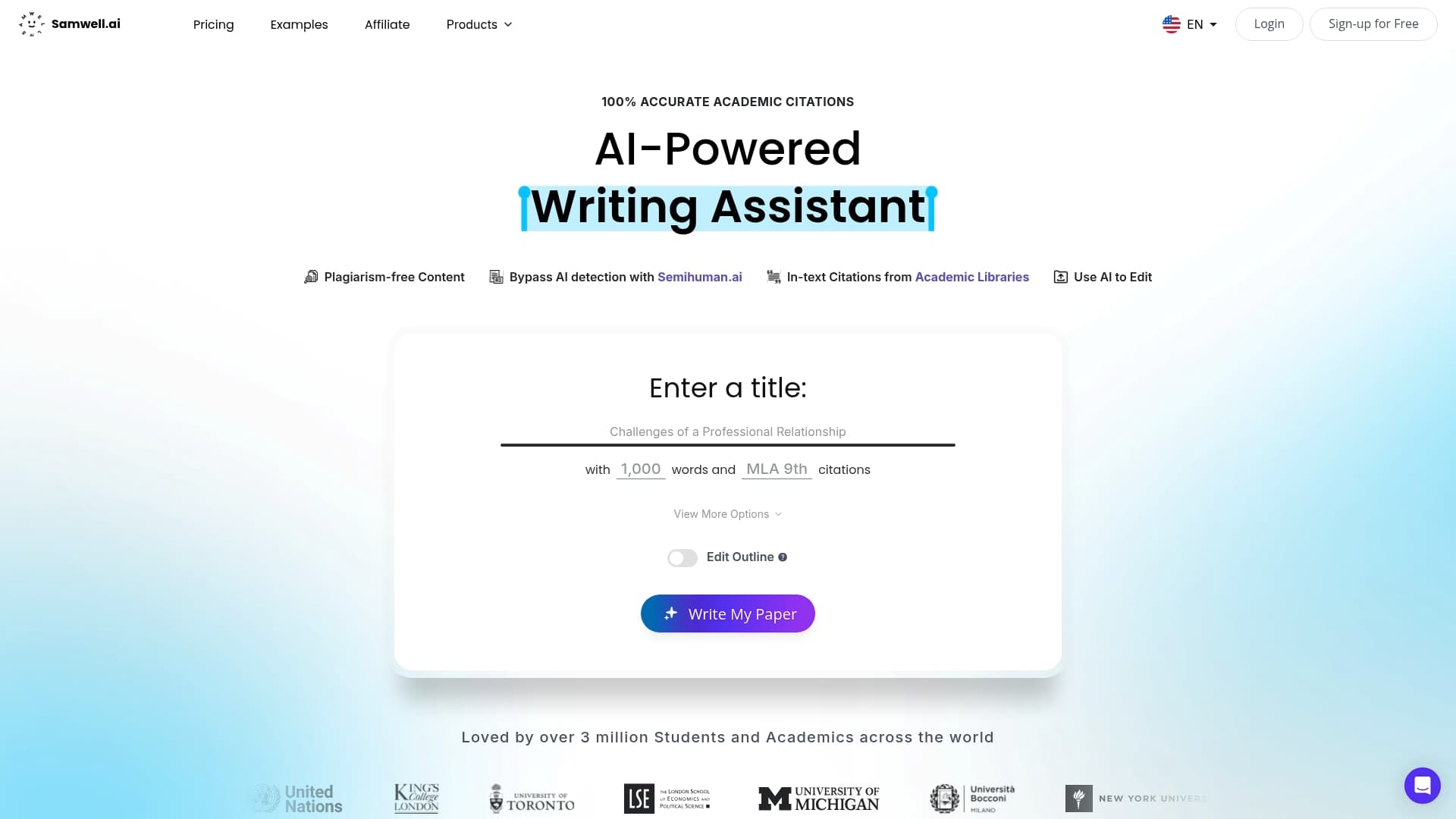
Real-time feedback catches errors immediately and explains corrections. The system identifies grammar mistakes, suggests stronger vocabulary choices, and evaluates structural organization. This instant guidance accelerates learning compared to delayed feedback from traditional methods.
Samwell's research paper generator and Power Editor help refine arguments and expand content while maintaining academic integrity. For IELTS students, these tools support developing fuller task achievement by suggesting relevant examples and strengthening logical flow.
The platform ensures originality through advanced plagiarism detection, critical for ethical academic writing. You can practice confidently knowing your work is unique and meets integrity standards. Over 1,000,000 students trust Samwell AI for efficient, quality preparation that boosts writing confidence and test performance.
Opinion, discussion, and problem-solution essays dominate IELTS Writing Task 2. Understanding their structural and language differences helps you respond appropriately to any prompt you encounter on test day.
Study well-annotated examples to understand structure, vocabulary choices, and task achievement techniques. Practice writing similar essays, then compare your work to high-scoring models to identify specific improvement areas.
AI tools provide personalized feedback based on IELTS criteria, improving writing quality through immediate corrections and suggestions. They work best when combined with human guidance for nuanced argument development and cultural context.
Most universities require Band 6.5-7.0 overall, with individual section minimums often at Band 6.0. Check your specific program requirements, as competitive programs may demand Band 7.5 or higher.
Plan at least 8-12 weeks of focused practice using quality examples and receiving regular feedback. This timeline allows mastery of different essay types and substantial improvement in weaker areas before test day.