Loading...

Writing an essay about a book isn't about retelling the plot. Many students mistakenly treat book essays as extended summaries, but effective essays demand focused analysis, clear arguments, and strategic use of evidence. This guide teaches you proven techniques for crafting impactful book essays and shows how AI-driven tools can enhance your research, structure, and originality while maintaining academic integrity.
| Point | Details |
|---|---|
| Focus defines direction | Choosing literary analysis, comparative, cultural, or personal reflection focus shapes your thesis and research approach. |
| Research combines sources | Close reading of primary texts plus scholarly secondary sources builds strong evidence foundations. |
| Thesis anchors argument | A precise thesis statement guides essay structure and ensures analytical coherence throughout. |
| Structure boosts clarity | Outlining reduces writer's block and organizes ideas into compelling, logical progression. |
| AI enhances quality | Tools improve originality checks, citation accuracy, and editing efficiency for academic success. |
Selecting a clear focus transforms vague ideas into purposeful analysis. The four primary essay types for books each serve distinct analytical goals and shape how you approach your thesis and evidence.
Literary analysis examines themes, symbols, character development, or narrative techniques within a single work. Comparative essays contrast two or more books, exploring similarities and differences in style, theme, or cultural context. Cultural impact essays investigate how a book influenced society, politics, or artistic movements. Personal reflection essays connect the text to your experiences while maintaining analytical depth.
Your chosen focus determines which evidence matters most and how you structure arguments. A literary analysis of symbolism in "The Great Gatsby" requires different textual evidence than a cultural impact essay exploring how the novel shaped 1920s American identity. Clarity here prevents scattered arguments and weak conclusions.
Defining focus early directs every subsequent decision, from research questions to paragraph organization. Students who skip this step often produce essays that summarize plot or jump between unrelated observations. AI-powered essays can help clarify focus by generating structured outlines based on your chosen analytical angle.
Pro Tip: Write your focus as a single sentence before researching. If you can't articulate it clearly in one sentence, your essay direction needs refinement.
Effective research balances deep engagement with your primary text and strategic use of scholarly sources. This dual approach builds credible arguments anchored in textual evidence and supported by academic context.
Close reading forms the foundation of book essay research. Read actively with a notebook, marking passages that connect to your focus. Annotate quotes, note page numbers, and track recurring motifs or contradictions. This granular attention reveals nuances that superficial reading misses.
Scholarly secondary sources provide critical perspectives and historical context. Academic journals, university press books, and peer-reviewed articles offer interpretations that deepen your analysis. Academic research engines in 2026 streamline finding credible sources, cutting research time significantly while ensuring relevance.
Organized note-taking prevents information overload and maintains argument coherence. Create separate documents or sections for primary text quotes, secondary source insights, and your own analytical observations. Tag notes by theme or argument point to simplify outline creation later. Digital tools allow quick searches when you need specific evidence during drafting.
Your thesis statement distills your entire argument into one or two focused sentences. It answers the "so what?" question and tells readers exactly what interpretive claim your essay will prove.
A strong thesis makes a debatable claim about the book rather than stating obvious facts. "The Great Gatsby explores wealth" is too broad and indisputable. "Fitzgerald uses contrasting symbols of light and darkness to expose how wealth corrupts moral vision in 1920s America" presents a specific, arguable interpretation that requires evidence to support.
The thesis guides every body paragraph's topic sentence and determines which evidence belongs in your essay. Weak theses produce wandering essays that introduce irrelevant points or fail to build cumulative arguments. Each paragraph should clearly advance your thesis or provide necessary context for understanding it.
Drafting a preliminary thesis before detailed outlining helps, but expect to revise it as research deepens your understanding. The thesis often sharpens during writing as you discover which arguments your evidence actually supports. AI writing tools can generate thesis variations based on your focus, helping you identify the most compelling angle.
Pro Tip: Read your thesis to someone unfamiliar with your essay. If they can't predict your main arguments, the thesis needs clearer direction.
Structured organization transforms research into persuasive writing. The classic essay format includes an introduction with thesis, body paragraphs that develop arguments with evidence, and a conclusion that synthesizes insights without simply repeating earlier points.
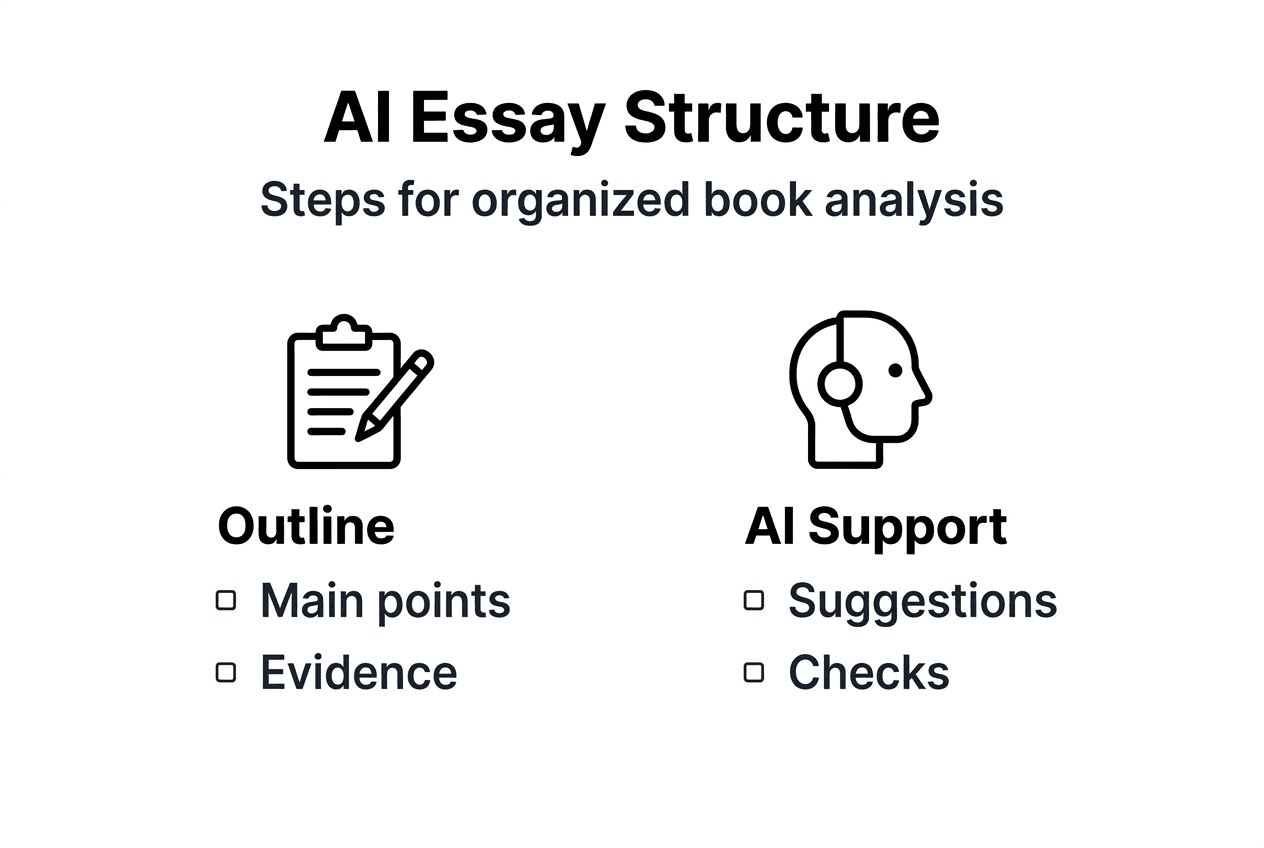
Creating an effective outline before drafting saves time and improves coherence. Follow these steps:
Using an essay outline to organize main ideas reduces writer's block and helps maintain logical progression. Structured approaches to essay writing create better clarity and reduce common pitfalls according to academic writing research.

The difference between outlined and unstructured writing becomes clear when comparing outcomes:
| Aspect | Outlined Essay | Unstructured Essay |
|---|---|---|
| Argument flow | Logical progression building to conclusion | Scattered points without clear connection |
| Time efficiency | Faster drafting with clear roadmap | Frequent rewrites and reorganization |
| Evidence use | Strategic placement supporting claims | Random insertion where convenient |
| Reader clarity | Easy to follow argument development | Confusion about main points |
AI writing tools generate structured outlines based on your thesis and evidence, providing frameworks that ensure comprehensive coverage of your topic while maintaining focus.
Pro Tip: Color code your outline by argument strength. If you notice weak sections lacking solid evidence, research those areas before drafting to avoid gaps in logic.
Proper citation demonstrates academic integrity and allows readers to verify your sources. Different disciplines require specific formatting styles, and precision here impacts your essay's credibility and grade.
MLA format, common in literature courses, uses parenthetical in-text citations with author and page number. Book titles appear in italics while chapter titles use quotation marks. APA style, frequent in social sciences, emphasizes publication dates and uses different formatting for references. Chicago style offers footnotes or endnotes with detailed source information.
Understanding these distinctions prevents formatting errors that undermine otherwise strong analysis. A literature professor expects MLA formatting, and submitting an APA-formatted essay signals carelessness regardless of content quality. Best AI citation generators automate formatting across styles, ensuring accuracy without manual memorization of complex rules.
Citation errors create unnecessary grade deductions and raise plagiarism concerns. Even unintentional mistakes like missing quotation marks or incorrect attributions can trigger academic integrity investigations. Investing time in proper citation protects your work and reputation.
Advanced AI platforms transform how students approach academic writing by enhancing efficiency without sacrificing originality. These tools assist with drafting, editing, citation management, and plagiarism detection throughout the writing process.

AI-driven tools streamline essay writing by enabling custom instructions, generating structured content, and minimizing plagiarism through specialized technology. Over 1,000,000 students and academics worldwide use these platforms to improve writing quality while maintaining academic standards.
Modern AI writing assistants offer several key capabilities. Custom instruction features let you specify focus, thesis, and preferred sources so generated content aligns with your analytical goals. Source integration ensures essays reference credible academic materials rather than generic information. These features produce relevant first drafts that require refinement rather than complete rewriting.
Tools like Samwell.ai provide Power Editor for targeted content expansion and Guided Essays for creating structured outlines. Real-time plagiarism detection adapts to evolving AI detection technologies, ensuring your work maintains originality. Citation support automates formatting across MLA, APA, and Chicago styles, eliminating manual formatting errors.
"AI writing tools don't replace critical thinking. They amplify your ideas by handling mechanical tasks like formatting and initial structuring, freeing you to focus on developing sophisticated arguments and original insights."
Plagiarism-free essays remain the priority, and modern AI platforms include safeguards that prevent copied content while encouraging original analysis. Understanding AI writing trends in 2026 helps you use these tools strategically rather than becoming dependent on automated outputs.
Several persistent myths undermine essay quality by leading students toward ineffective approaches. Recognizing and avoiding these errors strengthens your analytical writing immediately.
Common misconceptions include believing more quotes automatically improve essays and that general summaries suffice instead of deep analysis. These misunderstandings produce essays that read like book reports rather than analytical arguments.
Excessive quoting actually weakens essays by replacing your analytical voice with the author's words. Quotes should support claims you make, not substitute for making claims. A paragraph dominated by quotes tells readers you haven't developed your own interpretation. Use quotes sparingly and always explain their significance to your argument.
Summary alone fails because it doesn't demonstrate critical thinking or interpretation. Professors assume you read the book; they want to see what you think about it. Analytical essays require you to make claims about meaning, technique, or significance that go beyond describing plot events or character actions.
Disregarding essay structure produces confusion regardless of insight quality. Even brilliant observations lose impact when presented in random order without clear transitions. Readers need signposting that shows how each paragraph connects to your thesis and builds toward your conclusion.
Avoid writing style that sounds like high-scoring essay misconceptions by focusing on clear arguments supported by strategic evidence rather than impressive-sounding language without substance.
Multi-dimensional analysis elevates book essays from basic literary critique to sophisticated academic argumentation. Incorporating ethical, social, and political perspectives reveals deeper insights about texts and their cultural contexts.
High-scoring essays exhibit multi-dimensional analysis addressing social, economic, political and ethical perspectives beyond surface literary elements. Incorporating multiple perspectives enriches analysis by examining how books engage with complex real-world issues.
Ethical analysis explores moral questions the text raises about right and wrong, justice, or human nature. Social analysis examines class dynamics, gender roles, or cultural norms the book reflects or challenges. Political analysis investigates power structures, governance themes, or ideological conflicts within the narrative or its historical context.
These analytical layers work together to create richer interpretations. A basic analysis of "1984" might discuss Orwell's writing style. An advanced multi-dimensional approach examines the novel's ethical warnings about truth manipulation, its social commentary on conformity and individuality, and its political critique of totalitarianism drawing from 1940s historical context.
| Analysis Level | Scope | Example for "To Kill a Mockingbird" |
|---|---|---|
| Basic literary | Plot, character, style | Analyzes Scout's character development and narrative voice |
| Advanced multi-dimensional | Ethical, social, political layers | Examines racial justice ethics, Southern social hierarchies, and legal system failures in 1930s America |
Pro Tip: Choose one primary analytical dimension aligned with your thesis, then incorporate one or two secondary dimensions for depth. Attempting to cover all perspectives equally creates unfocused essays.
Understanding AI essay writing approaches helps you use tools to develop these sophisticated analyses rather than producing generic observations.
Applying these strategies becomes easier with the right tools supporting your writing process. Samwell AI specializes in helping students and academics produce high-quality, original essays that meet rigorous academic standards.
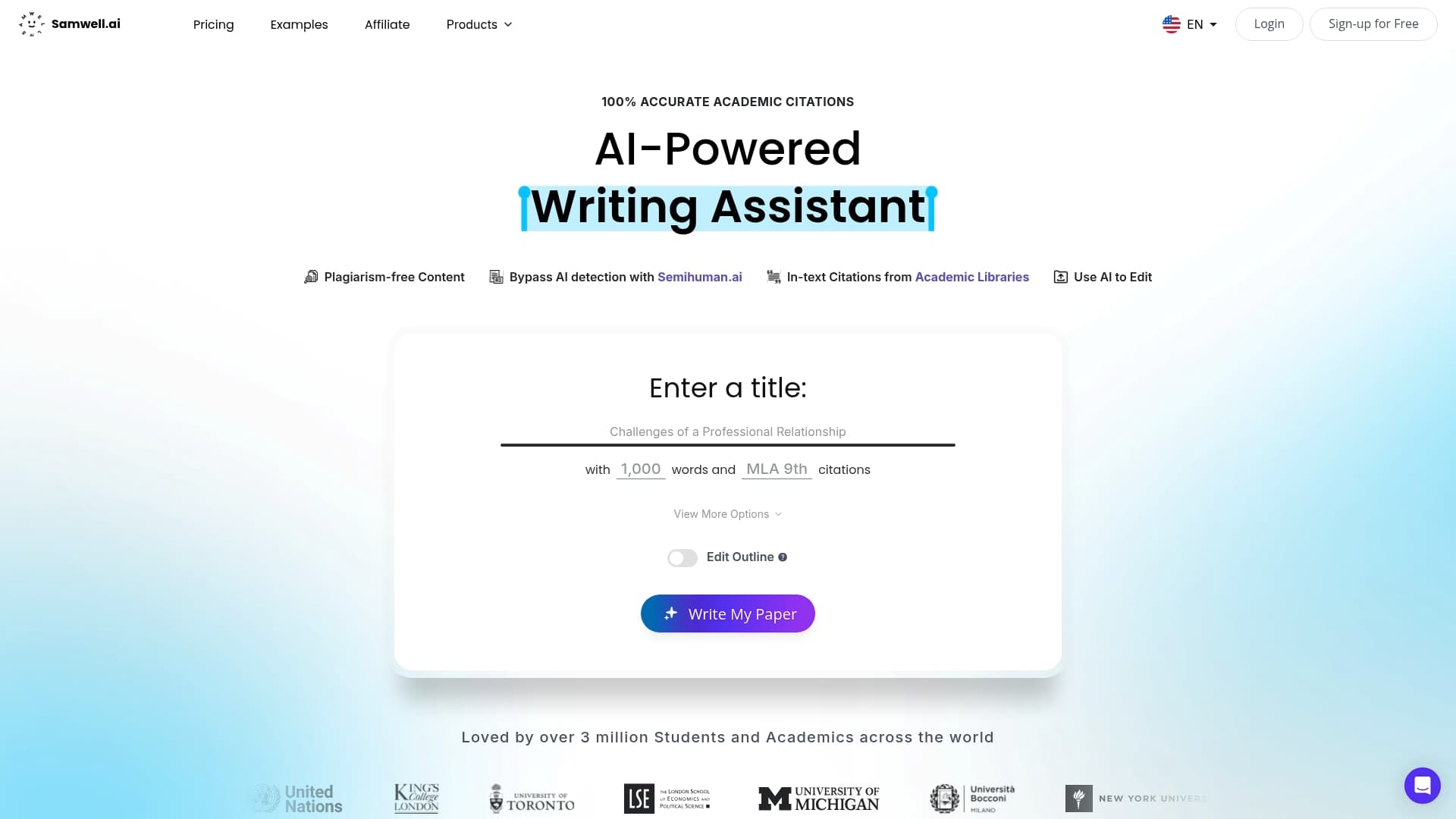
The platform combines structured essay generation with powerful editing features designed specifically for academic writing on books and literature. Whether you're analyzing classic novels or contemporary works, Samwell AI helps you develop clear arguments, maintain proper citations, and ensure your work remains plagiarism-free throughout the writing process.
With features including real-time originality checks and automated citation formatting for MLA, APA, and Chicago styles, you can focus on developing sophisticated analysis rather than worrying about technical formatting requirements. The Guided Essays feature creates structured outlines based on your thesis, while Power Editor helps expand and refine sections that need development. Join the million-plus students already using plagiarism-free essay tools to elevate their academic writing and achieve better results.
The four primary essay focuses are literary analysis examining themes and techniques, comparative essays contrasting multiple works, cultural impact essays exploring societal influence, and personal reflection connecting texts to experience. Each focus type directs different research approaches and argument structures, so choosing the right one early clarifies your analytical direction.
AI-powered tools help create structured drafts based on your thesis and sources, automatically format citations across academic styles, and check for plagiarism before submission. These features improve writing efficiency by handling mechanical tasks while you focus on developing original analysis and sophisticated arguments that demonstrate critical thinking.
Avoid excessive quoting that replaces your analytical voice with the author's words, substituting plot summary for interpretive argument, and ignoring essay structure that guides readers through your logic. Focus instead on making clear claims supported by strategic evidence, explaining the significance of quotes rather than just inserting them, and maintaining organized paragraphs that each advance your thesis directly.
Correct citation demonstrates academic integrity, allows readers to verify your sources, and prevents plagiarism accusations that can damage your academic record. Different disciplines require specific styles like MLA for literature or APA for social sciences, and formatting precision signals professionalism and attention to scholarly standards that directly impacts your credibility and grade.
Outlining organizes your arguments logically before drafting, identifies evidence gaps early, and reduces writer's block by providing a clear roadmap. Structured outlines ensure each paragraph advances your thesis, create smooth transitions between ideas, and save significant revision time by preventing the scattered organization that requires extensive rewriting in unstructured drafts.