Loading...

Writing a strong conclusion paragraph often feels like the hardest part of any academic paper. You have spent hours researching, analyzing, and crafting your arguments, but now you must tie everything together in a way that leaves a lasting impression on your reader. Many students and academic professionals struggle with this final section, unsure whether to summarize, synthesize, or simply restate their thesis. Mastering the conclusion paragraph format is essential for clarity and impact. This guide will walk you through the purpose, structure, and best practices for writing conclusions that truly resonate.
| Point | Details |
|---|---|
| Synthesis over summary | Effective conclusions synthesize findings and analysis rather than merely repeating what was already stated. |
| Address research gaps | Strong conclusions revisit literature gaps identified earlier and explain how your work contributes to filling them. |
| Leverage recency effect | The last thing readers encounter shapes their overall impression, making conclusions critical for retention and impact. |
| Avoid new information | Introducing fresh ideas or evidence in the conclusion confuses readers and undermines the paper's coherence. |
| Propose future research | Suggesting realistic next steps based on your findings demonstrates scholarly rigor and opens pathways for continued inquiry. |
The conclusion paragraph serves as the final chapter of your academic paper, bringing together all your research and analysis to highlight what you discovered and why it matters. Research conclusions tie everything together and clarify the value of your study for readers. Rather than simply restating your thesis or summarizing each section, a well-crafted conclusion synthesizes your findings, addresses your research questions, and demonstrates the broader significance of your work.
Every effective conclusion should include several key components. First, restate your main findings in a fresh way that reflects the depth of your analysis. Second, directly address the research questions or hypotheses you posed at the beginning of your paper, showing how your work answered them. Third, explain the significance of your results within the larger academic conversation or real-world context. These elements work together to create a cohesive ending that reinforces your paper's contribution.
Consider these standard elements when formatting your conclusion:
The difference between synthesis and summary is crucial. Summary involves listing what you covered in each section, which often feels repetitive and flat. Synthesis, by contrast, combines your findings into a larger picture, showing how different pieces of evidence support your overall argument. When you synthesize effectively, you demonstrate critical thinking and help readers understand the interconnected nature of your research. This approach transforms your conclusion from a perfunctory ending into a powerful statement about your work's scholarly value. Learning how to write a conclusion that synthesizes rather than summarizes will elevate your academic writing significantly.
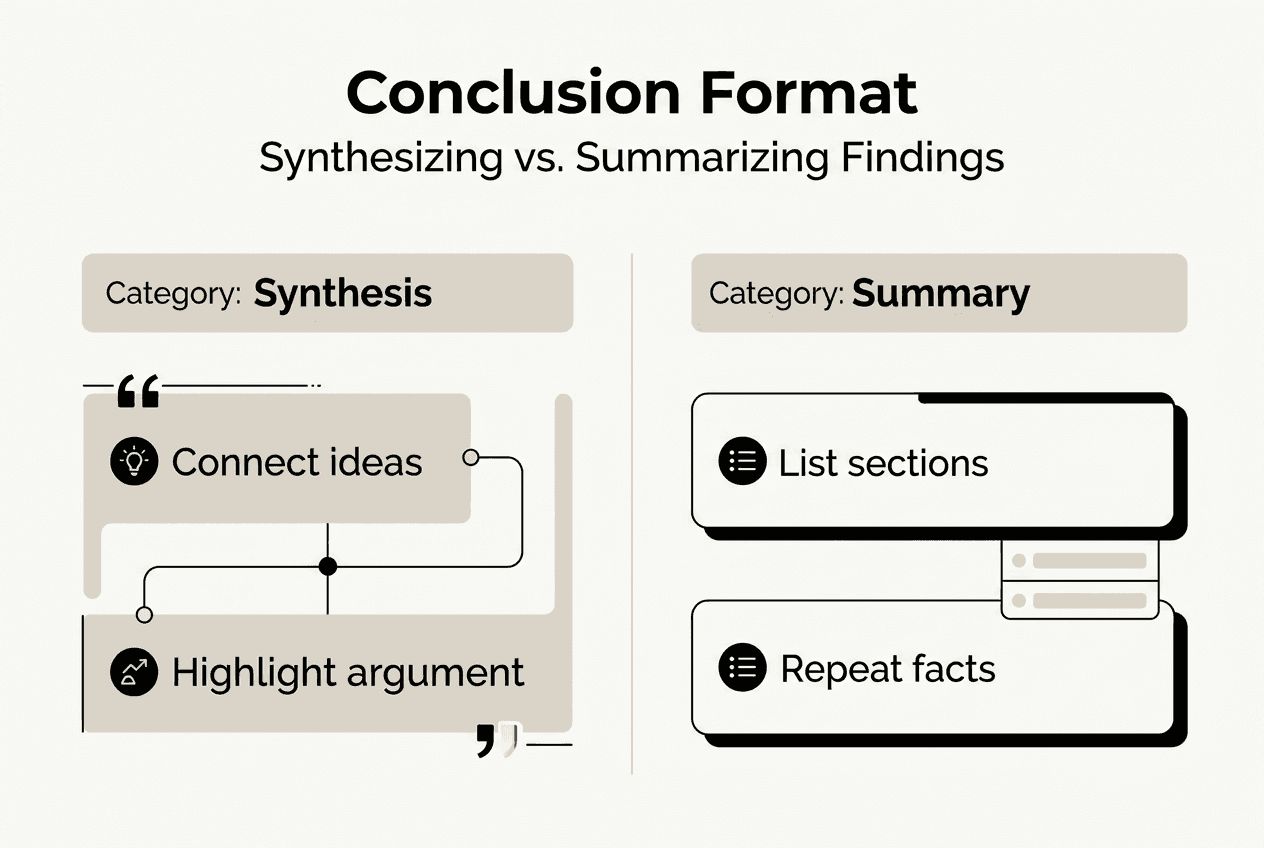
Synthesis means weaving together different threads of your argument to create a unified understanding of what your research accomplished. Unlike summary, which repeats information, synthesis integrates findings into a coherent narrative that shows relationships between ideas. This approach demonstrates analytical depth and helps readers grasp the full significance of your work.
Follow these steps to synthesize your main points effectively:
Avoid the common mistake of merely restating your research problem without showing how you addressed it. Instead, demonstrate how your analysis moved beyond the initial question to generate new understanding. Link your findings explicitly to the research questions you posed, showing readers the logical progression from inquiry to insight. This connection helps readers appreciate the journey your paper took them on and understand why your conclusions matter.

Pro Tip: Before writing your conclusion, reread your thesis statement and highlight the specific claims you made. Use these highlights as anchors for your synthesis, ensuring each major claim receives attention in your conclusion. This technique keeps your ending focused and prevents you from drifting into tangential reflections.
When you synthesize effectively, you create a conclusion that feels like a natural culmination of your argument rather than an abrupt stop. Synthesis transforms findings into meaningful insights by considering implications for future research and showing how individual results contribute to a larger understanding. This approach requires you to think critically about what your research accomplished as a whole, not just what each section covered. By taking this broader view, you help readers see the forest, not just the trees, and leave them with a clear sense of your work's contribution to the field. Mastering synthesis is essential for writing conclusions for research papers that truly resonate.
Addressing literature gaps and proposing future research directions strengthens your conclusion by showing how your work advances knowledge and opens new avenues for inquiry. Earlier in your paper, you likely identified gaps in existing research that your study aimed to address. The conclusion is the perfect place to revisit these gaps and explain how your findings contribute to filling them. This approach demonstrates scholarly awareness and positions your work within the ongoing academic conversation.
To clearly state how your research addresses literature gaps, start by briefly reminding readers of the specific gaps you identified in your literature review. Then, explain precisely how your findings, methodology, or theoretical framework helps bridge these gaps. Be specific about what was missing before and what your study now provides. This clarity helps readers understand your work's unique contribution and why it matters for the field.
When proposing future research directions, consider these strategies:
Including future research directions offers several benefits. It shows you understand your study's limitations and scope. It demonstrates critical thinking about what remains unknown. It provides a roadmap for other researchers interested in building on your work. Most importantly, it positions your conclusion as a beginning rather than an ending, suggesting that your research opens doors rather than closing them.
Pro Tip: Keep your future research suggestions realistic and directly connected to your findings. Avoid vague statements like "more research is needed." Instead, propose specific questions or methodologies that logically extend from what you discovered. This specificity makes your suggestions actionable and shows you have thought carefully about next steps.
Balancing closure with open-ended suggestions requires finesse. You want to give readers a sense of completion while also acknowledging that research is an ongoing process. Frame your future research proposals as natural extensions of your work rather than admissions of failure. This framing helps readers see your study as a valuable contribution that lays groundwork for continued inquiry. When done well, discussing gaps and future directions transforms your conclusion from a simple ending into a springboard for ongoing scholarly dialogue. This approach is particularly important when concluding a literature review, where synthesizing existing knowledge and identifying research needs go hand in hand.
Even experienced writers fall into predictable traps when crafting conclusions. One of the most frequent errors is introducing new ideas or evidence that should have appeared in the body of the paper. This mistake confuses readers who expect the conclusion to wrap up existing arguments, not present fresh information. Another common pitfall is weak restatement, where writers simply copy their thesis word for word without showing how their analysis enriched or refined their initial position.
Compare these features to distinguish strong conclusions from weak ones:
| Strong Conclusion | Weak Conclusion |
|---|---|
| Synthesizes findings into integrated themes | Lists findings from each section separately |
| Shows how research questions were answered | Restates research questions without resolution |
| Connects results to broader implications | Focuses only on narrow study details |
| Proposes specific future research directions | Offers vague "more research needed" statements |
| Leaves readers with memorable final insight | Ends abruptly or with cliched phrase |
Follow these expert tips to polish your conclusions:
Understanding the recency effect helps explain why conclusions matter so much. This psychological principle suggests that people remember information presented last more vividly than information from the middle of a sequence. Your conclusion is the final impression you make on readers, shaping how they recall and evaluate your entire paper. A strong conclusion capitalizes on this effect by reinforcing your most important points and leaving readers with a clear sense of what your research accomplished.
Pro Tip: Write your conclusion last, but revise it first. After drafting your entire paper, return to the conclusion with fresh eyes and refine it until every sentence adds value. Then, when you revise the rest of your paper, start with the conclusion to ensure it accurately reflects your final argument. This approach helps you craft an ending that truly captures your work's essence.
Crafting memorable concluding sentences requires balancing confidence with humility. You want to assert your findings' importance without making exaggerated claims. Consider ending with a thought-provoking question, a call to action, or a reflection on your work's broader implications. Avoid cliches like "only time will tell" or "this research is just the beginning," which feel generic and unmemorable. Instead, aim for specificity and originality that reflects your unique contribution to the field. These techniques for writing a concluding paragraph and crafting concluding sentences will help you create endings that resonate long after readers finish your paper.
Mastering conclusion paragraph format takes practice, but you don't have to navigate this challenge alone. Samwell.ai offers AI-powered tools specifically designed to help students and academic professionals craft compelling conclusions and elevate their overall writing quality. Whether you struggle with synthesizing findings, avoiding common pitfalls, or simply finding the right words to end your paper, Samwell.ai provides intelligent assistance that respects academic integrity while enhancing efficiency.
Our platform's Power Editor helps you refine your conclusion paragraphs with targeted suggestions that strengthen synthesis, improve clarity, and ensure your ending leaves a lasting impression. The Guided Essays feature provides structured outlines that help you plan conclusions alongside your entire paper, ensuring coherence from introduction to final paragraph. With real-time AI detection checks and support for multiple citation standards, Samwell.ai helps you produce high-quality academic work that meets the rigorous standards of leading universities. Explore how our tools can transform your approach to writing strong conclusions and take your academic writing to the next level.
The ideal conclusion length varies depending on your paper's overall length and complexity. For most academic essays, a conclusion paragraph should contain five to seven sentences, providing enough space to synthesize findings without becoming repetitive. Research papers and dissertations may require longer conclusions, often comprising five to seven percent of the total word count. The key is ensuring your conclusion feels proportionate to your paper and includes all necessary elements without padding or unnecessary elaboration.
No, you should avoid introducing new ideas in your conclusion to maintain clarity and prevent confusing readers. The conclusion's purpose is to synthesize and reflect on information already presented in your paper, not to introduce fresh arguments or evidence that require explanation. New ideas belong in the body of your paper where you can develop them fully with proper support. If you discover important points while writing your conclusion, revise your body sections to include them rather than cramming them into your ending.
Address future research by identifying specific gaps your study revealed and proposing realistic directions that build upon your findings. Keep your proposals concise and directly connected to what you discovered, avoiding vague statements about needing more research. Suggest particular methodologies, populations, or contexts that could yield valuable insights based on patterns you observed. This approach demonstrates scholarly thinking and helps other researchers see how your work opens pathways for continued inquiry. When concluding a literature review, future research suggestions become especially important for showing how existing knowledge can advance.
No, you should rephrase your thesis to reflect the depth of analysis your paper provided rather than copying it verbatim. Your conclusion thesis restatement should show how your understanding evolved through the research and writing process. Use different words and sentence structure while maintaining the core argument, demonstrating that your analysis enriched rather than simply confirmed your initial position. This approach shows intellectual growth and helps readers appreciate how your paper developed its central claims.