Loading...

TL;DR:
- Correct citation styles depend on your academic discipline, with APA for social sciences, MLA for humanities, and Chicago for history.
- Consistency in citation formatting throughout your paper is crucial for credibility and avoiding penalties.
- Proper citations build trust, reduce plagiarism concerns, and enhance your academic reputation.
Getting citations wrong is one of the fastest ways to lose points on a paper you worked hard on. Whether you're a first-year student or working on a graduate thesis, citation requirements can feel arbitrary and confusing. The truth is, citing sources correctly protects your academic reputation and shows readers how your ideas connect to established research. This guide walks you through APA, MLA, and Chicago citation formats with real examples so you can apply the right style with confidence, regardless of your assignment.
| Point | Details |
|---|---|
| Match format to field | APA, MLA, and Chicago styles are each designed for different academic areas—check your assignment requirements. |
| Consistent citations matter | Stick to your chosen citation format throughout your entire paper to avoid confusion and lost marks. |
| Reference trusted guides | Authoritative resources like Purdue OWL and your institution’s library can ensure correct citation mechanics. |
| Sample examples help | Seeing real citation examples makes it easier to learn and apply rules to your own academic work. |
The single biggest factor in choosing a citation format is your academic field. Disciplines have standardized around specific styles for good reasons. Social science researchers value publication dates because research evolves quickly. Literary scholars care more about the text edition than the year. Historians need footnotes to add context without cluttering the main argument. Understanding this logic makes the rules feel less arbitrary.
As a practical starting point, citation in essays varies by discipline, and the following breakdown covers the most common assignments:
According to the University of Pittsburgh citation guide, APA is standard for social sciences and psychology, MLA is standard for humanities and literature, and Chicago is standard for history and the arts. Your course syllabus or assignment sheet is the most reliable source of this information. When it is not specified, email your instructor before you submit.
Consistency matters as much as the format itself. Switching between styles midpaper is a red flag for graders. Pick one and apply it throughout, including your in-text citations, reference list, and headers.
Pro Tip: Before starting any major paper, screenshot or copy the specific citation requirements from your assignment sheet and keep them open in a separate tab while you write. This 30-second habit prevents hours of reformatting later.
For further guidance on applying specific styles, the Purdue OWL citation guide is the most comprehensive free resource available online.
APA stands for American Psychological Association. It is the dominant style across psychology, education, business, and nursing programs. The core logic of APA is to highlight the author and the year of publication, since currency of research matters in these fields.
The general structure for an APA reference entry is: Author, A. A. (Year). Title of work: Capital letter also for subtitle. Publisher.
Here are the most common source types you will encounter:
For APA research paper citation, in-text citations follow this structure: (Author, Year). For a direct quote, add the page number: (Smith, 2022, p. 45).

| Source type | In-text example | Reference list format |
|---|---|---|
| Book | (Smith, 2022) | Author. (Year). Title. Publisher. |
| Journal article | (Lee & Park, 2023) | Author. (Year). Title. Journal, Vol(Issue), pages. |
| Website | (CDC, 2024) | Organization. (Year, Date). Title. URL |
Understanding APA vs. MLA differences is especially useful if you are switching between courses that require different styles.
The most common APA mistakes are forgetting the DOI (digital object identifier) for journal articles, using the wrong date format, and failing to italicize only the title of the major work. For technical formatting details like hanging indents and font requirements, Purdue OWL for citation mechanics provides examples that match the official APA 7th edition manual.
Pro Tip: APA uses "&" between author names in the reference list but writes "and" in the body text. This small inconsistency trips up even experienced writers.
MLA stands for Modern Language Association. It is the standard for English literature, foreign language studies, philosophy, and many humanities courses. The University of Pittsburgh citation guide confirms that MLA is the go-to format for humanities and literature assignments.
MLA's emphasis is on the author and page number rather than the publication year, because in literary analysis, the edition and the text itself matter more than when a book was published. This is a key conceptual difference from APA.
Here is the core MLA Works Cited structure: Author Last, First. Title of Work. Publisher, Year.
Real-world MLA examples by source type:
In-text citations in MLA look like this: (Morrison 112). No comma between author name and page number.
"The beauty of MLA is its simplicity for literary sources. Once you master the Works Cited structure, you can apply it to virtually any text type with minimal adjustment."
For a full walkthrough on how to use MLA format in your papers, including formatting for online sources and multimedia, the rules are straightforward once you see enough examples. When comparing MLA and APA, the key distinction is that MLA focuses on the author and page, while APA focuses on the author and year. The MLA citation mechanics page at Purdue OWL breaks down formatting for every edge case.
Chicago style is unique because it actually has two separate systems, and confusing them is a common mistake. The Purdue OWL explains that Chicago's two systems are Notes-Bibliography, which uses footnotes and a bibliography page, and Author-Date, which works similarly to APA.
Notes-Bibliography (N-B): Used primarily in humanities, arts, and history. Citations appear as numbered footnotes at the bottom of each page, with a full Bibliography at the end.
Footnote example: 1. David McCullough, The Wright Brothers (New York: Simon & Schuster, 2015), 78.
Bibliography entry: McCullough, David. The Wright Brothers. New York: Simon & Schuster, 2015.
Author-Date: Used in the natural and social sciences. It looks much like APA.
In-text: (McCullough 2015, 78)
Reference list: McCullough, David. 2015. The Wright Brothers. New York: Simon & Schuster.
| Feature | Notes-Bibliography | Author-Date |
|---|---|---|
| In-text format | Numbered footnote | (Author Year, page) |
| End list title | Bibliography | References |
| Common fields | History, arts, humanities | Sciences, social sciences |
| Page numbers | In footnote | In in-text citation |
Key facts about Chicago style in-text citations that students often overlook:
Now that you know each style individually, here is a direct comparison to help you decide quickly.
| Feature | APA | MLA | Chicago (N-B) |
|---|---|---|---|
| In-text format | (Author, Year) | (Author Page) | Footnote number |
| Date placement | After author | End of entry | End of entry |
| Reference page title | References | Works Cited | Bibliography |
| Main use | Social sciences | Humanities | History, arts |
| Page numbers in-text | Only for quotes | Always | In footnote |
The Purdue OWL is widely regarded as the most authoritative free source for examples across all major citation styles. Bookmark it now.
Situational recommendations based on your assignment type:
To keep your citations organized, use a citation styles checklist before submitting. A well-organized research papers guide can also help you work through citations systematically rather than scrambling at the last minute. The University of Pittsburgh citation guide offers a quick visual reference for matching fields to formats.
Common pitfalls across all styles:
Here is something most guides skip: citations are not just a formatting exercise. They are a trust signal. When a grader sees a clean, consistent reference list, they assume the research behind your paper is equally rigorous. That impression raises the baseline before they even read your argument.
Most students treat citations as the last step, something to rush through after the real writing is done. That mindset is the root cause of most citation errors. The students who get this right treat it as part of the writing process, not separate from it.
Learning citation mechanics early also removes a significant source of plagiarism anxiety. When you know how to properly attribute every idea, you stop second-guessing yourself. For practical strategies on avoiding citation mistakes, small habits like noting source details when you first find a source (not after) make a dramatic difference in your final paper quality.
Strong citation practice is a transferable professional skill, not just an academic requirement.
Citations can feel like a moving target when every course has different requirements. Samwell.ai takes the guesswork out of academic writing by generating properly formatted citations and helping you build essays that meet the highest standards of originality. Over 1,000,000 students from leading universities already use it to write smarter.
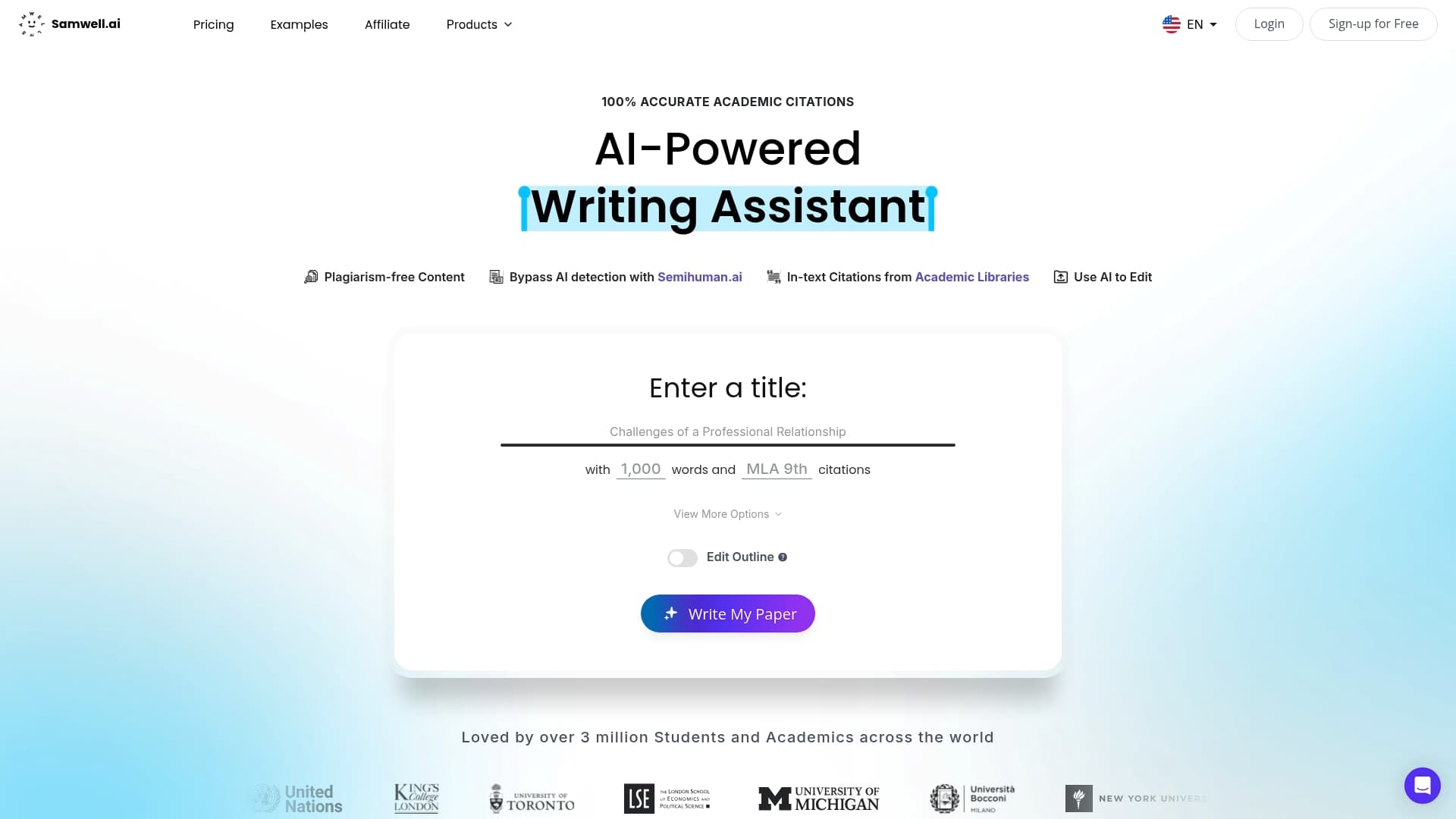
With Samwell.ai, you can produce plagiarism-free AI essays that include correctly formatted in-text citations and reference lists across APA, MLA, and Chicago styles. The platform's real-time AI detection checks mean you submit with confidence every time. Explore all the AI-powered academic tools available to you and stop letting citation formatting slow down your writing.
Science papers typically use APA style, as confirmed by standard discipline guides, but always confirm your instructor's specific guidelines before starting.
Chicago style includes two distinct systems: Notes-Bibliography for humanities, which uses footnotes, and Author-Date for sciences, which resembles APA format.
Yes, platforms like Purdue OWL and academic writing tools offer free citation generators and formatting guides for all major styles.
Follow your chosen style's official guide and cite every idea, fact, or quote that is not originally yours, even when you paraphrase.
Mixing styles signals carelessness to graders. Proofread your reference list using an authoritative style guide and a citation checklist to catch inconsistencies before you submit.