Loading...

Many students and academics struggle with choosing between APA and MLA citation styles, often leading to formatting mistakes that undermine their research papers. Understanding these two dominant citation systems is essential for maintaining academic credibility and meeting disciplinary expectations. This guide clarifies the fundamental differences between APA and MLA, showing you exactly when and how to apply each style effectively in your scholarly work.
| Point | Details |
|---|---|
| Citation focus | APA emphasizes author and publication date; MLA prioritizes author and page number |
| Reference page naming | APA uses a References page; MLA uses a Works Cited page |
| Primary disciplines | APA dominates social sciences like psychology and education; MLA prevails in humanities such as literature |
| Title page requirements | APA typically requires a separate title page; MLA includes header information on the first page |
| Dating emphasis | APA highlights research currency through prominent dates; MLA focuses on textual location through page numbers |
Understanding the origins and purposes of citation styles helps you apply them correctly. MLA format, designed by the Modern Language Association, dominates in humanities fields like English literature or cultural studies. APA style, governed by the American Psychological Association, prevails in psychology, education, and several social sciences.
Each citation system reflects the priorities of its academic discipline. APA was developed by the American Psychological Association to standardize research communication in behavioral and social sciences. The style emphasizes publication dates because currency matters tremendously in fields where new studies can overturn previous findings.
MLA, created by the Modern Language Association, serves scholars analyzing texts, literature, and cultural artifacts. This style prioritizes authorship and specific textual locations through page numbers, allowing readers to locate exact passages being discussed or analyzed.
Primary users of each style include:
The fundamental distinction lies in what each discipline values most. Social scientists using APA need to show their work builds on recent research, hence the date emphasis. Humanities scholars using MLA analyze specific texts and arguments, requiring precise page references for quotations and evidence.
Formatting requirements create the most visible distinctions between these citation styles. APA generally requires a separate title page with centered elements including paper title, author name, and institutional affiliation. MLA does not require a title page but includes a header with your name, instructor name, course, and date on the first page.
Both styles typically use Times New Roman 12-point font, but header details and title placements differ significantly. APA papers include a running head (shortened title) in the header with page numbers. MLA papers place your last name and page number in the upper right corner of every page.

Reference page formatting shows clear style differences. APA uses a References page with entries in hanging indent format, where the first line starts at the left margin and subsequent lines indent. MLA uses a Works Cited page with similar hanging indents but different punctuation and element order.
Key structural elements to watch:
Citation list formatting has evolved with recent editions. APA 7th edition omits publisher location, while APA 6th included it. MLA includes container titles (journals, websites, databases) italicized and comma separated in its entries.
Pro Tip: Create a formatting checklist when switching between styles to catch header format errors, the most common mistake students make when working across multiple papers in different disciplines.
In-text citation mechanics reveal the core philosophical differences between these styles. APA emphasizes the author and date, while MLA prioritizes the author and page number. Understanding these patterns helps you cite correctly without constantly consulting manuals.
APA in-text citations include the author's last name, publication year, and page number if quoting directly. A typical citation looks like (Smith, 2024, p. 15) for quotes or (Smith, 2024) for paraphrases. The year placement immediately signals research currency to readers.
MLA citations include the author's last name and page number without separating comma, formatted as (Smith 15). This streamlined approach keeps focus on authorship and textual location. For works without page numbers, MLA allows omitting the number entirely.
Comparing citation patterns across source types:
| Source Type | APA Format | MLA Format |
|---|---|---|
| Book quote | (Johnson, 2023, p. 42) | (Johnson 42) |
| Journal paraphrase | (Martinez & Lee, 2025) | (Martinez and Lee) |
| Website | (Centers for Disease Control, 2026) | ("Article Title") |
| Multiple authors | (Smith et al., 2024) | (Smith et al. 156) |
MLA emphasizes authorship, placing the author's name prominently in citations and reference entries. This reflects humanities scholarship where analyzing specific authors and their arguments forms the core of academic discourse.
Special citation scenarios require attention:
Pro Tip: For direct quotes in essays with citations, always include page numbers in MLA. In APA, page numbers are required with direct quotes but optional for paraphrases, though including them aids reader verification.
The final reference page showcases each style's organizational priorities. APA's References page lists entries alphabetically by author's last name, with publication year immediately following in parentheses. This date prominence continues the emphasis on research currency throughout APA papers.
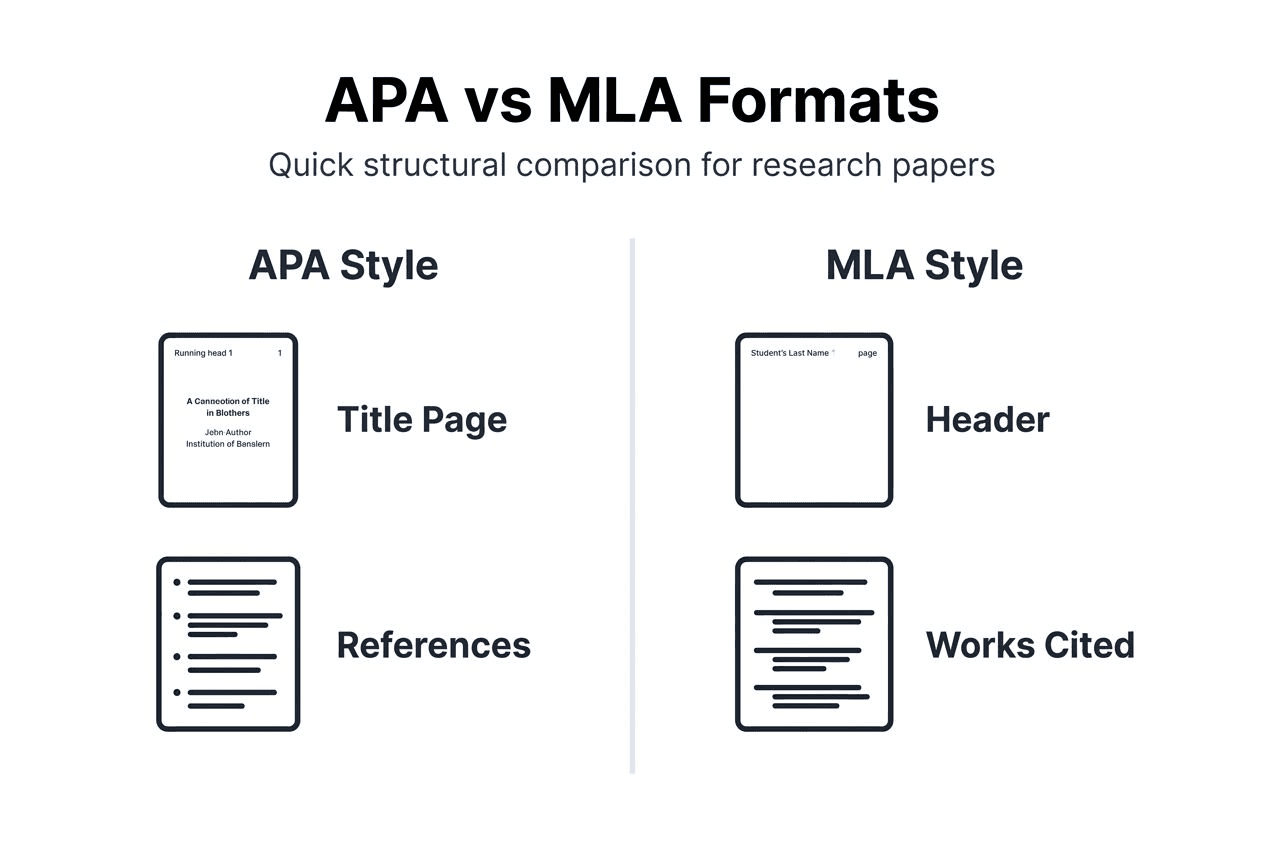
MLA's Works Cited page also alphabetizes by author but structures entries differently, emphasizing authorship and source containers rather than dates. The author's name appears first in reverse order (Last, First), followed by the work's title, then container information.
Formatting requirements create distinct visual appearances:
Information priorities differ substantially. APA 7th edition omits publisher location, previously required in APA 6th edition. MLA specifies containers like journals, websites, or edited collections, italicizing container titles and separating elements with commas.
Typical entry formats for common sources:
| Source | APA 7th Edition | MLA 9th Edition |
|---|---|---|
| Book | Author, A. A. (2024). Title of work. Publisher. | Author, First. Title of Work. Publisher, 2024. |
| Journal | Author, B. B. (2025). Article title. Journal Name, vol(issue), pages. | Author, First. "Article Title." Journal Name, vol. number, no. issue, 2025, pp. pages. |
| Website | Organization. (2026). Page title. Site Name. URL | Author/Org. "Page Title." Site Name, Date, URL. |
Special elements require attention. APA includes DOI (Digital Object Identifier) numbers for journal articles when available, formatted as https://doi.org/xxxxx. MLA includes access dates only when publication dates are unavailable or content changes frequently.
Multiple works by the same author follow different ordering rules. APA arranges chronologically from oldest to newest, using the author's name for the first entry and replacing with an em dash for subsequent entries. MLA alphabetizes by title, using three hyphens to replace the author name in later entries.
Mastering citation styles requires practice, but modern technology can streamline the process significantly. Samwell AI offers powerful tools to help format citations correctly in APA, MLA, and other styles, ensuring your research papers meet academic standards.

You can use AI writing assistance to boost your research paper quality and ensure compliance with citation standards without memorizing every formatting rule. The research paper generator quickly produces properly formatted references and in-text citations, saving time and reducing errors that could affect your grades. These tools integrate seamlessly with your research workflow, letting you focus on developing arguments rather than formatting details.
APA focuses on author and date, commonly used in social sciences like psychology and education, while MLA emphasizes author and page number, typical in humanities such as literature and cultural studies. APA uses a References page; MLA uses a Works Cited page. Formatting rules vary for title pages, headers, and reference entries, with APA requiring separate title pages and MLA including header information on the first page.
Mixing APA and MLA in one paper is not recommended and violates academic writing conventions. Choose one citation style based on your academic field or instructor guidelines and apply it consistently throughout your entire paper.
Consider your subject area as the primary factor: use APA for social sciences, psychology, education, and nursing; choose MLA for humanities, literature, languages, and cultural studies. Always consult your instructor or publication guidelines to confirm the preferred style, as requirements may vary by institution or journal.
Use detailed in-text citation guides available online to understand the mechanics of each style. Leverage AI tools to auto-format citations and catch errors before submission. Practice by reviewing MLA citation examples and templates to internalize formatting patterns.