Loading...

Getting citations right can make or break your academic credibility. Many students find themselves wrestling with APA format rules, uncertain whether they have placed parentheses correctly or formatted their reference list properly. This comprehensive tutorial walks you through the essential APA citation standards you need to master, from basic in-text citations to handling tricky edge cases. You will learn the formatting rules that matter, discover how to avoid common mistakes, and gain the confidence to cite sources accurately in every paper you write.
| Point | Details |
|---|---|
| In text citations | APA uses author date citations with two formats, parenthetical and narrative. |
| Author count rules | For one or two authors include all names each time, and for three or more use et al from the first citation. |
| Page number usage | Include page numbers for direct quotes with p and use pp for multiple pages. |
| Reference list formatting | Hanging indent, italics for titles, and correct capitalization govern each reference entry. |
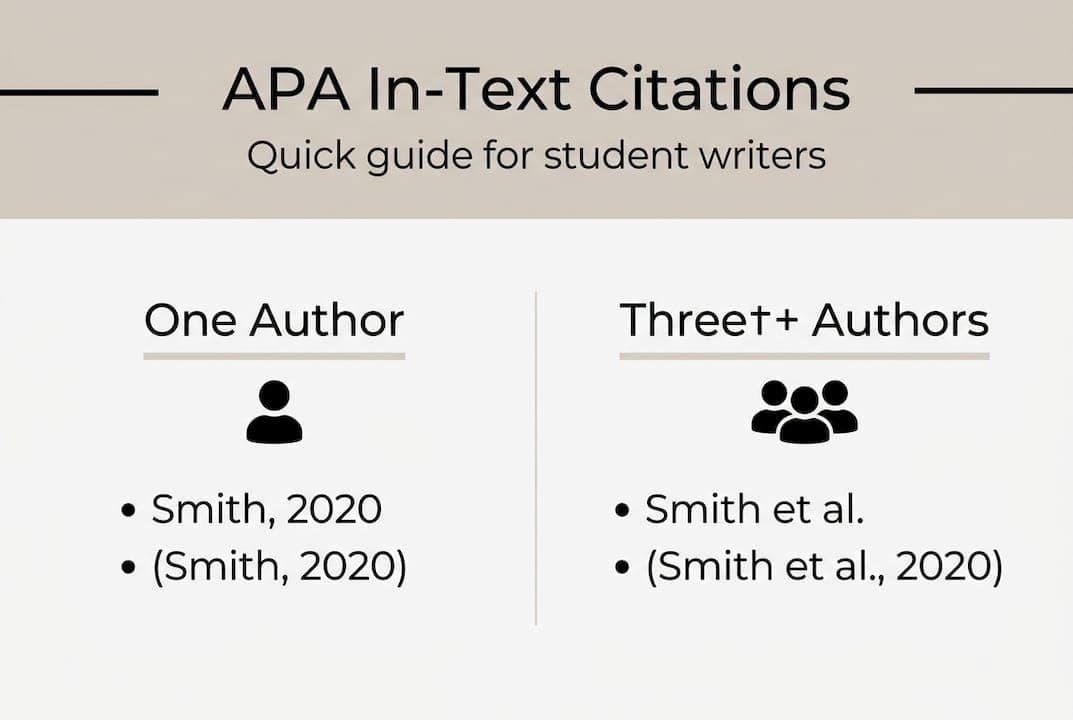
Mastering in-text citations forms the foundation of credible academic writing. APA Style uses an author-date citation system with two primary formats: parenthetical and narrative. Parenthetical citations place both the author and year inside parentheses at the end of a sentence, like this: (Johnson, 2024). Narrative citations weave the author's name into your sentence structure, with only the year in parentheses: Johnson (2024) argues that citation accuracy matters.
The number of authors determines how you structure your citation. When a source has one or two authors, include all names every time you cite the work. For three or more authors, use et al. immediately after the first author's name from the very first citation. This rule changed in APA 7th edition, so older guides may show different instructions.
Page numbers become essential when you quote directly or reference a specific idea from a particular section. Add a comma after the year and include the page number with a p. abbreviation: (Martinez, 2025, p. 47). For multiple pages, use pp. instead. When you paraphrase general concepts from an entire work, page numbers are optional but can help readers locate your source material.
Year placement varies depending on your citation style. In parenthetical citations, the year always follows the author inside the parentheses. In narrative citations, place the year immediately after the author's name in its own set of parentheses. If you mention the same author multiple times in a single paragraph, you can omit the year after the first citation, but include it again when starting a new paragraph.
Pro Tip: Create a quick reference sheet with examples of one author, two authors, and three-plus authors citations. Keep it visible while writing to avoid the common mistake of adding et al. too early or too late. Students often struggle with the transition point, so having clear examples for in-text citations at hand saves time and reduces errors.
Your reference list provides readers with complete information to locate every source you cited. Each entry must follow precise formatting rules that distinguish professional academic work from careless submissions. The hanging indent stands as the most recognizable feature: the first line starts at the left margin, while subsequent lines indent 0.5 inches.

Reference list entries follow specific formatting patterns that vary by source type. Book titles and journal names receive italic formatting, while article titles within those journals use regular font. This visual distinction helps readers quickly identify the type of source. Capitalize only the first word of article and book titles, plus the first word after a colon and any proper nouns. Journal names use title case, capitalizing all major words.
Alphabetical ordering organizes your references by the first author's last name. When an author has multiple works, arrange them chronologically from oldest to newest. Sources without an author start with the title, alphabetized by the first significant word (ignore A, An, The). Every entry ends with a period, and you must include DOIs (digital object identifiers) when available, formatted as URLs without "Retrieved from" language.
Here's how correct and incorrect formatting compare:
| Element | Correct Format | Incorrect Format |
|---|---|---|
| Indentation | Hanging indent (0.5 in) | No indent or first-line indent |
| Book title | The research methods handbook | The Research Methods Handbook |
| Article title | The impact of citation errors | The Impact of Citation Errors |
| Journal name | Journal of Academic Writing | Journal of Academic Writing |
| Author order | Smith, J., & Jones, M. | Smith J. and Jones M. |
| DOI format | https://doi.org/10.1234/example | DOI: 10.1234/example |
Punctuation matters more than you might expect. Place periods after author names, dates, titles, and at the very end of each entry. Use commas between authors and before the ampersand (&) that precedes the final author. Parentheses surround publication years. These small details signal attention to academic standards.
Pro Tip: Set up a hanging indent template in your word processor before you start entering references. Most programs let you save this as a style, so you can apply it instantly to each new entry. This prevents the frustration of manually adjusting dozens of entries right before your deadline. Review comprehensive reference list guidelines to see formatted examples across different source types, and check detailed reference standards for field-specific variations.
Not every source fits neatly into standard citation templates. Edge cases require special handling to maintain citation integrity. Personal communications like emails, interviews, or private conversations get cited in-text only, never in your reference list, because readers cannot access them. Format these as: (J. Smith, personal communication, March 15, 2026).
When a source lists no author, move the title into the author position for both in-text citations and reference list entries. Use quotation marks for article titles and italics for book titles, just as you would in a standard reference. For sources without publication dates, insert (n.d.) where the year would normally appear. Secondary sources, where you read about a study in someone else's work rather than the original, require you to cite both: (Original Author, year, as cited in Secondary Author, year). Only the secondary source appears in your reference list.
Students make predictable mistakes that undermine otherwise solid papers. Common errors include formatting problems like missing hanging indents, incorrect italicization, and wrong capitalization patterns. Many students apply title case to article titles when sentence case is required, or forget to italicize journal names. Punctuation errors cluster around ampersands (using "and" instead of &), missing periods, and incorrect comma placement.
Follow these steps to troubleshoot citation problems:
Missing or incorrect DOIs represent another frequent problem. Publishers assign DOIs to provide permanent links to scholarly articles, and APA requires you to include them when they exist. Search for DOIs on the publisher's website or through CrossRef.org if they do not appear on your downloaded copy. Never invent or guess at DOIs, as this prevents readers from finding your sources.
Pro Tip: Create a citation checklist specific to your most common source types and run through it before submitting any paper. Most errors happen from rushing through the reference list at the last minute. When you encounter unusual sources, bookmark guidance for sources without authors so you can quickly verify the correct format rather than guessing.
Citation accuracy means little if your overall paper format fails to meet APA standards. Student papers follow specific formatting requirements that frame your citations within a professional presentation. These rules apply to every page from title to references, creating visual consistency that meets academic expectations.
Margins must measure exactly one inch on all four sides of every page. Set your line spacing to double throughout the entire document, including the reference list, block quotations, and table titles. No extra spaces appear between paragraphs or sections. Choose a readable font like Times New Roman 12pt, Calibri 11pt, Arial 11pt, or Georgia 11pt. Stick with one font throughout your paper.
Your title page includes specific elements arranged in a particular order. Center the title about one-third down the page, using bold font. Two lines below, add your name. Below that, include your department and university name, course number and name, instructor name, and assignment due date. Each element gets its own line. Page numbers begin on the title page, positioned in the top right corner of the header.
Student papers no longer require running heads in APA 7th edition, a welcome simplification from earlier versions. Professional papers submitted for publication still need them, but your coursework does not. This distinction matters because older examples and templates may show running heads that you should now omit.
Use this checklist before submitting:
Formatting extends to headings within your paper. Level 1 headings use centered, bold, title case. Level 2 headings align left, bold, title case. Level 3 headings align left, bold italic, title case. Most student papers only need two or three heading levels. Consistent heading structure helps readers navigate your argument and shows organizational skill.
Review comprehensive student paper formatting guides and detailed format specifications to see complete examples. These resources show you exactly how each page should look, removing guesswork from the formatting process.
You have invested significant effort learning APA citation rules and paper formatting standards. Now you can streamline the writing process itself while maintaining the academic integrity these standards protect. Samwell AI offers specialized tools designed specifically for students working on research papers and essays that demand proper citation.
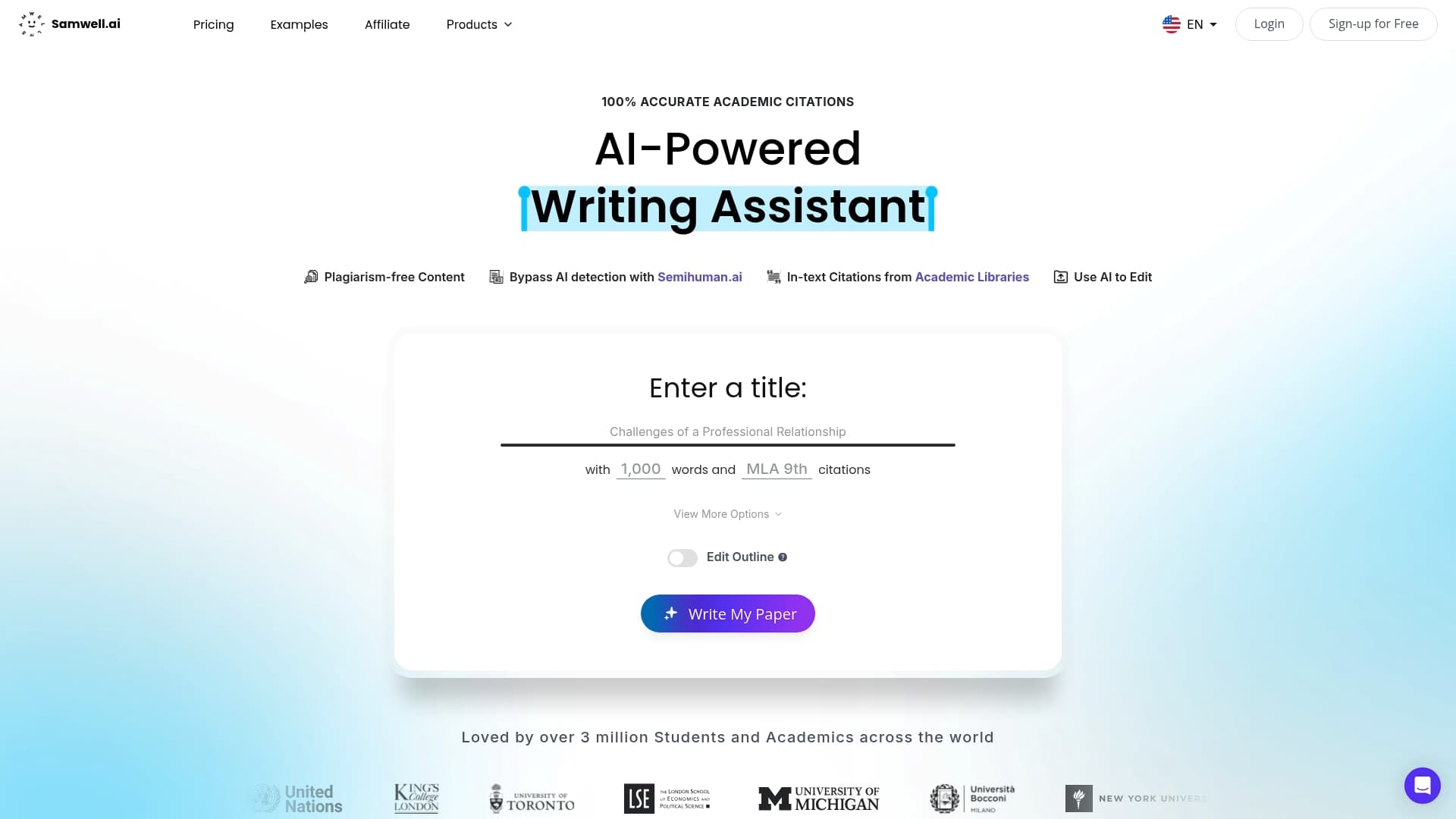
The enhanced essay creator helps you develop well-structured arguments with properly integrated sources from the start. Rather than writing first and struggling to insert citations later, you can build your paper with citation support throughout the drafting process. The platform's Semihuman.ai technology ensures your writing maintains originality while meeting academic standards, and real-time AI detection checks verify your work aligns with current institutional requirements.
When you need to expand ideas or clarify complex points, the sentence and paragraph expansion tool helps you develop concepts without losing your voice or adding empty filler. This proves especially valuable when you understand a concept but struggle to explain it clearly within your paper's flow. The Power Editor lets you target specific sections for enhancement, maintaining consistency across your entire document while strengthening weak areas.
Parenthetical citations place both the author's name and publication year inside parentheses at the end of a sentence: (Johnson, 2024). Narrative citations integrate the author's name into your sentence structure, with only the year appearing in parentheses: Johnson (2024) argues that proper citation builds credibility. Choose the format that creates the smoothest reading experience for each sentence.
Move the title into the author position for both in-text citations and reference list entries. Use quotation marks around article titles and italics for book or report titles. For example, an in-text citation would read ("Climate Change Effects," 2025), and the reference list entry would start with the title in the author position. Check detailed formatting for sources without authors to see complete examples across different source types.
Frequent errors include missing hanging indents, incorrect italicization of titles, wrong capitalization patterns, and punctuation mistakes. Students often use title case for article titles when sentence case is required, forget to italicize journal names, or omit DOIs when they are available. Create a personal checklist of elements you commonly miss and review it before submitting papers. Small formatting details signal your attention to academic standards.
The official APA Style website provides free tutorials, sample papers, and searchable examples for nearly every citation scenario you will encounter. These resources update regularly to reflect the current edition standards and offer video tutorials for visual learners. Bookmark the site and consult it whenever you face an unusual citation challenge. University writing centers also maintain APA guides tailored to common student needs and often provide one-on-one consultation for complex citation questions.