Loading...

The fastest legitimate way to make your essay longer is to expand your analysis and examples, not add filler. Add one extra example per body paragraph, answer "why" and "how" after every claim, and flesh out your introduction and conclusion. Those three moves alone can add 200–400 words to a typical five-paragraph essay while actually improving your grade.
Here is a quick checklist to start right now:
Pro Tip: Set a 20-minute timer and work through just one of these moves per paragraph. You will add words faster than you think, and the essay will read better, not worse.
Expanding analysis and examples, not adding filler, is the most effective and academically safe way to increase essay length while improving argument quality.
| Point | Details |
|---|---|
| Expand analysis first | Answer "why" and "how" after every claim; two analytical sentences per paragraph add 50–80 words. |
| Use the paragraph micro-structure | Topic sentence, evidence, analysis, and linking sentence keep expansion focused and coherent. |
| Add a counterargument | One counterargument paragraph adds 100–150 words and demonstrates critical thinking. |
| Avoid formatting tricks | Manipulating margins or font sizes is detectable and considered academic dishonesty at most institutions. |
| Samwell Power Editor | Paste a thin paragraph into Samwell's Power Editor for targeted, citation-checked expansion. |
EasyBib recommends revisiting the prompt and outline before adding a single word. Many word-count gaps come from incomplete coverage of the assignment's sub-questions, not from weak writing. Start there, then work through this ranked list.
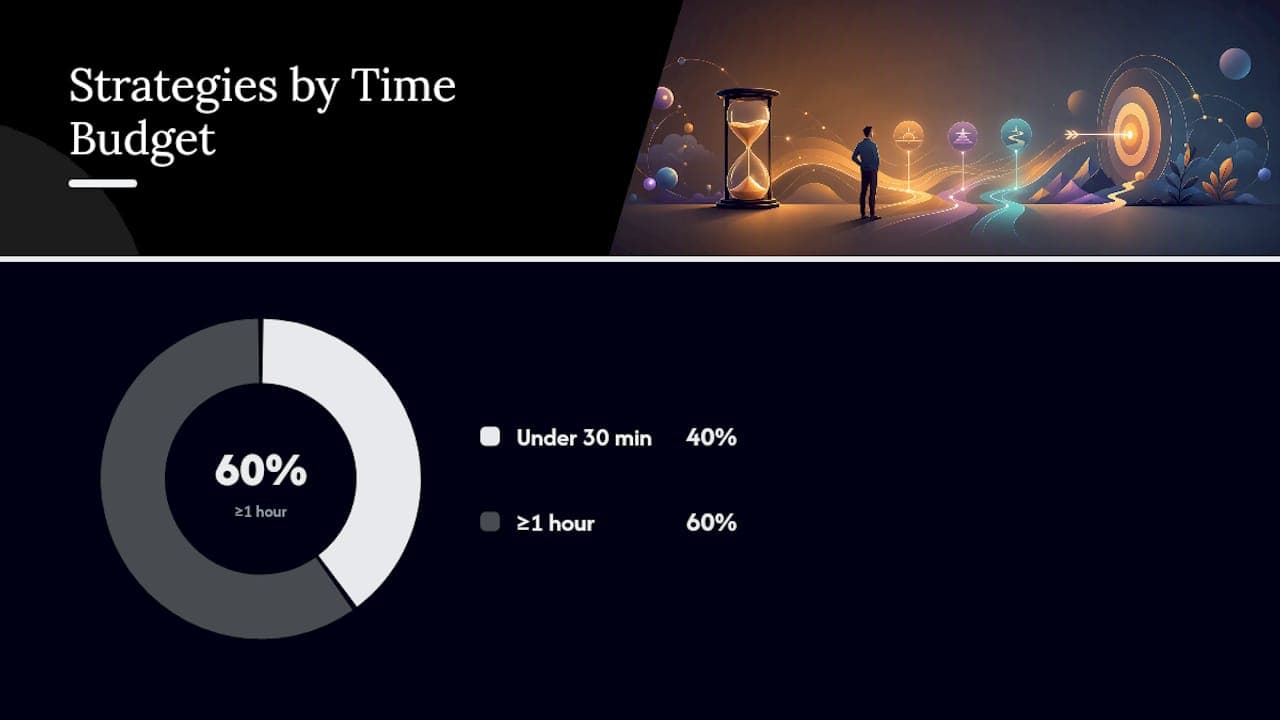
Pro Tip: If you have less than 30 minutes, focus only on strategies 1 and 2. If you have an hour or more, work through strategies 3, 4, and 5 as well. Match the tactic to your time budget.
Purdue OWL's paragraphing guidance is clear: effective paragraphs have a controlling idea and developed support. Expanding that support, through examples and analysis, is the academically correct way to lengthen a paragraph.
Use this four-part micro-structure for every body paragraph:
Here is a before-and-after example:
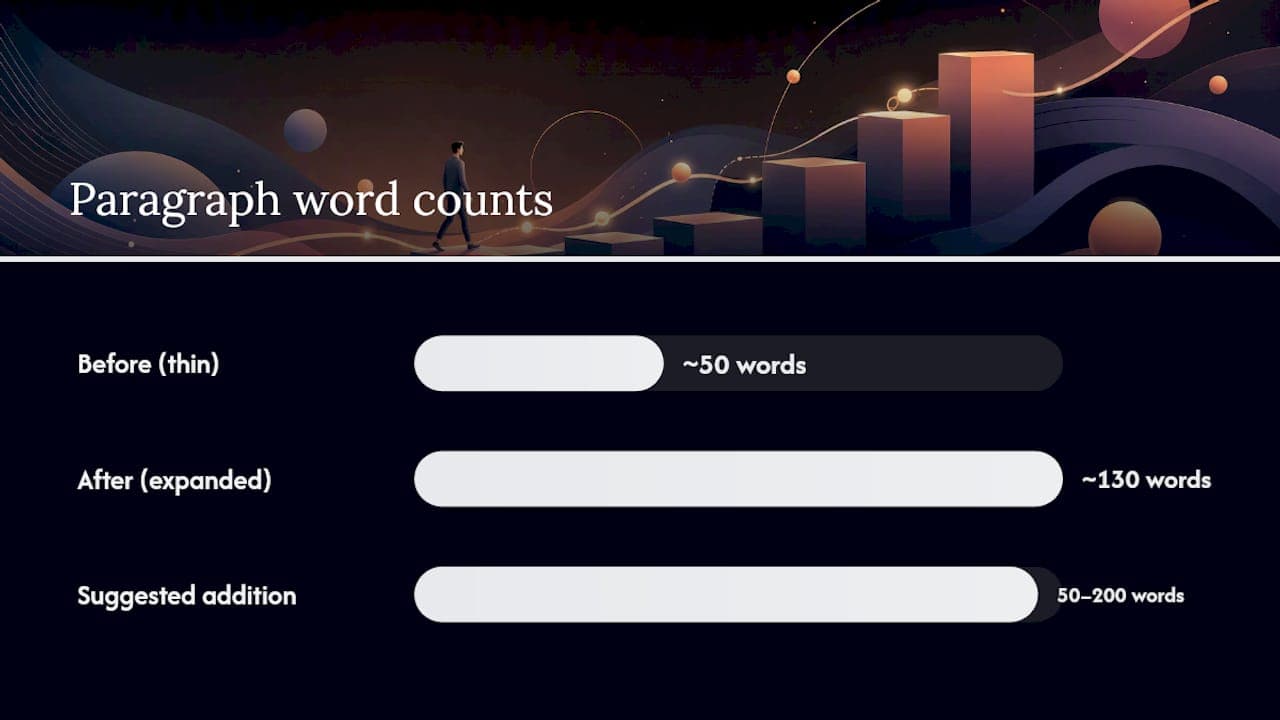
Before (thin paragraph, ~50 words): Social media affects teenagers' mental health. This is a growing problem that schools need to address.
After (expanded paragraph, ~130 words): Social media use is linked to rising anxiety rates among teenagers, particularly when daily screen time exceeds two hours. A 2019 study published in JAMA Pediatrics found that adolescents who spent more time on social platforms reported significantly higher levels of depressive symptoms than peers with limited use. The mechanism is partly social comparison: users see curated highlight reels of others' lives and measure their own experiences against an unrealistic standard. This dynamic is especially pronounced during adolescence, when identity formation makes young people particularly sensitive to peer evaluation. Schools that integrate media literacy programs into their curriculum give students tools to recognize and resist these pressures, which makes social media education a practical, evidence-based response to the problem.
Copy this template when editing:
[Topic sentence stating the claim] + [Evidence: quote or example with citation] + [Analysis: 2–3 sentences answering why/how] + [Linking sentence connecting to next paragraph]
A quotation without analysis is a missed opportunity. A short quote plus two to three sentences of explanation adds 60–100 words and strengthens your argument. The key is to never let a quote speak for itself.
Follow these guidelines when adding quotations:
For citation formatting, Purdue OWL is the most reliable free reference for both MLA and APA styles. In MLA, an in-text citation follows the closing quotation mark: (Kennedy 47). In APA, it includes the year: (Kennedy, 2001, p. 47). Getting this right adds formatted text and keeps you on the right side of your instructor's expectations.
Adding a counterargument is one of the highest-value moves you can make. Brandeis University's Writing Program shows that integrating an opposing view and then refuting it demonstrates critical engagement and deepens analysis. A single counterargument paragraph, of moderate length, can push a short essay over its word-count target while making the argument more persuasive.
Pro Tip: Place your counterargument paragraph just before your conclusion. It shows you have considered the full picture and gives your final argument more weight.
Transitions do more than connect sentences. A well-chosen phrase followed by a short analytical sentence adds legitimate words and signals to your reader, and your instructor, that your argument is progressing logically. Grammarly's revision guide lists adding transitions as one of the clearest ways to increase length while improving clarity.
Use these categorized phrase openers:
Additive (building on a point):
Contrast (introducing a counterpoint):
Cause and effect:
Exemplifying:
Clarifying:
Usage note: pair each phrase with one analytical sentence, not just a restatement of the previous point. The phrase opens the door; the sentence behind it has to walk through it.
Two examples of phrase use that add legitimate words:
Weak: "Social media affects self-esteem. This is a problem." Stronger: "As a direct result of this exposure, adolescents who use social media heavily report lower self-esteem scores than peers who limit their use, suggesting that platform design, not individual resilience, drives much of the effect."
Weak: "The policy failed. There were other options." Stronger: "While this argument holds merit, it overlooks the structural barriers that prevented alternative policies from gaining legislative support during the same period."
Some structural additions are fully acceptable; others require instructor permission. Know the difference before you submit.
Always acceptable (no permission needed):
Usually acceptable but worth confirming:
Before adding an appendix, run through this quick checklist:
Pro Tip: Use an appendix to include a longer quotation you wanted to discuss but could not fit in the body without breaking the paragraph's flow. Reference it in the text, then analyze it briefly in the appendix itself.
Read through your draft once with a single goal: find every paragraph that ends before it should. Thin paragraphs, those under 80 words, are almost always where the word count is hiding.
Work through these checks in order:
For time management, match your editing session to what you have:
5 minutes: Scan for abrupt paragraph endings only (check 3 above). Add one analytical sentence to each. 20 minutes: Work through checks 1–4. Add one example and one analytical sentence per flagged paragraph. 1 hour: Complete all six checks, then revisit your introduction and conclusion for a final expansion pass.
Some tactics feel like shortcuts but create real problems. Instructors recognize most of them immediately, and plagiarism-detection tools flag others automatically.
MLA and APA citation standards, detailed at Purdue OWL, exist partly to make source use transparent. Samwell.ai's integrity tools run real-time checks against these standards, so you can catch citation gaps before your instructor does.
Detection is more precise than most students expect. Instructors who read dozens of essays per semester develop a strong sense of a student's natural voice. A sudden shift in register, an unusually sophisticated sentence in an otherwise straightforward essay, or a paragraph that does not connect to the surrounding argument are all signals that something was added without care.
Automated tools look for different patterns:
Practical rules to follow:
Purdue OWL and university writing centers, including the JMU University Writing Center, offer detailed guidance on integrating sources and maintaining voice consistency. Both are worth bookmarking before your next revision session.
There is a version of this process that students rush through: they add a few filler sentences, hit the word count, and submit. The grade comes back lower than expected, with a comment like "needs more development" or "analysis is thin." The word count was met; the argument was not.
The moves described in this guide, expanding analysis, adding examples, integrating counterarguments, are not just word-count tactics. They are the actual skills that distinguish a B paper from an A paper. When you force yourself to answer "why does this evidence matter?" after every claim, you are doing the intellectual work that grading rubrics reward. The word count follows naturally.
There is also a longer-term benefit. Students who practice methodical expansion, paragraph by paragraph, develop stronger thesis complexity over time. A thesis that can support a counterargument and a multi-example analysis is a more sophisticated thesis than one that cannot. That skill transfers to every paper you write, every exam you take, and, eventually, every professional document you produce.
Run a final coherence check before you submit: read the essay aloud, one paragraph at a time. If a paragraph does not clearly connect to the one before it, add a transition. If a claim sits unsupported, add an example. Those two checks alone will catch most of the gaps that cost students points.
When you have identified the thin paragraphs and know which strategies to apply, execution is where most students lose time. Samwell's Power Editor lets you paste a paragraph, specify what you need ("add one example and two sentences of analysis"), and get a targeted expansion that preserves your voice rather than replacing it.
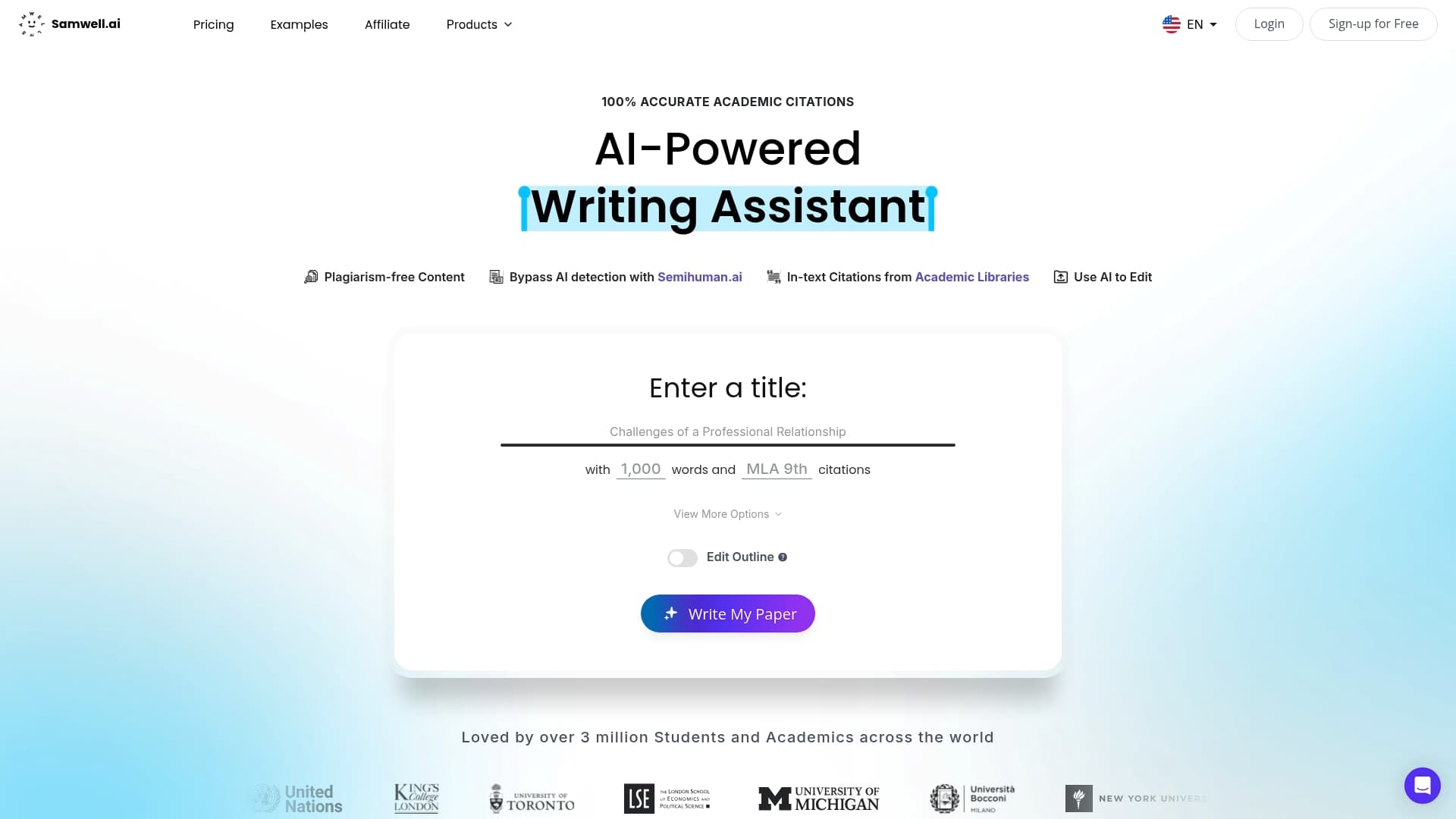
The platform's Guided Essays feature walks you through a structured outline, so you can see exactly where your argument has gaps before you start writing. MLA and APA citation checks run in real time, which means you catch formatting errors as you add new sources rather than in a last-minute panic. Samwell's Semihuman.ai technology also runs an integrity check on expanded content, flagging anything that might trigger a plagiarism detector so you can revise before submission.
Over 1,000,000 students have used Samwell to lengthen and strengthen their papers without sacrificing academic integrity. Always review and adapt any AI-generated suggestions to match your own voice and argument. The tool handles the scaffolding; the thinking stays yours. Try Samwell at Samwell and run your next expansion session with the Power Editor.
The sources below back the strategies in this guide and are worth keeping open during your next revision session.