
Loading...

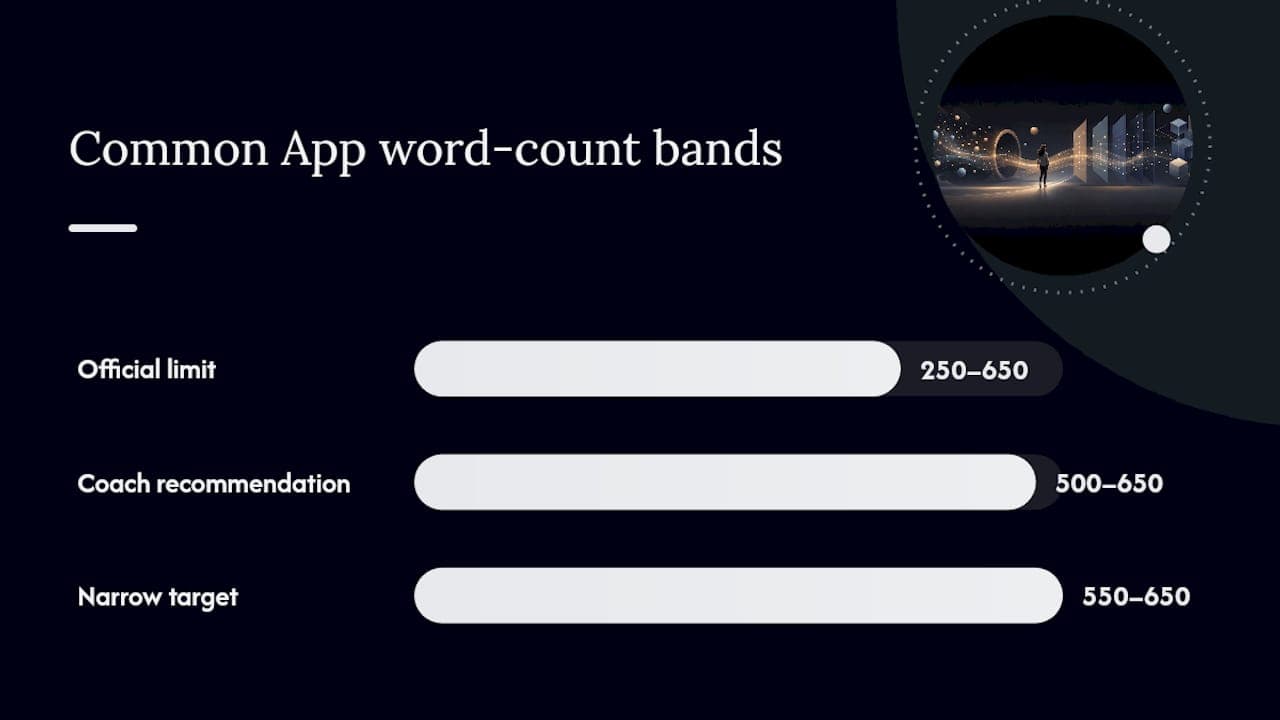
Your Common App personal statement must run between 250 and 650 words, and the platform will not accept more. Most advisers recommend landing somewhere between 500 and 650 words, with 550 to 650 giving you enough room for a real turning point and a reflection that lands. Shorter can work if the story is tight. Longer is not an option. Before you submit, paste your final draft into the actual Common App editor and check that the last sentence is still there.
TL;DR:
- The Common App personal statement must be between 250 and 650 words, with a hard enforcement preventing submissions outside this range.
- Most coaching experts recommend aiming for 500 to 650 words, emphasizing quality and focus over hitting the exact maximum.
- To avoid truncation, draft in a word processor first, then copy and check the word count within the platform before final submission.
- Cutting an essay should prioritize removing repetition, unnecessary details, and padding, focusing instead on clarity, a clear turning point, and meaningful reflection.
- The final word count is less important than making every sentence serve a purpose, with successful essays often falling in the 550 to 620-word range.
The personal statement has set minimum and maximum word limits, enforced by the platform, typically between about 250 and 650 words. The Common App's announcement for the 2025–2026 cycle confirms these limits carried over unchanged, and the seven essay prompts stayed stable too. That stability matters: schools compare essays against the same word budget year after year, so there is no shortcut in a "new" limit that quietly allows more room.
The text box itself enforces this. Type past 650 words and the editor stops accepting new characters. Paste in a longer draft from Word or Google Docs, and the system can cut off the end without any warning banner telling you it happened.
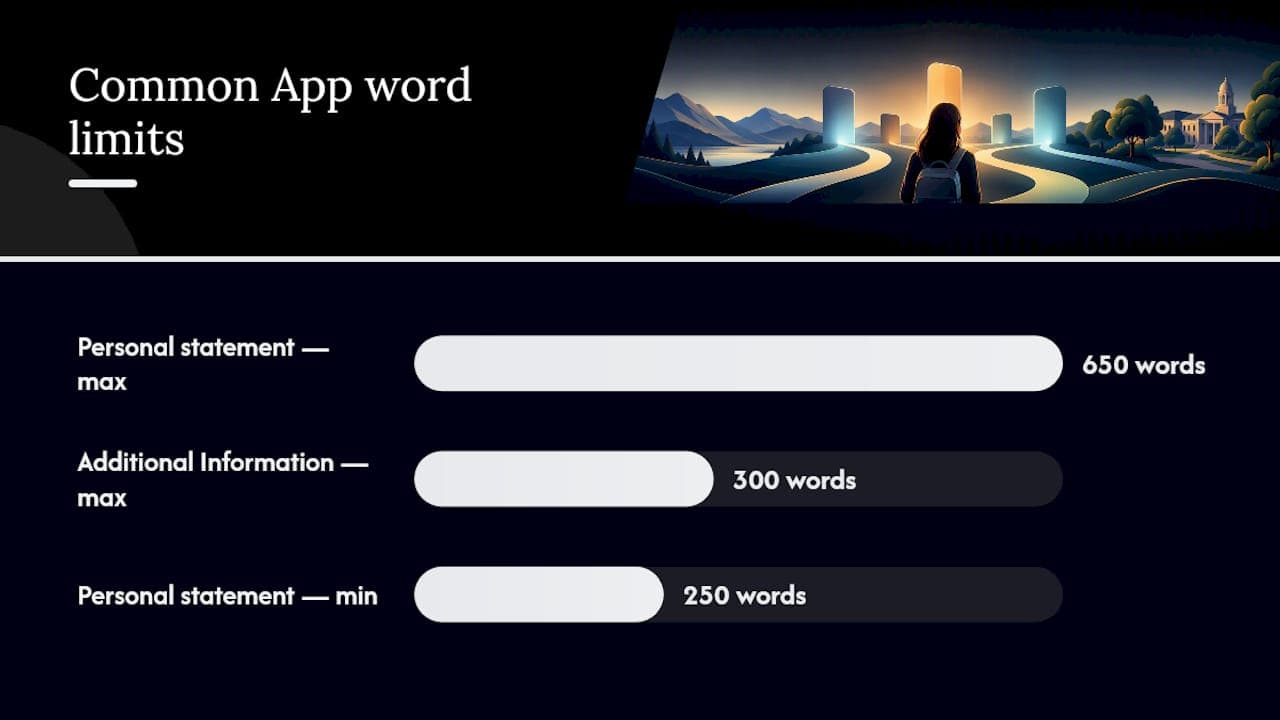
A separate change is worth knowing about. The Common App's official updates document shows the Additional Information field dropped from a 650 word maximum to just 300 words starting in the 2025–26 cycle, and that smaller cap carried into 2026–27. That field was never meant to be a backdoor extension of your personal statement, and treating it that way now costs you even more room than before.
Quick summary of what is locked in:
Hitting exactly 650 words is not the goal. College Transitions and most coaching guides point students toward 500 to 650 words, with many narrowing that further to 550 to 650 for a reason that has nothing to do with impressing anyone: that range gives you enough space to set a scene, walk through what changed, and end on a reflection that actually resolves something.
Go much below 500 and you often lose the connective tissue between the moment you're describing and why it mattered. Go for exactly 650 out of habit and you risk padding.
500 to 650 words is not a rule you have to fill to the top; the best length depends on whether the essay is complete and focused. Research makes a sharp point here: a focused 430-word essay that develops one moment fully can beat a repetitive 650-word essay that circles the same idea three times. The question is never "did I hit the number," it's whether every sentence earns its spot.
That said, shorter essays work best in specific situations:
If you're padding sentences just to climb from 480 to 650, stop. Readers notice filler faster than they notice brevity.
Draft somewhere other than the Common App first. Word or Google Docs both give you a live word count, and neither one will silently eat your last paragraph if you go slightly over.
Once your draft is set, follow this sequence before you consider the essay locked:
Formatting from Word or Docs sometimes carries hidden characters that inflate or shift your count when pasted. Strip formatting before pasting if your count looks off by more than a word or two.
Pro Tip: Never trust your word processor's count alone once you've pasted into Common App. Coaches specifically flag this because pasted text can drop silently near the 650 word cap, and a truncated ending is one of the easiest mistakes to miss during a final read.
Write your first draft without worrying about the limit at all. Get the whole story down, then start cutting with a clear priority order.
Coaches at College Transitions recommend cutting repetition and inventory-style content first, then trimming scene-setting that doesn't change the story's direction, and only touching your reflection language last, since that's usually the part carrying the most weight per word.
If you're under 500 words, don't add general statements about growth or resilience just to hit a number. Add one sensory detail that puts the reader in the scene, a quick beat of dialogue, or a sharper version of your reflection that goes one layer deeper than your first attempt.
Pro Tip: When you're stuck on how to expand without sounding padded, ask what the reader still doesn't understand about you after this draft. That single question usually points to a real gap worth filling, not filler worth avoiding.
No. The Common App counts words, not pages, and that's the number your reader's screen actually enforces. A 500 to 650 word essay typically runs about 1 to 1.5 pages single spaced, though that shifts with font size, margins, and how many paragraph breaks you use.
Two students can submit the same 600-word essay and get very different page counts depending on formatting choices:
If you're estimating length while drafting, a breakdown of how word counts map to page counts is a faster gut check than counting pages by hand. Page count is a formatting artifact. Word count is the actual constraint your application has to respect.
Protect insight and economy before you protect a number. The strongest essays we've seen described in coaching literature tend to cluster in the 550 to 620 word band, not because that range is magic, but because it's usually where a real story and a real reflection fit without padding or rushing.
Aim for clarity first. If your honest draft lands at 480 words and says everything it needs to say, that's a finished essay, not an unfinished one. And whatever length you land on, paste it into the actual Common App field and reread the ending before you submit. That final check has saved more students than any amount of extra polishing.
— Tilen
Coaches keep repeating the same advice: draft first, then cut with intention, then verify in the actual platform. Samwell.ai builds that exact workflow into one tool instead of three separate steps split across a word processor, a coach's notes, and the Common App editor itself.

Start a draft directly in Samwell.ai or import your existing essay, then use the Power Editor to make focused cuts without losing your turning point or your ending. Guided Essays helps structure the scene-to-reflection arc coaches recommend, and Upload Essay lets you confirm your final text before you ever touch the Common App field. Export clean plain text so nothing gets scrambled when you paste it in.
The Free Plan covers a first pass at drafting and editing. If you want deeper edit passes or extended features, the Academic Plan unlocks more room to work. Try Samwell with your draft today and see your word count settle where it should.
Most advisers recommend 500 to 650 words, with 550 to 650 often considered the sweet spot because it leaves room for scene, development, and a real reflection. A well developed essay under 500 words can still work if it stays focused.
Not automatically. A single-scene reflection with one clear insight can succeed at 400 to 525 words, though most narratives that need context and a turning point tend to need closer to 550 to 650 words to feel complete.
No. There's no bonus for hitting the maximum, and a tighter, 430-word essay can outperform a padded 650-word one if every sentence in it earns its place. Aim for the length your story needs within the 250 to 650 range, not the ceiling itself.
Usually not, since the Common App enforces a word limit, not a page limit. A 650-word essay typically runs about 1 to 1.5 pages depending on font, margins, and spacing, so page estimates are only a rough guide, never the actual constraint.



