Loading...

Many university students struggle with interview essays because they lack clear examples to guide their approach. Without understanding which style fits their topic, grades suffer. Students who follow structured interview essay formats score 15-20% higher, proving that choosing the right approach matters. This article clarifies key selection criteria and presents three proven interview essay styles. After reading, you will confidently select and write an interview essay that meets academic standards and boosts your grades.
| Point | Details |
|---|---|
| Balance quotes and analysis | Interview essays require 30-50% direct quotes to preserve originality and academic depth. |
| Three main styles exist | Thematic analytical, narrative dialogue, and reflective essays each serve distinct academic purposes. |
| Ethics and citations are critical | Obtain informed consent and follow APA or MLA citation standards strictly. |
| Style matching improves grades | Aligning interview style to academic discipline boosts grades by 12%. |
| Choose based on context | Select style based on topic, audience, data availability, and academic goals. |
After summarizing the key takeaways, let's dive deeper into the fundamental criteria that define an effective academic interview essay.
Relevance of interview content to your essay topic ensures meaningful insights. Your interviewee's responses must directly address your research question. Irrelevant quotes waste word count and confuse readers.
Maintain a balance of 30-50% direct quotes to preserve originality and depth. Too many quotes turn your essay into a transcript. Too few quotes fail to showcase the interview's value.
Obtain and document ethical informed consent before use. Ethical informed consent is mandated by 70-90% of academic institutions for interview data. Always explain how you will use the interview and get written permission.
Structure coherence and thematic clarity improve reader comprehension. Your essay needs logical flow, whether you organize by themes, narrative, or reflection. Strong essay structure keeps readers engaged and supports your argument.
Follow academic citation styles strictly. Use APA, MLA, or your university's preferred format. Consistent citations demonstrate professionalism and protect against plagiarism accusations.
Pro Tip: When selecting interview content, prioritize quotes that reveal insight rather than simple facts. A powerful quote challenges assumptions or offers unique perspective your analysis can expand.
Building on selection criteria, here's the first example: a thematic analytical style widely valued for academic rigor.
Thematic analytical essays organize interview content into clear themes that enhance clarity. You group related quotes and responses under conceptual headings like "Challenges," "Opportunities," or "Implications." This structure helps readers follow complex ideas.

Use 30-50% direct quotes, blending analysis effectively. Structured thematic essays with 30-50% direct quotes have high academic rigor and improve acceptance in humanities. Each quote should support a specific point in your analysis.
Require ethical consent clearly documented. Before conducting interviews, explain your research purpose and how you will present their words. Get signed consent forms that specify usage rights.
Best suited for humanities and social sciences. If you're writing about literature, history, sociology, or cultural studies, thematic structure works well. It allows deep exploration of complex concepts.
Demands a strong analytical framework for thematic coherence. Your themes must connect logically. Each section should build on previous insights, creating a compelling argument.
"The thematic analytical approach allowed me to synthesize diverse perspectives into coherent patterns that supported my thesis. By organizing quotes around three central themes, I demonstrated critical thinking that earned top marks."
Pro Tip: Create your thematic framework before conducting interviews. This helps you ask targeted questions that generate quotes aligned with your essay's thematic essay structure.
After thematic style, let's present the narrative dialogue approach that highlights personal stories in interview essays.
Narrative dialogue focuses on the interviewee's voice to tell their story. You present interview content chronologically or as an unfolding narrative. The interviewee becomes the protagonist, and their perspective drives the essay.
Less emphasis on thematic structuring. Instead of organizing by concepts, you follow the natural flow of conversation. This creates an immersive reading experience that feels personal.
Ideal for human-interest or exploratory academic topics. Narrative dialogue form suits exploratory topics but requires balance to avoid transcript-like content. If you're writing about personal experiences, social issues, or individual journeys, this style works well.
Careful paraphrasing needed to keep professional academic tone. While you preserve the interviewee's voice, you must maintain scholarly language. Balancing quotes and paraphrasing prevents the essay from sounding casual or unprofessional.
Risk of transcript style if overusing direct quotes. Too many uninterrupted quotes make your essay read like an interview transcript rather than an academic paper. Add context, commentary, and analysis between quotes.
Pro Tip: Use narrative dialogue when your interviewee's unique voice adds authenticity that analysis alone cannot capture. Their word choice, emotion, and personal perspective become evidence supporting your broader argument.
Complementing the first two styles, let's introduce reflective essays that blend personal and academic insights effectively.
Reflective essays marry interview insights with personal academic reflection. You don't just present what the interviewee said. You explain how their responses changed your understanding or challenged your assumptions.
Good fit for early-career academics developing critique skills. Reflective interview essays support originality by combining personal reflection with academic analysis. If you're building your scholarly voice, this style helps you practice critical thinking.
Mix direct quotes and paraphrasing ethically. You weave interviewee perspectives with your own observations. This creates a dialogue between their expertise and your emerging academic perspective.
Require strong ethical awareness and consent. Because you're adding personal commentary, you must ensure the interviewee understands how you will interpret their words. Misrepresentation damages trust and violates research ethics.
Enhance essay depth and originality. Reflective essays demonstrate higher-order thinking. You're not just reporting data. You're synthesizing it with your knowledge to generate new insights. This approach helps maintain originality and ethics in academic writing.
Let's summarize and clarify differences among styles with a comparison table to aid your selection.
| Style | Academic Rigor | Engagement | Best For | Key Strength | Main Challenge |
|---|---|---|---|---|---|
| Thematic Analytical | Highest | Moderate | Humanities, social sciences | Clear organization, deep analysis | Requires strong analytical framework |
| Narrative Dialogue | Moderate | Highest | Exploratory, human-interest topics | Authentic voice, immersive storytelling | Risk of transcript format |
| Reflective | High | High | Early research, critique development | Originality, personal insight | Balancing reflection and data |
Thematic Analytical style ranks highest for academic rigor and grading. If your professor values structured argument and deep analysis, choose this approach. It demonstrates critical thinking clearly.
Narrative Dialogue scores well on engagement but risks transcript style. Readers connect emotionally with personal stories. However, you must add enough analysis to maintain academic credibility.
Reflective style fosters originality and personal academic growth. By connecting interview data to your own intellectual development, you create unique insights. This impresses professors looking for independent thinking.
All styles require ethical consent and appropriate citation standards. Never skip informed consent or proper citations. Discipline-aligned interview essay style improves grades by 10-15%, averaging 12% better acceptance.
Match style to discipline and essay purpose for best results. Consider your assignment requirements, audience expectations, and the type of interview data you collected. The right style showcases your research effectively. Review interview essay styles comparison for detailed guidance.
Let's close the body by guiding you to apply comparison insights and choose the best style for your unique academic context.
Use Thematic Analytical style for structured research topics needing clarity. If you're analyzing policy, comparing theories, or examining complex systems, thematic organization helps readers follow your argument. It works best when you have multiple interviewees or extensive data to organize.
Choose Narrative Dialogue style for exploring personal or human-interest themes. When individual experience is central to your research question, narrative approach brings that experience to life. Use it for case studies, oral histories, or exploratory research where the journey matters as much as the conclusions.
Adopt Reflective style to incorporate critique and originality in early research. If you're developing your academic voice or writing a course assignment that values personal growth, reflective essays demonstrate intellectual development. They show professors you can think independently.
Always consider ethics and citation compliance first. Selecting interview essay style aligned to discipline and topic improves assignment grades substantially. But no grade boost justifies ethical violations. Get consent, protect privacy, and cite properly.
Ensure interview data availability supports chosen style. Don't commit to thematic analysis if you only have one brief interview. Don't choose narrative dialogue if your interviewee gave short, technical answers. Match style to your actual data.
Pro Tip: If you're unsure which style fits, write a short outline using each approach. Whichever outline flows most naturally and showcases your data best is probably the right choice. Consult the essential guide to academic essay features for more selection strategies.
After learning these proven interview essay approaches, you need tools that help you implement them effectively.
Samwell.ai offers tools to organize interview essays effectively. Whether you choose thematic, narrative, or reflective style, our platform helps structure your content clearly. The Power Editor lets you expand sections that need more analysis.
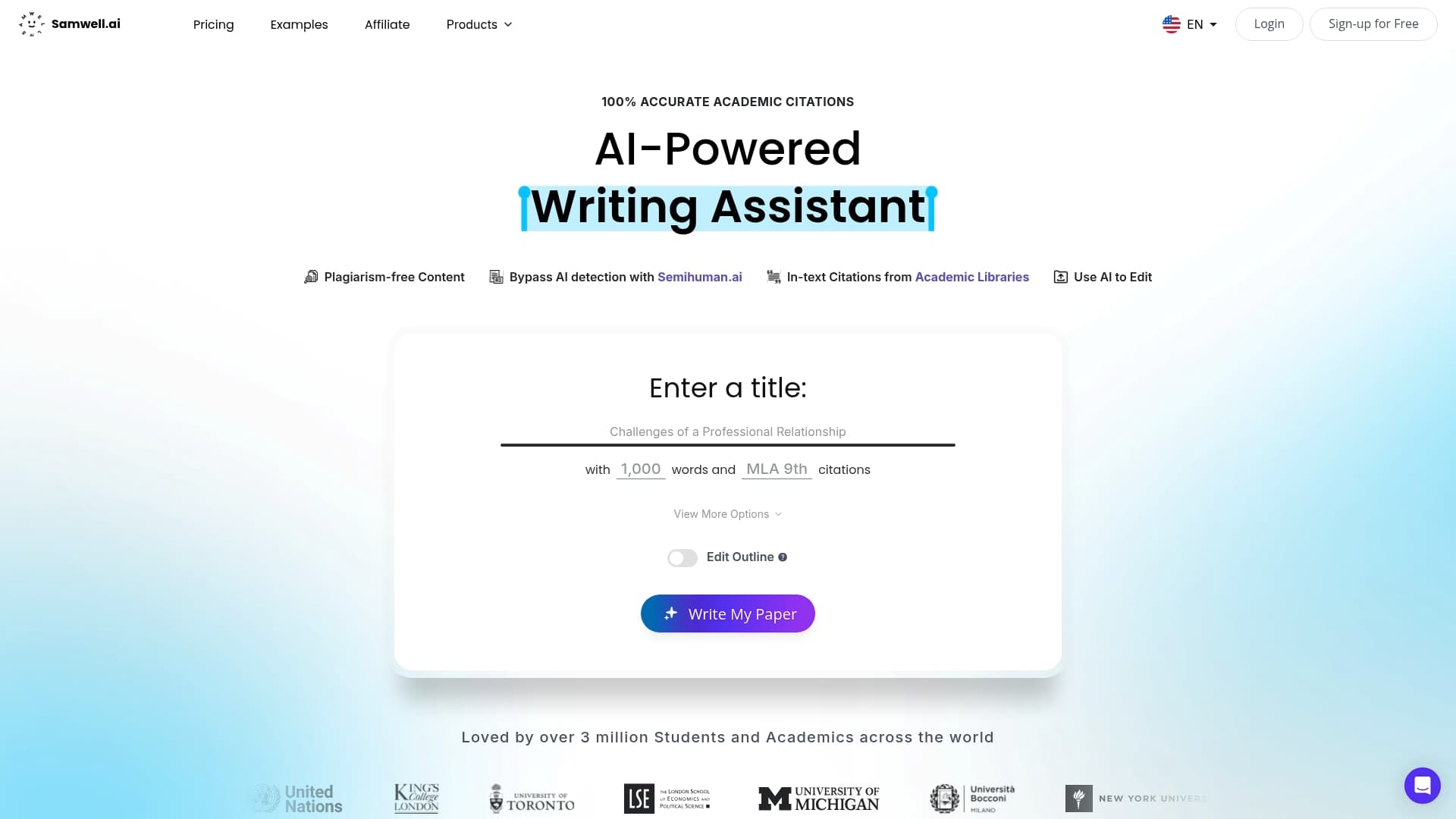
Ensure citation correctness and avoid unintentional plagiarism. Our academic writing checklist guides you through proper citation formatting for interview content. We support APA, MLA, and other major citation styles.
Use AI-powered originality checks to maintain academic integrity. Samwell.ai's Semihuman.ai technology helps you produce plagiarism-free essays while preserving your unique voice. Real-time detection checks ensure your work meets evolving academic standards.
Comprehensive writing checklists help meet university standards. From consent documentation to final proofreading, our guides cover every step. Enhance your essay with tools designed for over 1,000,000 students at leading universities worldwide.
Aim for 30-50% direct quotes to balance the interviewee's voice with your analysis. Too many quotes make your essay read like a transcript. Too few quotes fail to showcase the interview's value and unique insights.
Explain your research purpose clearly and how you will present their words in your essay. Provide a written consent form that specifies usage rights and privacy protections. Record their permission before conducting the interview.
Yes, paraphrasing with proper citation supports originality while conveying interview insights. It helps you maintain academic tone and integrate ideas smoothly. However, preserve some direct quotes to showcase authentic voice and key points.
Integrate analysis and commentary between quotes to provide context and interpretation. Organize content thematically or narratively rather than as Q&A format. Your voice should guide readers through the interview content, not just present it.
Follow your university or discipline's standard like APA or MLA. Humanities typically use MLA, while social sciences prefer APA. Check your assignment guidelines or ask your professor if you're unsure which format to apply.