Loading...

A hook is the opening sentence or two that grabs your reader's attention and connects directly to your thesis. It works by turning a stranger into someone curious enough to finish paragraph one, then paragraph two.
Here are two you can adapt right now:
A hook only works if it hits three marks:
A strong essay hook combines specificity, relevance, and a direct link to the thesis, and it usually improves most when written after the body draft is finished.
| Point | Details |
|---|---|
| Specificity beats cleverness | Concrete details, real numbers, and precise images consistently outperform vague, dramatic openers. |
| Hooks serve the thesis | Every hook type should lead into a bridge sentence that connects directly to your argument. |
| Write it last, when possible | Drafting the hook after the body reduces the risk of promising an argument the essay doesn't deliver. |
| Match the hook to the assignment | Argumentative essays favor bold claims or statistics; narrative essays favor scenes and anecdotes. |
| Test before finalizing | Read two hook options aloud or to a classmate and pick the one that connects faster to your point. |
| Samwell speeds the process | Guided Essays generates multiple hook options while Power Editor tightens specificity and tone. |
A hook has exactly three jobs: capture attention, establish why the topic matters, and lead the reader toward your thesis. Miss any one of those and the sentence is just decoration.
Harvard's Writing Center frames the introduction as a promise to the reader: the hook should frame the intellectual question your paper addresses, not just perform drama for its own sake. That's a useful reset for anyone who thinks "catchy" means "shocking." UNC's Writing Center makes a similar point, noting that introductions exist to give context and preview where the paper is headed. A hook that entertains but doesn't orient the reader has done half the job.
The most common failure isn't a boring hook. It's a vague one. A sentence like "Throughout history, technology has changed society" could open literally any essay ever written, which is exactly the problem.
Pro Tip: Write your hook after you finish the body paragraphs, not before. You'll know your actual argument by then, and the hook can be built to match it instead of guessing at it.
Before you move past your opening line, run it through five quick checks:
If you're working under classroom constraints, add a second pass: check your word limit, reread your assignment sheet for specific formatting requests, and confirm whether a quote or statistic needs an immediate citation.
When you're stuck between two options, write both out fully, read each aloud, and pick the one that sounds less like everyone else's opening line. This quick A/B test catches problems your eyes skip on a silent read.
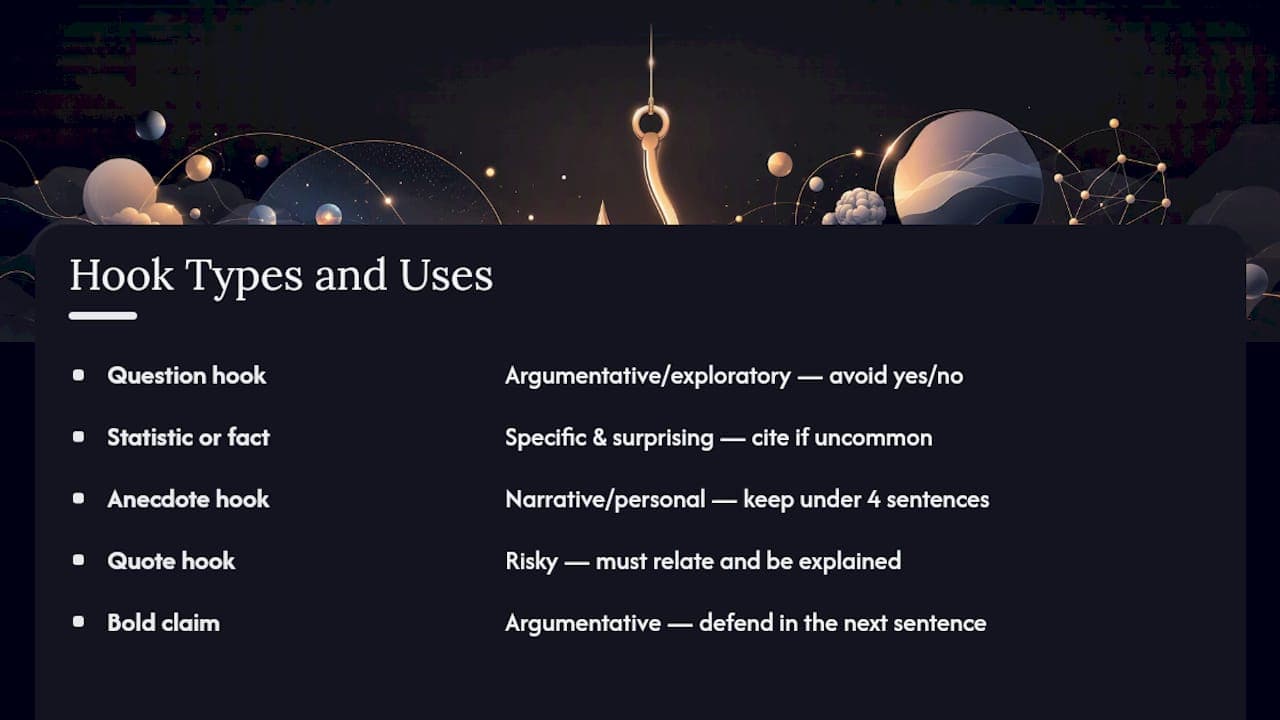
Different assignments call for different hook types. Here's the full range, with lines you can adapt directly.
The question hook poses something the reader wants answered. "Why do some countries recover from recessions in months while others take a decade?" Questions work well for argumentative and exploratory essays, but avoid one so broad it invites a one-word answer.
The statistic or fact hook leads with a number or verified detail. "Opioid overdoses have become a leading cause of death annually in the United States, exceeding many previous tragic events." Facts land hardest when they're specific and slightly surprising, but they need a citation nearby if they're not common knowledge.
The anecdote hook opens with a brief story. "When Maria opened her paycheck and found $40 missing for a 'processing fee' she'd never agreed to, she filed the complaint that would eventually reach the state legislature." Anecdotes suit narrative and personal essays especially well, though they need to stay under three or four sentences. A long windup kills momentum before the thesis even arrives.
The quote hook borrows someone else's words to set the tone. This one carries the most risk. A quote that's famous but disconnected from your argument reads as filler. ESU's Writing Studio handout is blunt about this: a hook must relate directly to the paper's main idea and needs to be explained once you've used it, not left to speak for itself.
The scene or sensory hook puts the reader inside a moment. "The smell of diesel and burnt rubber hung over the intersection long after the ambulance left." This works for narrative essays and literary analysis openings where atmosphere supports the argument, but it drags in research papers where readers want the point fast.
The bold statement or claim hook states something contestable outright. "Standardized testing may reflect access to resources rather than pure intelligence." This suits argumentative essays because it signals your position immediately, though it only works if you can defend it in the next sentence.
The metaphor or analogy hook compares your topic to something familiar. "A city without public transit is a body without a circulatory system." Analogies help explain abstract or technical topics, but a strained comparison ("her heart was a rusty gate") reads as effort without payoff.
The definition hook opens by defining a term, and it's the one to reach for least often. St. Louis Community College's writing resources list it alongside anecdote, quote, and general statement as a workable option, but dictionary-style openers ("Webster's defines courage as...") have become a classroom cliché. If you use a definition, make it your own working definition tied to your argument, not a copy-paste from a dictionary site.
Whatever type you pick, skip the vague generality, the irrelevant quote, and the sensory description with no connection to your point. Each one wastes the reader's first ten seconds.
The right hook depends on what kind of essay you're writing, not just what sounds clever.
Argumentative essays benefit from a surprising statistic, a bold claim, or a pointed question tied directly to your position. Example: "If solar panel costs have dropped dramatically in recent years, why do so few homeowners have them installed?"
Narrative and personal essays work best with vivid description, a snippet of dialogue, or a compressed anecdote. Example: "My grandmother taught me to drive stick shift the same week she told me she was dying."

Research and academic papers need a precise, sourced fact or a clean problem statement that funnels into your research question. Example: "Coral bleaching events have tripled in frequency since 1980, and researchers still disagree on which recovery interventions actually work."
Literary analysis opens strongest with a striking image from the text or a tight interpretive claim. Example: "Gatsby's green light isn't hope. It's proof that hope, chased too literally, curdles into obsession."
UW–Madison's Writing Center frames this well: the goal is to excite your reader's intellectual curiosity using an opener suited to your discipline, whether that's a question, an example, or a claim. A history paper and a creative nonfiction piece shouldn't sound alike in their first sentence, and matching tone to genre is half the battle.
The gap between your hook and your thesis needs a bridge, or the reader feels the jolt. A reliable template: hook, one sentence of context, then thesis.
Example one: "A significant number of coral reefs have died since 1980." (hook) "Marine biologists point to warming oceans, but recent data suggests a second, less discussed culprit." (bridge) "This essay argues that agricultural runoff, not temperature alone, is accelerating reef collapse in Southeast Asia." (thesis)
Example two: "My grandmother taught me to drive stick shift the same week she told me she was dying." (hook) "That contradiction, teaching me something permanent while preparing to leave, shaped how I think about legacy." (bridge) "This essay explores how small, practical acts of care outlast grand final words." (thesis)
Keep the whole introduction to three to six sentences for a standard essay. Longer than that, and you've buried your thesis.
Most weak hooks fail for one of four repeatable reasons, each with a fast fix.
Statistics and quotes almost always need a citation attached immediately, not several sentences later. Check your assignment sheet for whether your instructor wants MLA, APA, or another format before you finalize the line.
Pro Tip: Read your hook out loud to a classmate before submitting. If they ask "wait, what does that have to do with your paper?", you've found the disconnect before your grader does.
Two quick exercises build this skill faster than staring at a blank page.
This mirrors the workflow Grammarly recommends: draft the body first, then write or revise the hook so it matches the argument you actually made instead of the one you guessed at. Harvard's framing of the introduction as a promise to the reader applies directly here. A hook drafted before the essay exists is a promise you haven't earned the right to make yet.
A hook that works for a college seminar can fall flat in a high school classroom, and the reverse is just as true.
For middle and high school assignments, instructors usually reward clarity over cleverness. A direct question or a simple, concrete fact tends to score better than an elaborate metaphor that risks confusing the grader about your actual point. Keep the vocabulary natural rather than reaching for words you wouldn't normally use in conversation.
For college-level argumentative or research papers, readers expect a hook that signals genuine command of the topic. A precise statistic with a citation, or a pointed problem statement, reads as more credible than a dramatic anecdote unless the anecdote is doing real analytical work.
For general audiences (a blog post, an op-ed, a personal essay meant for people outside academia), anecdotes and sensory scenes tend to land harder than statistics. Readers outside a classroom aren't grading you on rigor first. They're deciding whether to keep reading at all.
For specialized or expert audiences, like a paper submitted to a professor in your major, a hook that name-drops a real debate in the field, an unresolved data point, or a specific case study signals you've done the reading. A generic opener in a specialized context reads as a sign you haven't.
The through-line across all four: match your hook's complexity and tone to what your specific reader already expects walking in. A hook isn't calibrated to impress you. It's calibrated to work for the person grading or reading the piece.
The version of your hook you write in the first ten minutes rarely survives contact with your finished essay. Once the whole draft exists, three revision techniques catch what a rushed read misses.
Read backward from your conclusion. Reread your final paragraph, then check whether your hook set up the argument that conclusion actually delivers. Mismatches show up here more than anywhere else, because your thesis often shifts slightly as you write.
Cut every word that doesn't earn its place. Vague qualifiers ("very," "really," "many people") almost always weaken a hook. Delete them and check whether the sentence still makes sense; if it does, it's stronger without them.
Generate three alternate versions and compare. Don't just tweak your original. Write two entirely different hooks, in different styles, and put all three side by side. Wordtune's guide to essay hooks recommends exactly this: drafting multiple openings to find which one actually fits the essay's central thread, since the strongest option is rarely the first one you wrote.
One detail worth knowing: instructors who work with student writing regularly report that the strongest hooks tend to surface only after the full essay is drafted, because writing the hook last reduces the risk of promising an argument the essay doesn't fully deliver. If your hook currently feels slightly disconnected from your body paragraphs, that's normal at the draft stage, not a sign you've done something wrong.
The students who write the strongest hooks aren't the most naturally clever ones. They're the ones willing to write five bad openings before landing on a sixth that actually fits. Most people give up after the first attempt because it feels "good enough," and good enough is exactly what a grader skims past without remembering.
Practicing multiple versions, whether by hand or with tools like Samwell's Guided Essays, consistently produces sharper openings than settling on the first idea that comes to mind.
Samwell gives you a faster way to generate real hook options instead of staring at a blinking cursor waiting for inspiration. Guided Essays walks you through a structured outline and can produce several distinct opening approaches for the same thesis, so you're comparing real alternatives instead of just revising one idea over and over. Once you've picked a direction, the Power Editor tightens the language, sharpens vague phrasing into something specific, and checks that the tone matches the rest of your essay.
A practical way to use it: generate three hook options with Guided Essays for your next assignment, then run each through Power Editor to cut filler words and confirm it connects cleanly to your thesis. If you're working on a research paper specifically, the research paper generator handles citation formatting alongside the drafting, so your statistic-based hook and its source stay properly attached. Start a draft on Samwell and see how many usable hook options you get in the first ten minutes.
Borrow their templates, adapt their examples to your own topic, and treat these as a starting checklist rather than a script to copy word for word.
What's the difference between a hook and a thesis statement? A hook grabs attention and sets tone. The thesis states your actual argument. They work together but do different jobs, and confusing one for the other is why some introductions feel disjointed.
How long should an essay hook be? One to three sentences in most cases. Anything longer risks delaying your thesis and losing the reader's patience before you've made your point.
Can I use a question as my entire hook? Yes, as long as it's specific enough to signal where your essay is headed. A question so broad it could apply to any topic isn't doing its job.
Do I need to cite a statistic used in a hook? Yes, if the fact isn't common knowledge. Attach the citation immediately rather than waiting several sentences, especially in research and argumentative essays.
Is it normal for my hook to change after I finish writing my essay? Very normal, and often a sign of a better final draft. Many writers find their strongest opening only after the argument itself is fully developed.