Loading...

TL;DR:
- A literature review is a critical synthesis that positions research within an existing scholarly conversation.
- Choosing the appropriate review type depends on research goals, such as narrative, systematic, or scoping approaches.
- Effective reviews prioritize synthesis and argumentation over mere coverage, highlighting gaps and critical evaluations.
Most students treat a literature review like a reading list with commentary. That instinct is understandable, but it misses the point entirely. A literature review is a critical synthesis of scholarly work that positions your research within an existing conversation, justifies why your study needs to exist, and demonstrates that you genuinely understand your field. Done well, it is the intellectual backbone of any strong research paper. This guide walks you through what a literature review actually is, the main types, a proven step-by-step process, and how to structure your analysis for maximum scholarly impact.
| Point | Details |
|---|---|
| Literature reviews synthesize, not just summarize | A high-quality literature review integrates sources and reveals research gaps, not just lists prior studies. |
| Match review type to your research goal | Choose narrative, systematic, or other review types based on your question, timeline, and need for rigor. |
| Follow a structured process | Effective reviews are conducted through clear steps, from search strategy to synthesis and critical analysis. |
| Synthesis and critique show scholarly mastery | Moving beyond summary to connect, analyze, and critique sources is key to an impactful review. |
| No one-size-fits-all success metric | Focus on transparency, generativity, and field advancement over word count or reference number. |
A literature review is not a summary of everything you read. It is a structured, critical analysis of existing scholarship focused on a specific research question or topic. The definition of literature review in academic contexts goes beyond listing sources. You are expected to evaluate, compare, and synthesize what researchers have found, argued, and debated.
"A literature review synthesizes prior research, showing methods, theories, and gaps to contextualize new work."
Think of it as building a case. You are showing your reader that you know the landscape of your field well enough to identify where the map runs out. That boundary is where your research begins.
The core goals of a strong literature review include:
One common misconception is that a literature review is just an annotated bibliography. An annotated bibliography describes individual sources. A literature review integrates them. You are building an argument, not a catalog. The benefits of literature reviews extend to every stage of your project: they sharpen your research question, guide your methodology, and give your conclusions credibility.
The strength of your entire research paper often hinges on this single section. Reviewers and committee members read it first to judge whether you belong in the scholarly conversation. A weak review signals shallow preparation. A rigorous one signals mastery.
With the fundamentals explained, it is crucial to understand the specific types of literature reviews and when to use each.
Not all literature reviews are built the same. Choosing the wrong type for your research goals can undermine your entire project. The five main types of reviews are narrative, systematic, scoping, rapid, and meta-analysis.
| Type | Flexibility | Rigor | Time required | Best for |
|---|---|---|---|---|
| Narrative | High | Moderate | Low to moderate | Broad overviews, theoretical papers |
| Systematic | Low | Very high | High | Clinical, policy, or evidence-based research |
| Scoping | Moderate | Moderate | Moderate | Mapping a new or emerging field |
| Rapid | High | Lower | Very low | Quick policy decisions or preliminary work |
| Meta-analysis | Low | Very high | Very high | Quantitative synthesis across studies |
A narrative review gives you flexibility to interpret and discuss a broad topic. It is ideal when you are exploring a theoretical question or writing a dissertation introduction. Check out this narrative review guide for a deeper look at how to write one effectively.
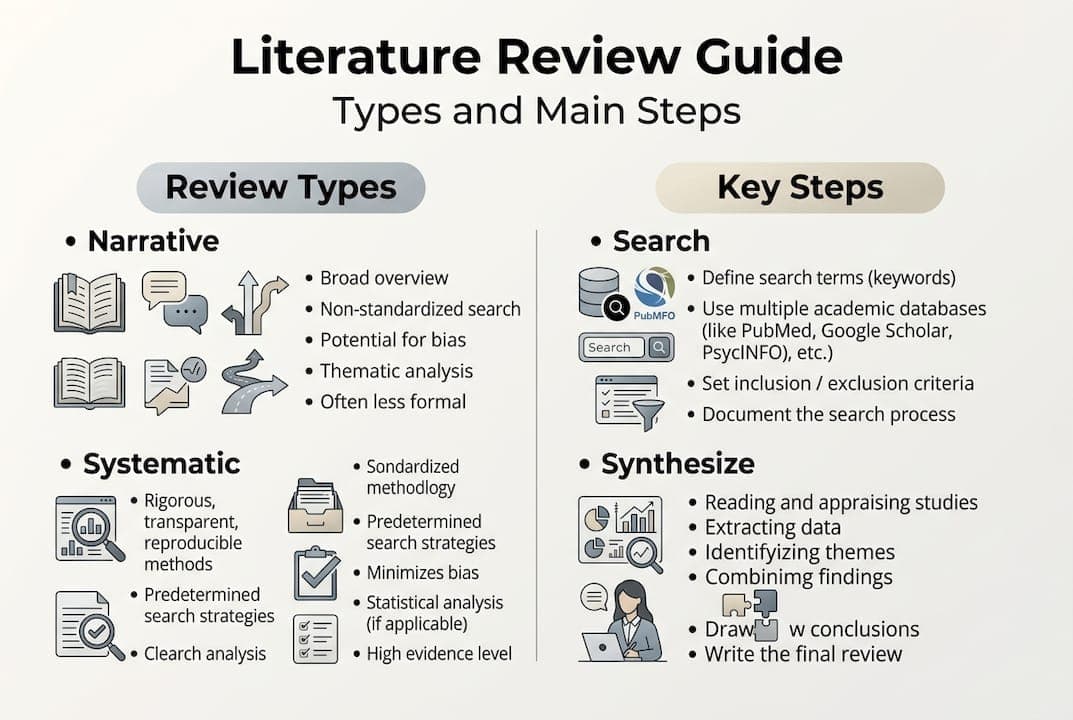
A systematic review follows strict, pre-registered protocols to minimize bias. It is the gold standard in medicine, public health, and education research. If you need to follow systematic review steps, the process is more demanding but produces the most replicable results.
A scoping review maps what is known about a topic without evaluating quality in depth. It is useful when you are entering a new field and need to understand the terrain before committing to a specific question.
Here is a quick guide on when to use each type:
Understanding the difference between narrative and systematic reviews is especially important if your field has strong expectations about methodological rigor. To fully leverage any review type, it is vital to follow a clear and evidence-based methodology.
A good literature review does not happen by accident. It follows a deliberate process that keeps your search transparent, your analysis focused, and your writing credible. Conducting a review involves six core stages.
The steps for defining and conducting a review emphasize that logging your search process is not optional. It supports replicability and transparency, which are requirements for systematic reviews and increasingly expected in all scholarly work.
Two of the most common pitfalls are relying on a single database and summarizing sources instead of synthesizing them. Relying on one database means missing entire bodies of literature. Summarizing means you are describing, not analyzing. Both weaken your review significantly. For a full walkthrough of the process, the project review guide covers each stage in practical detail.
Pro Tip: Keep a detailed search log that records every database you used, the keywords you searched, and the number of results returned. This supports replicability and saves you hours if you need to update your review later.
Understanding the value of good synthesis leads naturally to mastering the art of analysis and thematic structure in your review.
Synthesis is the skill that separates a good literature review from a great one. Summary tells the reader what each study found. Synthesis tells the reader what those findings mean together. You are building a coherent argument from multiple voices, not just reporting them one by one.

To prioritize synthesis and evaluate methods, you need to actively compare studies: Where do they agree? Where do methods differ in ways that explain conflicting results? What assumptions do most studies share, and are those assumptions valid?
Here are the three main ways to structure a review, with their trade-offs:
| Structure | Pros | Cons |
|---|---|---|
| Thematic | Shows conceptual connections clearly | Can obscure chronological development |
| Chronological | Reveals how thinking evolved | Can feel like a timeline, not an argument |
| Methodological | Highlights research design differences | Less intuitive for non-specialist readers |
Thematic structure is the most common choice for research papers because it organizes your review around ideas rather than dates or methods. It forces you to synthesize across studies rather than describe them sequentially.
Critiquing methodology is equally important. A study with a small sample size, a biased instrument, or a non-representative population has real limitations that affect how much weight you give its findings. Noting these limitations is not being harsh. It is being rigorous. For practical guidance on this, the analysis of literature review resource walks through how to evaluate sources critically without losing focus on your argument.
Research on high-quality literature reviews consistently points to gap identification as a core marker of quality. Your review should make it obvious, by the end, exactly what question remains unanswered and why your research addresses it. For citation formatting, the APA review example shows how to apply these structural choices within APA style.
Pro Tip: Use color-coded tags in a reference manager like Zotero or Mendeley to group sources by theme as you read. When you sit down to write, your thematic clusters are already built.
Here is something most guides will not tell you: there is no formula for a perfect literature review. Studies on what makes reviews high-quality confirm that no empirical benchmarks exist for success metrics like length or citation count. What matters is generativity: does your review advance thinking in the field?
Most students focus on coverage. They want to include every relevant source, as if completeness equals quality. But experts focus on argument. They select sources that build a case, and they cut sources that do not add to it. That is a fundamentally different mindset.
The other thing guides miss is that synthesis is a skill you train, not a technique you apply. Reading exemplary review examples from top journals in your field is the fastest way to develop your instinct for structure and voice. You absorb how experts connect ideas, handle contradictions, and frame gaps. Imitation is a legitimate learning strategy in academic writing, and it works.
Mastering the literature review is one of the highest-leverage skills you can build as a researcher. Every other part of your paper depends on how well you understand and frame the existing conversation in your field.
Samwell.ai offers a full suite of tools designed specifically for students and academics who want to write stronger, more credible research papers. From guided essay structures to real-time citation support and AI-powered editing, the platform helps you move from a rough draft to a polished, publication-ready review faster than working alone. With over 1,000,000 students already using it, you are in good company. Explore the resources, try the tools, and give your next literature review the foundation it deserves.
A literature review positions new research by summarizing, critiquing, and connecting previous studies while revealing gaps your work aims to address. It is a critical synthesis of existing scholarship, not a simple summary.
There is no fixed length. No empirical benchmarks exist for success metrics like length or citation count, so quality, clarity, and synthesis matter far more than word count.
The main types of reviews are narrative, systematic, scoping, rapid, and meta-analysis, each serving different research goals and levels of methodological rigor.
Organize thematically, chronologically, or methodologically, then synthesize findings critically by evaluating methodologies, noting biases, and highlighting trends and gaps throughout.