Loading...

TL;DR:
- Only 27% of U.S. students are proficient in writing, often due to teaching methods.
- Effective strategies include explicit instruction, process writing, and targeted feedback focusing on ideas and organization.
- Using mentor texts and fostering motivation through purpose and self-efficacy enhance students' academic writing skills.
Only 27% of U.S. students in 8th and 12th grade are proficient in writing. That number should stop you cold. If you are teaching academic writing and feeling like your students are not making real progress, you are not alone, and the problem is rarely effort. It is usually method. The good news is that decades of classroom research have given us a clear, repeatable framework for building writing skills that actually stick. This article walks you through five evidence-based strategies, from explicit instruction to genre modeling, so you can start seeing measurable gains in your students' writing right away.
| Point | Details |
|---|---|
| Combine instruction methods | Blending explicit teaching with process writing helps students master complex academic skills. |
| Prioritize high-order issues | Feedback and revision should focus on argument and clarity before grammar corrections. |
| Use frameworks and models | Structured rubrics and mentor texts provide a clear path for student success. |
| Encourage peer review | Collaborative feedback and revision cycles help students deeply engage with the academic writing process. |
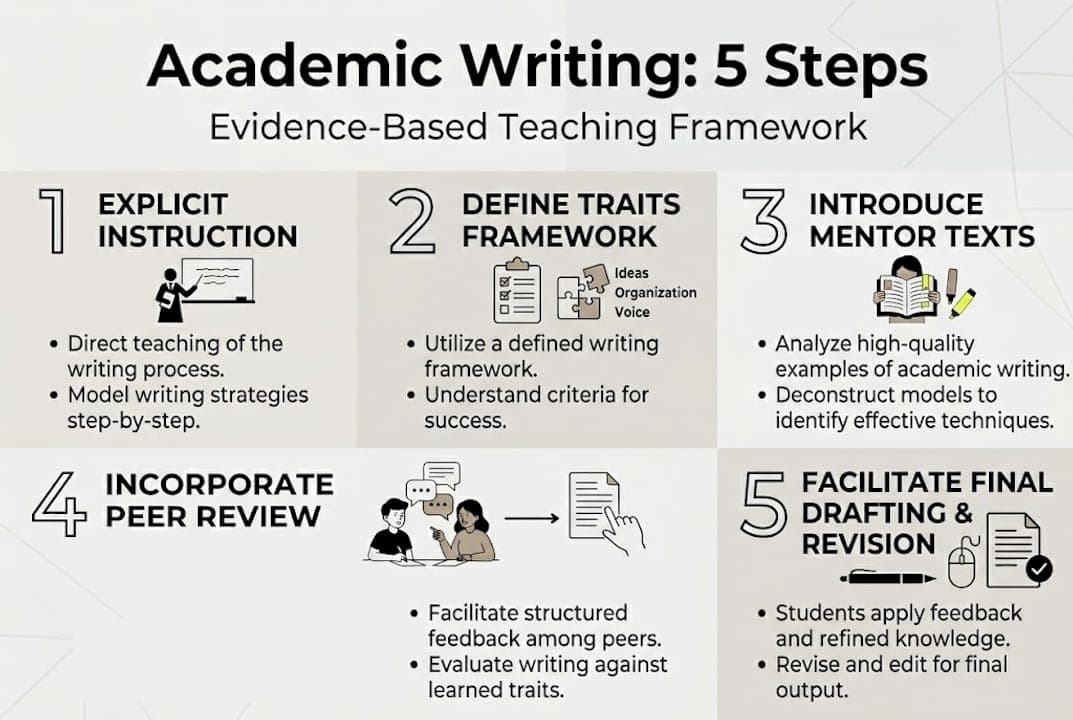
If you want students to write better academic essays, you need to show them exactly how it is done. That is the core idea behind explicit instruction: the teacher models the task, sets clear goals, and breaks down every step so students can follow along and replicate the process. It is the opposite of handing out a prompt and hoping for the best.
Pair explicit instruction with process writing, and you have a combination that research consistently backs. Explicit instruction plus process writing significantly improves students' writing quality, and strategy instruction improves the quality and coherence of students' texts, according to multiple meta-analyses. Together, they turn writing from a mysterious talent into a teachable skill.
Process writing moves students through five stages:
For more on how these stages connect, the writing process basics overview breaks it down in practical terms.
Here is how these three instructional approaches compare:
| Approach | Focus | Strength | Limitation |
|---|---|---|---|
| Explicit instruction | Teacher modeling and direct explanation | Builds foundational understanding fast | Can feel passive if students do not practice |
| Process writing | Student-led drafting and revision cycles | Builds independence and deeper thinking | Needs structure to avoid drift |
| Feedback-focused (traditional) | Error correction after submission | Addresses mistakes directly | Often too late and too general to drive real growth |
For a broader look at academic writing best practices, the research consistently points in the same direction: structure first, then iteration.
Pro Tip: Do not rely only on error correction. Combine explicit modeling with process writing research approaches to build both skill and confidence before students ever reach the editing stage.
Once you have established a process foundation, the next step is giving students and teachers a shared language for talking about writing. The Six Traits of Writing model does exactly that. The Six Traits model helps anchor feedback and guides students through ideas, organization, voice, word choice, sentence fluency, and conventions. Each trait is a specific, teachable dimension of writing quality.
Here is how each trait maps to classroom practice:
| Trait | What it means | Classroom application |
|---|---|---|
| Ideas | The central message and supporting details | Teach students to develop one strong claim with evidence |
| Organization | Logical structure and flow | Practice outlining before drafting |
| Voice | The writer's individual tone and engagement | Compare formal and informal writing samples |
| Word Choice | Precise, academic vocabulary | Build discipline-specific vocabulary lists |
| Sentence Fluency | Rhythm and variety in sentence structure | Read drafts aloud to catch choppy or repetitive sentences |
| Conventions | Grammar, spelling, and punctuation | Reserve this for the editing stage |
Check the essay writing rubric guide for ready-to-use templates that align with each of these traits.
Here is a simple sequence for rolling out the traits in class:
You can also connect each trait to a step in your academic writing checklist so students always know where they are in the process.
Pro Tip: Do not try to assess all six traits on every assignment. Focus feedback on just one or two traits per draft. Students improve faster when they can concentrate their revision energy.
A rubric and a process framework are only as powerful as the feedback loop that reinforces them. This is where many instructors lose ground. Vague comments like "unclear" or "needs more detail" do not tell students what to fix or how. Targeted feedback on specific writing aspects improves outcomes, with argument and organization taking priority over grammar in early drafts.
Here is a practical feedback cycle to build into your course:
Peer review and revision cycles are critical for developing student writers' skills, especially when the feedback is specific and tied to clear criteria. Research also shows that students who revise actively internalize writing standards faster than those who only receive one round of instructor comments.
For practical peer review strategies your class can start using immediately, the linked guide offers structured formats that work across disciplines.
Target the message before the mechanics to maximize growth.
This principle sounds simple, but it runs against the instinct of many instructors. Most of us were trained to mark every error. The research on feedback techniques tells a different story: prioritizing content-level feedback in early drafts leads to stronger final papers. For tips on improving student writing at the revision stage, explore those strategies with your next cohort.

Pro Tip: Limit yourself to three actionable comments per draft. More than that, and students get overwhelmed. Fewer, targeted notes drive deeper revision.
Students write better when they have seen what better looks like. That is the whole argument for mentor texts. Instead of describing what an academic argument should do, you show them a real example of one doing it well. Genre models and mentor texts teach academic writing structures and formal tone in ways that abstract rules simply cannot match.
When you select a mentor text, point out these core features:
For a deeper look at genre teaching strategies across different academic writing types, that resource covers the full range from lab reports to argumentative essays.
Build mini-lessons around specific structural moves. Spend one class entirely on thesis statements. Spend another on introductions. Break topic sentences down into their own dedicated session. Each micro-skill compounds into stronger overall writing. Reviewing the full range of academic writing genres also helps students understand why conventions shift between a research paper and a reflective essay.
Pro Tip: Choose mentor texts from within the course content itself. A history class should analyze historical essays. A science writing course should look at published abstracts and lab reports. Relevance accelerates learning.
Here is the uncomfortable reality: most academic writing instruction is reactive. A student submits a draft, an instructor marks it up, and the student files it away. That cycle rarely builds lasting skill. Some experts debate the efficacy of written corrective feedback, especially when it is overemphasized at the expense of actual instruction. Feedback alone is not teaching.
What actually works is harder to scale but far more effective: active modeling, intentional scaffolding, and consistent attention to student motivation. Students who understand why academic writing matters to their field, and who believe they can actually improve, outperform students who are just chasing grades.
That is the piece most curricula skip. Goal-setting and self-efficacy are not soft extras. They are core drivers of writing growth. If you want to understand why academic writing matters beyond mechanics, the answer is always connected to purpose and audience. Students write better when they write for a real reason, not just for a rubric. Build that into your course design, and the other strategies here will hit harder.
Implementing these strategies well takes time, structure, and the right resources. The good news is you do not have to build everything from scratch.
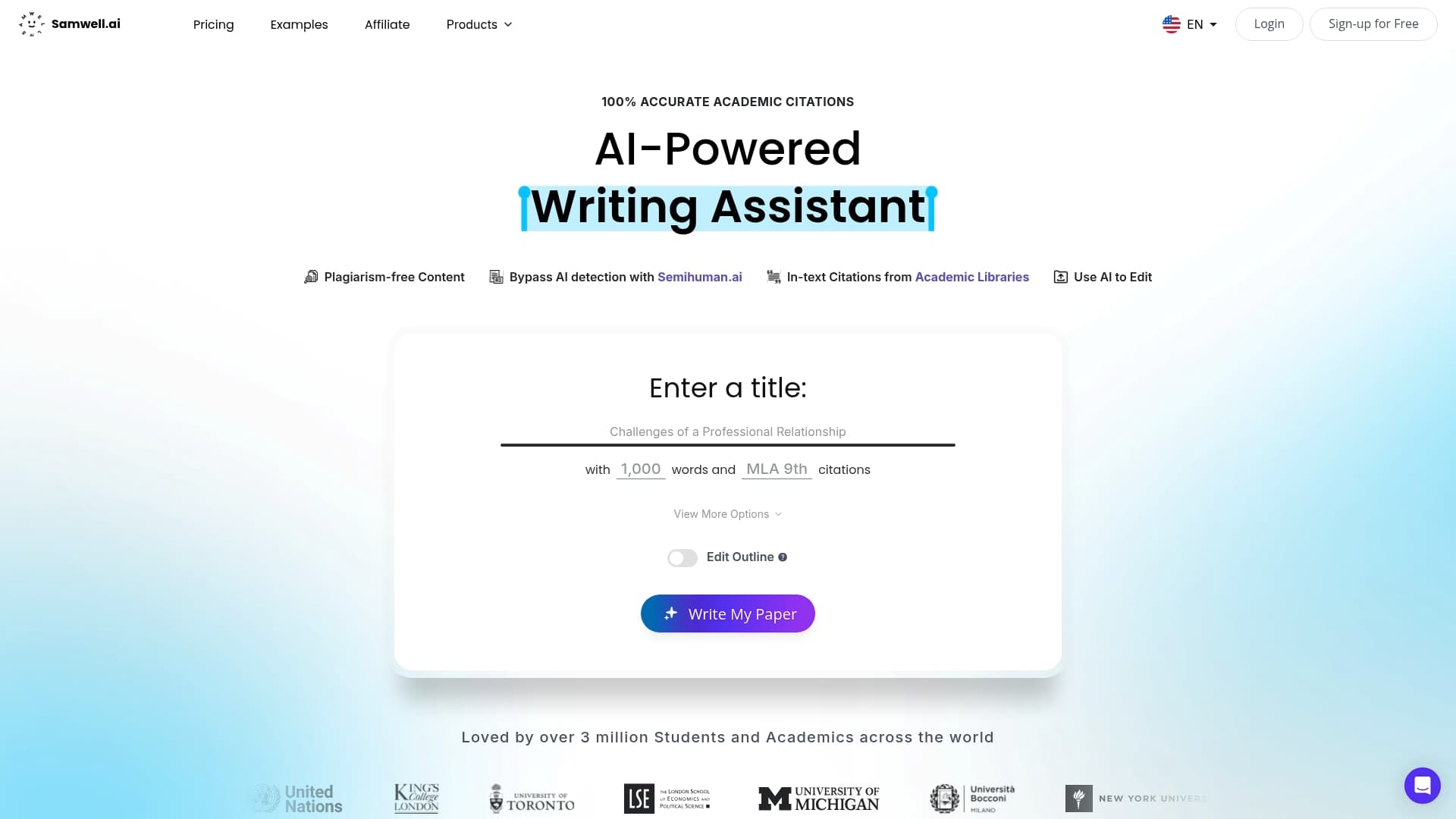
Samwell.ai offers a full suite of tools designed to support both instructors and students through every stage of the academic writing process. From guided essay frameworks to real-time AI detection checks, the platform makes evidence-based writing support practical and scalable. Whether you are looking for structured templates, citation-ready outputs, or a writing improvement guide your students can follow independently, Samwell.ai brings it together in one place. Over 1,000,000 students and academics already use it to produce stronger, more credible work.
Combining explicit instruction with process writing and targeted feedback yields the best results, and strategy instruction consistently improves text quality and coherence across meta-analyses.
Use explicit grammar and vocabulary instruction alongside process writing, and prioritize overall coherence before correcting every surface-level error.
Mentor texts provide genre-specific models students can analyze and emulate, making academic structures and tone concrete rather than abstract.
Start with high-order concerns like argument and organization. Targeted feedback research shows that addressing content before conventions produces stronger final papers.
Goal-setting, self-efficacy, and connecting writing tasks to students' fields of study all support writing growth and long-term skill development.