Loading...

A strong research-paper introduction is a four- to five-paragraph funnel that moves from broad context to a narrow, defensible claim using five components: hook, background, gap, purpose, and an optional roadmap. Here's the micro-checklist to build one:
That five-part structure with its suggested sentence counts comes straight from writing-center guidance used across disciplines. If drafting all five parts from scratch feels like the hardest part of the paper, tools like Samwell's Guided Essays can scaffold the structure while you supply the actual thinking.
A research-paper introduction succeeds when its four to five paragraph funnel delivers a specific gap statement that logically sets up a direct, testable purpose statement.
| Point | Details |
|---|---|
| Use the funnel structure | Move from broad context to a narrow gap across four to five paragraphs, not one dense block. |
| Keep components proportional | Hook gets 1-2 sentences, background 2-5, gap 1-3, purpose 1-3, per standard writing-center guidance. |
| Make the gap specific | Name what, where, or why something is unknown; avoid vague phrases like "more research is needed." |
| Revise the intro last | Write or rewrite the introduction after the body is done so it matches your actual findings. |
| Use Samwell for structure | Guided Essays and the Power Editor help scaffold each component and check citations before submission. |
Building an introduction works best in the order readers experience it, not the order it occurs to you. Here's how each piece gets built.
1. Write the hook with restraint. In STEM and social science papers, a striking statistic or a pointed question does the job in one or two sentences. In humanities papers, a short historical or textual observation works better, than a dramatic claim. Whatever the field, the hook needs to connect directly to your topic within the very next sentence. A vague attention-grabber that has nothing to do with your actual argument confuses readers before you've made a single claim.
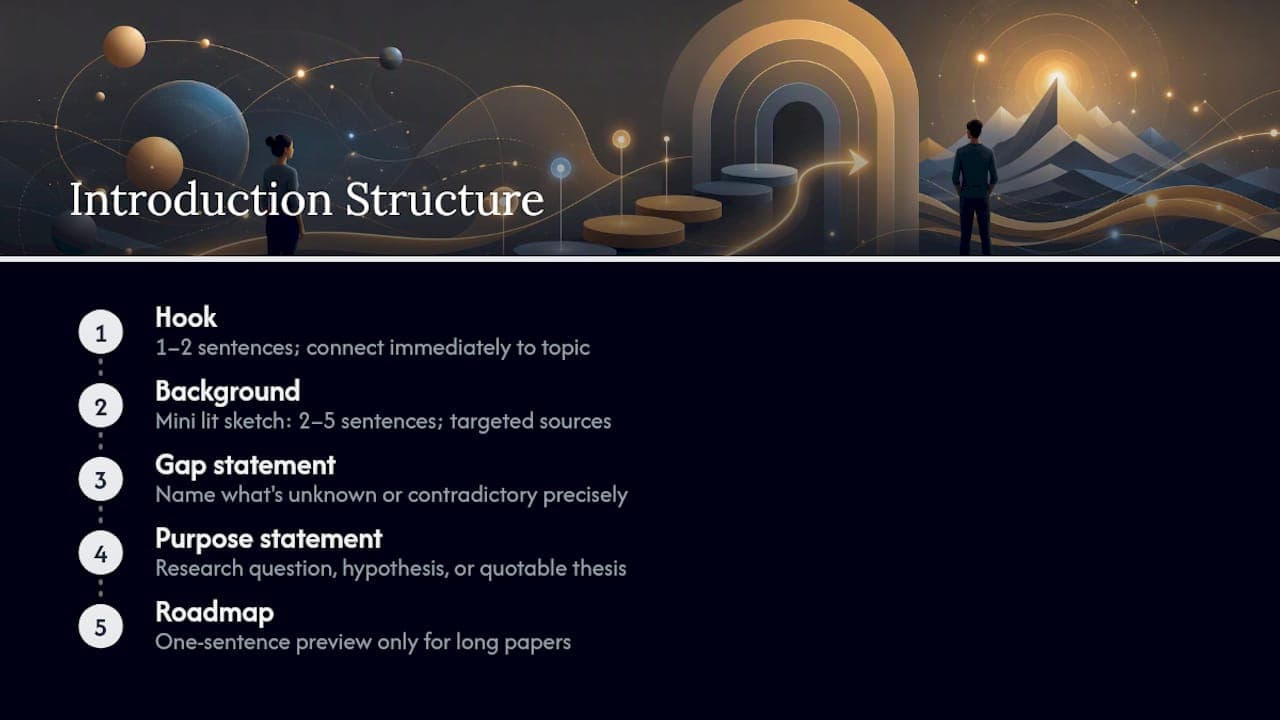
2. Compress the background into a mini-lit sketch. You need just enough prior research to make the gap make sense, typically two to five sentences. The Harvard Writing Center warns against stacking citations into long strings after a single broad claim. Break big claims into narrower sub-claims, and attach one or two targeted sources to each rather than five sources to one sentence.
3. State the gap with precision. This is where most drafts go soft. "More research is needed" tells the reader nothing. Name what's unknown, contradictory, or unexamined, and use pivot language like "however" or "despite this" to connect it to the background you just gave.
4. State your purpose directly. This is your research question, hypothesis, or thesis, phrased as a claim your paper will actually support, not a hope. In experimental papers, the hypothesis often appears here in a single testable sentence. In argumentative papers, this is your thesis statement, and it should be nearly quotable.
5. Add a roadmap only if the paper is long. A one-sentence preview of the paper's structure helps readers of a 20-page paper. For a 6-page paper, it's usually just filler.
Pro Tip: Draft your gap statement before your background paragraph. Writing the "so what" first tells you exactly which prior studies you actually need to mention, so you stop over-explaining context nobody asked for.
Openers should prioritize relevance over flash. A striking fact, a targeted question, or a brief anecdote tied directly to your research's significance all work, as long as the connection to your topic is immediate.
Anecdotes and quotes can work in humanities papers but rarely belong in empirical science writing, where they read as padding rather than evidence.
A hook only succeeds if the very next sentence explains why it matters to your specific research question. A clever opener that dangles unconnected for a paragraph does more harm than a plain one.
For more worked examples, Samwell's guide on how to write a good hook walks through several rewrites from vague to specific.
A weak gap statement uses vague filler. A strong one names what, where, why, or how something remains unknown, and uses pivot words to connect it to the literature you just summarized. Gaps generally fall into four types:
Try this frame: "While [prior finding] is well established, little is known about [specific unknown], particularly regarding [narrow condition]." From there, the purpose statement should answer the gap directly: "This study examines [gap] by [method/approach]." That direct pivot from gap to purpose is what reviewers scan for first.
Pro Tip: If your purpose sentence could apply to five other papers in your field, it's not specific enough. Name your variable, population, or method explicitly.
A compact template you can adapt for most empirical papers:
This mirrors the CARS model, which frames introductions as three moves: establishing the territory, establishing a niche (the gap), and occupying that niche with your own contribution.
Empirical example:
Nearly one in three hospital readmissions within 30 days are considered preventable. (hook) Prior research has linked readmission rates to discharge planning quality and post-discharge follow-up contact. (background) However, most of these studies focus on urban hospital systems, leaving rural readmission patterns largely unexamined. (gap) This study tests whether discharge-call frequency predicts 30-day readmission rates in rural hospitals. (purpose) Section two reviews prior discharge models before presenting our methodology. (roadmap)
Argumentative example:
Public libraries face the sharpest municipal budget cuts of any civic institution. (hook) Advocates typically defend libraries on cultural grounds, citing literacy and community access. (background) Yet these arguments rarely address the libraries' documented economic return per dollar invested. (gap) This paper argues that municipal budget decisions should weigh libraries' measurable economic contribution alongside their cultural value. (purpose)
Discipline shifts the phrasing, not the structure. Experimental papers often state a formal hypothesis; argumentative papers state a thesis. Samwell's guide to crafting a strong thesis introduction has more worked conversions from gap to argument.
Draft or heavily revise your introduction after the body is finished. Experienced researchers write it last so the promises it makes match what the paper actually delivers. An introduction functions as a promise to the reader: if you claim you'll address three factors and only address two, that mismatch is the fastest way to lose a reviewer's trust.
Run this checklist before submitting:
| Point | Details |
|---|---|
| Promise-match | Reread your conclusion, then confirm your intro promises exactly what the paper delivers. |
| Gap specificity | Replace "more research is needed" with a named unknown, tied to a pivot word like "however." |
| Citation distribution | Break stacked citations into narrower sub-claims, each with its own targeted source. |
Getting the funnel structure right takes practice, and most writers tighten it over several drafts, not one sitting. Samwell's Guided Essays walk you through hook, background, gap, and purpose in sequence, while the Power Editor helps expand a thin paragraph without losing your voice. Built-in citation tools handle APA and MLA formatting, and real-time AI detection checks help you confirm your draft still reads as your own work.
Samwell gets you from blank page to a structured, five-part introduction in one sitting, instead of staring at a cursor trying to remember what a gap statement is supposed to sound like. The Guided Essays tool prompts you through hook, background, gap, purpose, and roadmap in order, so you're never guessing what comes next. If a paragraph reads thin, the sentence and paragraph expansion tool builds it out while keeping your original claim intact.
Getting started takes three steps: sign up, select a Guided Essay template for your paper type, then run the built-in citation and AI-detection checks before you submit. Samwell's citation tools handle APA and MLA formatting automatically, so you're not hunting down comma placement while trying to finish a gap statement. Start your next introduction with a template instead of a blank page.
How long should a research paper introduction be? Most introductions typically include several paragraphs, following the funnel structure from broad context down to your specific purpose statement.
What's the difference between a hook and a thesis? The hook opens the paragraph and earns attention in one or two sentences. The thesis or purpose statement, usually three to four sentences later, states exactly what your paper argues or investigates.
Should I write the introduction first or last? Writing it last, or heavily revising it after finishing the body, keeps your gap and purpose statements aligned with what your paper actually found or argued.
How many sources should I cite in the background section? Enough to support each sub-claim individually, typically two to five sentences with citations distributed rather than stacked on a single sentence.
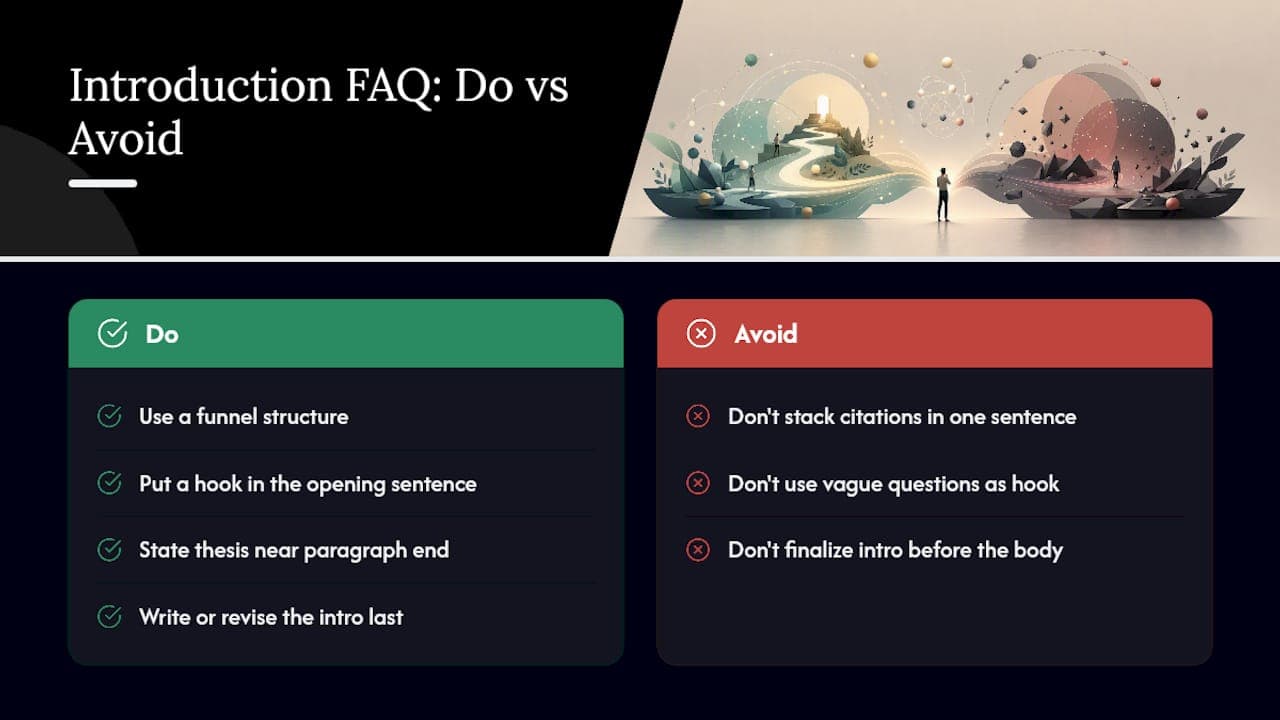
Can I use a question as my hook? Yes, a targeted question works well as a hook, especially in social science papers, as long as your next sentence ties it directly to your research topic.