Loading...

TL;DR:
- Proper formatting enhances readability and signals professionalism in academic papers.
- Understanding discipline-specific structures and guidelines prevents extensive revisions later.
- Using templates and official style guides ensures consistency and reduces common formatting errors.
Getting a paper handed back because your margins were wrong or your citations didn't match the required style is one of the most frustrating experiences in academic life. You spend hours on research and writing, only to lose points over technical details that feel secondary to your actual argument. But formatting isn't just bureaucratic busywork. Proper formatting enhances readability and signals professionalism to reviewers, editors, and instructors alike. This guide walks you through every step, from understanding why structure matters to setting up your document, applying citations correctly, and doing a final check before submission.
| Point | Details |
|---|---|
| Use the right structure | Select IMRaD or a standard academic format based on your field and assignment. |
| Follow style guidelines | Apply formatting and citation rules (APA, MLA, Chicago) exactly as required for your discipline. |
| Double-check before submitting | Review your formatting, citations, and layout to catch common mistakes and ensure compliance. |
| Tools simplify the process | Formatting templates and online resources can save time and boost accuracy if used wisely. |
Formatting is the first thing a reviewer sees before reading a single word of your argument. A paper with inconsistent headings, wrong font sizes, or missing page numbers immediately raises doubts about the author's attention to detail. Proper adherence to formatting directly affects readability and your paper's chance of acceptance, whether you're submitting to a journal or turning in a class assignment.
Before you write a single sentence, you need to know which structural format your discipline or instructor requires. Research papers use two primary structures: IMRaD (Introduction, Methods, Results, Discussion) for scientific and empirical work, and a standard academic structure paired with citation styles like APA, MLA, or Chicago for humanities and social sciences. Getting this wrong from the start means rebuilding your entire document later.
Here's what you need to confirm before you begin:
Understanding the structure of a research paper at the macro level saves you from restructuring large sections after writing. Think of formatting as the skeleton of your work. It holds everything in place and makes it possible for your reader to follow your ideas without friction.
| Format type | Common disciplines | Citation style used |
|---|---|---|
| IMRaD | Sciences, medicine, engineering | APA, Vancouver |
| Standard academic | Humanities, social sciences | MLA, Chicago, APA |
| Report format | Business, education | APA, Chicago |
| Annotated bibliography | All disciplines | APA, MLA, Chicago |
Taking five minutes to read the submission guidelines before you start writing will save you hours of reformatting. Always download or bookmark the official style guide for the format you're using.
Now that you know why formatting matters and what structure to follow, make sure you've got all the materials and settings ready before writing a single word. Setting up your document correctly at the start prevents painful corrections later.
Universal formatting mechanics include 1-inch margins on all sides, double-spaced lines, 12-point Times New Roman or a comparable serif font, and page numbers in the header or footer. These basics apply across APA, MLA, and Chicago, though each style has its own specific rules layered on top.

Here's a quick comparison of the three major styles:
| Setting | APA | MLA | Chicago |
|---|---|---|---|
| Font | 12pt Times New Roman | 12pt Times New Roman | 12pt Times New Roman |
| Margins | 1 inch all sides | 1 inch all sides | 1 inch all sides |
| Line spacing | Double | Double | Double |
| Title page | Required | Not required | Optional |
| Page numbers | Top right | Top right | Top right |
| Paragraph indent | 0.5 inch | 0.5 inch | 0.5 inch |
Before you start typing your paper, make sure you have these materials ready:
Pro Tip: Most word processors like Microsoft Word and Google Docs have built-in style templates for APA and MLA. Open a new document, select the correct template, and your margins, font, and spacing will be configured automatically. This cuts setup time significantly and reduces human error on the basics.
Once your document is set up, don't change font sizes or spacing mid-paper unless the style guide specifically calls for it (such as in block quotations). Consistency is the goal.
With your document set up, it's time to apply formatting to every section, citation type, and key element to meet your required standard. This is where most students hit trouble because the three major styles differ in meaningful ways.
Here is how to approach formatting in order:
Pro Tip: Write your citations as you go, not at the end. Every time you use a source, add the in-text citation immediately and paste the full reference into a working bibliography at the bottom of your document. Rebuilding citations from scratch at 11 PM before a deadline is miserable.
"The citation style you use should match your discipline's standards. APA is built for empirical social sciences. MLA is streamlined for literary analysis. Chicago is flexible enough for historical and archival research."
For more detailed walkthroughs, check out how to format an APA student paper, handle a Chicago in-text citation, or follow a full MLA citation guide for 2025 standards.
Even with a good system, mistakes happen. Here are ways to catch and prevent them before you hit submit.
The most frequent formatting errors students make include:
Choosing the right style depends on your discipline and journal, and Purdue OWL is the most reliable free resource for verifying APA and MLA rules in detail. Always cross-check your work against official guidelines, not just memory.
For complex papers that include appendices, check the rules for APA appendix formatting and the broader MLA style manual if you're working in humanities. Both have specific requirements that trip up even experienced writers.
If your paper follows IMRaD structure, verify that each section has the right content and that your abstract meets the word limit specified by the journal.
Pro Tip: Before submitting, read your paper in print or PDF preview mode. Digital documents often hide spacing and margin issues that become obvious on a printed page. A five-minute visual scan can catch errors that spell-check misses entirely.
Do a final checklist pass: margins, font, spacing, title page, page numbers, in-text citations, and reference list. Check them in that order, one at a time.
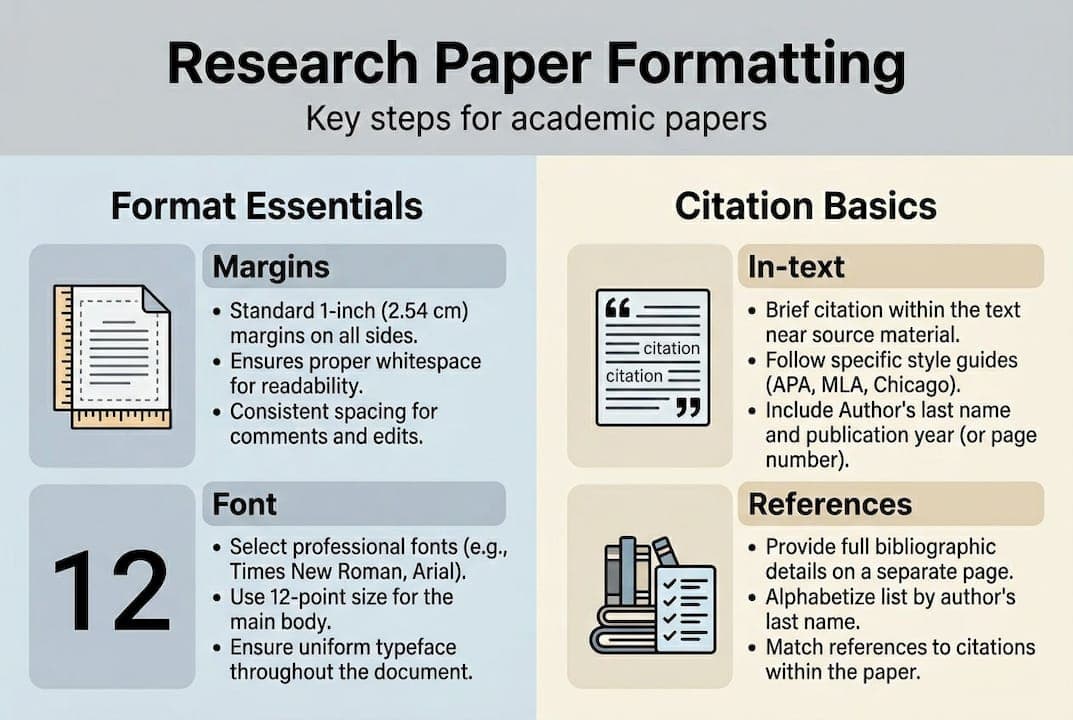
Here's something most formatting guides won't tell you: you can have a perfectly formatted paper with wrong margins corrected, citations aligned, and every heading styled correctly, and still produce writing that fails to communicate.
At Samwell.ai, we've worked with over a million students, and we see this pattern repeatedly. Students spend so much energy on technical compliance that they lose confidence in their actual argument. They start writing defensively, hedging every claim, burying their thesis, and over-citing to compensate for unclear reasoning.
Formatting is the floor, not the ceiling. Different disciplines favor different formats for good reasons. APA's structured style supports empirical replication. MLA's lighter touch serves close reading and interpretation. Chicago's flexibility fits archival and historical research. No single format is universally superior.
What matters most is whether your ideas come through clearly. Use formatting as a tool to support your argument, not as a substitute for it. For deeper context on how citation conventions shape meaning, our Chicago citation guide offers useful perspective on why style choices reflect disciplinary values.
Format correctly. Then focus on having something worth reading.
Formatting a research paper correctly takes practice, but you don't have to figure it out alone. The steps in this guide give you a reliable system, but the right tools can make the process significantly faster and less stressful.
Samwell.ai gives you access to AI-assisted writing tools built specifically for academic standards. Whether you need help structuring your paper, generating citations in APA, MLA, or Chicago format, or checking your draft for consistency, Samwell.ai handles the technical work so you can focus on your ideas. Trusted by over 1,000,000 students and academics from leading universities, our platform blends formatting precision with real academic integrity support.
The easiest way is to use a trusted template based on your required citation style and then double-check every section against your instructor's guidelines. Most standard settings, including 1-inch margins, 12-point font, and double spacing, apply across all major styles.
Choose the style your discipline or instructor specifies. APA suits social sciences, MLA is standard for humanities, and Chicago works best for history and fields requiring flexible citation options.
Online citation generators save time, but they produce errors often enough that you should always verify against official guidelines before submitting.
Typical mistakes include incorrect margins and font sizes, inconsistent citation styles, missing page numbers, and improperly formatted reference lists. Formatting errors affect readability and can lead to lower grades or outright rejection.