
Loading...

A strong compare-and-contrast conclusion does three things: it restates the thesis in new words, synthesizes what the comparison actually reveals instead of listing it again, and answers "so what?" for the reader. Skip any one of those and the essay ends with a shrug instead of a point.
TL;DR:
- A good conclusion should synthesize the strongest comparison points to reveal their broader significance, not just list or restate earlier details.
- Linking phrases like "because they share" or "together these differences show" help create effective synthesis rather than mere summaries.
- Avoid introducing new evidence or using generic phrases like "in conclusion," which weaken the analytical impact.
- The conclusion should connect back to the thesis with fresh wording, emphasizing insight and implication rather than repetition.
- Allocate enough space, roughly 150 words, to craft a conclusion that genuinely ties the comparison to a meaningful takeaway.
A conclusion that just repeats body paragraphs in miniature is the most common way students lose points on an otherwise solid comparison essay. The fix is a short checklist you can run through before you call the paragraph done.
Pro Tip: Read your conclusion's first sentence out loud. If it could open a completely different essay on a different topic, it's too generic. Name your actual subjects.
Run through those five checks and you'll catch most of the weaknesses before a professor does.
You don't need to reinvent the ending every time. A repeatable three or four sentence structure covers the vast majority of compare-and-contrast assignments, and once you've adapted it once, you can reuse the shape for the next essay.
For timed or in-class essays, compress the formula to three sentences: paraphrase, synthesize the single strongest point, and one line of implication. That compressed version still hits every function a grader is checking for. A typical compare-and-contrast conclusion runs around 150 words, which is roughly the length of the paragraph you just read. That's enough space to synthesize without repeating your whole essay.
One more trick worth borrowing: circle back to an image, question, or theme from your introduction. If you opened by asking why two historical figures made opposite choices under similar pressure, your conclusion can return to that same framing, now answered. It gives the essay a sense of closure rather than a stop.
Seeing the formula in finished form makes it easier to copy. Here are three short models, each built for a different type of assignment.
Analytical comparison (literature or history):
The first sentence paraphrases the thesis with new phrasing. The second synthesizes the shared technique and states its implication, which is the "so what."
Argumentative or evaluative comparison:
Notice the stance is explicit ("offer a stronger return") without ever using "I think" or "I believe." The decision comes from the synthesis, not from personal preference.
Summary-style comparison (block or point-by-point):
This version stays tight and concise, which matters more in a point-by-point structure since the body has already done heavier comparative work. According to guidance from Bellevue College, point-by-point organization tends to suit longer, more complex college essays better than block format, and the conclusion for that structure should briefly restate findings and explain why they matter rather than re-walking each point.
Most weak conclusions fail for one of five predictable reasons. Once you can name the mistake, the fix is usually a single sentence rewrite.
Not every compare-and-contrast assignment wants the same closing tone. What changes is stance and how directly you name it.
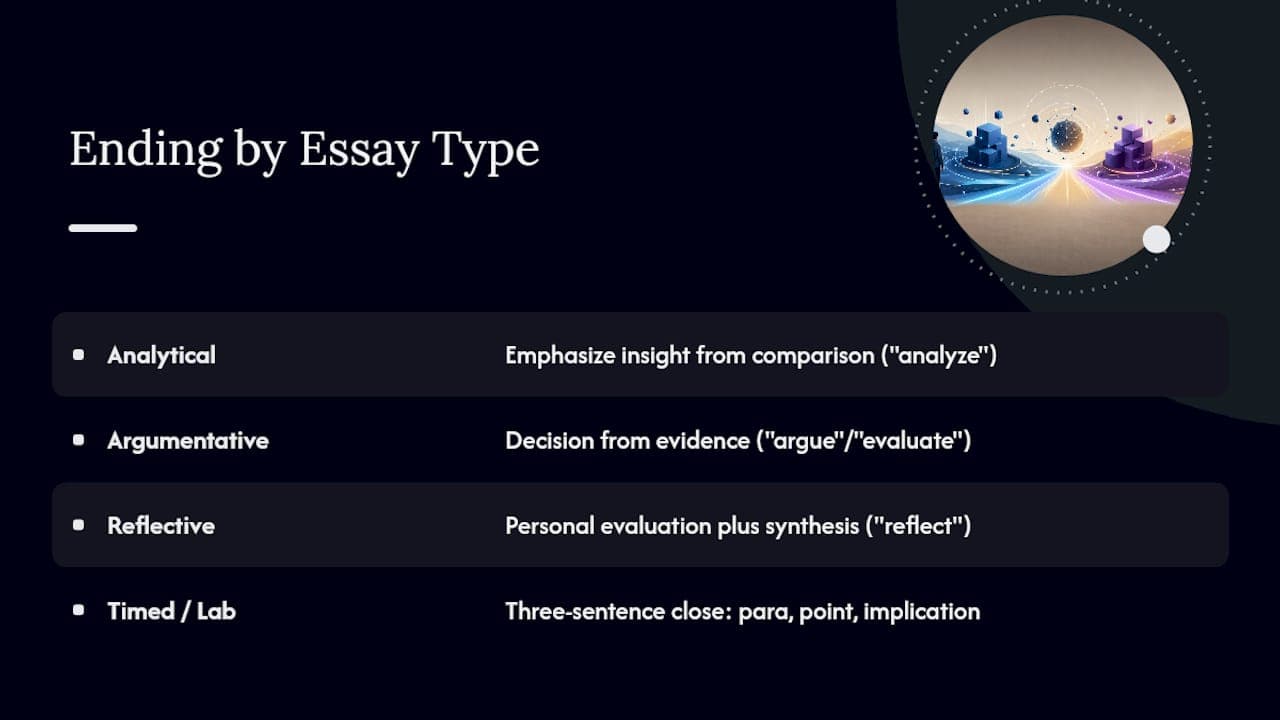
Analytical essays (most literature and history assignments) want you to emphasize the insight the comparison produces, not a verdict. Your job is to show the reader something they didn't see before you laid the two subjects side by side.
Argumentative essays need a clear decision that grows out of your synthesis. State which option is stronger, more effective, or more defensible, and explain why, without ever writing "I think" or "In my opinion." The stance should sound like a conclusion drawn from evidence, not a personal preference.
Reflective or personal-response assignments allow more cautious personal evaluation. You can say what the comparison meant to you, but the synthesis still needs to be there. A reflection that's all feeling and no comparison isn't doing the assignment.
Timed essays, lab reports, and finals reward the compressed three-sentence version: paraphrase, one synthesized point, one implication. Save the fourth "closing thought" sentence for take-home work where you have room to develop nuance.
Pro Tip: If you're not sure which tone your assignment wants, check the verb in your prompt. "Analyze" wants insight. "Argue" or "evaluate" wants a stance. "Reflect" wants evaluation with some personal voice mixed in.
University writing centers agree on the basics: synthesize instead of summarize, skip clichéd transitions, and run every draft through the "so what" test before you call it finished. If your conclusion doesn't change how the reader sees the topic, it hasn't done its job yet.
When you want help getting from checklist to finished paragraph, a few tools handle different parts of the process:
Use tools for structure and phrasing. Rely on instructor feedback for whether your specific argument and evidence choices actually hold up. The two aren't interchangeable.
The advice students get most often, "restate your thesis and summarize your points," is technically correct and mostly useless. It's the reason so many compare-and-contrast conclusions read like a shrinking echo of the intro.
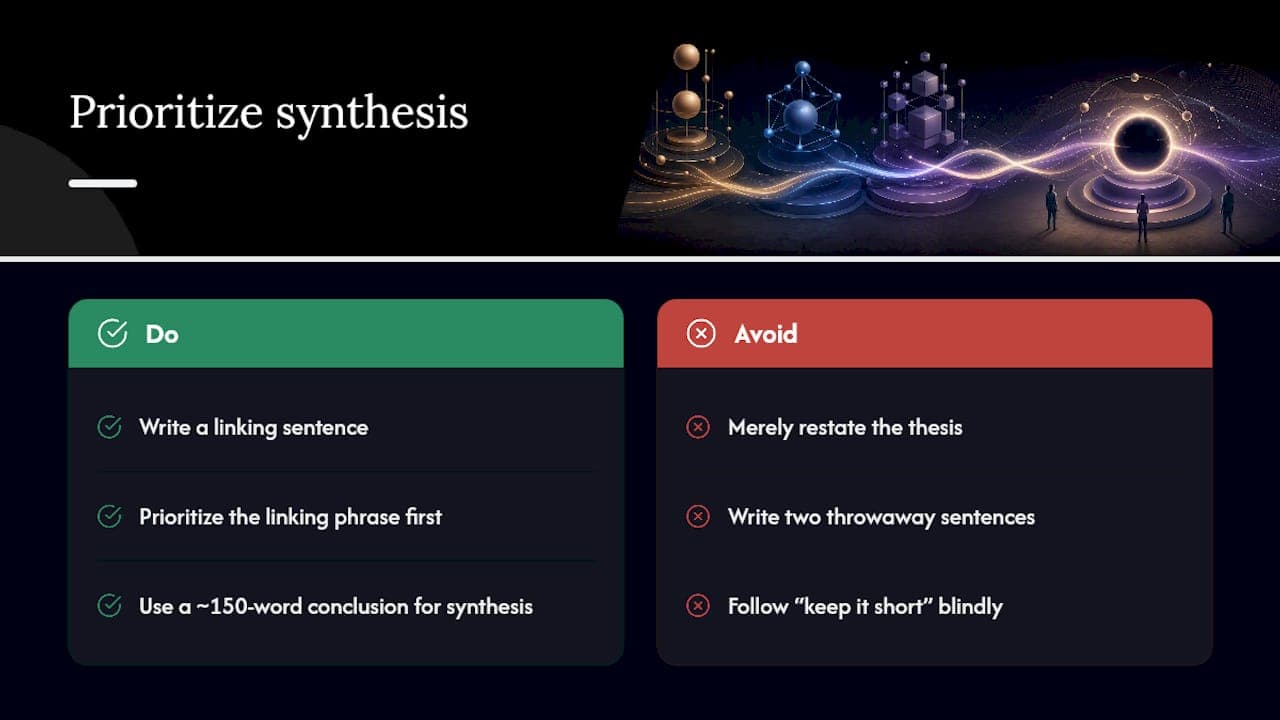
Here's what I'd prioritize if you only have time to fix one thing: learn to write the linking phrase. "Because X and Y share this, they suggest..." or "Together these differences show..." That single sentence habit does more for your conclusion than any amount of thesis-polishing.
The other place conventional advice falls short is length guidance. Students hear "keep it short" and write two throwaway sentences. A 150-word conclusion has room for real synthesis, not just a restatement. Use the space you're given.
— Tilen
Staring at a blinking cursor after finishing your body paragraphs is its own special kind of stuck. Guided Essays builds your comparison structure from the outline forward, so by the time you reach the final paragraph, your thesis and key points are already organized and ready to synthesize instead of scattered across a dozen open tabs.

Power Editor targets just your conclusion paragraph if the rest of your essay is already written, tightening a thesis restatement or reworking a flat summary into real synthesis, and every draft runs through plagiarism-safe generation so the wording stays your own. You can test the workflow on a real assignment before committing to anything larger. If your comparison essay is due and the ending isn't cooperating, start with Samwell and get the conclusion finished tonight.



