Loading...
Citing images in academic papers often trips up students and researchers, especially when navigating APA format requirements. The confusion typically centers on whether to use traditional author-date citations or figure callouts, and how to properly attribute sources in figure notes. This guide walks you through each step of APA image in-text citation with clarity, providing concrete examples and expert tips to ensure your papers meet rigorous academic standards while avoiding common pitfalls that lead to citation errors.
| Point | Details |
|---|---|
| Figure callouts only | Reproduced images are cited in text by their figure number rather than with parenthetical author year citations. |
| Figure notes carry sources | Source attribution for reproduced images appears in the figure note beneath the image, not in running text. |
| Own images labeled no citation | Your own images should be labeled as figures but do not require a source citation in the note. |
| Figure formatting sequence | Follow the sequence Figure X in bold flush left, italic title, the image, and a note with attribution if reproduced or adapted. |
When you include images in your APA-formatted paper, the citation method differs significantly from standard text citations. All figures must be mentioned by their number as a callout rather than using vague references. This means writing "Figure 1 shows the distribution of responses" instead of "the figure above demonstrates" or "as seen below."
The primary in-text citation for reproduced images is the textual callout to the figure number, with source attribution appearing in the note beneath the image itself. You do not insert (Author, Year) parenthetical citations in your running text when discussing reproduced figures. This approach keeps your writing clean while maintaining proper attribution standards.
Think of figure callouts as navigation markers that guide readers to specific visual evidence. When you write "As shown in Figure 3, the correlation between variables is strong," you create a direct link between your analysis and the supporting image. This method eliminates ambiguity and ensures readers can quickly locate the visual data you reference.
Key rules for figure callouts:
Pro Tip: Create a master list of all figures in your paper before writing. This prevents numbering errors and helps you plan where each callout will appear in your text, ensuring smooth integration of visual evidence throughout your argument.
Understanding this distinction between callouts and traditional citations becomes especially important when working with complex papers containing multiple images. The image in text citation guide offers additional strategies for managing various citation scenarios across different academic contexts. Proper callout usage improves both readability and compliance, making your research more accessible to readers while meeting strict APA standards.
Once you understand callouts, the next step involves properly formatting the figures themselves. The figure setup follows a specific structure: bold "Figure X" flush left at the top, an italic title directly below, the actual image, and finally a note with attribution if the image comes from an external source. Each element serves a distinct purpose in helping readers understand and properly credit visual content.
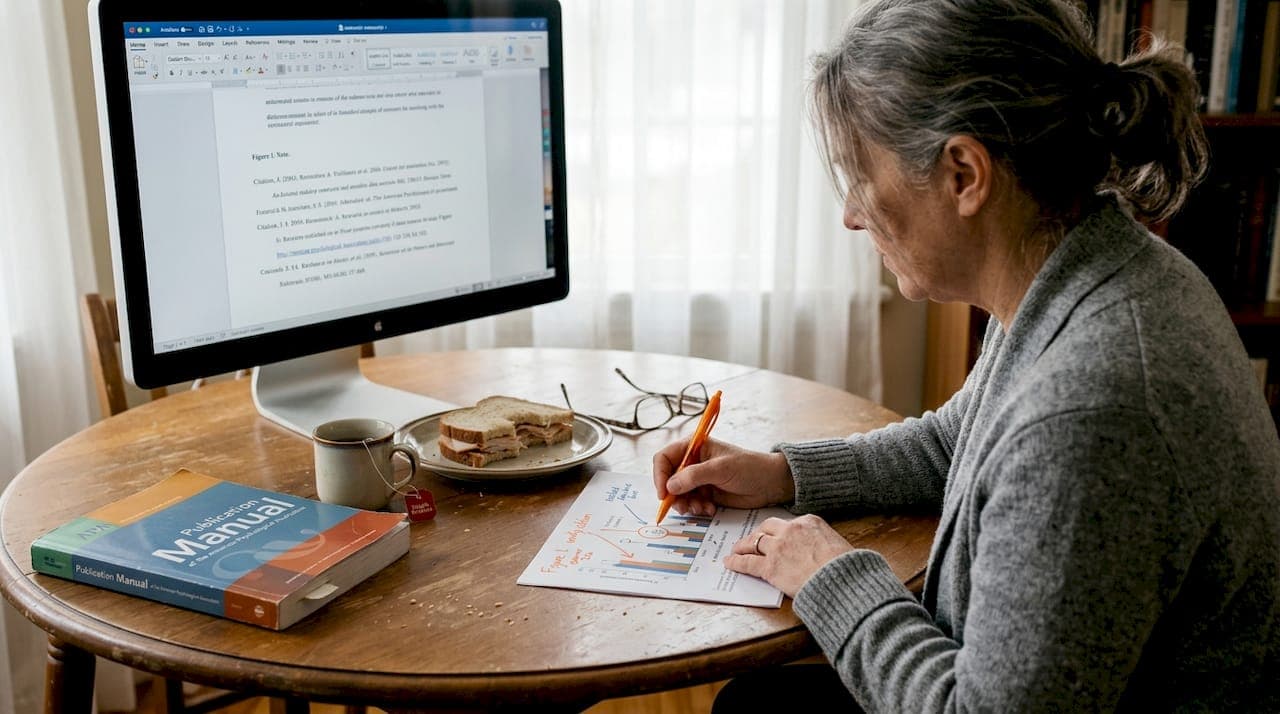
The figure label and number appear in bold without a period. Directly underneath, you write a brief but descriptive title in italic font that explains what the image shows. The image itself sits below the title, sized appropriately for clarity. If you reproduced the image from another source, you must include a note below the image providing attribution in the figure note, not in your running text.
Complete formatting sequence:
The note section requires careful attention to detail. Start with "Note." in italics, followed by any explanatory information about the figure. If you reproduced the image exactly as it appeared in the original source, begin the attribution with "From" followed by the title and source information. For modified images, use "Adapted from" to indicate changes you made. This distinction matters because it signals to readers whether they are viewing original content or your interpretation.
| Figure Element | Format | Example |
|---|---|---|
| Label | Bold, flush left | Figure 1 |
| Title | Italic, descriptive | Distribution of Survey Responses by Age Group |
| Image | Centered or flush left | [actual image] |
| Note | Italic "Note.", then attribution | Note. From "Survey Results," by J. Smith, 2025, Journal Name, 15(3), p. 42. |
Pro Tip: When creating figure notes, copy the exact reference format you will use in your reference list, then adapt it slightly for the note format. This ensures consistency and reduces the chance of formatting errors between your figure notes and reference list.
You can explore the APA 7th edition essay example for visual demonstrations of properly formatted figures within complete papers. Additionally, the APA style appendix guide covers situations where you might place figures in appendices rather than the main text, offering flexibility for papers with extensive visual content that might disrupt narrative flow.
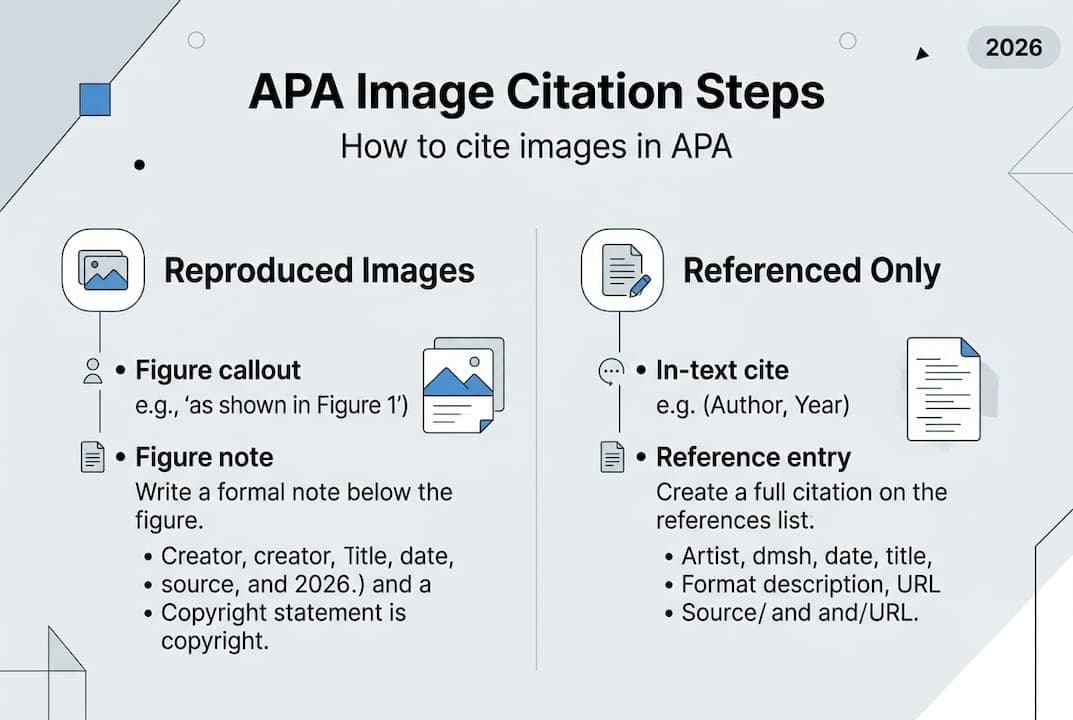
Not every image you reference needs to appear in your paper. When you discuss an image without reproducing it, images not reproduced use standard in-text author-date citations and require a full reference list entry. This approach treats the image like any other source material you cite but do not directly quote or display.
For example, if you write about a famous photograph without including it in your paper, you would cite it as (Photographer, Year) in your text and provide complete publication details in your reference list. This method acknowledges the source while keeping your paper focused on analysis rather than visual reproduction.
Stock images and clip art present unique challenges. Stock images require license checks because attribution requirements vary based on the license type and any modifications you make. Some stock image licenses require full attribution even for purchased images, while others grant broad usage rights without citation requirements. Always verify license terms before including stock imagery in academic work.
Citation approaches for different image types:
Your own images require labeling as figures but need no citation or note because you created the content. Simply format them with the standard figure label and descriptive title. This applies to photographs you took, charts you generated from your own data, diagrams you created, and any other visual content you produced specifically for your research.
| Image Source | In-Text Treatment | Figure Note Required | Reference List Entry |
|---|---|---|---|
| Reproduced from publication | Figure callout | Yes, with attribution | Yes |
| Discussed but not shown | (Author, Year) | No | Yes |
| Your own creation | Figure callout | No | No |
| Stock (license requires attribution) | Figure callout | Yes, with source and license | Depends on license |
| Stock (no attribution required) | Figure callout | Optional | No |
The distinction between "From" and "Adapted from" in figure notes carries significant weight. Use "From" when you reproduce an image exactly as it appeared in the original source, maintaining all elements without changes. Choose "Adapted from" when you modify the image in any way, such as cropping, adding annotations, changing colors, combining multiple images, or extracting specific elements. This transparency helps readers understand the relationship between your figure and the original source.
For comprehensive guidance on various in-text citation scenarios beyond images, the APA how to cite in text guide provides detailed examples across multiple source types, helping you maintain consistency throughout your academic writing.
Even experienced researchers make mistakes with image citations. The most frequent error involves using vague positional references instead of specific figure callouts. Writing "the chart below" or "as seen in the image above" violates APA standards and creates confusion, especially in digital formats where page breaks shift based on device and font size.
Another common mistake occurs when students number figures incorrectly or inconsistently. Figures must be numbered consecutively in the order they first appear in your text. If you mention Figure 3 before Figure 2, you need to renumber them. Every figure callout in your text must match exactly with a corresponding labeled figure, and the numbers must follow sequential order without gaps.
Omitting figure notes for reproduced images represents a serious citation violation. If image data is transformed, you must include both the standard author-date citation in your text and a figure note below the image. This dual citation approach applies when you reanalyze data from an image, extract specific elements, or present the information in a new format while building on someone else's original work.
Critical mistakes to avoid:
License verification deserves special attention because verifying licenses carefully prevents compliance issues that could affect your paper's integrity. Before using any stock image, read the license agreement thoroughly. Some licenses restrict academic use, require attribution even for paid images, or prohibit modifications. Violating these terms creates both ethical and potentially legal problems.
Pro Tip: Create a citation checklist specifically for figures before submitting your paper. Verify that every figure has a bold label, italic title, proper callout in text, and appropriate note if reproduced from another source. This systematic review catches errors that are easy to miss during regular proofreading.
Consider this expert perspective on maintaining citation accuracy:
"The key to flawless figure citations lies in treating each image as seriously as you would a direct quotation. Just as you would never present someone else's words without attribution, visual content demands the same rigorous citation standards. A well-cited figure demonstrates both your research integrity and your commitment to giving proper credit to original creators."
When you transform image data through reanalysis or reinterpretation, the citation requirements change. You must provide both the figure note acknowledging the original source and an in-text author-date citation in your running text where you discuss your analysis. This dual approach clarifies that while the underlying data came from another researcher, your interpretation and presentation represent original analytical work.
The APA format student paper guide 2025 offers comprehensive coverage of all formatting elements, including detailed sections on integrating figures seamlessly into your paper structure while maintaining proper citation standards throughout your document.
Mastering APA image citations represents just one aspect of producing high-quality academic papers. After learning these citation rules, you might wonder how to streamline the entire writing process while ensuring every element meets rigorous academic standards. Samwell AI offers powerful tools designed specifically for students and researchers who need to create well-formatted, properly cited papers efficiently.
Our research paper generator helps you develop comprehensive papers with correct APA formatting from the start, including proper figure integration and citation. The platform ensures compliance with APA 7th edition guidelines while you focus on developing your arguments and analyzing your sources. You can specify your citation requirements, and the system automatically formats figures, notes, and references according to current standards.

The enhanced essay creator takes your writing further by offering targeted editing suggestions and content expansion options. Whether you need to strengthen your analysis, improve transitions between sections, or ensure your figure callouts integrate smoothly with your text, these tools provide intelligent support that respects academic integrity while boosting efficiency. With over 1,000,000 students and professionals already benefiting from Samwell AI, you can join a community committed to excellence in academic writing.
Modified images require careful citation that acknowledges both the original source and the changes you made. If image data is transformed, include a standard author-date citation in your running text where you discuss your modifications, plus a figure note below the image starting with "Adapted from" instead of "From." This dual approach clarifies the relationship between the original work and your version. The figure note should specify what modifications you made, such as "Adapted from [original source], with annotations added" or "Adapted from [original source], cropped to show detail."
When you reference an image without reproducing it in your paper, treat it like any other cited source. Images not reproduced use standard in-text author-date citations such as (Photographer, Year) or (Artist, Year) within your text where you discuss the image. Include a complete reference list entry with all publication details, just as you would for a book or journal article you cite but do not quote directly. This approach maintains proper attribution while keeping your paper focused on analysis rather than visual reproduction.
Your original images do not require citation because you created the content. Own images require labeling as figures with the standard bold "Figure X" label and an italic descriptive title, but you omit both the figure note and reference list entry. This applies to photographs you took, charts generated from your own data collection, diagrams you created, and any other visual content you produced specifically for your research. The figure formatting helps organize your paper, but no external citation is needed for your original work.
Attribution requirements for stock images depend entirely on the specific license agreement. Some stock image licenses require full attribution regardless of whether you paid for the image, while others grant broad usage rights with no citation needed. Always read the license terms carefully before using stock imagery in academic work. If attribution is required, include it in the figure note below the image with source and license information. When in doubt, providing attribution demonstrates good academic practice even if the license does not strictly require it, showing respect for the original creator's work.