Loading...

TL;DR:
- Cite a specific chapter in APA when authored by different people from the book's editors.
- APA chapter citation format includes author(s), year, chapter title, editors, book title, pages, publisher, and DOI or URL.
- Proper citations improve credibility by enabling readers to locate the exact source accurately.
Getting a citation wrong feels minor until your professor circles it in red and knocks off points you worked hard to earn. APA chapter citations trip up even experienced researchers because the rules are specific, the formatting is unforgiving, and the difference between citing a chapter and citing a whole book is easy to overlook. This guide walks you through every element of a correct APA chapter citation, from understanding when to use one to handling tricky edge cases like missing DOIs and e-books. Follow these steps and your reference list will reflect the same rigor your research deserves.
| Point | Details |
|---|---|
| Distinguish citation type | Cite the chapter’s author for book chapters and the editor for whole edited books. |
| Follow APA 7th format | Use sentence case for chapter titles, italics for book titles, page range, and include DOI or URL as needed. |
| Handle special cases | Apply et al. for 3+ authors in-text and list up to 20 in references; adapt formatting for missing DOIs or database e-books. |
| Verify before submitting | Cross-check every citation element with official examples to ensure accuracy and avoid common errors. |
After understanding the importance of accurate citations, you'll need to know when it's necessary to cite a chapter, not just the whole book. This distinction trips up a surprising number of students, and getting it wrong signals a gap in your research literacy to any instructor or peer reviewer reading your work.
The core rule is straightforward. When a book is an edited collection where different authors wrote each chapter, you cite the specific chapter, not the entire volume. When a single author or group of authors wrote every chapter in the book, you cite the whole book as one unit. The APA 7th edition is clear on this: you must distinguish a chapter in an edited book, where you cite the chapter author, from a whole edited book, where you cite the editors as authors.
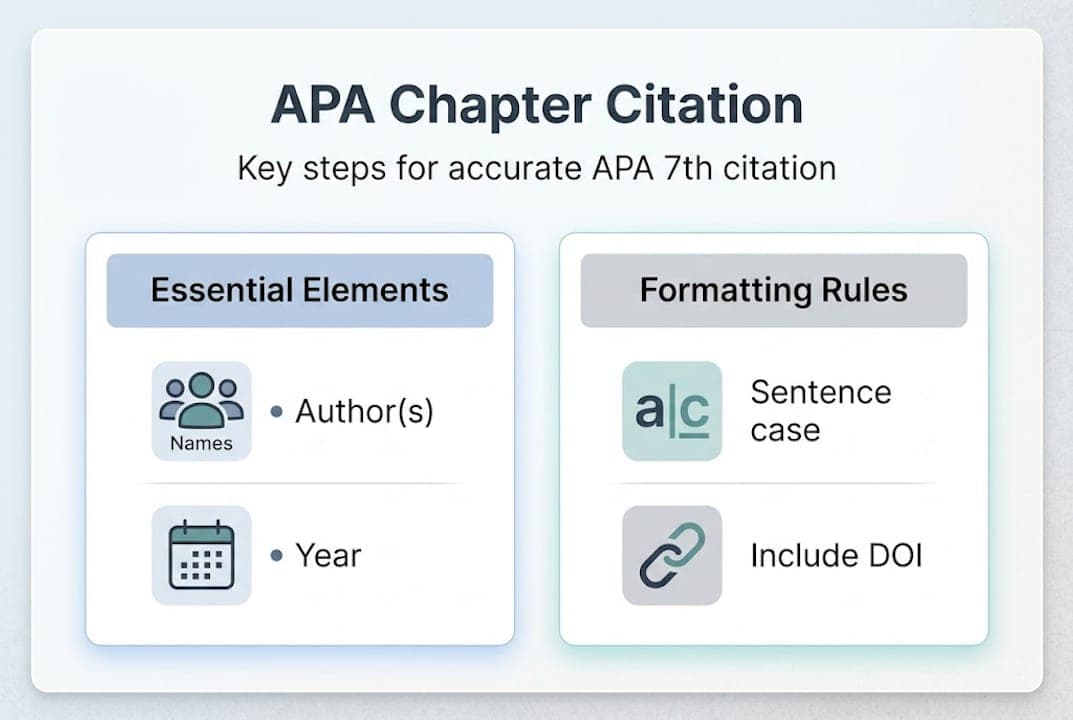
Here is why this matters practically. Imagine you are writing a paper on trauma-informed classroom strategies and you found a valuable chapter by Dr. Asha Patel in an edited volume on school psychology. Citing only the book's editors would mislead your reader into thinking the entire book makes your specific argument. It also fails to credit Dr. Patel for her intellectual contribution. Proper chapter citation protects authorship, supports traceability, and gives your reader an exact path back to your source.
You should cite a specific chapter in APA format in these situations:
Beyond accuracy, chapter citations also strengthen your academic credibility in a visible way. A well-constructed reference list demonstrates that you understand how knowledge is organized and attributed in your field. Reviewers and instructors recognize the difference between a student who cites a whole book lazily and one who tracks down the precise chapter with the correct author, page range, and publication details.
"A reference list is a communication tool. Every element tells the reader something about the source. A sloppy reference signals a sloppy researcher."
For further context on how APA structures its broader reference system, the APA references guide breaks down how different source types are treated and why the distinctions exist. Understanding the logic behind the rules makes them far easier to apply consistently.
Knowing when to cite a chapter, the next step is learning the precise structure APA 7th edition requires. Every element in the citation has a defined role, and skipping or misplacing even one can make it harder for your reader to locate your source.
The standard APA 7th edition format for a chapter in an edited book is:
Author, A. A., & Author, B. B. (Copyright Year). Title of the book chapter. In A. A. Editor & B. B. Editor (Eds.), Title of the book (2nd ed., pp. #–#). Publisher. DOI or URL

Here is what each piece does:
| Element | Format rule | Example |
|---|---|---|
| Chapter author(s) | Last name, initials | Zeleke, W. A. |
| Publication year | In parentheses | (2020) |
| Chapter title | Sentence case, no italics | Home school collaboration |
| Editors | Initials then last name, in "In ... (Eds.)," | In C. Maykel & M. A. Bray (Eds.) |
| Book title | Sentence case, italicized | Promoting mind body health |
| Edition and page range | Abbreviated | (2nd ed., pp. 11–26) |
| Publisher | Name only, no location | American Psychological Association |
| DOI or URL | No period at end | https://doi.org/... |
A few of these rules catch people off guard. First, the chapter title uses sentence case, meaning you capitalize only the first word and any proper nouns. It is not italicized. Many students italicize both the chapter and book titles, which is incorrect. According to the University of Auckland APA 7th guide, the chapter title is in sentence case and not italicized, while the book title is italicized in sentence case, and the page range uses "pp." with no publisher location included.
Second, APA 7th edition removed the requirement to include the publisher's city and country. You no longer write "New York, NY:" before the publisher name. Just the publisher name alone is correct.
Third, always include the DOI when one is available. If the source has no DOI, include a URL only if the e-book is publicly available outside a database. Do not place a period after the DOI or URL because it can break the link.
Pro Tip: Copy the DOI directly from the article or book page and paste it in the format https://doi.org/xxxxx rather than using the doi.org shortcut alone. This ensures the link resolves correctly when your reader clicks it.
Understanding the full logic of APA formatting becomes easier with a guided walkthrough. The APA citation tutorial at Samwell offers step-by-step examples for multiple source types, which can reinforce what you have just learned here.
Once you know the format, let's build an APA chapter citation from scratch using real examples. Walking through each step one at a time removes the guesswork and shows you exactly where each detail goes.
Here is the official APA example we will use as our reference point:
Zeleke, W. A., Hughes, T. L., & Drozda, N. (2020). Home school collaboration to promote mind body health. In C. Maykel & M. A. Bray (Eds.), Promoting mind body health in schools: Interventions for mental health professionals (pp. 11–26). American Psychological Association. https://doi.org/10.1037/0000157-002
Now let's break it down step by step:
Write the chapter author(s) last name first. Start with the last name, then a comma, then initials separated by periods. Multiple authors are separated by commas, with an ampersand before the final author. For this example: Zeleke, W. A., Hughes, T. L., & Drozda, N.
Add the publication year in parentheses. Place it immediately after the authors, followed by a period. Example: (2020).
Write the chapter title in sentence case with no italics. Only capitalize the first word and any proper nouns. End with a period. Example: Home school collaboration to promote mind body health.
Introduce the editors with "In." Write the word "In" followed by editor initials and last name, then "(Eds.)," with a comma after. Example: In C. Maykel & M. A. Bray (Eds.),
Italicize the book title in sentence case. Include a subtitle after a colon if applicable. Example: Promoting mind body health in schools: Interventions for mental health professionals
Add the edition and page range in parentheses. Use "pp." for multiple pages. If it is the first edition, omit the edition note. Example: (pp. 11–26).
List the publisher name only. No city, no country, no colon. End with a period. Example: American Psychological Association.
Add the DOI or URL without a trailing period. Example: https://doi.org/10.1037/0000157-002
Before you submit, run through this quick checklist:
| Checklist item | Done? |
|---|---|
| Chapter author listed with last name first | Yes / No |
| Year in parentheses followed by period | Yes / No |
| Chapter title in sentence case, not italicized | Yes / No |
| Editors introduced with "In" and "(Eds.)," | Yes / No |
| Book title italicized in sentence case | Yes / No |
| Page range uses "pp." | Yes / No |
| Publisher listed with no location | Yes / No |
| DOI or URL present with no trailing period | Yes / No |
For your in-text APA citation that corresponds to this reference, you would write (Zeleke et al., 2020) since the chapter has three authors. The reference list entry and the in-text citation must always match.
Even with the format mastered, unusual cases can appear, so here's how to tackle them using APA rules. Knowing the standard format is step one. Handling real-world complexity is where citations actually get tested.
Multiple authors and the et al. rule
The rules for authors in APA 7th edition are layered. In-text, if the chapter has three or more authors, you use et al. in every citation, including the first one. So (Zeleke et al., 2020) is correct even the first time you reference the chapter. According to the APA Classroom Poster, for three or more chapter authors, you use et al. in all in-text citations but list up to 20 authors in the reference entry. If there are 21 or more authors, list the first 19, add an ellipsis, and then give the final author's name.
Here is a quick summary of common challenges and how to handle them:
Pro Tip: When searching databases like PsycINFO or EBSCO, check the record for a DOI even if the PDF does not show one. Many database records include a DOI field that the document itself omits.
For a full-length paper example showing how these citations appear in context, the APA essay example at Samwell is worth reviewing. If you encounter sources with no clear date, the APA citation with no year guide explains exactly what substitutions to make.
Now that you know how to handle every scenario, it is worth understanding what sets standout citations apart from ones that merely meet the minimum.
Most students treat citation as a compliance task. They follow the rules well enough to avoid losing marks, then move on. But researchers who build genuinely strong reference lists understand something different: every citation is a precision instrument. It must be accurate enough that any reader, anywhere, can locate the exact source you used.
The APA 7th edition guidelines do not exist to create bureaucratic friction. They exist because ambiguous or incomplete citations erode trust in research. A missing page range or a wrong editor initial means someone trying to verify your claim might fail. That failure reflects on your credibility, not just your formatting.
The researchers who earn the highest marks are not always the ones who wrote the most or cited the most. They are the ones whose reference lists are clean, consistent, and complete. Every entry follows the same logic. Every DOI resolves. Every author name matches the source document. Building citations with that level of care is a skill, and it signals scholarly maturity to anyone reading your work. Making citations part of your process from the start, rather than a rushed final step, is what separates adequate from excellent. A well-structured APA citation list built with intention throughout the writing process will always outperform one assembled at the last minute.
Formatting every citation element by hand is time-consuming, and a single misplaced period can cost you points. Samwell.ai is built specifically for students and researchers who want accurate, APA-compliant references without spending hours double-checking every field.
The Samwell citation generator handles chapter citations, in-text references, and full reference lists in APA 7th edition format, so you can focus on the substance of your argument rather than the mechanics of formatting. If you want to understand the deeper reasoning behind citation rules before using any tool, the guide on why citation matters explains how proper attribution shapes academic integrity. Samwell combines guided writing with built-in citation support so your references are always ready when your paper is.
List all authors up to 20 in the reference entry. In your in-text citations, the APA rule is to use et al. for three or more authors in every in-text citation, including the first one.
Include the DOI whenever one is available. Per the APA reference guide, for a print or e-book without a DOI from an academic database, omit the URL entirely; for e-books available on other public sites, include the URL.
Italicize the book title only. The University of Auckland guide confirms the chapter title is in sentence case and not italicized, while only the book title receives italics.
Citing a chapter credits the chapter's specific author and points readers to a precise section. As the APA 7th edition makes clear, when citing a chapter in an edited book you cite the chapter author, but when citing a whole edited book you cite the editors as authors.