Loading...

TL;DR:
- References connect research to verified knowledge, signal credibility, and enable source verification.
- Proper citation style use reflects discipline priorities and aids in source verification.
- Responsible referencing involves reading sources fully, matching citations accurately, and avoiding citation errors.
References rarely get the credit they deserve. Most students treat them as the last step in finishing a paper, a formatting chore to handle after the real thinking is done. But citations in research do something far more fundamental: they connect your work to an entire ecosystem of verified knowledge, signal scholarly credibility, and determine how seriously your argument will be taken. This article breaks down what references actually accomplish, how citation styles enforce transparency, where automated reference systems fall short, and how to build referencing habits that genuinely strengthen your research.
| Point | Details |
|---|---|
| References serve four critical roles | They give credit, build authority, provide context, and ensure claims are traceable to sources. |
| Citation style impacts verification | Choosing the correct style ensures readers can easily check evidence and supports research transparency. |
| Reference databases have limits | Automated indexers miss some references, so citation counts should be interpreted with care. |
| Responsible citation is essential | Maintain accurate, one-to-one correspondence between in-text citations and reference lists. |
| References are a foundation | Treat referencing as part of your research design, not an afterthought, for genuine academic success. |
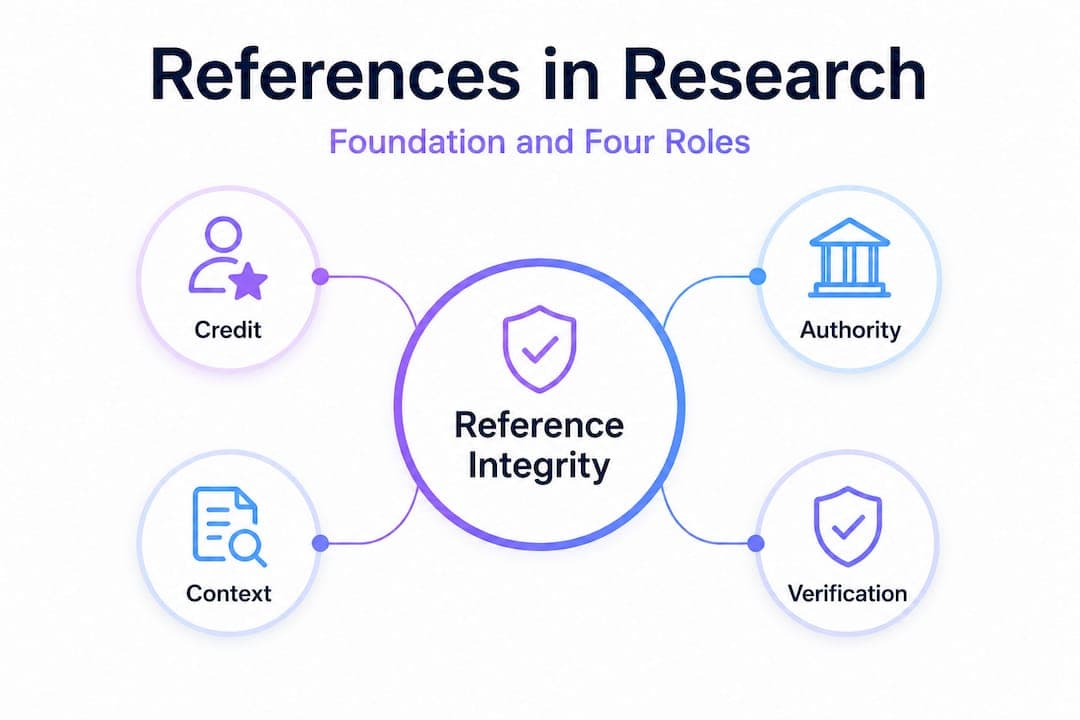
Establishing the bigger picture, let's clarify exactly what references achieve within academic research. Most people think of citations as a way to avoid plagiarism, and while that is true, it is only a fraction of the story. Why do researchers cite? According to library researchers at the University of Washington, references in scholarly writing primarily serve four distinct communication functions:
Each of these functions serves a different audience. Your instructor or journal reviewer cares about authority and credit. Future researchers care about traceability. The broader academic community cares about context. A well-referenced paper satisfies all four simultaneously.
"Trustworthiness of research findings depends on more than venue-level proxies such as journal impact factors or citation counts. It requires transparent, verifiable, and reproducible documentation of how evidence was gathered and represented."
This quote from a trustworthiness framework published in PNAS underscores a point that often gets lost: credibility is not automatic. A paper published in a prestigious journal is not automatically trustworthy. Trustworthiness is built through the specific decisions researchers make, including how completely and accurately they document their sources.
One practice that directly undermines trustworthiness is mismatched citations. This happens when a reference appears in the reference list but is never cited in the text, or when an in-text citation has no corresponding reference entry. Both errors signal carelessness to reviewers and make it impossible for readers to trace your evidence chain. The standard to aim for is a strict one-to-one correspondence: every in-text citation must match a reference list entry, and every reference list entry must be cited in the text.
For students, finding trustworthy references is itself a research skill. Peer-reviewed journal articles, books from academic publishers, and government or institutional reports are generally reliable starting points. The source you cite reflects on you as a researcher, so the selection process deserves the same rigor as any other methodological decision.
Now that we know why references matter, how you cite them is just as important. Let's unpack citation styles and their deeper significance.
Different citation style families exist because different academic disciplines prioritize different kinds of evidence verification. Different citation methodologies reflect fundamentally different approaches to locating and confirming evidence, not just aesthetic preferences. The three most commonly used style families are APA, MLA, and Chicago, and each encodes a specific scholarly value.
APA (American Psychological Association) emphasizes the date of publication prominently, because in the sciences and social sciences, the recency of data matters enormously. A psychology study from 2005 might already be outdated by 2026 standards. The author-date in-text format (Smith, 2023) lets readers immediately assess whether a source is current.
MLA (Modern Language Association) is used primarily in humanities, where the exact page number matters more than the date. Literary scholars often analyze specific passages, so pinpointing the location of evidence is central to the format. The in-text citation (Smith 42) points directly to page 42.
Chicago Style offers two tracks: the Notes and Bibliography system (common in history and arts) and the Author-Date system (common in sciences). The notes system allows scholars to include explanatory footnotes alongside citations, which is valuable in disciplines where source context is as important as the source itself.
| Citation style | Primary discipline | In-text format | Key emphasis |
|---|---|---|---|
| APA 7th edition | Social sciences, education, psychology | Author, year | Recency of publication |
| MLA 9th edition | Literature, humanities | Author, page | Exact location of evidence |
| Chicago Notes | History, arts, some humanities | Footnote number | Contextual sourcing |
| Chicago Author-Date | Sciences, social sciences | Author, year | Publication date |
| IEEE | Engineering, computer science | Numbered [1] | Sequential citation order |
The importance of citation styles goes beyond aesthetics. When you use the wrong style, or apply it inconsistently, you make it harder for readers to verify your sources efficiently. A reviewer who works with APA daily will notice immediately if you place the date at the end of an entry rather than after the author's name.
Knowing common citation formats in detail also helps you identify errors in published work, which is a genuinely useful critical reading skill.
Pro Tip: Always check your target journal's author guidelines or your instructor's syllabus for the required citation style before you write a single word. Switching styles mid-draft is time-consuming and error-prone.
With style and citation method understood, it is essential to recognize the real-world limits of reference technology and discovery systems.
Most students and researchers assume that databases like Google Scholar, Crossref, Scilit, or Semantic Scholar give complete and accurate citation data. The reality is messier. Reference extraction and citation networks are not indexed equally across databases, and empirical analyses have found significant variation in coverage, especially for non-article sources.

Here is where real problems emerge:
Book chapters and monographs: Most major databases focus on journal articles because they have DOIs (Digital Object Identifiers) that make extraction straightforward. Books and book chapters, especially older ones, are frequently absent or only partially represented. If your reference list leans heavily on seminal monographs in your field, database tools may completely miss them.
DOI-only extraction: Some tools pull citations solely from DOI-linked records, which means any reference published before widespread DOI adoption, or in a venue that does not assign DOIs, may not be found. This creates an invisible gap in automated bibliographies.
Inflated citation counts: Because databases do not always deduplicate records, the same paper can appear multiple times with separate citation tallies. A paper might show 300 citations in one database and 450 in another, not because of genuine difference in impact, but because of indexing methodology.
| Database | Strength | Weakness | Best for |
|---|---|---|---|
| Crossref | Large DOI registry | DOI-dependent extraction | Verifying published DOIs |
| Semantic Scholar | AI-powered extraction | Weaker on humanities | STEM literature |
| Scilit | Broad journal coverage | Limited book indexing | Life sciences |
| Google Scholar | Widest coverage | Accuracy issues, preprints | Quick discovery |
| Web of Science | High quality peer-reviewed | Subscription required | Impact analysis |
The critical takeaway is this: citation counts are not a proxy for research quality. A paper with 2,000 citations might be highly cited because it is foundational, or because it introduced a concept that was later disproven. Conversely, a paper with 50 citations might represent the gold standard in a niche subfield. The risks in academic referencing increase when people rely on automated metrics without checking the underlying evidence.
Always read the sources you cite. This sounds obvious, but a surprising number of citation errors trace back to researchers citing a paper based only on its abstract, or worse, based on how another author described it. If you cite a source you have not read in full, you risk misrepresenting its findings, which is an integrity issue that no citation style can fix.
Appreciating the complexities of referencing systems, here is how to anchor your own work to best-in-class academic standards.
Responsible referencing is a workflow, not a final step. Treating references as part of the method and integrity workflow rather than an afterthought is one of the most concrete ways to improve research quality. Here is a numbered checklist to follow:
What to actively avoid is just as important. Citation padding, which means adding references to inflate the list without actually engaging with the sources, is an integrity violation that reviewers notice. Inaccurate quoting, such as changing a few words without indicating paraphrase, misrepresents the original author's meaning. And mismatched references, where the cited text does not support the claim made, undermine every argument you build on it.
For more structured guidance, how to cite sources correctly in academic writing is a practical reference that covers format-specific rules across disciplines. If you work regularly with published research, this step-by-step citation guide covers everything from DOI formatting to handling multiple authors. For undergraduate work, this citation guide for essays is a reliable starting point.
Pro Tip: Keep a running reference log in your notes app or reference manager as you draft. Record full source details, including author, title, publication, year, and URL or DOI, the moment you encounter a useful source. Reconstructing references at the end is how errors creep in.
Stepping back, let's consider the real impact of references on how research is perceived and how scholars succeed.
Here is a perspective that most citation guides skip entirely. References do not just support your argument; they actually clarify your own thinking. When you are required to find a credible source for every major claim, you are forced to examine whether that claim is actually supported by evidence or whether it is just something you assumed. This pressure is uncomfortable and it is precisely what makes it valuable.
The conventional approach is to write the paper first and attach references at the end. But that sequence is backwards. Research built on a solid reference architecture, where you map out the key claims and identify your strongest sources before drafting, is more logically coherent. Your argument does not drift because each major point is anchored to verifiable evidence from the start. Your literature review is faster because you have already organized your sources by theme. And critical reviewers have fewer weak points to attack.
Reviewers and journal editors, whether for academic journals or course submissions, judge research soundness in large part by how well it engages with existing scholarship. A paper that cites only recent sources in a field with a rich older literature looks shallow. A paper that cites only older sources in a fast-moving field looks out of date. Reference discovery strategies that balance recency and foundational scholarship signal that you understand your field's intellectual history and its current direction.
The uncomfortable truth is that weak referencing is not just a formatting problem. It is a signal about how carefully you did your research. Strong referencing, by contrast, does something positive: it shows the reader exactly why they should trust you.
Managing references accurately across a long research paper is genuinely difficult. For students and professionals who want to meet high academic standards without spending hours on manual formatting checks, the right tools make a real difference.
Samwell.ai's enhanced essay creator is built specifically for this challenge. It handles citation generation across major styles including APA, MLA, and Chicago, while its Semihuman.ai technology ensures that content meets originality standards. The platform's Power Editor lets you expand specific sections and improve citation density in targeted areas, and its real-time AI detection check means your work stays aligned with academic integrity requirements. Over one million students and researchers from leading universities use Samwell.ai to produce well-cited, credible academic writing efficiently and without the formatting errors that derail otherwise strong papers.
References give credit to original authors, support claims with authority, contextualize work within existing scholarship, and provide a traceable path so others can verify sources independently.
Select the style required by your discipline, journal, or instructor, since different methodologies reflect different priorities for evidence verification, such as date emphasis in APA versus page emphasis in MLA.
No. Database indexing gaps and extraction inconsistencies mean citation counts across platforms can differ significantly and should not be treated as a direct measure of research quality.
Maintain a strict one-to-one correspondence between in-text citations and your reference list as you write, adding full reference entries in real time rather than reconstructing them at the end.
Many databases rely on DOI-only extraction, which means books, book chapters, and older publications that predate widespread DOI adoption are frequently missing or only partially indexed.