
Loading...

A five-page double-spaced paper runs about 1,250 words at the standard academic default of 12-point font, double spacing, and 1-inch margins. The realistic range is 1,100 to 1,500 words, depending on your font choice and how much space headings, block quotes, or lists eat up. If your assignment leans heavy on citations or subheads, expect the lower end.
TL;DR:
- Changing fonts to wider characters or looser spacing can reduce the words per page by 5% to 20%, affecting your overall word range.
- Block quotes, headings, and references take up space without significantly increasing word count, often lowering your effective word density by 10% to 20%.
- A standard five-page paper typically contains between 1,100 and 1,500 words, with 1,250 words being a common midpoint for most formats.
- Always verify your word count after formatting changes and check whether your assignment emphasizes page count or word count to avoid misalignment.
- Planning and outlining your paper before writing helps manage length, but final formatting and accurate counting ensure you meet the target precisely.
The 250-words-per-page figure isn't arbitrary. It comes straight from the formatting that APA and MLA style guides have used for decades: 12-point Times New Roman, double spacing, and 1-inch margins on all sides. That combination is the default setting in Word and Google Docs for a reason, and it's why the 250 wpg rule shows up in nearly every academic writing guide.
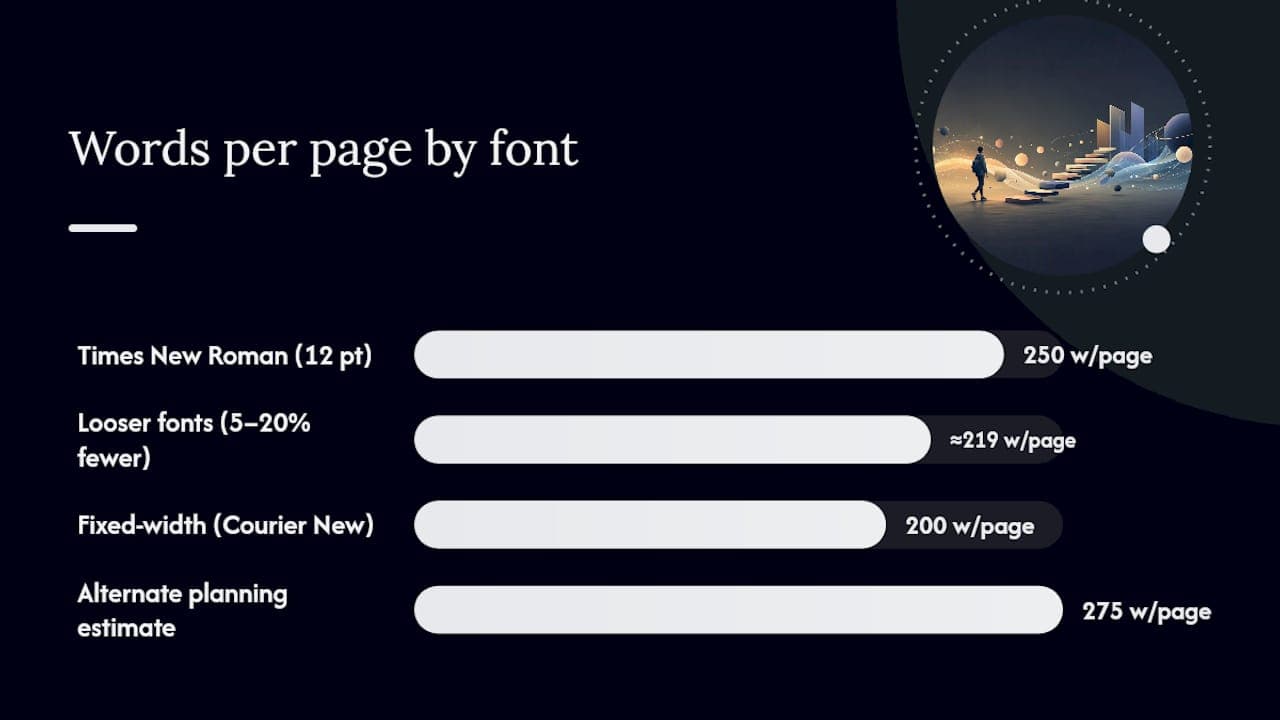
Change the font, and the math shifts. Times New Roman at 12 points gives you roughly 250 words per page. Switch to a font with wider characters or looser spacing, and you'll fit fewer words in the same space, sometimes a swing of 5% to 20% depending on the font's character width and default spacing. Courier New, a fixed-width font that mimics old typewriters, is the most extreme example, packing noticeably fewer words per page than a proportional font like Calibri.
Structural elements matter just as much as font choice. A heading takes up a full line but might only be four words long. A block quote gets indented and often single-spaced within a double-spaced document, which throws off any simple word-per-page math. Bulleted lists leave white space between items. Together, these elements can reduce your effective word density by 10% to 20%, which is exactly why a paper heavy on subheadings and citations tends to land on the lower end of the 1,100 to 1,500 word range.
Before you estimate your page count from a word total, check these formatting details:
Pro Tip: If your assignment includes a lot of block quotes or a long works cited page, plan for the higher end of your word target. Those elements eat page space without adding much to your word count.
Here's how the math plays out across the fonts students use most often, assuming standard letter-size pages, 1-inch margins, and true double spacing:
These numbers assume no headings, no block quotes, and no reference page eating into your five pages. Real assignments rarely stay that clean, so treat the table as a planning tool, not a guarantee.
If you're not sure which font your instructor expects, 1,250 words is a safe midpoint to plan around. It sits close to the Times New Roman estimate, which remains the default font for most academic formatting requirements.
Pro Tip: Some guides suggest 275 words per page as a rounder planning number when you want one figure to work from instead of a range. Either works. The key is checking your actual draft once it's formatted, not trusting the estimate alone.
Estimating is fine for planning. Verifying is what keeps you from turning in a paper that's 200 words short.
Structuring your argument before you draft makes both directions easier. A clear outline shows you where a paper is thin and where it's padded, which beats discovering either problem after you've already written five pages. Samwell's research paper outline examples walk through how to build that structure before you start writing.
Pro Tip: Never trust a word count you checked before your final formatting pass. Fonts, margins, and spacing all shift page count independently of your actual word total.
A rushed first draft on a familiar topic can take 2 to 4 hours. A properly researched, revised paper on a topic you're still learning can run 6 to 12 hours or more, and that gap comes down to how much time you spend finding and reading sources before you write a single sentence.
A workable time-boxed approach looks like this:
Guided outlining tools can shrink that first block substantially, since they push you to define your thesis and structure before you start typing instead of discovering your argument halfway through page three. Guided outlining tools work this way, giving you a structured outline to draft against rather than a blank page.
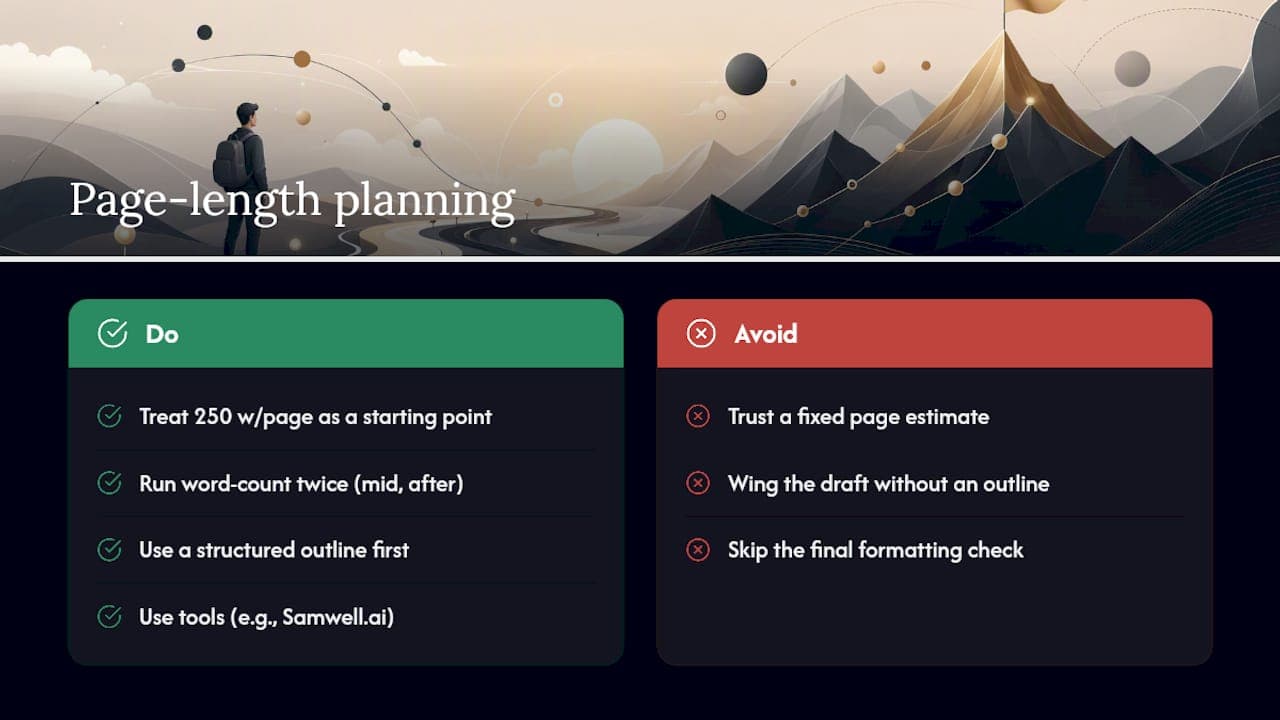
Most advice on this topic treats the word-to-page conversion like it's fixed. It isn't, and treating it that way is where students get tripped up. The 250-words-per-page rule is a useful starting point, not a contract, and the gap between 1,100 and 1,500 words for the same five pages is real enough to sink a paper that's technically "done" but falls short once it's formatted.
The bigger mistake is trusting an estimate instead of checking it. Word count tools take ten seconds to use, and running that check twice, once mid draft and once after formatting, catches problems an estimate never will. If you're staring at a blank document and the clock is the real constraint, a structured outline beats winging it every time. Tools like Samwell.ai's research paper generator can help you build that structure before you commit to a full draft, which matters more for your final page count than any font swap.
— Tilen



